Billionaire Sam Altman Just Called His Own Movie Awful — And It Changes Everything For Founders Who Let Buyers Control Their Story
Hollywood cast Andrew Garfield to play Sam Altman as a villain — and Altman's response just became the most powerful sales move of the year.
On October 5, 2026, Artificial — a film depicting Altman as an ego-driven tech oligarch — premiered at the New York Film Festival to a 95% Rotten Tomatoes score. Amazon MGM, which originally acquired it, quietly dropped it after closing a $50 billion deal with OpenAI. Neon picked it up. It opens Christmas Day.
Altman's public response? Three sentences that disarmed an entire narrative — and revealed the one sales skill most startup founders have never been taught.
Why This Matters To You Right Now
Right now, your buyers are Googling you before they reply to your email. Before they take your call. Before they even open your proposal. What they find — a weak LinkedIn profile, a sparse website, a company with no story — is shaping their decision before you get the chance to speak.
And if someone else — a competitor, a disgruntled ex-client, a sloppy press mention — has written the first chapter of your story, you are already behind in a deal you don't even know you've entered.
Hollywood spent millions casting Andrew Garfield to frame Altman as a cautionary tale. Altman spent three sentences to flip it. Most founders don't even have three sentences ready — and the deal is already lost before the first meeting.
What Actually Happened
Artificial premiered at the New York Film Festival on October 5, 2026. Directed by Alex Garland, the film portrays a fictionalised version of OpenAI's leadership crisis — with Andrew Garfield playing a character modelled on Altman. Critics responded warmly: 95% on Rotten Tomatoes, 74/100 on Metacritic (Wikipedia, October 2026).
Behind the scenes, Amazon MGM — the original distributor — quietly exited the project after inking a landmark $50 billion cloud infrastructure deal with OpenAI (Variety, October 2026). Neon acquired distribution rights. The film is set for a Christmas Day 2026 release.
Asked for his reaction, Altman said: "It looks like an awful movie, but I appreciate people's creativity." He added: "It will not be good as an accurate depiction. Except for the walk." And then: "So in that sense, no, it doesn't bother me." (Vanity Fair / Variety, October 2026).
Billionaire Sam Altman's move — calm, disarming, even self-deprecating — is one Jason has seen replicated across 1,000+ founders. Here's what most miss.
The Lesson — And The Root Cause Most Founders Miss
Beat 1 — Root Cause Reframe
Most founders think the problem is that buyers don't know enough about their product. So they add more slides. More case studies. More feature comparisons. More proof.
But the real problem is that buyers have already formed a story about you — and you were not in the room when it was written.
Your buyer's first touchpoint is not your pitch. It's a Google search. A LinkedIn scroll. A forwarded email. A whisper from someone in their network. The story that lives in those places — or the absence of one — is doing more selling than you are. And if you haven't deliberately authored it, someone else has. Or worse: silence has.
Beat 2 — The Lesson
Here is what Altman understood that most founders do not: narrative control is not spin — it is the precondition for trust. The moment a buyer encounters a negative frame about you and hears you respond with panic, defensiveness, or silence, the deal compounds downward. The moment they hear you respond with calm, wit, and self-awareness, they trust you more than they did before the attack.
Notice what Altman did not do. He did not attack the director. He did not threaten legal action. He did not demand accuracy. He acknowledged the creativity of the filmmakers — then quietly drew a boundary around what was real. And then he let it go.
That sequencing — acknowledge, reframe, release — is not a PR strategy. It is a sales strategy. Every founder who has ever lost a deal to a rumour, a bad review, or a competitor's whisper campaign needed exactly this skill and had no training for it.
Founder Story
Stanley Tan — 45 Buyers in 3 Hours
Stanley came to Jason with a real problem: one of his competitors had been spreading doubt in the market about his company's stability. Buyers were bringing it up in calls. He was losing deals he should have won — not because of product, but because the competitor had authored the narrative before Stanley walked in the room.
After working through the Future of Selling System, Stanley rebuilt his narrative architecture — the exact sequence of what he said, when, and in what order. His next event: 45 buyers committed in 3 hours. The competitor's story never came up again. Stanley didn't fight the narrative. He replaced it.
The founders who close the most deals are not the ones with the best product. They are the ones whose story is already doing the selling before they arrive.
The Hidden Opportunity — And Whether You're Ready
Beat 1 — The Hidden Opportunity
Here is what most founders are not seeing: the AI era has made narrative control both more fragile and more accessible than at any point in history. A single LinkedIn post with the right angle now reaches your next buyer before your sales team does. A founder who masters the sequence of their story — what buyers see first, second, and third — is operating with an asymmetric advantage over every competitor who is still relying on a pitch deck and a prayer.
Altman's Christmas Day film release will be seen by millions of people who have never heard of OpenAI. And every single one of them will walk away thinking: that CEO handled that with class. That is not an accident. That is a system. And the founder who builds their own version of it — at startup scale, in their market, before their next big deal — will close the room before anyone else opens their mouth.
Beat 2 — Are You Ready? Check These Conditions.
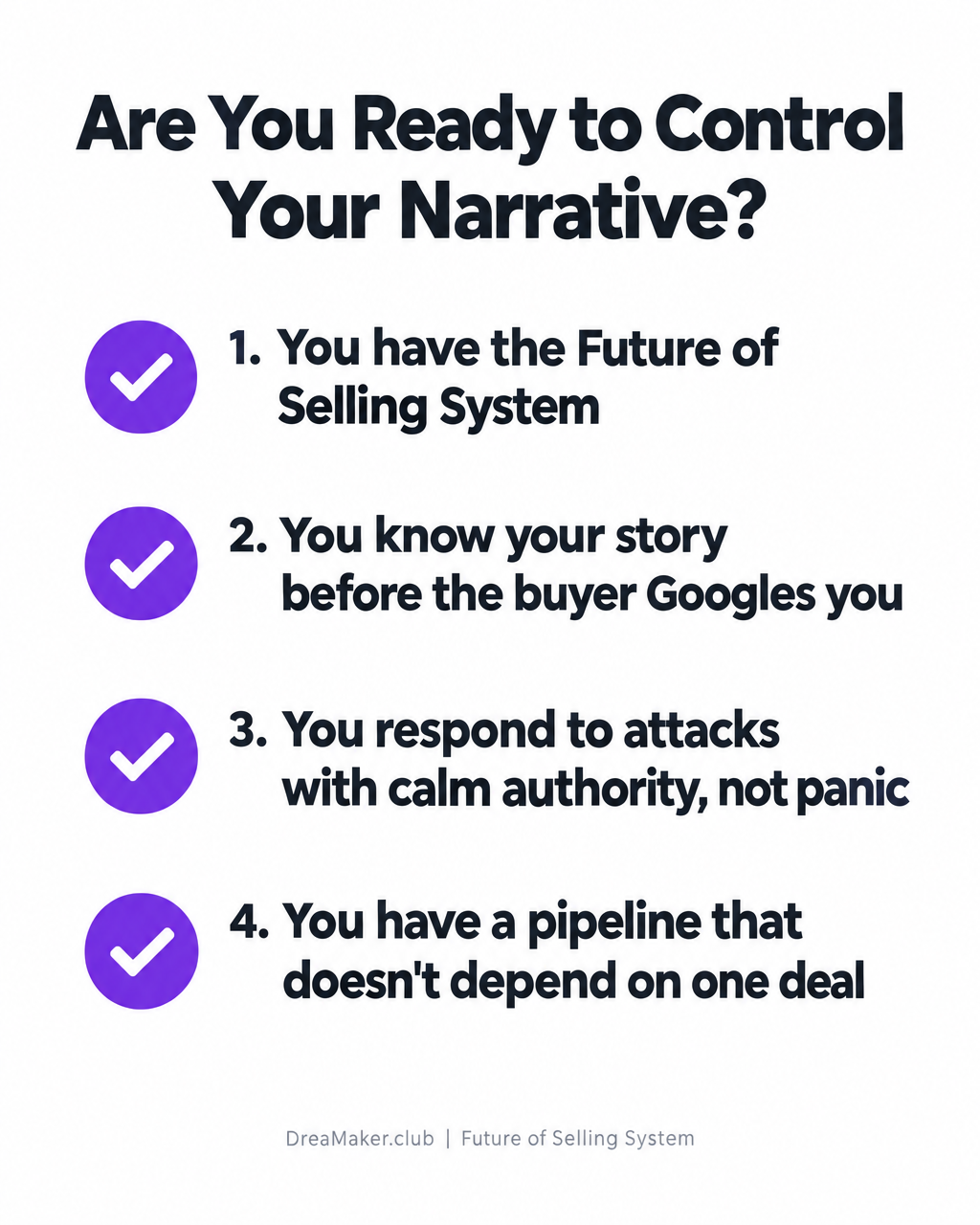
Only move on the opportunity if ALL of these are true:
- 1You have the Future of Selling System. Narrative control without a selling system behind it is a performance, not a process. FOS gives you the structure so that when your story attracts the buyer, you know exactly what to do next. Start at $0.63/day →
- 2You know your story before your buyer Googles you. If you have not deliberately crafted what a buyer finds in the first 60 seconds of research — your LinkedIn headline, your company narrative, your signature story — you are not ready. Fix this before you spend another dollar on ads or outreach.
- 3You can respond to buyer objections with calm authority, not panic. Altman's three-sentence response worked because it was calm, specific, and self-aware. Most founders go defensive the moment a buyer pushes back. If that is you, the opportunity will slip through your hands even after you attract it.
- 4You have a pipeline that does not depend on one deal. Altman could afford to be calm because he was not desperate. Desperation is visible. Pipeline — real pipeline, multiple qualified buyers at different stages — is the only cure. If you do not have it, this is the condition to build first.
NEW! → October 2026
Dear Founder,
If your buyer is already forming a story about you before you walk in the room — and you have no system for what to say, when to say it, and how to sequence trust — you are not losing deals to better products. You are losing them to better narratives. And the gap compounds every week you do nothing about it.
I know how you feel. You have a genuinely good product, a capable team, and real results for clients — but you watch deals stall, buyers go quiet, and competitors with inferior offerings close contracts you should have won. You feel like the problem is your pitch, your pricing, or your market timing.
Many founders felt the same way when they first came to Jason. Jeffrey Teo felt it — until he used FOS and brought in 63 customers in 100 days. Leon felt it — until FOS gave him the structure for a $2 million partnership. Stanley Tan felt it — until he closed 45 buyers in 3 hours at a single event.
What they found is that the Future of Selling System is not a script. It is a framework for knowing exactly what to say at every stage — so your narrative does the work before the meeting, and your conversation closes the deal instead of starting it. Over 1,000 founders since 2015, with $22M+ in combined sales by graduates.
According to the Salesforce State of Sales report, 76% of buyers expect companies to understand their needs before contact. If you are not shaping the story before first contact, you are already behind.
Not ready for $19? Start free.
The Objection Playbook: 25 Word-for-Word Scripts to Close More Sales
The exact words Jason's founders use when a buyer says "too expensive", "send me info" or "I need to think about it". Free PDF, sent to your inbox.
Send Me the 25 ScriptsSam Altman already moved — he authored his story before Christmas, before the reviews, before the world decided what to think of him. The only question is whether you will do the same for your next deal, or whether you will read about someone else who did.


