Billionaire Sergey Brin Just Spent $102M Fighting A $14 Billion Tax Bill — And It Changes Everything For Founders Who Think External Conditions Control Their Revenue
Part 1 — The Story
Sergey Brin just spent $102 million. To save $14 billion. Before a single vote is cast.
That is the headline everyone is reading. But here is what they are missing: Brin did not panic. He did not wait for the outcome. He ran the numbers, calculated the ROI, and moved — deliberately, immediately, and at scale. The November 3 ballot has not landed yet. The external shock is not even confirmed. And he is already three moves deep.
Most founders are waiting to see how things go before they act on their sales. Brin's move reveals exactly why that instinct is the most dangerous one in business.
Part 2 — Why This Hits Different
Think about the last time an external condition disrupted your revenue. A client went quiet. A deal you counted on fell through. The economy shifted. A competitor dropped their price. Your top salesperson quit.
What did you do? Most founders do one of three things: freeze, hustle harder, or blame the market. None of those is a system.
The same week Brin's $102M donation made headlines, how many startup founders lost a deal and called it bad luck? How many had no pipeline because they had stopped prospecting in Q2? How many are running a business that resets to zero every time something external goes wrong?
External conditions will always arrive. The only variable is whether your selling system can absorb them — or whether they absorb you.
Part 3 — What Actually Happened
California's Proposition 40 is a one-time 5% tax on the total assets of state residents with a net worth above $1 billion, set to appear on the November 3, 2026 ballot. Supporters argue it could raise approximately $100 billion for state healthcare costs — a response to federal Medicaid cuts projected to cost California roughly $30 billion annually. (QZ / Los Angeles Times, September 29, 2026)
Google co-founder Sergey Brin donated $102 million to Building a Better California, the opposition PAC fighting the measure. (CNN, September 29, 2026) With a net worth estimated at approximately $270 billion — top five globally per Bloomberg's Billionaires Index — Brin would face a tax bill of nearly $14 billion if Prop 40 passes. (CNN, September 29, 2026) In that context, $102M to fight a $14B liability is less than a 1% premium on a $14 billion insurance policy.
Opponents of Prop 40 have raised $187 million to date against $32 million for supporters, according to QZ citing the Los Angeles Times. The latest available poll finds 48% of likely California voters support the measure — short of a majority as of September 30, 2026. (QZ) Brin's group is also backing rival Propositions 41 and 42, either of which could nullify Prop 40 if they receive more votes. (QZ, September 29, 2026)
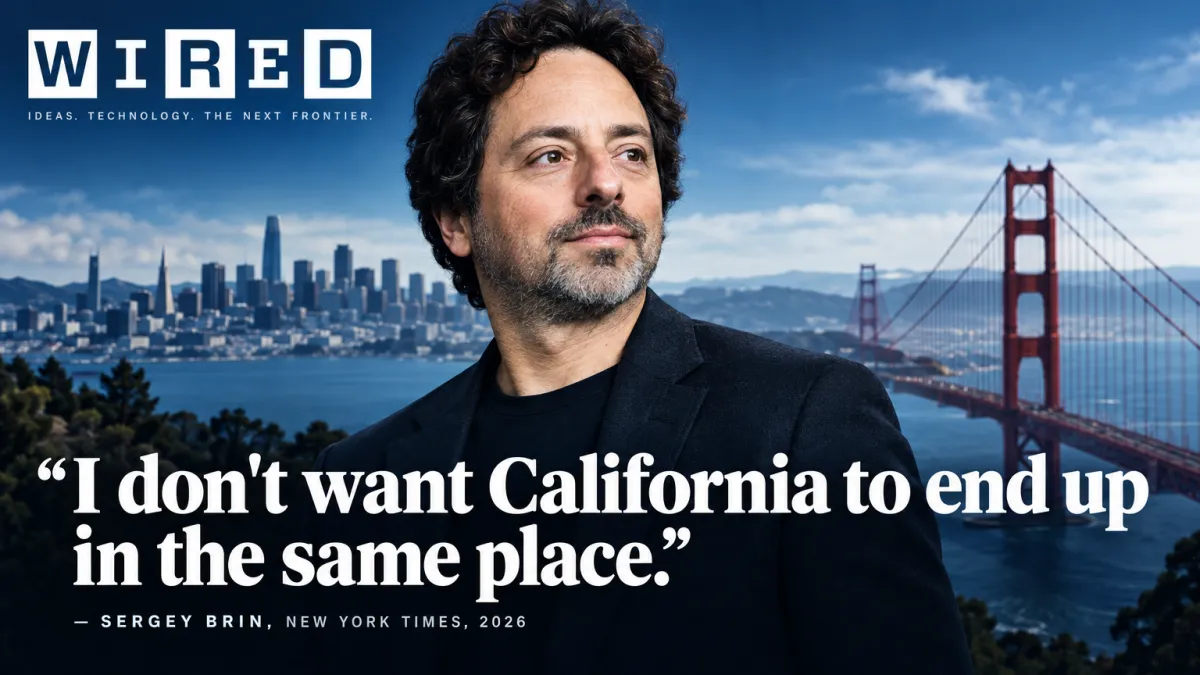
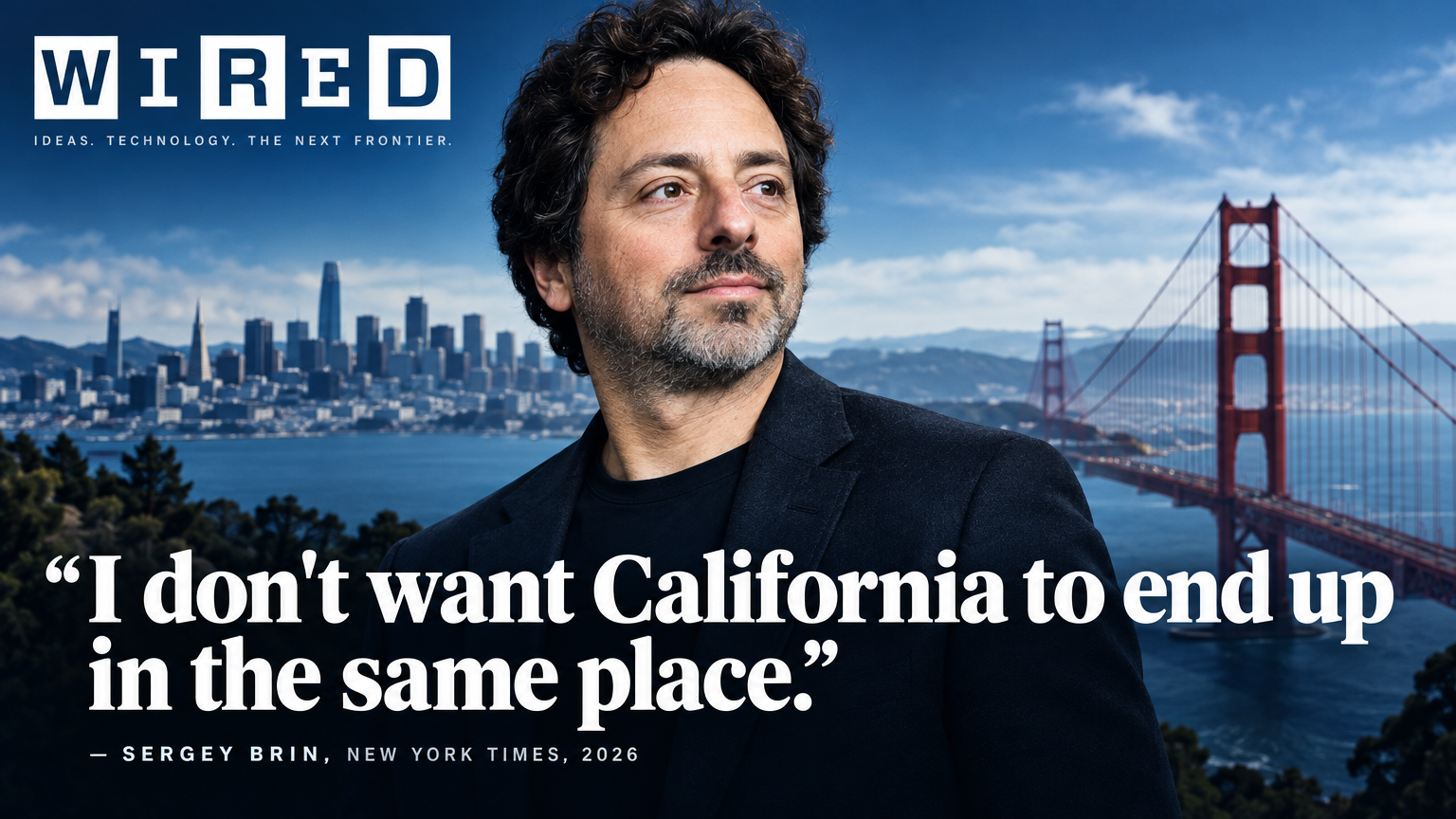
In a rare public comment, Brin compared the measure to conditions in the Soviet Union, which his family fled in 1979. (QZ, September 29, 2026) He told The New York Times: "I don't want California to end up in the same place." (The New York Times, 2026, via QZ)
Billionaire Sergey Brin's move is one Jason has seen across 1,000+ founders. Here is what most miss.
Part 4 — The Lesson + Root Cause Reframe
Beat 1 — Root Cause Reframe
Most founders think the problem is external conditions. Rising costs. A slower economy. A key client who pulled back. A competitor who undercut them. They spend their energy managing the shock — reacting, pivoting, firefighting.
But the real problem is not the external condition. The real problem is that they have no selling system that can operate independently of those conditions.
Brin does not panic about Prop 40 because his wealth-generating system does not depend on California's approval to function. The wealth compounds regardless. The system operates. He can fight the external threat AND keep building — at the same time — because the two things are structurally separated.
Now apply that to your startup. If your biggest client paused their contract tomorrow — what happens to your sales pipeline? If your lead salesperson left this week — does revenue continue? If the market slowed for 90 days — does your closing process still run?
If the honest answer to any of those is that it stops — then you do not have a selling system. You have a founder-dependent revenue dependency dressed up as a business.
Beat 2 — The Lesson
The founders who survive external shocks are never the ones who react better — they are the ones who built a system that did not need permission from external conditions to keep selling.
— Jason Lim, DreaMaker.club
Founder Story Card
Stanley Tan — 45 Buyers in 3 Hours
When Stanley joined the Future of Selling System, he did not wait for the market to be perfect. He ran the process. Within 90 days he had closed 45 buyers in a single 3-hour session — not because conditions were ideal, but because his system did not require them to be. External conditions do not close deals. Systems do.
Part 5 — The Opportunity Hiding Inside This Story
Beat 1 — Hidden Opportunity
Here is what most people will do with the Brin story: they will read it as billionaire politics and scroll on. They will file it under not relevant to me. They will feel the same vague anxiety they always feel when external conditions dominate the headlines.
And that reaction is the opportunity — for the founders who see it differently.
Every time an external shock dominates the news cycle, the founders without a selling system freeze. They pull back on outreach. They go quiet with prospects. They wait. And the founders with a system? They lean in. They keep the pipeline moving. They close while others are catching their breath.
November 3 is 29 days away. Whatever happens with Prop 40, a new wave of economic anxiety is about to hit the market. Buyers will be cautious. Deals will stall. The founders without a system will feel it. The founders with one will take market share.
The question is which category you are in — and whether you will decide before the shock arrives.
Beat 2 — Are You Ready? Run the Conditions Checklist
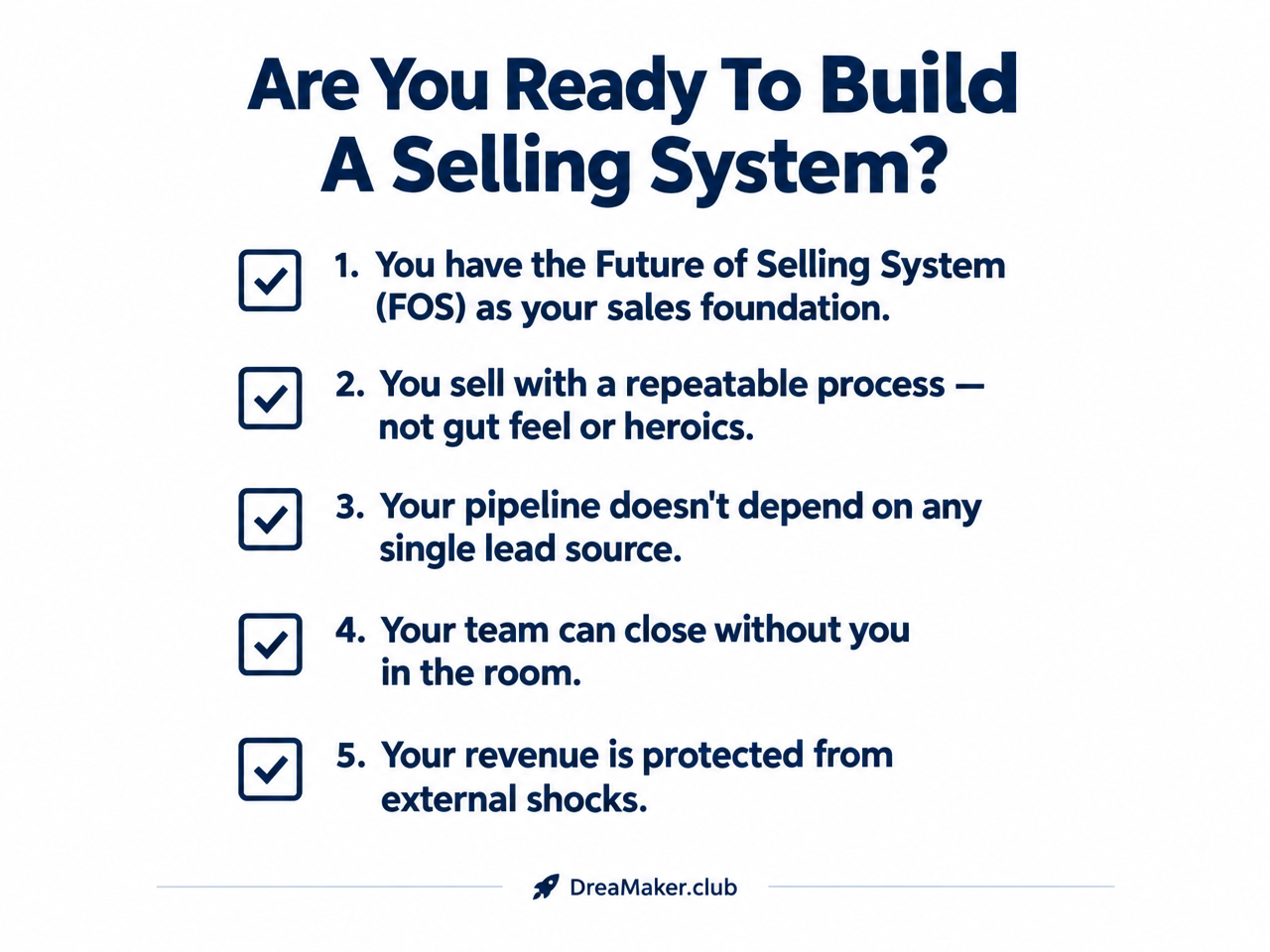
Are You Ready To Build A Selling System? Check All That Apply:
- ☐ Condition 1: You have the Future of Selling System (FOS) as your sales foundation — a repeatable, structured process your whole team can follow.
- ☐ Condition 2: You sell with a repeatable process — not gut feel, not relationship dependency, not heroic solo efforts by the founder.
- ☐ Condition 3: Your pipeline does not depend on a single lead source, a single client, or a single salesperson.
- ☐ Condition 4: Your team can close deals without you in the room — and the results are consistent, not random.
- ☐ Condition 5: Your revenue can withstand a 90-day external shock without resetting to zero.
If you could not check all five — the gap is the lesson. Brin invested $102M to protect a system that was already working. The founders who win invest first in building one.
NEW!
October 2026
Dear Founders — If You Are Still Waiting for Conditions to Improve Before You Fix Your Sales, You Just Ran Out of Time.
If you are still closing by gut feel and hoping next month looks better, you are not running a business — you are running a gamble. And right now, with one of the most expensive political battles in California history about to land on November 3, the founders who do not have a selling system are the most exposed they have ever been.
Jason's founders used to feel the same way. They felt like every external event — a slow Q3, a key client pausing, a market shift — reset everything they had built. Then they found the Future of Selling System. And what they found was this:
According to Salesforce's State of Sales report, 76% of sales reps say they do not have the right tools or processes to consistently close — and that number spikes when external conditions create buyer hesitation. FOS is built specifically for that environment. (Salesforce State of Sales, 2025)
More than 1,000 startup founders since 2015. $22M+ in combined sales by graduates. Jeffrey Teo: 63 customers in 100 days. Stanley Tan: 45 buyers in 3 hours. Leon: a $2M partnership closed through the FOS framework.
Not ready for $19? Start free.
The Objection Playbook: 25 Word-for-Word Scripts to Close More Sales
The exact words Jason's founders use when a buyer says too expensive, send me info or I need to think about it. Free PDF, sent to your inbox.
Send Me the 25 ScriptsBillionaire Sergey Brin already moved. The only question is whether you will — or whether you will read about someone else who did.


