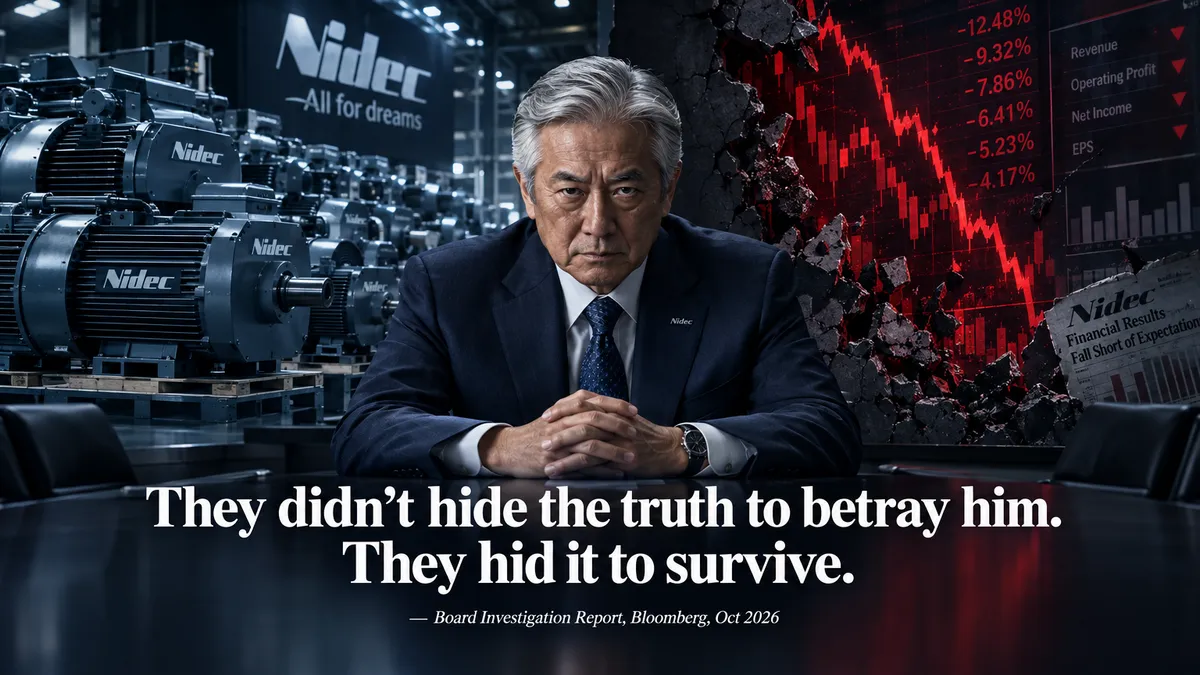
Billionaire Shigenobu Nagamori Never Said Cook The Books — And That Is Exactly What Makes His $1 Billion Scandal The Wake-Up Call Every Founder Needs Right Now
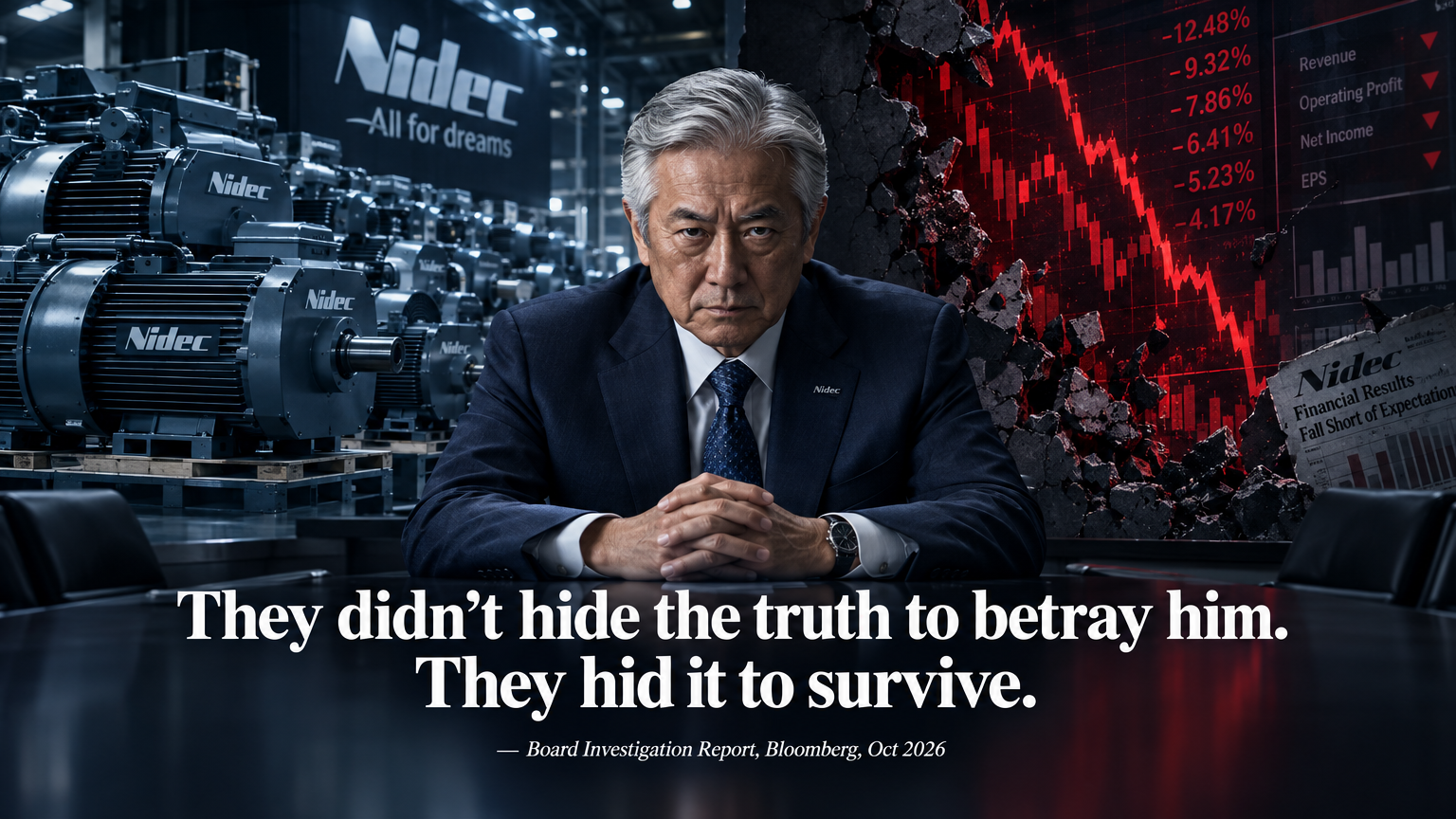
Billionaire Shigenobu Nagamori Never Said Cook The Books — And That Is Exactly What Makes His $1 Billion Scandal The Wake-Up Call Every Founder Needs Right Now
Nagamori never ordered the fraud. His team did it anyway — to protect him from the culture he built.
On October 20, 2026, Nidec Corporation's board committee released a report naming founder Shigenobu Nagamori personally liable for civil damages — not because he fabricated a single number, but because the pressure culture he built over 50 years made a $1.1 billion accounting fraud not just possible, but inevitable. The investigators did not find orders. They found something worse: a company where people hid the truth not to betray their founder — but to survive him.
This Is Not A Japan Story. This Is Your Story.
You built your startup by being the hardest-charging person in the room. You pushed your team. You set targets that made people uncomfortable. You called it high standards. You called it hunger. You called it what separates us from the competition.
And your team smiled, nodded, and went back to their desks.
Here is what you do not know: When did they last bring you a deal that was dying? When did they last tell you the pipeline was thinner than it looked? When did they last walk into your office and say we missed this month — here is the real reason?
If the answer is rarely or never — the Nagamori story is not a cautionary tale from Japan. It is a mirror. And what it is reflecting should make every founder stop and think hard about the culture they have built, right now, today.
What Actually Happened At Nidec
Shigenobu Nagamori founded Nidec — then called Nihon Densan — in a shack in Kyoto in 1973 (The Economist, 2026). He built it into the world's largest precision motor manufacturer, supplying Apple, the global automotive sector, and data centres across the planet. It was, by every external measure, one of the great founder stories of the 20th century.
The fraud accumulated over roughly a decade. A third-party committee report found accounting misconduct totalling approximately 166.2 billion yen — around $1.1 billion — as of 2023 (The Economist, June 2026). Impairment losses reached 632.1 billion yen (approximately $4.0 billion), producing the largest net loss in the company's history (Bloomberg, October 2026). On October 1, 2026, shares plunged 19.8% in a single day.
The board committee's October 20 report was explicit: Nagamori created a corporate culture that led to losses being improperly deferred and inaccurately reflected in earnings (Bloomberg, October 20, 2026). He and other executives are now potentially liable for civil damages. Japan's Securities and Exchange Surveillance Commission has launched an inspection that could escalate to criminal charges.
Critically: investigators found no evidence that Nagamori personally directed a single specific manipulation (The Economist, 2026). What they found instead was his credo — red ink is a sin — enforced so absolutely, across so many subsidiaries, for so many years, that the only rational survival strategy for managers below him was to make the numbers look right regardless of the underlying reality.
Nagamori stepped down as Representative Director in December 2025 and resigned as Honorary Chairman in February 2026 — forced off the company he built by the seeds he himself had sown (Bloomberg, 2026). Billionaire Shigenobu Nagamori's move is one Jason has seen at his events, which since 2016 have reached 100,000+ founders across Asia — not the fraud itself, but the pressure dynamic underneath it. Here is what most miss.
The Lesson Most Founders Miss — And The Root Cause Hiding In Plain Sight
Root Cause Reframe
Most founders think the problem is dishonest team members. But the real problem is a culture where honesty feels more dangerous than silence.
Nagamori did not have a fraud problem. He had a feedback problem — so severe, so sustained, and so embedded in every layer of his organization that by the time anyone could name it, a billion dollars had quietly vanished. The committee's report pointed to his must-achieve 10% operating profit margin target, enforced with relentless top-down pressure, as the breeding ground for improper accounting at headquarters and subsidiaries both at home and abroad (Bloomberg, 2026). Managers were not conspiring against him. They were adapting to him — the only way they knew how to survive.
This is the founder's dilemma that nobody talks about: the stronger your personality, the more your team self-selects for agreement. The more you punish bad news — even implicitly, even without meaning to — the more your pipeline, your forecast, and your understanding of your own business becomes a performance designed to satisfy you rather than a map of reality.
The Lesson
Your team is not lying to protect themselves. They are lying to protect YOU — from the culture you built.
This is the hardest lesson for high-performing founders to absorb, because it does not come from weakness — it comes from the very thing that made you successful. Your drive. Your standards. Your refusal to accept mediocrity. All of it, unchecked by a system that allows honest data to flow upward safely, becomes a machine for generating beautiful lies.
Each individual manipulation at Nidec was modest. Aggregated across dozens of subsidiaries over multiple years, they added up to a billion-dollar problem (The Economist, 2026). In a startup, the scale is smaller — but the dynamic is identical. Your sales rep who says this deal is still warm when it is cold. Your account manager who says they are happy when they are three weeks from churning. Your head of sales whose forecast is 20% higher than the pipeline actually justifies.
None of them are bad people. They are rational actors in a culture where bad news travels upward at great personal cost.
Founder Story
Jeffrey Teo came to Jason with a sales team he thought was performing well. His CRM showed a full pipeline. His reps were hitting activity metrics. But deals were not closing. When Jason ran the FOS diagnostic, the problem was immediately clear: the team had learned, over 18 months, that forecasting accurately was more painful than forecasting optimistically. They were padding every stage. Jason rebuilt the pipeline review process — not around pressure, but around honest data and a system that rewarded early escalation of stuck deals. Jeffrey went on to sign 63 new customers in 100 days. Not by pushing harder. By finally being able to see the truth.
The Hidden Opportunity In Nagamori's Collapse
The Hidden Opportunity
Here is what almost no one is saying about the Nidec story: the companies that come out ahead in the next decade will not be the ones with the most aggressive founders. They will be the ones whose founders built systems sturdy enough to carry honest data without distorting it under pressure.
Every major enterprise buyer in 2026 is asking the same question before they sign: Is this vendor's revenue repeatable, or is it founder-dependent? The answer to that question is not in your deck — it is in whether your sales pipeline is a real-time map of your market, or a performance designed to keep the founder happy.
Most of your competitors are running Nagamori's playbook without knowing it. The founders who build cultures of honest data — who replace fear of bad news with a structured system for handling it — will close faster, forecast better, and scale without the landmines that are quietly being planted right now in every personality-pressure-driven sales org.
Are You Ready To Capture This Opportunity?
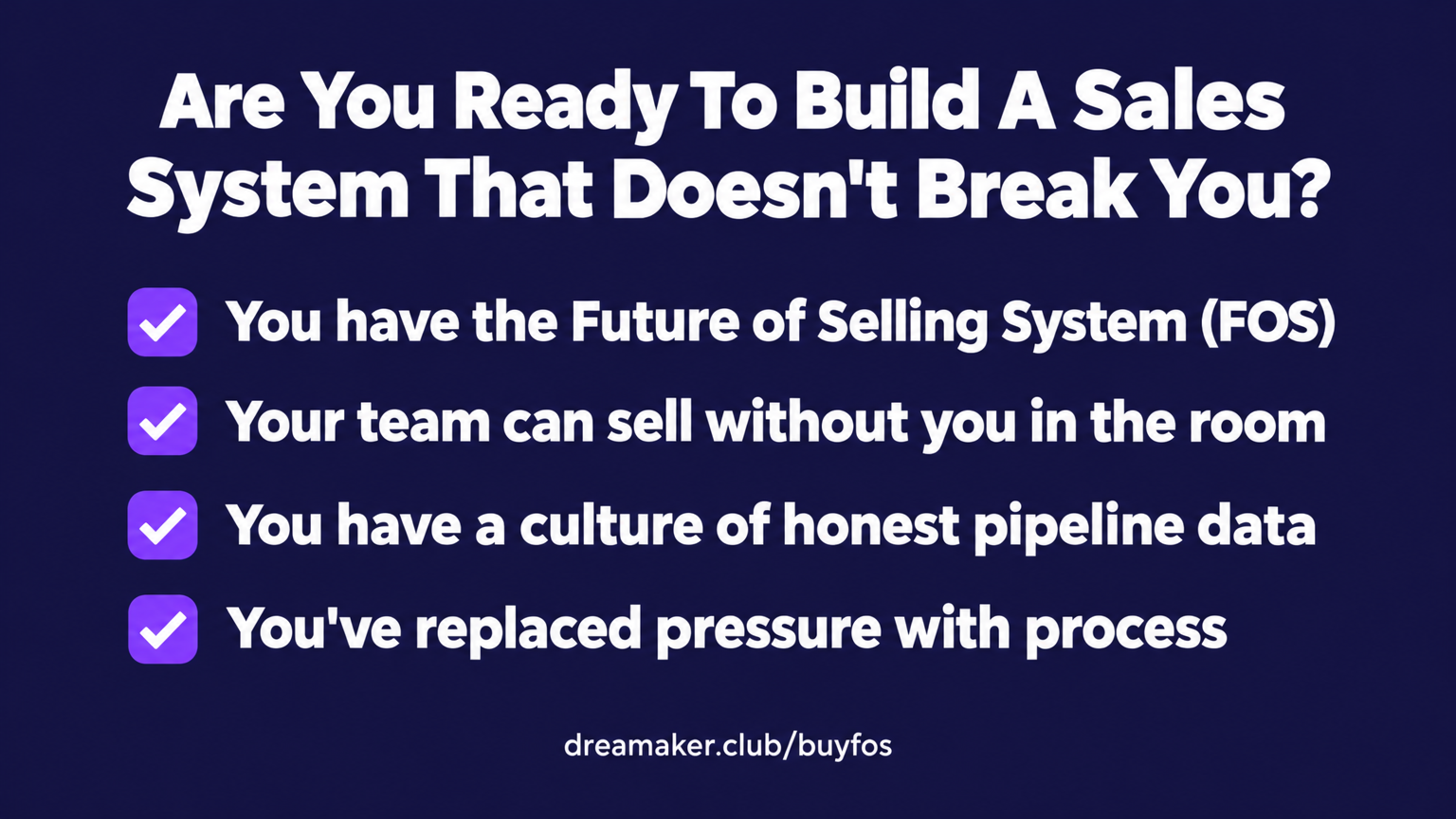
Check every condition before you move:
- ✅ Condition 1 — You have the Future of Selling System (FOS). You have a documented, repeatable process your team runs without you in the room. Not a CRM. Not a script. A system that produces honest pipeline data by design, not by personality.
- ✅ Condition 2 — Your team escalates bad news early. Your reps tell you a deal is dying before it is dead — not after the quarter closes. If they do not, the problem is not their courage. It is your culture.
- ✅ Condition 3 — Your pipeline review is a diagnostic, not a performance. You review deals to find stuck points and remove them — not to pressure people into happy-path optimism. Your team leaves the review energised, not relieved it is over.
- ✅ Condition 4 — You have replaced pressure with process. Your standard for performance is a number that comes from a system — not from how convincingly your team presents at the weekly standup. When results are bad, the system tells you why — not just what.
NEW! → October 2026
Dear Founders...
If your team is hiding bad pipeline numbers from you — it is not about honesty. It is about the pressure culture you built without realising it. And until you replace pressure with process, your pipeline will always show you what you want to hear, not what is actually true.
I know how that feels. So did the founders who came to my events. They said: I felt exactly the same way — like my team was performing well but deals still were not closing. I thought it was a motivation problem.
What I found — and what they found — is that it was never a motivation problem. It was a system problem. And the moment you put a real selling system in place, the data gets honest, the pipeline gets real, and the closes start stacking.
Salesforce's own research shows that 76% of salespeople feel their pipeline does not reflect reality — and in founder-led teams, that number is almost certainly higher (Salesforce State of Sales, 2024).
My graduates have generated $22M+ in combined sales. Jeffrey Teo signed 63 customers in 100 days. Leon closed a $2M partnership. Stanley Tan pitched to 203 people with 90 showing up — after we rebuilt his pitch deck and ran a single consult. Since 2016, my events have reached 100,000+ founders across Asia.
The Future of Selling System (FOS) is how you replace the pressure culture with a real-data culture — without becoming a worse leader. It is $19/month ($0.63/day). Less than one cold outreach tool. More than one system change.
Not ready for $19? Start free.
The Objection Playbook: 25 Word-for-Word Scripts to Close More Sales
The exact words Jason's founders use when a buyer says too expensive, send me info or I need to think about it. Free PDF, sent to your inbox.
Nagamori already moved — and his team moved with him, in silence, for a decade. The only question is whether you will build a system that lets your team tell you the truth, or whether you will keep reading about someone else who did not.


