
Billionaire Steve Schwarzman Just Opened Blackstone's Vault To The World — And It Changes Everything For Startup Founders
Part 1 — Hook
Schwarzman just unlocked Blackstone's $1.3 trillion vault for investors who were never allowed inside. That sounds like a finance story. It is not. It is the sharpest distribution lesson of 2026 — and most founders will read right past it.
On September 24, 2026, Blackstone announced BXPM: the first multi-asset private markets fund built specifically for non-US individual investors. Not a new product. Not a new strategy. The same institutional-grade assets that ultra-wealthy US clients have accessed for decades — now packaged for a global retail audience that was quietly waiting. Schwarzman did not build something new. He built a new door.
Part 2 — Press
Here is the part that should make you uncomfortable.
Blackstone has managed over $1.3 trillion in assets. It has been doing this since 1985. It operates the world's largest private equity platform, the world's largest commercial real estate portfolio, and a $469 billion credit business. None of that changed this week.
What changed is that a massive, qualified, motivated group of buyers — non-US individual investors — finally got a single, simple pathway to say yes.
They were not blocked by price. They were not blocked by distrust. They were blocked by the absence of a door.
Now ask yourself: how many of your ideal buyers are in exactly the same position right now? They want what you have. They can afford what you have. But they have never been handed a clear, structured way to access it — and so they buy from whoever made it easiest to walk through.
That is not a lead-generation problem. That is a distribution architecture problem. And it is costing you more than you think.
Part 3 — Play
On September 24, 2026, Blackstone Inc. announced the launch of BXPM — the Blackstone Private Markets Fund — described by Bloomberg as the firm's first multi-asset fund for non-US individuals. According to Blackstone's official press release (September 24, 2026), BXPM gives eligible non-US investors access to four of Blackstone's core asset classes through a single allocation: private equity across Blackstone's $364 billion strategies, private infrastructure via its $90 billion infrastructure business, private real estate through its $314 billion real estate portfolio — the largest owner of commercial real estate globally — and credit via its $469 billion credit and insurance business.
The fund is not available to US investors. It is built on Blackstone's $324 billion Private Wealth business and is the first strategy launched under Blackstone Portfolio Solutions, an initiative announced earlier in 2026, according to the official Blackstone press release. Joan Solotar, Global Head of Private Wealth, described the launch as a meaningful access milestone for eligible global investors (Blackstone press release, September 24, 2026).
In other words: Blackstone took decades of institutional-grade work, repackaged it into one simple allocation, and handed it to a buyer category that had always been willing — but had never been shown a door. Billionaire Steve Schwarzman's move is one Jason has seen across 1,000+ founders. Here's what most miss.
Part 4 — Lesson + Root Cause Reframe
Most founders think the problem is that they need more leads, a better product, or a lower price. But the real problem is that the right buyer has never been given a structured way to say yes.
This is the root cause Schwarzman's move exposes. He did not build new assets. He built new access. The infrastructure already existed. The buyer already existed. What was missing was the onramp — a single, simple, purpose-built vehicle that made it possible for a motivated, qualified buyer to walk through.
That is the lesson: before you build something new, audit whether the right buyer can even reach what you have already built.
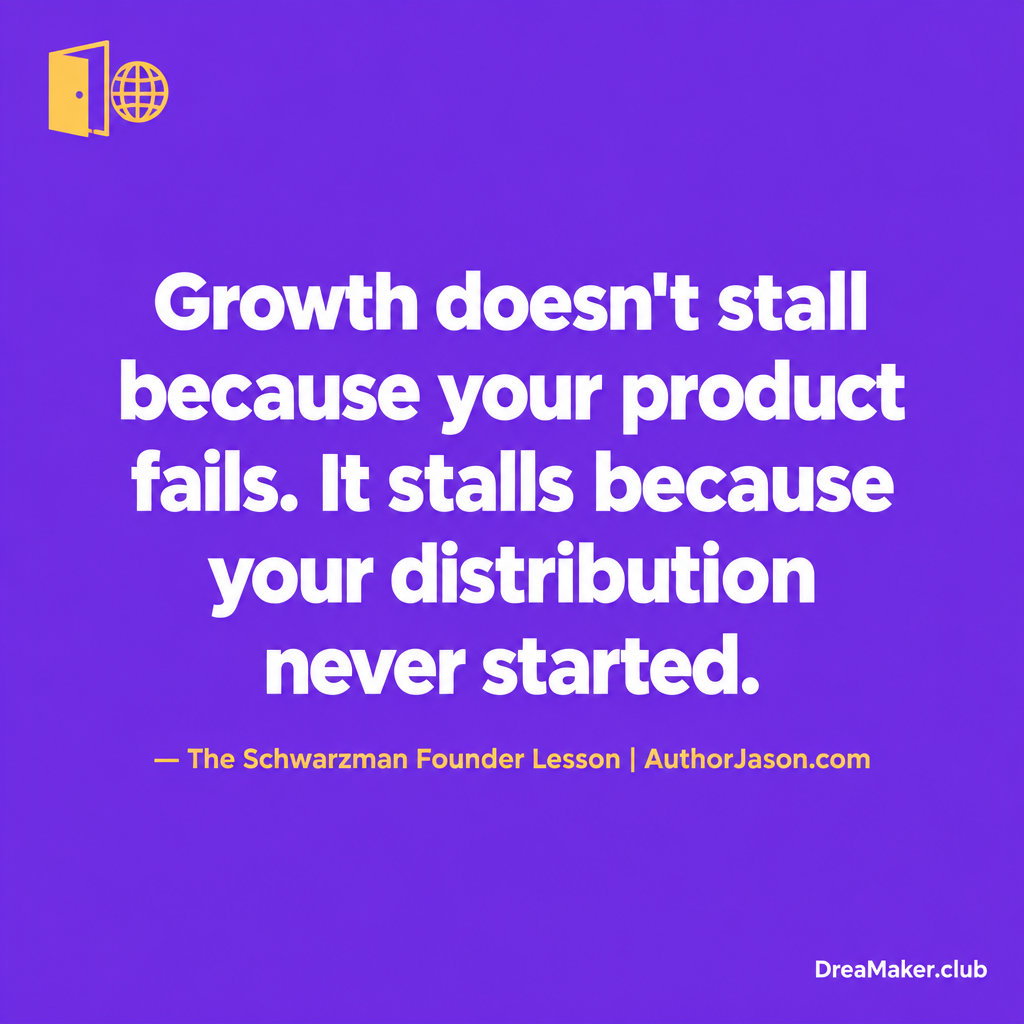
"The buyers who want you most might not be blocked by price. They might be blocked by the door you have not built yet."
Founders spend enormous energy trying to convert leads who were never the right fit, while quietly ignoring the qualified buyer who simply had no pathway in. This is not a marketing problem. It is a distribution architecture problem. And it is one of the most common structural failures Jason sees across founders at every stage.
The real move is this: map who wants what you have but has never been given a door. Then build the door before you spend another dollar on ads, before you redesign your pitch, before you hire another salesperson. Because the buyers are often already there. They are just standing outside a wall.
Founder Story Card
The visible problem: "We are not getting enough leads and our close rate is too low."
The real root cause: The right buyer exists — qualified, motivated, and willing — but has no structured pathway to access what you sell. The gap is not awareness. It is architecture.
The founder lesson: Distribution creates demand. Schwarzman did not invent new assets. He invented new access. The result was a brand-new revenue channel from a buyer category that was always ready.
The move to make now: Audit your buyer landscape. Who can't buy from you today — not because they don't want to, but because the pathway doesn't exist? Build that pathway before a competitor does.
Part 5 — Opportunity + Conditions
Here is the hidden opportunity most founders will miss entirely while reading about Blackstone this week.
Right now, the window for building first-mover distribution into an underserved buyer category is wide open. In virtually every industry, there is a qualified buyer segment — a geography, a buyer type, a professional group, a market tier — that wants what you offer but has never been handed a clear, simple way to access it. The first founder in that category to build structured access will not just win the early customers. They will own the association. When that buyer thinks of the solution, they will think of the founder who made it easy to say yes first.
But this only works under specific conditions:
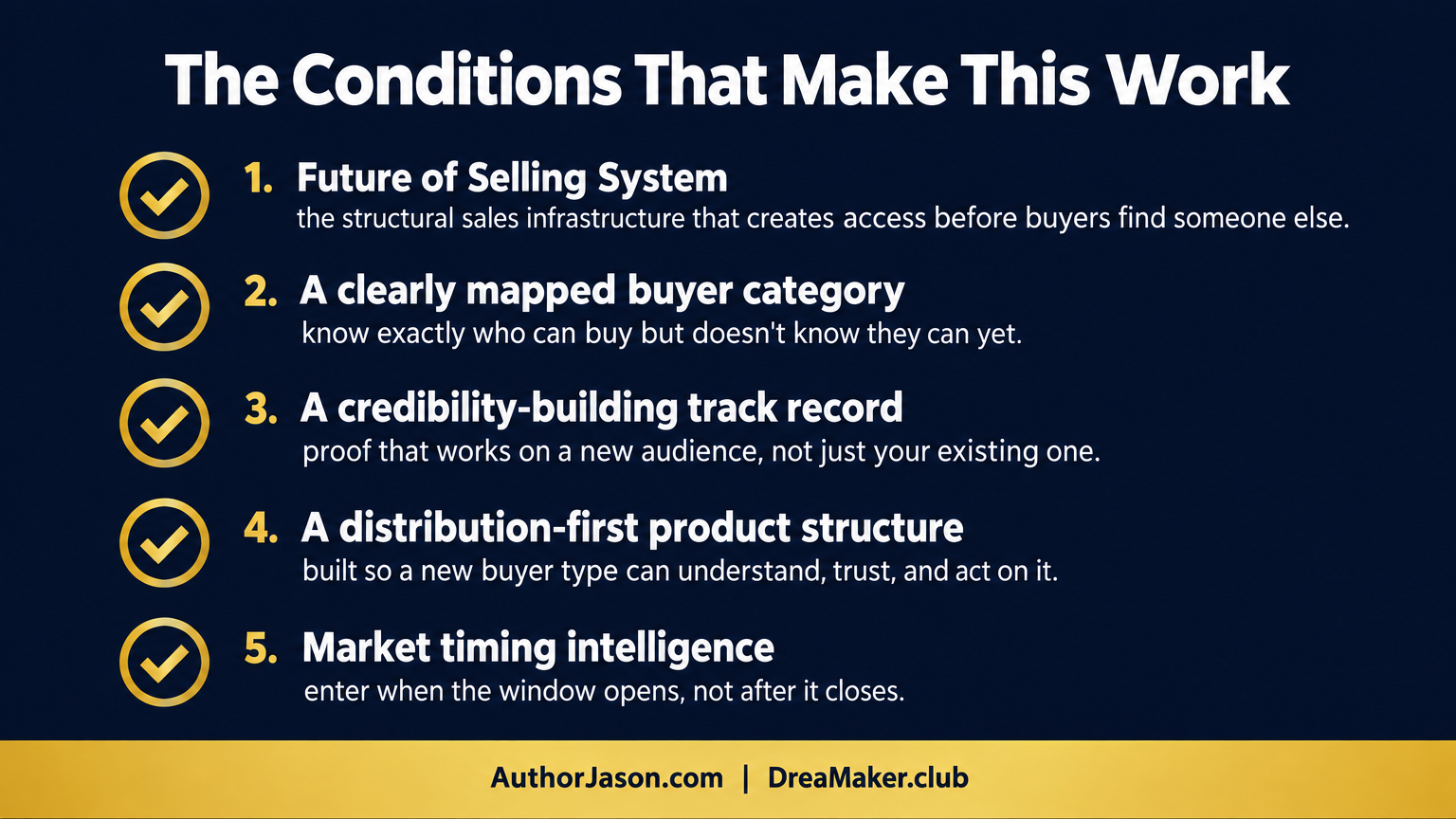
The Conditions That Make This Work
- Future of Selling System: The structural sales infrastructure that creates buyer access before the buyer goes looking for someone else. Without a system behind the door, the door leads nowhere — and the buyer walks away just as fast as they arrived.
- A clearly mapped untapped buyer category: Know exactly who wants what you have but has never been given a pathway in. This is not a persona exercise. It is a genuine access audit: where are the qualified buyers who are structurally excluded from reaching you right now?
- A credibility-building track record: Proof that lands with the new buyer type — not just your existing audience. Blackstone did not launch BXPM on hope. It launched it on nearly 25 years of private markets delivery (Blackstone press release, September 24, 2026). Your new door needs proof behind it.
- A distribution-first product structure: Built so a new buyer type can understand, trust, and act on it quickly. Complexity kills access. BXPM is explicitly described as giving investors access to four asset classes through a single, simple allocation. Simplicity is distribution strategy.
- Timing intelligence: The window for first-mover access in an underserved buyer category is finite. Enter when the window opens — not after competitors have already claimed the association.
Part 6 — Native Ad
Part 7 — Sting
Schwarzman already built the door. The only question is whether you will — or whether you will read about someone else who did.


