Billionaire Tilman Fertitta Just Won a $17.6B Casino Empire - And It Changes Everything For Founders Who Want to Build to Own
Tilman Fertitta just won shareholder approval for a $17.6 billion casino buyout. He was serving as US Ambassador to Italy while the deal was done.
On September 23, 2026, Caesars Entertainment stockholders voted to hand their company to Fertitta Gaming - 65.4% of outstanding shares in favour, filed directly with the SEC. The man engineering one of the biggest gaming consolidations in modern history was not in the room. His systems were.
Why This Is Not Just a Casino Story
Most founders read this headline and think: good for him. Big money, big deal, big life. Then they go back to grinding - personally chasing every lead, sitting on every sales call, hand-holding every client renewal.
That is the gap this story is really about.
Fertitta did not win because he was in the room. He won because he built something that did not need him in the room. While he was in Rome, his legal team, his banking syndicate of 10 institutions, his executive leadership at both Landry's and Golden Nugget, and his M&A process were all moving - without a daily directive from him.
Ask yourself honestly: if you stepped away from your business for 90 days, would your sales process keep running? Would leads still convert? Would your pipeline still move? Or would it freeze the moment you stopped touching it? That question is the mirror this story holds up.
What Actually Happened
In May 2026, the Caesars Entertainment board of directors approved a definitive agreement to be acquired by Fertitta Entertainment, Inc. - a holding company owned by Tilman and Paige Fertitta - in an all-cash transaction valued at approximately $17.6 billion, including the assumption of roughly $11.9 billion in Caesars debt, according to a press release filed with the SEC.
The deal priced each Caesars share at $31 in cash, representing a 49% premium over Caesars' unaffected share price as of February 25, 2026 - the last trading day before merger rumours surfaced - and a 46% premium over the unaffected 30-day volume-weighted average price, per the same SEC filing.
On September 23, 2026, a special shareholder meeting was held at the Eldorado Resort and Casino in Reno, Nevada. According to an SEC filing cited by the Las Vegas Review-Journal, 133,313,001 votes were cast in favour, representing 65.4% of outstanding shares, per SBC Americas.
Fertitta Entertainment's existing portfolio already includes the Golden Nugget brand operating across seven US cities, more than 450 restaurants globally under 60 dining brands through Landry's Inc., and the Houston Rockets NBA franchise, per Inside Asian Gaming. Fertitta is also the largest individual shareholder in Wynn Resorts, holding a 12.3% stake, according to the same source. Adding Caesars brings eight Las Vegas Strip casinos into the group: Caesars Palace, Harrah's, Paris Las Vegas, Planet Hollywood, Horseshoe, The LINQ Hotel, Flamingo, and The Cromwell.
The transaction still requires federal antitrust clearance - the FTC issued a second request for information to both companies on September 14, 2026, per the Las Vegas Review-Journal, extending the federal waiting period. A closing deadline of June 26, 2027, has been set, per 8 News Now. Fertitta fended off a competing bid from investor Carl Icahn to secure this position, according to SBC Americas.
Billionaire Tilman Fertitta's move is one Jason has seen across 1,000+ founders. Here's what most miss.
The Lesson Most Founders Miss
Root Cause Reframe
Most founders think the problem is that they don't have enough leads, enough time, or enough capital. But the real problem is that they are the system - and when they stop, everything stops.
Fertitta did not accidentally end up running a 600-property empire while serving as a sitting US Ambassador. He built systems - operational, financial, legal, and strategic - that could execute without his physical presence. The $17.6 billion deal did not close because he worked harder. It closed because he built smarter.
The founder who builds to own doesn't answer to the market. The market answers to him.
Here is what is actually happening in most founder-led businesses: the founder is the sales system. They pitch. They follow up. They close. They onboard. And because they are talented, it works - right up until it doesn't. Until they burn out, miss a window, or get distracted by something more urgent.
Fertitta's businesses did not depend on him being present to sell, to operate, or to close. They depended on structures, brands, loyalty ecosystems like Caesars Rewards, and proven operating playbooks. His presence added leverage. His absence did not create collapse. That is the distinction most founders never make - and never build toward.
Founder Story Card
The visible problem: A founder is personally involved in every sales conversation. Revenue is growing, but so is founder exhaustion. The pipeline stalls whenever they travel or get sick.
The real root cause: There is no sales system - only a sales person. The founder's skill is not transferable, documented, or scalable. The business runs on their charisma, not on a repeatable process.
The founder lesson: Fertitta did not build a casino empire by being the best dealer at every table. He built systems, brands, and loyalty infrastructure that converted and retained customers without him. Your sales process must work the same way.
The move to make now: Document your sales process. Identify the exact points where your presence is required and ask why. Then systematise those touchpoints so they can run without you - or scale with you instead of bottlenecking at you.
The Hidden Opportunity Right Now
What Fertitta understood - and what this deal makes visible - is that privately held, systems-driven businesses have a structural advantage over founder-dependent ones. When your business runs on process, you can grow, acquire, delegate, and disappear to Rome without the lights going out.
The founders who will benefit most from the next 12 to 24 months are not the ones grinding hardest. They are the ones who used this period to build a sales system that generates trust, converts buyers, and operates independent of their daily involvement. They will be ready to scale, raise, acquire, or exit - on their terms, not the market's.
That window is open right now. But it requires building the infrastructure before you need it - exactly what Fertitta did, long before any Caesars conversation began.
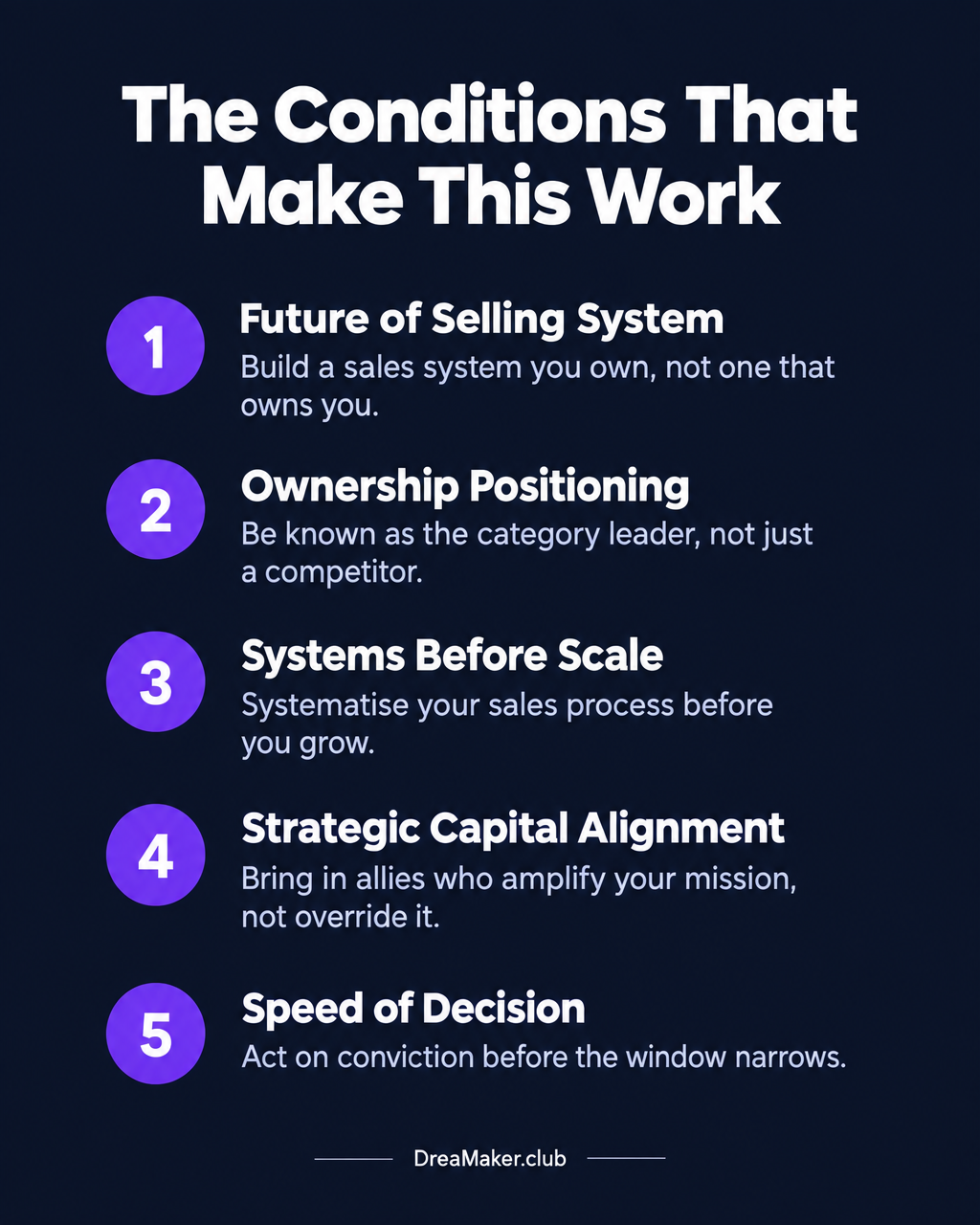
The Conditions That Make This Work
- Future of Selling System: You need a documented, repeatable sales process that converts buyers without requiring you to personally run every call. Without this, you are the bottleneck - not the founder.
- Ownership Positioning: Your brand must be known as the obvious category leader in your niche - not just another option. Fertitta did not buy Caesars to be one of many casino groups. He bought it to own the category.
- Systems Before Scale: Build the operational and sales infrastructure before you accelerate growth. Fertitta's empire ran in his absence because the systems existed first. Scale without systems is just faster chaos.
- Strategic Capital Alignment: The Caesars deal was financed through a consortium of 10 banks - allies whose incentives were aligned with Fertitta's outcome. Make sure the people and partners around your business amplify your mission rather than dilute it.
- Speed of Decision: Fertitta fended off a competing bid from Carl Icahn. Conviction and speed of decision - backed by clear positioning - won the deal. Founders who hesitate to act on their best opportunities will find someone else already moved.
Fertitta already moved. The only question is whether you will - or whether you'll read about someone else who did.


