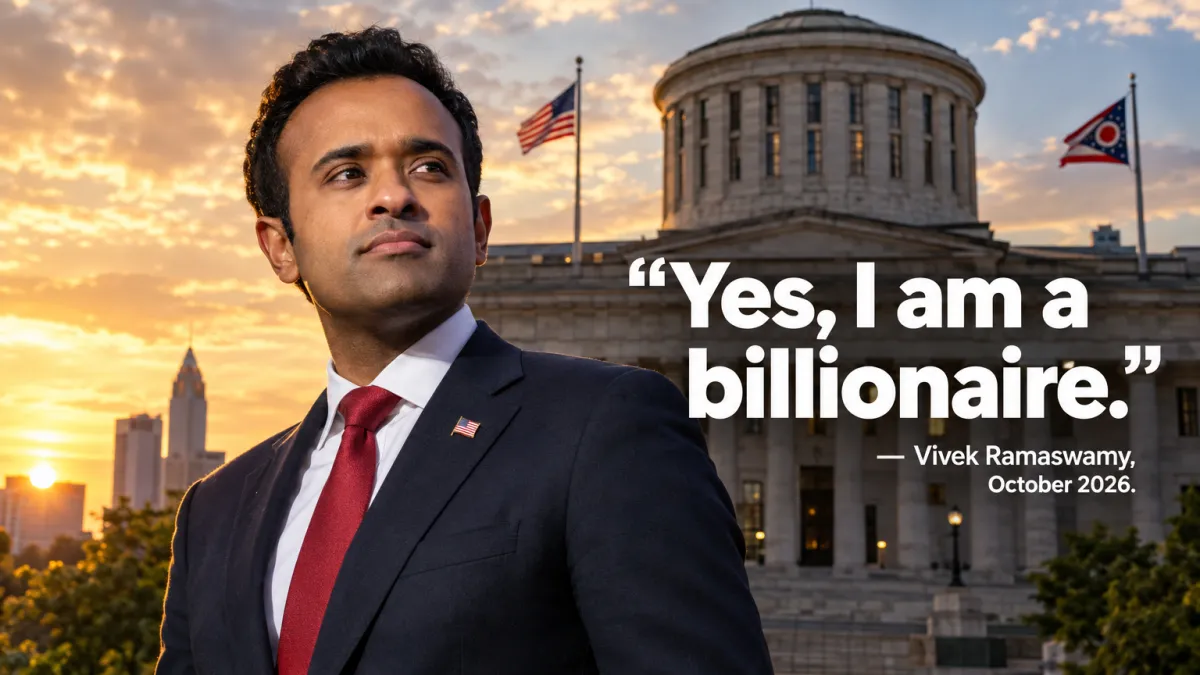
Billionaire Vivek Ramaswamy Saved $12M Before He Even Ran for Office — And It Changes Everything For Founders Who Think Tax Is an Accountant's Job
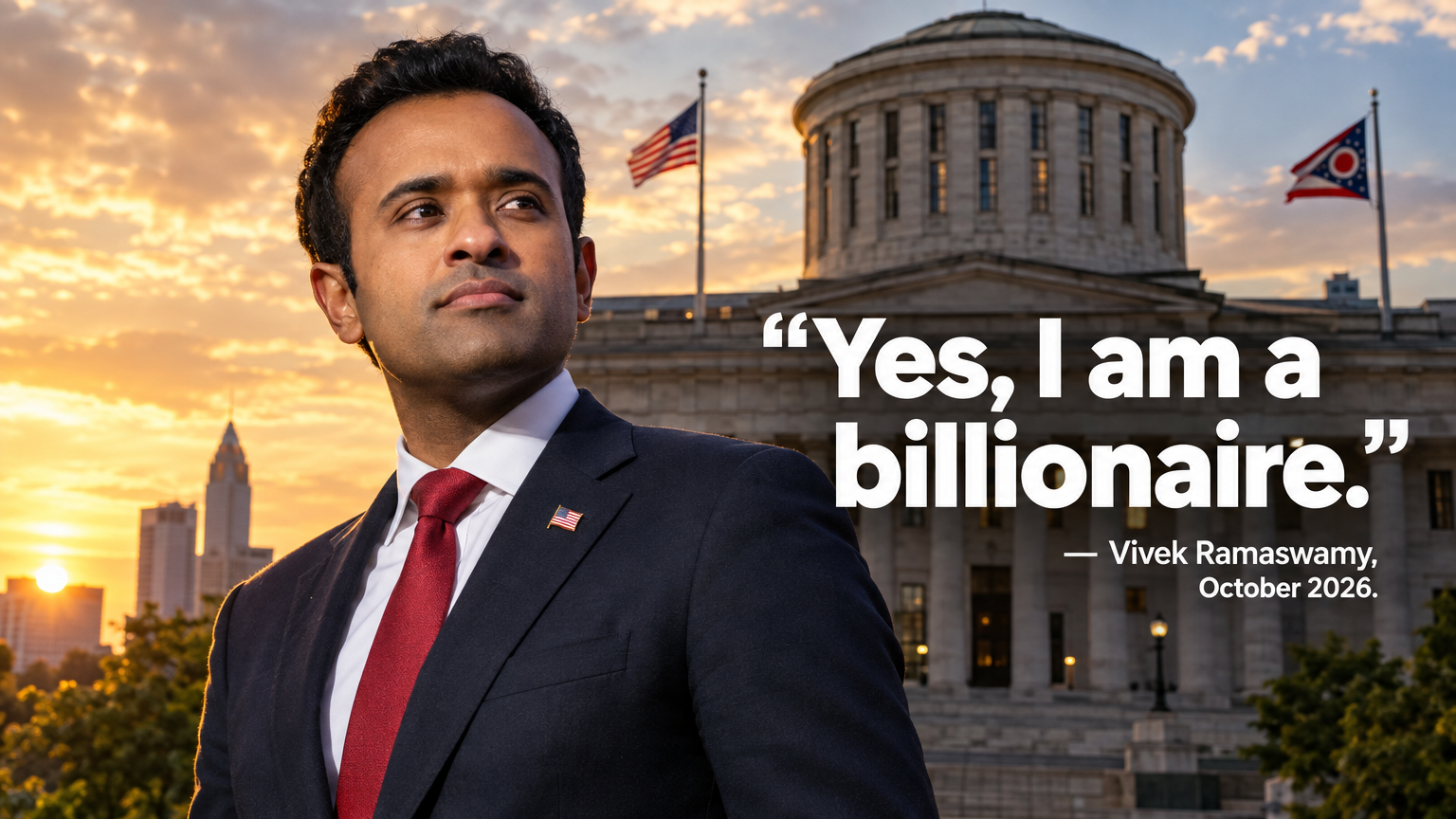
Editorial concept. Source: Forbes, October 2, 2026.
Part 1 — The Hook
Vivek Ramaswamy saved $12 million in taxes before anyone knew his name.
In 2020, he quietly moved from New York City to a township in Ohio. No fanfare. No press release. No political career yet — just a 34-year-old founder making a calculated move that Forbes estimates saved him approximately $12.3 million in state-and-local taxes compared with staying in New York City. Six years later he is a $2.3 billion gubernatorial candidate running on a platform to eliminate Ohio's income tax entirely — and he is turning his own relocation into the most powerful campaign argument in the race. Most people are watching this as a political story. Founders should be watching it as a business masterclass.
Part 2 — The Press
Here is the uncomfortable truth: most founders think strategy begins at the pitch.
You perfect the deck. You rehearse the objections. You sharpen the close. And then you walk into a conversation you were never going to win — because you did not engineer the conditions long before you opened your mouth.
Ramaswamy did not win $12 million in a negotiation. He made a decision in 2020 — quietly, without urgency — that removed an enormous friction from his future. By the time the stakes were highest, the game was already tilted in his favour.
Your buyers are making decisions about you before you ever speak. Your market position is being set before you ever pitch. The founders who win are not better at closing. They are better at engineering the conditions in which closing becomes inevitable.
Part 3 — The Play
According to a Forbes investigation published October 2, 2026, Ramaswamy relocated from New York to West Chester Township, Ohio in 2020. Forbes estimates his Ohio state income-tax liability for that year at approximately $8.5 million — versus a combined New York State-and-City liability that would have approached $20.8 million had he remained a full-year New York City resident. West Chester Township levies no resident income or payroll tax, producing an estimated total state-and-local tax saving of approximately $12.3 million.
Ramaswamy, now 41, founded Roivant Sciences in 2014 and sold approximately 16.5 million shares from 2023 through December 2025, generating around $225 million in gross proceeds (Forbes, October 2026). His current net worth is estimated at $2.3 billion. He is the Republican nominee for Ohio governor, having won the May 2026 primary with 82.5% of the vote, and carries a full endorsement from President Donald Trump. His core policy pledge: eliminate Ohio capital gains tax beginning next year, then phase out the state income tax entirely over the following decade.
When challenged about his billionaire status on the campaign trail, Ramaswamy turned the attack into his clearest statement: "My opponent, all she will talk about is the fact that I am a billionaire. Well, the truth is yes, I am." (Town hall, 2026.)
Billionaire Vivek Ramaswamy's move is one Jason has seen replicated — consciously or not — across 1,000+ founders. Here is what most miss.
Part 4 — The Lesson & Root Cause Reframe
Beat 1: Root Cause Reframe
Most founders think the problem is that they are not closing enough deals.
So they go hunting for a better close. A stronger pitch. A slicker objection handler. They grind harder inside a system that was never set up for them to win.
The real problem is that they never engineered the conditions before they started selling.
Ramaswamy's 2020 move was not a tax hack. It was environment engineering. He looked at the rules of the game — the financial environment he was operating in — and repositioned himself before the stakes arrived. By 2026, when the political scrutiny was at its highest, he did not have to defend the move. He could wear it. It had compounded into a platform, into an identity, into a campaign.
Most founders wait for the deal to be in front of them before they think about conditions. They pitch to buyers who were never going to convert. They operate in markets where their positioning is unclear. They chase deals without a system that creates trust before the conversation even starts. Then they blame the close.
You do not fix a closing problem by getting better at closing. You fix it by engineering an environment where your ideal buyers arrive pre-sold — or close to it.
Beat 2: The Lesson
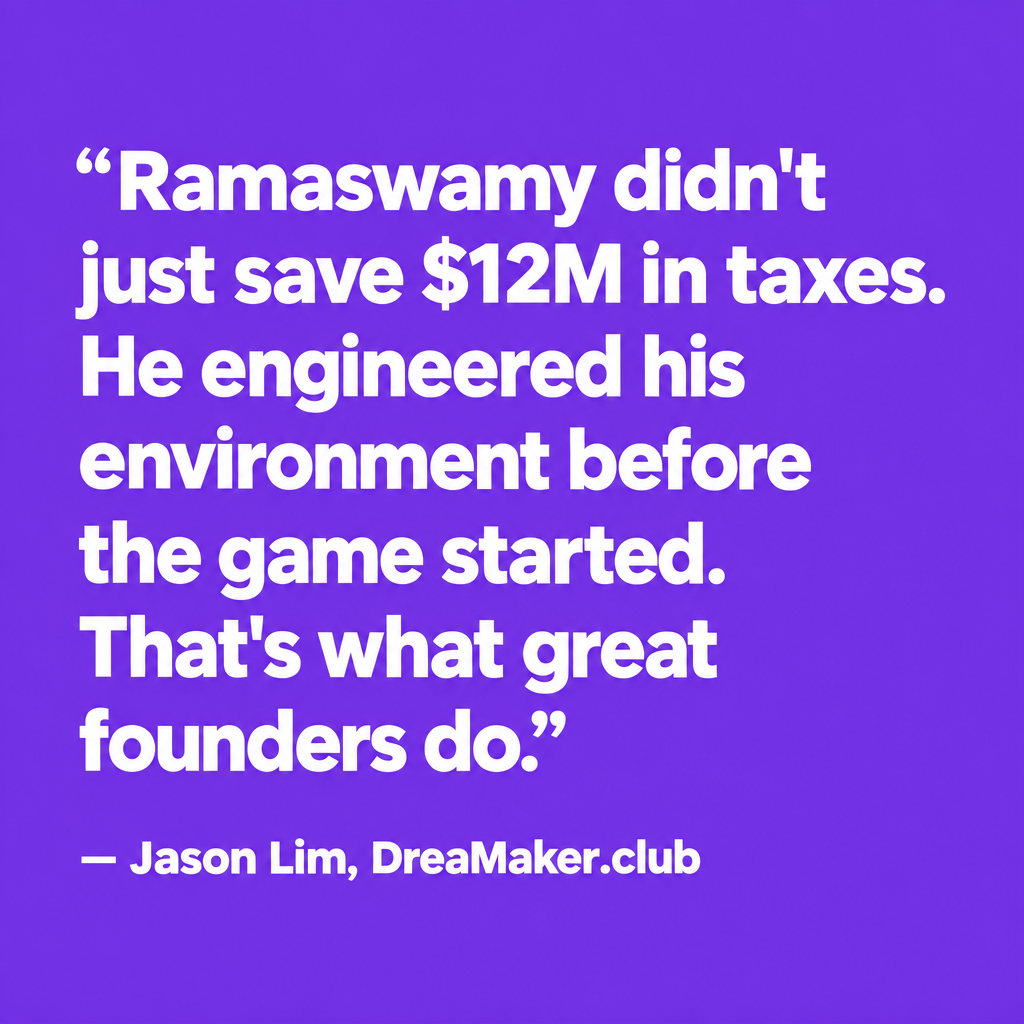
The lesson: The founder who engineers the environment before the pitch wins deals the hustler never even gets to have.
Founder Story
Jeffrey Teo — 63 Customers in 100 Days
Jeffrey came to Jason with a product that worked and a sales approach that did not. He was chasing every conversation, burning energy on buyers who were never going to commit. The shift was not his pitch — it was his system. He stopped selling into chaos and started engineering the right conditions: right buyers, right sequencing, right environment. The result was 63 paying customers in 100 days. He did not get better at closing. He stopped needing to close as hard — because the environment was already doing the work.
Ramaswamy is not unique in this. Every founder Jason has worked with who built serious revenue — the ones who hit $1M, $2M, $10M without burning out — they all did some version of environment engineering first. They chose their market carefully. They positioned clearly before they pitched. They built trust at scale before they needed it at the individual deal level.
The ones who struggled were technically better at selling. But they were operating in the wrong environment and wondering why the same effort was not producing the same results.
Part 5 — The Opportunity & Your Conditions
Beat 1: Hidden Opportunity
Here is what the Forbes headline missed: Ramaswamy's $12.3M saving was not the opportunity. The opportunity was what that decision signalled about how he thinks.
He looked at his future — the wealth events coming, the deals on the horizon, the growth ahead — and restructured his environment to meet it. He did not react. He pre-empted.
The hidden opportunity for founders right now is identical. The US market is shifting. Buyers are more sceptical, more distracted, and have more options than ever. The founders who will win in the next 24 months are not the ones who get better at convincing. They are the ones who restructure their sales environment now — before the next cycle of growth demands it.
That means building a selling system that creates trust before conversations begin. That positions you as the obvious choice — not just another option. That makes the close feel like a natural conclusion rather than a desperate finish line.
Beat 2: Are You Ready? Check Your Conditions.
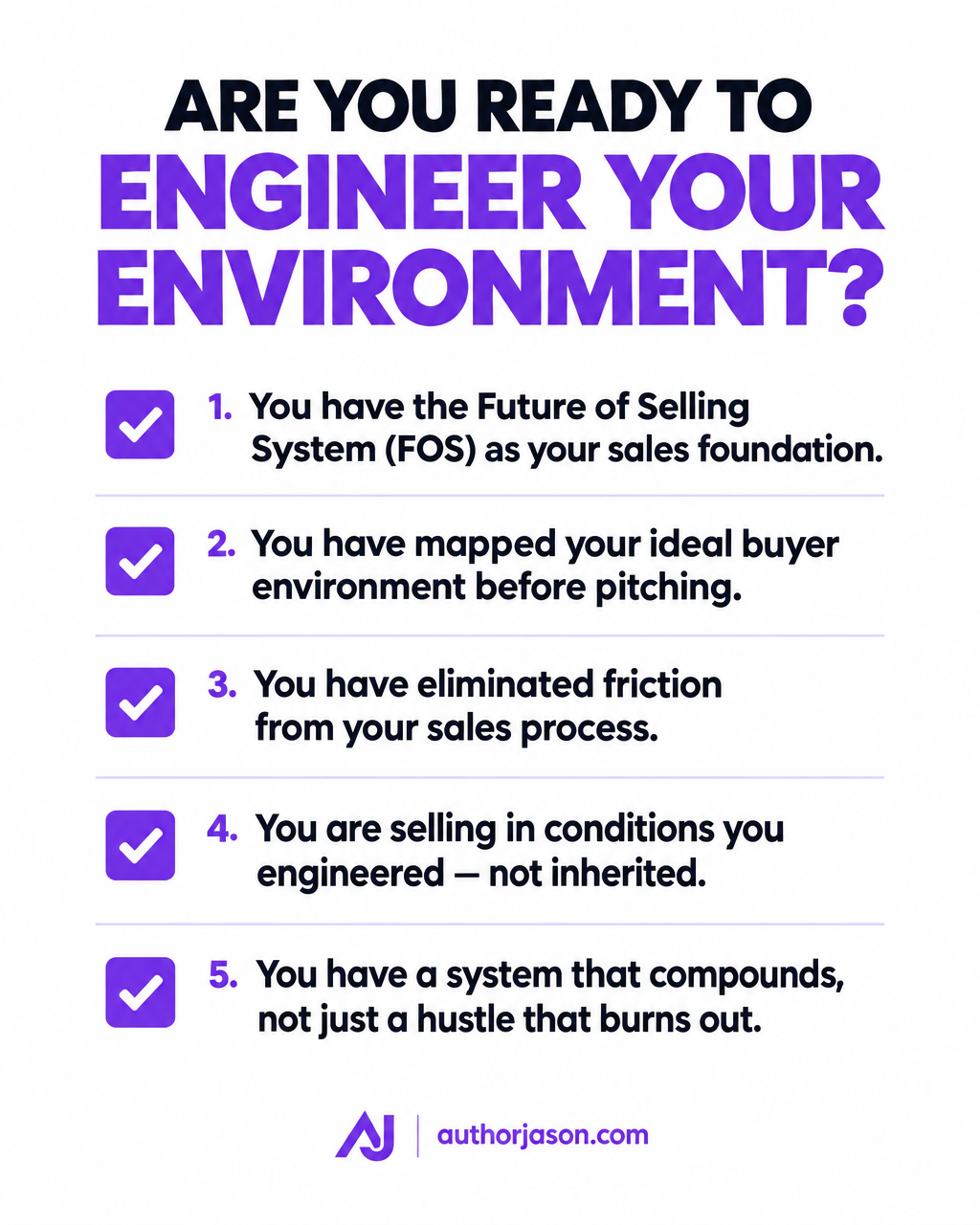
Are You Ready to Engineer Your Environment? Check These 5 Conditions:
- You have the Future of Selling System (FOS) as your selling foundation. Not a script. Not a deck. A repeatable system that engineers trust, relevance, and conviction before you ask for the close. If you do not have FOS, everything else on this list is harder than it needs to be. Get it here for $19/month.
- You have mapped your ideal buyer environment — not just your ideal buyer profile. Where do they make decisions? Who influences them? What makes them move? Ramaswamy did not just know who he was selling to. He restructured his environment to match.
- You have eliminated the friction that stops buyers from saying yes. Not just objections — structural friction. Pricing confusion, unclear value, positioning noise. Every piece of friction you have not removed is $12M sitting on the table.
- You are selling into conditions you engineered — not conditions you inherited. Most founders sell into markets they stumbled into. The shift is deliberate: choosing the market, the buyer, the positioning — then building the system around that choice.
- You have a system that compounds, not just a hustle that burns out. Ramaswamy's 2020 move is still paying off in 2026. That is compounding. Your selling system should work the same way — building trust and pipeline that gets easier over time, not harder.
NEW!
October 2026
Dear Founders,
You have got a product that works. You have got buyers who need what you sell. But every time the conversation gets close to a decision, something stalls — and you walk away wondering if you said the wrong thing. You did not say the wrong thing. You are selling into a system that was never designed to support you.
I know how that feels. I have worked with 1,000+ founders since 2015 across the US market — founders with teams, with traction, with real products — who were still stuck every time the conversation came to the close. They felt it. Their buyers felt it. The gap between a great conversation and a signed deal felt impossibly wide.
What they found — and what the data confirms — is that 76% of buyers make their decision before the final conversation even begins (Salesforce State of Sales, 2026). The close is not won in the meeting. It is won in the environment you built long before you get in the room.
The Future of Selling System (FOS) is the system Jason built with $22M+ in combined graduate sales and case studies including Jeffrey Teo (63 customers in 100 days), Stanley Tan (45 buyers in 3 hours), and Leon ($2M partnership). It is the system that engineers your environment so the close is a conclusion — not a gamble.
Not ready for $19? Start free.
The Objection Playbook: 25 Word-for-Word Scripts to Close More Sales
The exact words Jason's founders use when a buyer says too expensive, send me info or I need to think about it. Free PDF, sent to your inbox.
Send Me the 25 ScriptsBillionaire Vivek Ramaswamy already moved. The only question is whether you will — or whether you will read about someone else who did.


