Sales Coaching, Startup Founders, What to Look for in a Sales Coach for Founders
What to Look for in a Sales Coach for Founders — The Warren Buffett Checklist
Most founders pick a sales coach the way they pick a restaurant: by reviews, vibes, and how polished everything looks on the surface. But when it comes to revenue, headcount, and runway, “looks good” is not good enough. You need a coach who can help you turn your product, team, and story into predictable sales — not just someone who sounds confident on a call.
Custom HTML/CSS/JAVASCRIPT
Choose Your Sales Coach Like Buffett Chose His Mentor
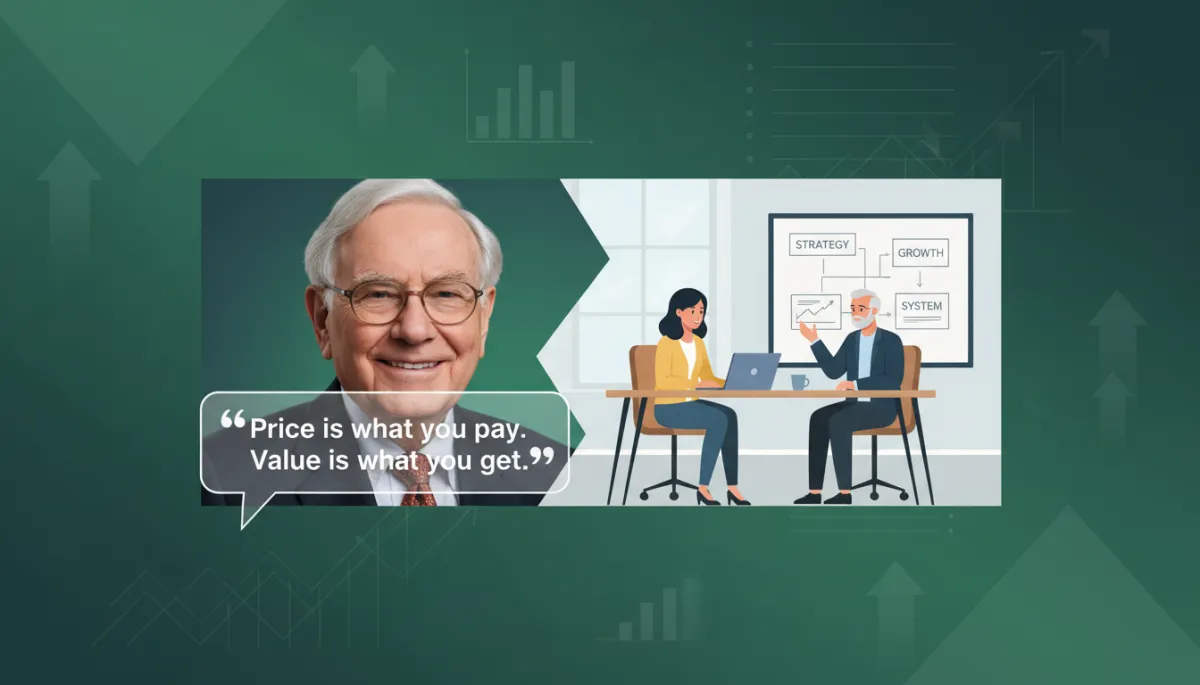
Slow, thoughtful, and focused on what actually compounds" alt="Portrait of Warren Buffett with a quote overlay about choosing the right mentor" /><h2 style="line-height: 2; text-align: left;"><span style="font-family: 'Helvetica Neue', sans-serif; font-size: 24px;"> What Made Benjamin Graham the Right Mentor for Buffett </span></h2><p style="line-height: 2; text-align: left;"><span style="font-family: 'Source Serif 4', serif; font-size: 18px;"> Before Buffett became a household name, he was a young investor looking for someone who could help him turn curiosity into a real craft. Benjamin Graham became that mentor — not because he was famous, but because he had three qualities every founder should demand from a sales coach. </span></p><ul><li style="line-height: 2; text-align: left;"><span style="font-family: 'Source Serif 4', serif; font-size: 18px;"><strong>Graham had done the thing.</strong> He wasn’t theorizing about markets; he had invested through real cycles, with real money on the line, and real results. For you, this is the difference between a coach who has sold complex deals and one who only talks about them. </span></li><li style="line-height: 2; text-align: left;"><span style="font-family: 'Source Serif 4', serif; font-size: 18px;"><strong>He had a system.</strong> Graham taught a disciplined framework for value investing, not a random playlist of stock tips. In sales, this is the difference between being handed scripts and being given a repeatable process your whole team can learn. </span></li><li style="line-height: 2; text-align: left;"><span style="font-family: 'Source Serif 4', serif; font-size: 18px;"><strong>He had a track record with students.</strong> Graham’s approach had already shaped other successful investors, not just his own portfolio. A great sales coach doesn’t just close for themselves — they help <em>founders</em> close and grow. </span></li></ul><p style="line-height: 2; text-align: left;"><span style="font-family: 'Source Serif 4', serif; font-size: 18px;"> When you think about <em>how to choose a sales coach</em>, picture that relationship. You are not hiring a cheerleader. You are choosing the person whose voice will be in your head when a big buyer pushes back, when your team is discouraged, and when the month is on the line. That person needs substance, not just style. </span></p><h2 style="line-height: 2; text-align: left;"><span style="font-family: 'Helvetica Neue', sans-serif; font-size: 24px;"> The 5 Non-Negotiables in a Sales Coach for Founders </span></h2><ol><li style="line-height: 2; text-align: left;"><span style="font-family: 'Source Serif 4', serif; font-size: 18px;"><strong>They have sold at your price point to your buyer type — recently.</strong> If you sell a $40K ARR SaaS product to CFOs, a coach whose experience is closing $99 courses to freelancers is not a fit. The psychology, risk, and politics are completely different. Insist on: <ul><li style="line-height: 2; text-align: left;"><span style="font-family: 'Source Serif 4', serif; font-size: 18px;"> Similar deal sizes and sales cycles </span></li><li style="line-height: 2; text-align: left;"><span style="font-family: 'Source Serif 4', serif; font-size: 18px;"> Similar decision-maker level (founder, VP, C‑suite, committee) </span></li><li style="line-height: 2; text-align: left;"><span style="font-family: 'Source Serif 4', serif; font-size: 18px;"> Wins in the last 12–24 months, not just “back in the day” </span></li></ul><em>Sales coach qualities founders</em> overlook most often? Recency and relevance. You deserve both. </span></li><li style="line-height: 2; text-align: left;"><span style="font-family: 'Source Serif 4', serif; font-size: 18px;"><strong>They teach a system, not a collection of tactics.</strong> Scripts and “magic lines” can help, but they do not scale across a team of five, ten, or fifty. Look for: <ul><li style="line-height: 2; text-align: left;"><span style="font-family: 'Source Serif 4', serif; font-size: 18px;"> A named framework or methodology you can describe in a paragraph </span></li><li style="line-height: 2; text-align: left;"><span style="font-family: 'Source Serif 4', serif; font-size: 18px;"> Clear stages: from lead to close to expansion </span></li><li style="line-height: 2; text-align: left;"><span style="font-family: 'Source Serif 4', serif; font-size: 18px;"> Tools and templates your team can reuse without the coach in the room </span></li></ul> A real system survives bad weeks, investor pressure, and hiring mistakes. Tactics do not. </span></li><li style="line-height: 2; text-align: left;"><span style="font-family: 'Source Serif 4', serif; font-size: 18px;"><strong>They can show documented results from founders like you — not outliers.</strong> Every industry has a few “lightning in a bottle” stories. You are not looking for lottery tickets; you are looking for <em>patterns</em>. Ask for: <ul><li style="line-height: 2; text-align: left;"><span style="font-family: 'Source Serif 4', serif; font-size: 18px;"> Case studies with timeframes, numbers, and founder quotes </span></li><li style="line-height: 2; text-align: left;"><span style="font-family: 'Source Serif 4', serif; font-size: 18px;"> Examples where the founder started from a similar revenue and team size </span></li><li style="line-height: 2; text-align: left;"><span style="font-family: 'Source Serif 4', serif; font-size: 18px;"> Wins that look like the future you actually want, not just vanity numbers </span></li></ul> If their best story is an outlier, treat it as marketing, not proof. </span></li><li style="line-height: 2; text-align: left;"><span style="font-family: 'Source Serif 4', serif; font-size: 18px;"><strong>They still sell — they have skin in the game.</strong> Markets change. Buyers change. What worked even three years ago may not land today. Coaches who still carry a quota, close deals, or actively sell their own services are forced to stay honest. Ask: <ul><li style="line-height: 2; text-align: left;"><span style="font-family: 'Source Serif 4', serif; font-size: 18px;"> “What are you personally selling right now?” </span></li><li style="line-height: 2; text-align: left;"><span style="font-family: 'Source Serif 4', serif; font-size: 18px;"> “What objections are you hearing this quarter?” </span></li></ul> Their answers will tell you whether their advice is living or fossilized. </span></li><li style="line-height: 2; text-align: left;"><span style="font-family: 'Source Serif 4', serif; font-size: 18px;"><strong>They pass the intellectual honesty test.</strong> One simple move: ask something you know they will not know. Watch what they do. A coach you can trust will say, “I don’t know, but I can find out,” or “That’s outside my lane.” Someone who bluffs under zero pressure will almost certainly bluff when your board is nervous and you need real guidance. Your revenue deserves the same level of integrity you expect from your CTO or head of finance. </span></li></ol><aside style="line-height: 2; text-align: left;"><span style="font-family: 'Source Serif 4', serif; font-size: 18px;"><strong>Self‑Check:</strong> If you applied these five non‑negotiables to your current or potential sales coach, would they pass? If not, you are not being demanding — you are being responsible. Your team of five, ten, or fifty is counting on you to choose teachers who compound, not just impress. </span></aside><h3 style="line-height: 2; text-align: left;"><span style="font-family: 'Helvetica Neue', sans-serif; font-size: 24px;"> How do I know if a sales coach is right for my stage? </span></h3><p style="line-height: 2; text-align: left;"><span style="font-family: 'Source Serif 4', serif; font-size: 18px;"> For a founder with a team of 5+ people, the right coach understands both <em>founder‑led selling</em> and <em>team‑led selling</em>. They should help you step out of being the only closer, without disconnecting you from customers. Ask them: </span></p><ul><li style="line-height: 2; text-align: left;"><span style="font-family: 'Source Serif 4', serif; font-size: 18px;"> How they transition founders from solo selling to a repeatable team process </span></li><li style="line-height: 2; text-align: left;"><span style="font-family: 'Source Serif 4', serif; font-size: 18px;"> What changes when you move from 3 to 10 reps </span></li></ul><h3 style="line-height: 2; text-align: left;"><span style="font-family: 'Helvetica Neue', sans-serif; font-size: 24px;"> What red flags should founders watch for when choosing a sales coach? </span></h3><ul><li style="line-height: 2; text-align: left;"><span style="font-family: 'Source Serif 4', serif; font-size: 18px;"> No clear system, just “I’ll hop on calls and give feedback.” </span></li><li style="line-height: 2; text-align: left;"><span style="font-family: 'Source Serif 4', serif; font-size: 18px;"> Case studies with no numbers, dates, or founder names you can verify. </span></li><li style="line-height: 2; text-align: left;"><span style="font-family: 'Source Serif 4', serif; font-size: 18px;"> Overpromising (“We’ll 10x your revenue in 30 days”) instead of setting grounded expectations. </span></li></ul><h3 style="line-height: 2; text-align: left;"><span style="font-family: 'Helvetica Neue', sans-serif; font-size: 24px;"> How much should founders expect to invest in a good sales coach? </span></h3><p style="line-height: 2; text-align: left;"><span style="font-family: 'Source Serif 4', serif; font-size: 18px;"> There is no single right number, but a useful benchmark is: <em>would this investment still feel smart if it only improved close rates by 20–30% over 6–12 months?</em> Serious coaching is rarely cheap, but it should feel small compared to the revenue and confidence it creates. Publications like <a href="https://www.forbes.com/sites/forbescoachescouncil" target="_blank" rel="noopener">Forbes</a> and <a href="https://hbr.org/2009/01/what-can-coaches-do-for-you" target="_blank" rel="noopener">Harvard Business Review</a> both emphasize that the real ROI of coaching comes from decision quality and behavior change, not quick hacks. </span></p><figure><img src="[IMAGE_PLACEHOLDER:photorealistic editorial. Startup founder and sales coach in a glass-walled meeting room with forest green #1a4731 accents, laptop open to a sales dashboard, both reviewing metrics and notes thoughtfully
The right coach helps you translate dashboards into decisions, not just reports.
What Jason Looked for When He Was Rebuilding
Jason has helped 1,000+ founders since 2015 and driven more than $22M in combined sales, but that track record was forged the hard way. He hit rock bottom three separate times — emotionally, financially, and professionally — and had to rebuild his sales confidence from the ground up each time. Those seasons made him ruthless about what to look for in a sales coach for founders.
Compassion plus standards. Jason needed mentors who understood what it felt like to miss payroll and still demanded excellence. Kindness without standards kept him stuck; standards without kindness burned him out. The right coach held both.
Founders first. Many sales trainers come from big‑company sales. Jason specifically sought people who understood the chaos of early‑stage startups, where the founder is also the head of product, fundraising, and sometimes customer support.
System over personality. After being burned by “guru charisma,” Jason only invested in mentors who could show him a process he could teach to others — not just what made them personally persuasive.
Those criteria eventually shaped the Future of Selling System (FOS) he now teaches — a system designed specifically for founders who want to sell with integrity, clarity, and calm, even under pressure.
The P.I.T.C.H. Formula: A System Founders Can Actually Use
Inside FOS, Jason teaches the P.I.T.C.H. Formula, a simple, founder‑friendly way to structure every sales conversation:
P – Problem: Name the real cost of the status quo in the buyer’s language.
I – Insight: Share a perspective that reframes how they see that problem.
T – Transformation: Paint the “after” state in concrete, business‑relevant terms.
C – Case proof: Use specific examples, numbers, and stories to de‑risk the decision.
H – How to start: Make the first step small, clear, and time‑bound.
This is what a real system looks like: something your reps can learn, your managers can coach, and you as a founder can use in boardrooms and late‑night investor calls without feeling like you are pretending to be someone else.
Systems turn individual talent into team-wide performance that survives bad weeks.
Tier 1 Results: What Real Founders Achieved
Ultimately, the best answer to “what to look for in a sales coach for founders” is this: look at what happens to founders who work with them. Not just how they feel, but what changes in their pipeline, pricing, and confidence. Jason calls these “Tier 1” results — measurable, specific, and founder‑verified.
Tan — $29,693 in 16 days. Tan came in undercharging and over‑delivering. With coaching rooted in the FOS principles, Tan re‑positioned his offer, tightened his discovery calls, and stopped apologizing for his price. In just 16 days, he closed $29,693 in new revenue — not from a brand‑new audience, but from leads he previously would have let slip away.
Teo — 63 customers in 100 days. Teo was stuck in “infinite tweaking” mode, constantly rewriting decks and emails. With a clear system and weekly accountability, he shifted focus from perfection to consistent outreach. Over 100 days, that discipline translated into 63 new customers — enough to change how investors and his own team saw the company’s future.
Leon — from $2.5K to $2M+. Leon’s first offer was a $2.5K engagement. Over time, using the same core principles you have read here — clarity of problem, proof, and a repeatable conversation structure — he stair‑stepped his way to more than $2M in total sales. Not overnight. Not with one “viral” moment. With a coach, a system, and a commitment to telling the truth in every deal.
These are not fairy tales; they are examples of what happens when a founder chooses a coach the way Graham and Buffett chose each other — carefully, thoughtfully, and with respect for the compounding power of good decisions.
The right sales coach will not just help you close more deals — they will help you become the kind of founder whose calm, honest, and confident selling compounds for decades.
I wanted more than just survival—I wanted control, options, and a life on my terms. The obsession with this goal led me to several places and acquired unique skillsets, in order to accomplish my goals. I found the secrets in my rock bottom, now I want to share them with you
![photorealistic editorial. Warren Buffett portrait in soft light, subtle forest green #1a4731 accents, verified quote overlay about the importance of choosing the right teacher, clean typography, minimal background]](https://images.leadconnectorhq.com/image/f_webp/q_80/r_1200/u_https://storage.googleapis.com/funnel-ai-production/blog-ai/1fJg9xnclIbfGnen8THW/hero-1789865286454-us70pt.png)