Part 1 — The Move Everyone Saw. The Lesson Almost Nobody Caught.
Aliko Dangote just opened Africa's most expensive refinery to anyone with $4. The minimum buy-in is ₦5,250.
A $20 billion industrial asset — the largest single-train oil refinery on the planet — now has an entry point smaller than a fast-food meal. Most people reading the headlines are talking about oil, Africa, and capital markets. But the real story is about the decision buried inside the architecture of the deal itself. The lesson has nothing to do with petroleum. It has everything to do with how the world's most effective deal-makers eliminate the friction standing between them and their buyer's first yes.
Part 2 — The Mirror Every Founder Needs Right Now
Most founders spend their careers building something too big for anyone to touch. The product is compelling. The vision is real. But the price of entry — the risk a buyer has to absorb just to say yes for the first time — is enormous. So buyers wait. They say they'll "think about it." They ask for a proposal. They go quiet. And founders call it a slow market.
It is not a slow market. It is a high-friction first step.
Dangote didn't make that mistake with his $20 billion refinery. He dropped the entry point to ₦5,250. Ten shares. Less than a dinner out. That decision was not a publicity stunt. It was architecture. It was a sales system designed from the buyer's psychology outward. And it is exactly the move that separates founders who build waiting lists from founders who build real wealth.
If your offer requires a large first yes, you have already lost the majority of your market before the first conversation has even started. The question is not whether your product is worth it. The question is whether you have made it easy enough to begin.
Part 3 — What Actually Happened (And Why The Numbers Matter)
On September 7, 2026, Aliko Dangote signed IPO offer documents at a ceremony at Eko Hotels in Lagos, formally marking a key milestone on the path to what Reuters and CNBC Africa reported as Africa's largest-ever share sale (CNBC Africa / Reuters, September 7, 2026). The public subscription window opened on September 14, 2026, and closes on October 13, 2026, according to the official offer prospectus (ipo.dangote.com, verified September 2026).
The numbers are significant. The offer comprises 4.1 billion ordinary shares at ₦525 (approximately $0.40) per share, targeting gross proceeds of approximately ₦2.15 trillion (approximately $1.63 billion), with a greenshoe option of up to 30% if demand exceeds the base offer (Daba Finance, September 2026). The refinery itself carries a valuation of approximately $48–49 billion (Serrari Group, September 18, 2026). The 700,000-barrel-per-day facility cost roughly $20 billion to build (CNBC Africa, September 7, 2026). In the first half of 2026 alone, it swung from a $476 million full-year loss in 2025 to $1.82 billion in net income (Discovery Alert, September 2026).
The minimum subscription is 10 shares — ₦5,250, approximately $4 (official IPO prospectus, verified September 2026). The offer is targeting 10 million retail investors, a figure that would vastly exceed Nigeria's capital market record of approximately 181,000 retail participants in a single transaction (Vanguard, September 7, 2026). At the launch, Dangote said: "This is the IPO for the people. There is no segregation on who can own the shares" (Vanguard, September 7, 2026).
Billionaire Aliko Dangote's move is one Jason has seen across 1,000+ founders. Here's what most miss.
Part 4 — The Root Cause Most Founders Misread
Root Cause Reframe
Most founders think the problem is that buyers won't pay their price. The real problem is that the first yes costs too much.
Price is rarely the real objection. Friction is. The risk of the first commitment — the cognitive, financial, and social weight of saying yes to something unfamiliar — is what kills deals before they even reach a real conversation. Dangote did not lower the value of his refinery. He lowered the cost of the first decision. That is an entirely different move, and most founders never learn to tell the difference.
The Lesson
The biggest deals are won by making the first yes the smallest risk.
Here is what this looks like in practice. When you structure your offer so that the first step is nearly effortless, you do not lose the high-value buyer — you gain access to them. They enter small. They learn. They experience the value. They build trust in you. And then they scale up. Dangote's IPO targets 10 million retail investors not because small investors will fund the refinery's expansion. They won't — the institutional and private placement capital already handled that. He targets them because mass entry at a low threshold creates proof of demand that institutional confidence, media attention, and secondary-market momentum all follow.
The founders Jason works with who struggle most aren't failing on product quality or price. They're failing on architecture. Their entry offer requires too much belief upfront — belief in the founder, the methodology, the category, and the outcome — before the buyer has experienced any of it firsthand. The fix is not to lower your price. The fix is to redesign the first step so the risk of taking it is so small, only someone who isn't paying attention would skip it.
Founder Story Card
The visible problem: A B2B SaaS founder kept losing deals at the proposal stage. Prospects loved the demo, asked great questions, then disappeared. The founder kept refining the pitch deck.
The real root cause: The first commitment — a 12-month contract at $24,000 — was too large a risk for buyers who hadn't yet experienced the product. The proposal wasn't the problem. The architecture was.
The founder lesson: No buyer will make a $24,000 decision before they feel safe making a $240 one. The entry point determines who gets to experience your value. If the entry point is too high, most of your best potential clients will never get past it.
The move to make now: Identify the smallest meaningful first step a buyer can take with you that delivers a real result — then price and package that as the front door to everything else you offer.
Part 5 — The Hidden Opportunity (And The Window Is Closing)
The real opportunity this story reveals for startup founders is not in oil. It is in the timing signal. The Dangote public offer closes on October 13, 2026 — but the window for founders to act on the lesson it contains is right now, before this concept becomes so mainstream that the competitive advantage disappears.
Markets are shifting. Buyers at every level — from retail investors to enterprise procurement — are increasingly trained to distrust high-friction first offers. The SaaS model already cracked this code with freemium. The consulting world is beginning to crack it with entry-level audits. The coaching world is cracking it with low-cost workshops. The founders who redesign their offer hierarchy — from "sign here for six months" to "start here for thirty dollars" — will unlock a pipeline that their higher-friction competitors have left sitting on the table.
The window is not theoretical. Buyer psychology is changing in real time. The founder who moves now builds the entry infrastructure while the category expectation is still forming. The founder who waits will be redesigning their offer architecture to catch up with competitors who already own the low-friction entry lane.
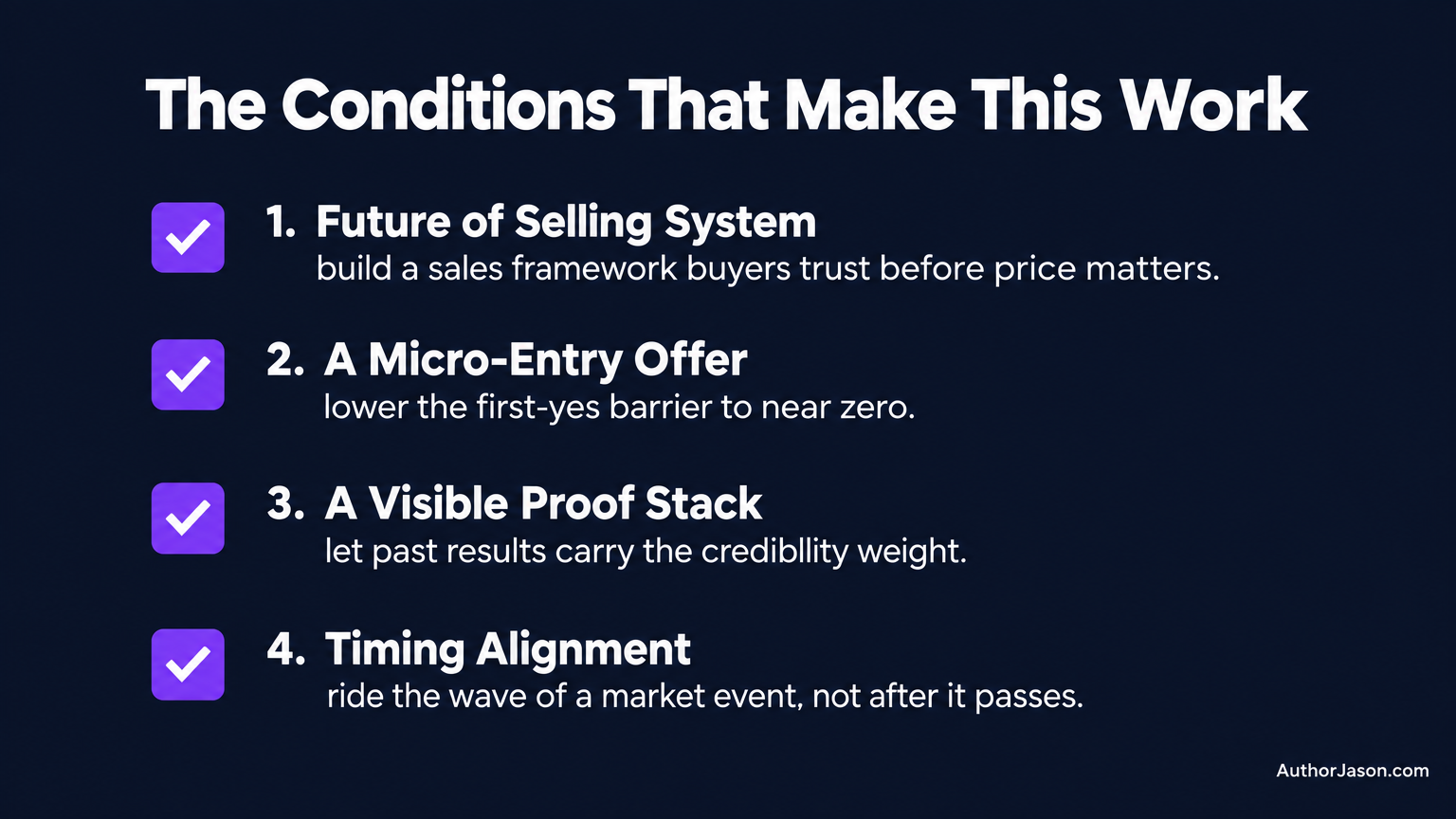
The Conditions That Make This Work
- Future of Selling System: You need a sales framework that converts micro-commitments into larger ones systematically — not through pressure, but through a sequenced buyer journey that builds trust at each step. Without this, a low-priced entry offer just produces low-priced clients.
- A Micro-Entry Offer: You need a specific, bounded first offer that delivers a genuine, tangible result on its own — not a stripped-down version of your main offer, but a real win that earns the right to the next conversation.
- A Visible Proof Stack: The entry offer must be backed by evidence that the next step is worth taking. Case studies, transformation stories, and outcome data need to be visible before the buyer even reaches the checkout page.
- Timing Alignment: The entry offer must map to a moment of active buyer pain or decision-making urgency — not a general-awareness campaign. Dangote didn't open the IPO when the refinery was half-built. He opened it when the financials were strongest and the market was watching.
Dangote already moved. The only question is whether you will — or whether you'll read about someone else who did.


