
Billionaire David Einhorn Just Called Out A Generation's Fatal Flaw — And It's Costing Startup Founders Millions
Billionaire David Einhorn Just Called Out A Generation's Fatal Flaw — And It's Costing Startup Founders Millions

Part 1 — The Hook
David Einhorn just told the world that impatience is the real wealth killer. Most people heard it as a hot take on home ownership. Startup founders should hear it as a mirror — because the same speculative reflex that destroys personal wealth is quietly doing the same to your sales pipeline, your offer, and your business future. The lesson the crowd missed is the one that decides whether your company compounds or collapses.
Part 2 — The Pressure
If you have been chasing the next growth hack, refreshing your ad dashboard every 90 minutes, or switching your sales strategy every quarter because nothing is working, you are the person Einhorn is describing. Not the millennial who cannot buy a house. You.
The pattern he identified — speculate, lose patience, speculate again — is the exact failure loop keeping founders stuck at inconsistent months, unable to scale, unable to convert. They are not failing because the market is wrong. They are failing because they are playing the wrong game: looking for one big swing instead of building a compounding system.
This is not a motivation problem. This is a structure problem. And structure is something you can fix — but only if you see it clearly first. The billionaire's comment about houses is really a comment about how most people, including most founders, are wired. And that wiring is costing them everything.
Part 3 — The Play
Here is what Einhorn actually said. Speaking on Morgan Stanley's Break the Playbook series — an episode published September 22, 2026 — the Greenlight Capital co-founder described why younger Americans are struggling to build wealth through home ownership. "I sense the younger generation is just more impatient," he said, as reported by Moneywise and Yahoo Finance on September 22, 2026. He added that they would rather "speculate in crypto or speculate in stocks or speculate on sporting events and try to build wealth by guessing those things correctly."
The reaction was swift. Critics pointed to real structural barriers: mortgages near 7%, stagnant wage growth, and home prices that have surged dramatically. Federal Reserve data, cited by Moneywise on September 22, 2026, shows the S&P Cotality Case-Shiller U.S. National Home Price Index rose approximately 85% from June 2016 to June 2026. Simultaneously, the S&P 500 price index climbed roughly 257% over the same ten-year period, excluding dividends — which is the compounding comparison Einhorn is gesturing at.
Both sides of the argument are missing the deeper pattern. Einhorn is not just talking about millennials and mortgages. He is diagnosing a cognitive trap that appears everywhere patience is required to win — including inside every startup that has ever stalled after a promising start. Billionaire David Einhorn's observation is one Jason has seen across 1,000+ founders. Here is what most miss.
Part 4 — The Lesson and Root Cause Reframe

Most founders think the problem is their product, their price point, or their pitch. But the real problem is that they have chosen speculation over system — and dressed that choice up as hustle.
Here is the lesson this story earns:
"The founder who builds a system beats the founder who bets on a tactic. Every time."
Speculation is seductive because it feels like momentum. A new ad. A cold DM blast. A viral post. A revised offer. Each one feels like action. Each one feels like you are doing something. But without an underlying sales system, every single one of those moves is a bet — not a strategy. And bets do not compound. Systems do.
What Einhorn is describing in the home-buying context maps precisely to what happens inside most early-stage startups. Founders chase quick wins because building a real system feels slow. It requires patience, repetition, and the willingness to let results arrive later than expected. Most founders cannot hold that line. They switch tactics, switch messaging, switch offers — and then blame the market when nothing sticks.
The difference between founders who scale and founders who stall is not intelligence, product quality, or market timing. It is the willingness to build and trust a system long enough to let it compound.
Founder Story Card
The visible problem: A SaaS founder is getting discovery calls but no conversions. She has tried three different pricing models in 60 days and is now considering pivoting her entire offer.
The real root cause: She does not have a sales system. She has a speculation habit — testing random variables and hoping one of them magically unlocks conversion. The problem is not the offer. It is the absence of a structured, repeatable sales process.
The founder lesson: Patience without a system is just waiting. A system without patience is just noise. You need both — and they have to be built in the right order.
The move to make now: Stop changing tactics. Diagnose your current sales process from first contact to signed contract. Find the one stage where buyers consistently drop off. Fix that stage. Then hold the line for 90 days.
Part 5 — The Opportunity and Conditions
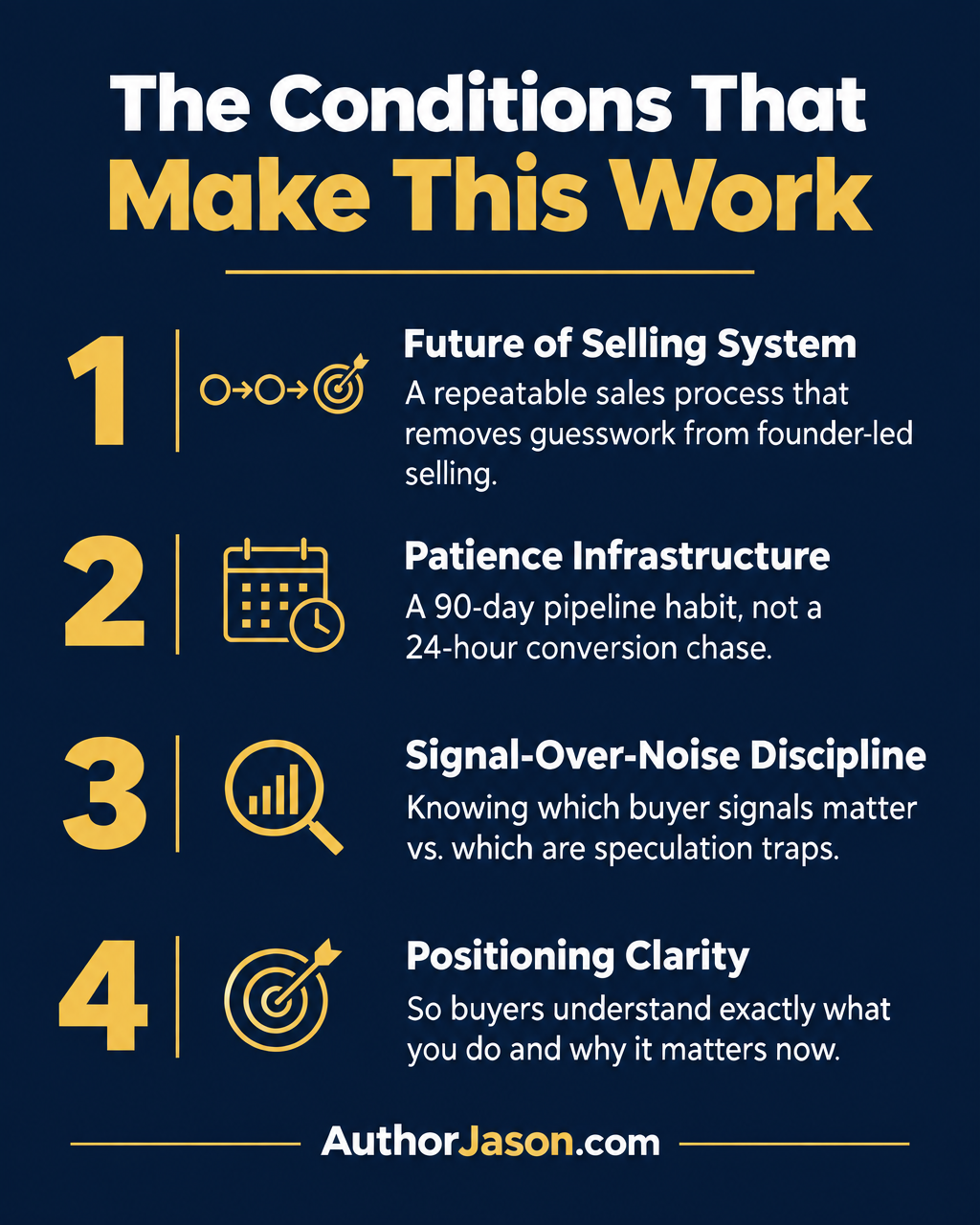
When the dominant conversation in a market is about impatience, the patient player holds a structural advantage that almost no one talks about. Right now, most of your competitors are pivoting weekly, chasing trends, and burning budget on speculative channels. The founder who locks in a durable, systematic sales process in this environment does not just survive — they compound while everyone else churns.
This is the window. The founders who move now — who build a real sales system while competitors are still speculating — will own their category positioning in 18 months. The gap between a systematic founder and a speculative one does not shrink over time. It widens. But the conditions have to be right for this to work.
The Conditions That Make This Work
- Future of Selling System: A repeatable, founder-led sales process that removes guesswork and replaces speculation with structured buyer conversations that consistently convert — the foundation without which everything else is just tactics dressed up as strategy.
- Patience Infrastructure: A 90-day pipeline habit — tracking real signals across real prospects, not refreshing ad dashboards for short-term dopamine hits that masquerade as progress.
- Signal-Over-Noise Discipline: The ability to distinguish genuine buyer intent signals from speculative noise, and the willingness to act on the former while ignoring the latter, even when the latter feels more urgent.
- Positioning Clarity: An offer so clearly articulated that buyers understand exactly what you do, who it is for, and why they need it now — removing the temptation to re-speculate on your messaging every time a month underperforms.
Part 6 — A Word From Jason
Einhorn already moved — he built a system that compounded for decades. The only question is whether you will — or whether you'll read about someone else who did.


