Billionaire David Ellison Was Ghosted, Rejected 8 Times, and Outbid By Netflix — Then Closed a $111 Billion Deal Anyway
Billionaire David Ellison Was Ghosted, Rejected 8 Times, and Outbid By Netflix — Then Closed a $111 Billion Deal Anyway
David Ellison got ghosted. Then rejected again. Then Netflix swooped in and stole the deal.
The Warner Bros. Discovery board said no eight times. Their CEO stopped responding to calls entirely. And when Ellison finally made progress, Netflix outmanoeuvred him and closed a competing agreement. Most founders would have deleted the contact and moved on. Ellison rewrote his offer, came back harder, and on October 6, 2026, closed the largest media deal in history: $111 billion, combining Paramount, Warner Bros., HBO, CNN, and 15,000 films under one roof — now trading on the NYSE as Skydance Corp. (ticker: SKYD). The lesson inside this deal is not about media. It is about what you do when the room goes silent.
Every Founder Has a Dead Deal in Their Pipeline Right Now
You know the one. The prospect who went cold after the second meeting. The enterprise account that said they would revisit in Q1 — six months ago. The partnership that looked certain until someone senior went quiet. You have followed up twice. Maybe three times. And now the file sits in your CRM labelled nurture — which is founder-speak for you gave up but you do not want to admit it yet.
Here is what the Ellison story forces you to confront: the difference between a dead deal and a deal you stopped working is almost always the founder, not the buyer. Most of the deals sitting cold in your pipeline were not lost. They were abandoned. And the founders who abandoned them told themselves a story about not wanting to be pushy or reading the room — when what they actually did was let discomfort make their decisions for them.
Ellison faced something worse than a cold prospect. He faced institutional rejection, public humiliation, and a direct competitor closing the deal he wanted. He came back anyway. What are you telling yourself about why you have not?
What Actually Happened — And What the Press Got Wrong
In September 2025, Ellison convened a board meeting at Paramount Skydance to begin pursuing Warner Bros. Discovery (WBD). What followed was one of the most complex deal-making runs in media history. According to Variety (October 6, 2026), the WBD board rejected his takeover offers eight times. CEO David Zaslav went dark in December 2025 after Netflix closed a competing agreement for WBD's streaming and studios business.
Ellison did not retreat. In February 2026, he returned with a superior offer of $31 per share — nearly 2.5 times WBD's stock price before the M&A activity began, per Variety. He navigated antitrust clearances across 68 countries, survived a legal challenge from 12 U.S. state attorneys general, and paid a $41.9 million ticking fee to WBD investors when the deal closed six days past its deadline. According to CNN (October 6, 2026), the combined Skydance Corp. now controls more than 200 million streaming subscribers globally, two of the five largest Hollywood studios, $80 billion in net debt, and a three-year target of $6 billion in run-rate synergies. SKYD began trading on the NYSE on October 7, 2026.
The press called this a media consolidation story. It is not. It is a closing story — and Billionaire David Ellison's move is one Jason has seen across 1,000+ founders. Here is what most miss.
The Lesson: Why Your Best Deals Are Dying in the Silence You Created
Root Cause Reframe: Most founders think the problem is that buyers are not interested. But the real problem is that founders interpret silence as rejection — and treat it as permission to stop selling.
Silence is not a no. Silence is ambiguity. And ambiguity is one of the most natural stages in any meaningful deal, because the bigger the decision, the more internal friction exists on the buyer's side that you cannot see. Zaslav was not ignoring Ellison because the deal was bad. He was managing a board, a competing offer, regulatory anxiety, shareholder pressure, and his own ego. None of those had anything to do with Ellison's offer quality. But a founder who interprets silence as rejection would have walked away and called it reading the room.
This plays out at every scale. Your $30,000 deal goes quiet not because the prospect changed their mind, but because their CFO asked a question, a competing priority landed, or someone went on leave. The deal is still alive. You just stopped selling into it.
The engineered lesson: Founders do not lose deals because buyers say no. They lose deals because they stop selling the moment the deal gets hard.
Founder Story
Stanley Tan: 45 Buyers in 3 Hours
When Stanley came to Jason, he had a pipeline full of warm leads who had gone quiet. He had followed up once or twice and then backed off, convinced they were not interested. Jason showed him a closing sequence that treated silence as a signal to move forward, not step back. At his next event, Stanley used a structured closing sequence and signed 45 buyers in three hours — not because he found better prospects, but because he stopped misreading the room. The prospects were always there. He just needed the system to re-engage them without flinching.
What Ellison understood — and what Jason teaches inside the Future of Selling System — is that closing is not a single conversation. It is a structured sequence of touches that keeps the deal alive through the buyer's internal friction. Ellison ran that sequence across a $111 billion deal. You need it for your $30,000 deal. The principle is identical. The stakes are proportional. The skill is the same.
The Hidden Opportunity: Your Pipeline Is Not Dry — It Is Abandoned
Every founder reading this has deals in their pipeline that went quiet in the last 30 to 90 days. The instinct is to call those leads dead and focus on new prospecting. That instinct is expensive. New leads take weeks to warm. The deals in your pipeline already know you. They already evaluated you. Something slowed them — but the desire that brought them into your pipeline has not disappeared. Re-engaging a cold-but-warm pipeline deal costs a fraction of the time and energy of generating a new lead from scratch.
The opportunity right now, with fiscal year-end approaching for most US companies, is to run a structured re-engagement sequence on every deal that went quiet in Q3. Buyers who stalled over budget decisions in July are now facing use-it-or-lose-it pressure. Deals that felt frozen three months ago are actively thawing — but only for the founders who show up with a clear, confident sequence instead of a timid check-in email.
Ellison's playbook was not magic. It was methodical: improve the offer, return with conviction, solve the objection that killed the last round. You can do the same to your Q3 pipeline before October 31. The question is whether you have the system to do it without flinching.
Are You Ready to Close Like Ellison? Check Your Conditions.
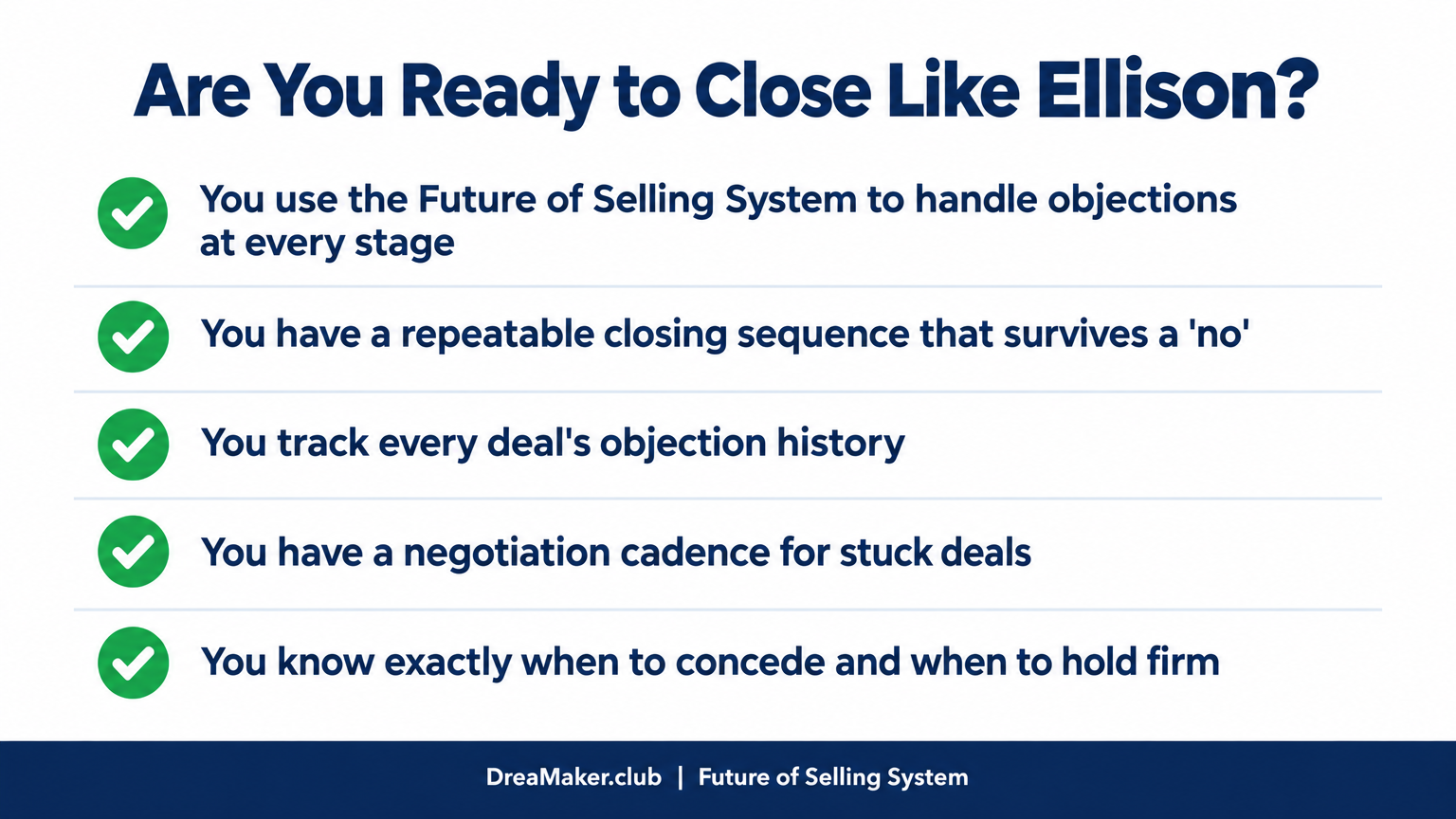
Condition 1 — You use the Future of Selling System to handle objections and re-engage silent deals at every stage of your pipeline.
Without a structured system, re-engagement feels like pestering. With it, every follow-up has a purpose, a tone, and a trigger. This is the foundation everything else rests on.
Condition 2 — You have mapped every stalled deal's last objection and prepared a superior response.
Ellison did not re-approach with the same offer. He studied what did not work and returned with something the buyer could not ignore. Do you know why each deal stalled — and have you prepared a sharper response?
Condition 3 — You have a closing sequence that survives multiple rounds of no without losing confidence or urgency.
A closing sequence is not a follow-up email. It is a multi-touch, multi-channel sequence designed to carry a deal through friction. If yours is send a polite email and hope, it will not survive 8 rejections.
Condition 4 — You treat Q4 year-end budget pressure as a re-engagement trigger, not background noise.
Q4 is the highest-velocity closing window of the year for US-market founders. Every deal that stalled in Q3 deserves a structured re-engagement this month — before budgets close and pipelines freeze again until February.
NEW! • October 2026
Dear Founders,
Your best deal is not dead — you just stopped selling the moment the room went quiet.
I have heard that from hundreds of founders. They feel it — the guilt of a pipeline full of deals they gave up on because no one taught them what to do when a buyer goes silent. What I found is that silence is not rejection. It is the gap where a structured closing sequence wins.
According to the Salesforce State of Sales report, 76% of sales professionals say their biggest challenge is closing deals — not finding leads. The pipeline exists. The closing system does not.
Since 2015, Jason has worked with 1,000+ startup founders leading their own sales in the US market. Combined graduate sales: $22M+. Jeffrey Teo generated 63 customers in 100 days. Stanley Tan closed 45 buyers in 3 hours. Leon closed a $2M partnership using the exact re-engagement sequence inside the Future of Selling System.
The Future of Selling System gives you the structured closing sequences, objection scripts, and re-engagement playbooks to turn silent deals into signed contracts — for $19/month. That is $0.63/day.
Get the Future of Selling System — $19/month$0.63/day. Cancel anytime. Built for startup founders with a team of 5+ in the US market.
Not ready for $19? Start free.
The Objection Playbook: 25 Word-for-Word Scripts to Close More Sales
The exact words Jason's founders use when a buyer says too expensive, send me info or I need to think about it. Free PDF, sent to your inbox.
Send Me the 25 ScriptsDavid Ellison already moved. The only question is whether you will — or whether you will read about someone else who did.


