Billionaire Elon Musk Lost $36 Billion Overnight — And Was Back By Morning. Here's What Every Founder Is Missing
Billionaire Elon Musk Lost $36 Billion Overnight — And Was Back By Morning. Here's What Every Founder Is Missing
Elon Musk lost $36.4 billion in a single trading day on October 8, 2026 — the largest single-day wealth loss ever recorded for any individual in financial history.
He was knocked below the $1 trillion mark. The press declared the end of his trillionaire status. By the next morning, he had reclaimed $22 billion. By Friday, he was back at $1.012 trillion.
Most founders read this and thought: “That’s a SpaceX story.” They missed the only part that matters to their business. Completely.
This Is Closer to Your Business Than You Think
Here is what happened on the day Musk lost $36 billion: he was in Washington DC attending the Golden Age of American Innovation Summit. He was not watching the ticker. He was not refreshing his net worth. He was not on the phone trying to stop the bleeding.
He showed up. He spoke. His system kept running.
Now think about your last bad month. A deal fell through. A client churned. A prospect ghosted you after three calls. What happened to your pipeline while you were processing that? What happened to your team’s momentum while you were deciding whether to regroup or panic?
If the answer is: “It slowed down. It stopped. We waited for me.” — that is not a bad-luck problem. That is a system problem. And it is costing you far more proportionally than $36 billion cost Musk.
The gap between founders who recover fast and founders who spiral is not intelligence, resilience, or even capital. It is whether the business runs on a system — or on the founder’s daily emotional state.
What Actually Happened — And What the Numbers Say
On October 8, 2026, Tesla shares fell approximately 2% and SpaceX’s private valuation dropped on reports that the company planned to raise up to $40 billion in new funding to purchase Nvidia chips for its Grok AI division — a move that spooked investors over dilution risk. The combined effect wiped $36.4 billion from Musk’s net worth in a single session, dropping his fortune to $991.6 billion (Forbes Real Time Billionaires, October 8, 2026).
By the morning of October 9, Tesla’s China sales data showed a 5% year-on-year increase in deliveries, and SpaceX secured a key spectrum agreement for Starlink Mobile. His net worth recovered to $1.012 trillion within hours — a $22 billion swing in one morning (Forbes and Yahoo Finance, October 9, 2026).
In a 2026 interview with Peter Diamandis (Fortune), Musk explained his own position on his wealth: “A ‘trillionaire’ refers to a stake in one of the companies I’ve founded, not cash sitting in a bank account.”
That quote is doing far more work than most people realise. Billionaire Elon Musk’s move is one Jason has seen across 1,000+ founders. Here’s what most miss.
The Lesson — And The Root Cause Most Founders Never See
Most founders think the problem is that they had a bad month. The real problem is that their business has no system that runs independently of how they feel about that month.
Musk’s $36 billion loss recovered overnight — not because he worked harder the next morning, not because he made sixty follow-up calls, not because he hustled his way back. It recovered because Tesla’s China delivery machine kept running. Because Starlink’s deal pipeline kept moving. Because the systems underneath the valuation were not dependent on Musk’s daily presence to function.
That is the counter-intuitive lesson: the founders who recover fastest from their worst losses are not the most resilient people. They are the ones whose systems are more resilient than their worst outcome.
Now look at your sales process. When you lose a deal, does your pipeline still move? Or does it freeze while you regroup? When your best salesperson has a bad week, does the team’s output collapse — or does the system carry them? When you’re unavailable for three days, does revenue slow down — or does it continue because the selling process doesn’t require you to be in every room?
The root cause is this: most early-stage founders build a selling habit, not a selling system. A habit requires the person. A system requires only the process. When the habit-founder has a bad day, the business feels it. When the system-founder has a bad day, the business doesn’t notice.
Founder Story
Stanley Tan, a graduate of Jason’s Future of Selling System, closed 45 buyers in 3 hours — not because he had a perfect day, but because the system handled the mechanics. He was not improvising. He was running a process. When one conversation went sideways, the next one started fresh because the system did not carry the emotional residue of the previous outcome.
The system absorbed the variance. Stanley didn’t have to.
The Hidden Opportunity — And Whether You Are Positioned to Take It
The hidden opportunity right now is not Musk’s recovery story. The opportunity is the gap it exposes in your business.
Most of your competitors are watching this story as entertainment. They will post something on LinkedIn about resilience and move on. The founders who extract the real lesson will do one thing differently: they will stop asking “How do I close more deals?” and start asking “How do I build a system that closes deals when I am not at my best?”
That question — that single reframe — is worth six figures to most founders within 12 months. Because it changes what you build next. Instead of hiring one more salesperson who operates on instinct, you build the system they run on. Instead of coaching your team every morning, you install the process that coaches itself.
The window to build this before Q1 2027 pipeline pressure arrives is now. Founders who install their selling system in Q4 enter Q1 with momentum. Founders who wait enter Q1 rebuilding from scratch — again.
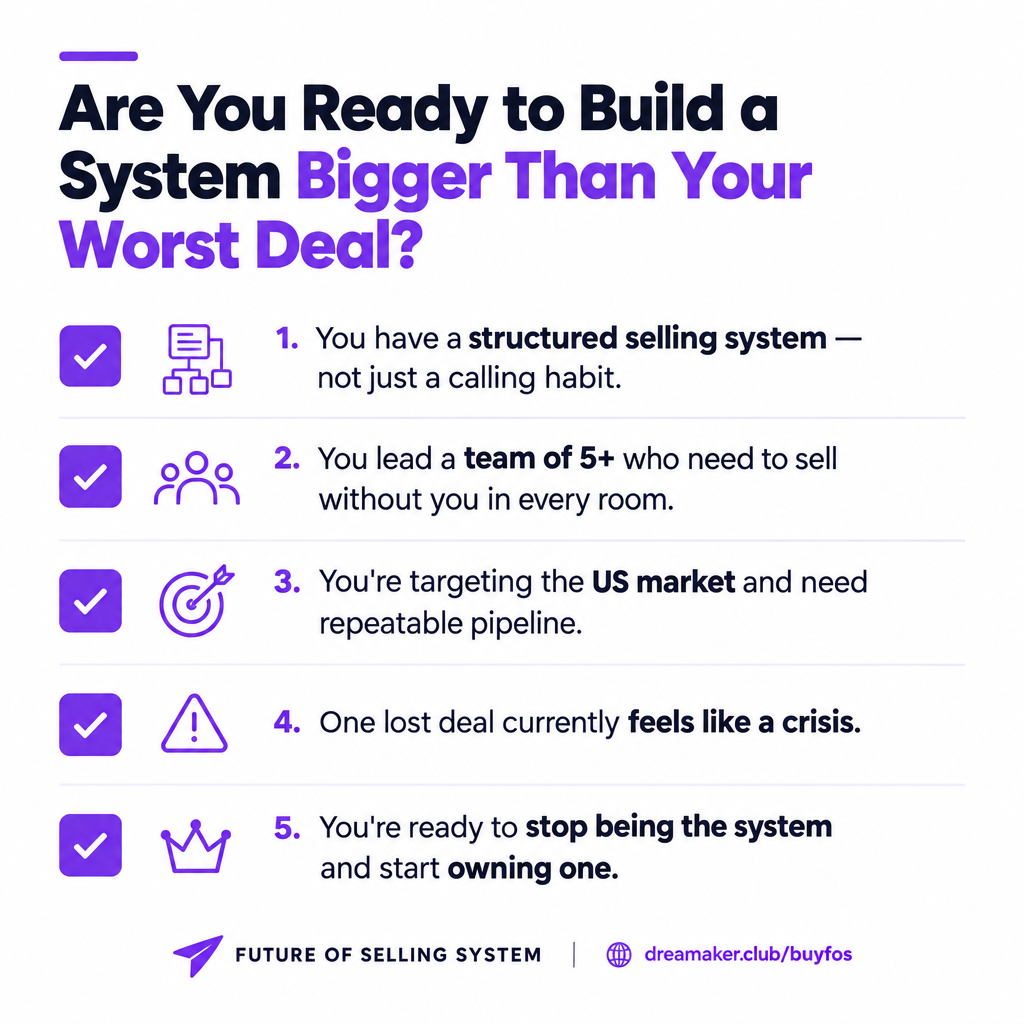
Are you ready? Check which conditions apply:
You are ready if:
- ✅ Condition 1 — You want a structured selling system: You are ready to replace your ad hoc selling habit with a repeatable process your whole team can run. The Future of Selling System is where you start.
- ✅ Condition 2 — You lead a team of 5 or more: You have people who need to sell without you in every room — and right now they rely on your energy, your presence, and your close. That is the bottleneck.
- ✅ Condition 3 — One lost deal currently feels like a crisis: When a big deal falls through, the whole team feels it. Pipeline stalls. Motivation dips. The business doesn’t shrug it off because there is no system underneath to carry the load.
- ✅ Condition 4 — You are targeting the US market: You need repeatable pipeline from US buyers — and you know that what worked in your home market won’t automatically transfer without a structured approach.
- ✅ Condition 5 — Q4 is your turning point: You are done waiting for the perfect moment. You want to enter 2027 with a system already running — not starting from zero in January.
NEW! → October 2026
Dear Founders — Stop Being The System. Own One.
The pain anchor: Every time you lose a deal and your whole pipeline slows down while you recover — that is not a sales problem. That is a system problem. And it will keep costing you every single quarter until you fix it.
I have heard this from founders across 1,000+ engagements since 2015. They felt exactly the same — one lost deal, one bad week, one team slump, and the whole business felt it. Then they found the Future of Selling System. What they found: a structured, repeatable selling process that their team could run with or without the founder in the room.
And the numbers back this up: 76% of salespeople say they don’t have the right tools or processes to hit their targets (Salesforce State of Sales, 2026). That means your competitors are running on instinct right now. The founders who install a system in Q4 will own Q1.
What FOS graduates have built:
- $22M+ in combined sales by FOS graduates
- 1,000+ founders trained since 2015
- Jeffrey Teo: 63 customers in 100 days
- Stanley Tan: 45 buyers in 3 hours
- Leon: $2M partnership closed using the FOS framework
Not ready for $19? Start free.
The Objection Playbook: 25 Word-for-Word Scripts to Close More Sales
The exact words Jason’s founders use when a buyer says “too expensive”, “send me info” or “I need to think about it”. Free PDF, sent to your inbox.
Send Me the 25 ScriptsElon Musk already moved. The only question is whether you will — or whether you’ll read about someone else who did.


