Billionaire Elon Musk Just Proved Every Founder Wrong — And Most Won't Understand Why
breakingnews, billionaire Elon Musk, startup sales system
Billionaire Elon Musk Just Proved Every Founder Wrong — And Most Won't Understand Why
September 21, 2026: SpaceX’s AI revenue is colliding with a $22B index shock, and the real story isn’t the stock — it’s the sales play every serious founder is about to miss unless they change how they choose what business they’re really in.
Part 1 — The Hook
On August 12, 2026, Elon Musk told SpaceX employees that the company’s AI revenue would exceed all other SpaceX revenue in September. Today, September 21, 2026, SpaceX’s weight in the Nasdaq‑100 more than doubled, forcing up to $22 billion of passive buying into his stock — and quietly confirming that his bet on AI wasn’t a prediction, it was a prepared sales pipeline coming due on schedule.
Part 2 — The Press: Why This Hits Founders Where It Hurts
If you’re a founder leading your own sales, what happened today is not just a market headline. It’s a live demonstration of what happens when a CEO stops optimizing the business they started and starts selling into the business their capabilities actually deserve.
Most teams reading this will treat it as “SpaceX news.” They’ll go back to tweaking outbound scripts, pushing for one more demo, and fighting over the same customers as every other startup in their category. They’ll miss that Musk just used a different startup sales system entirely — one designed to close a higher-value game before consensus even forms around it.
This is the pressure point: while you’re trying to win a slightly bigger slice of your current market, Musk is using AI infrastructure contracts and index mechanics to change what market he’s even playing in. The gap between those two mindsets is where most founders lose years — and eventually, the company.
Part 3 — The Play: What Billionaire Elon Musk Actually Did
Start with the hard numbers. SpaceX went public in June 2026 at $135 per share, in one of the largest IPOs in history, raising roughly $75–85 billion in proceeds earmarked heavily for AI and compute infrastructure (SEC filings; TechCrunch, June 2026). The market still mostly called it a “rocket company.”
By Q2 2026, revenue hit $7.81 billion, up 91.9% year-over-year (Blockonomi / InvestorPlace, August 2026). Inside that, the AI segment alone generated $2.6 billion — up 247% year-over-year (InvestorPlace, August 2026). SpaceX’s CFO guided to $100 billion in annual recurring revenue by December 2026 (CoinCentral, August 2026), a number that only makes sense if you accept that the real business is now AI infrastructure, not launches.
The customer list backs it up. Google signed a reported $920 million per month AI compute deal with SpaceX (InvestorPlace, September 2026). Anthropic followed with a multi‑billion dollar AI compute agreement (InvestorPlace, August 2026). To feed this, SpaceX spent $15.8 billion on AI capex in Q2 2026 alone — compared with just $463 million in all of 2023 (Yahoo Finance, September 2026). That’s not an experiment; that’s a full‑scale repositioning of the company’s core offer and infrastructure before the market fully priced it in.
On August 12, 2026, at a CNBC‑covered all‑hands, Musk told employees: “Probably our AI revenue — not probably, definitely — our AI revenue will exceed all other SpaceX revenue probably in September, like next month” (CNBC / Motley Fool). He also said, “AI will account for 99% of SpaceX’s value within five years” (BigGo Finance) and “The future is fundamentally AI and robots” (247 Wall St., August 2026). Today, September 21, 2026, that conviction shows up in the market structure itself: SpaceX’s Nasdaq‑100 weight jumps from 1.28% to 2.82%, triggering an estimated $15.5–$22 billion in forced passive buying (Bloomberg / Yahoo Finance / FlyOnWallStreet, September 2026).
InvestorPlace is already calling this “Elon Musk’s AWS moment,” explicitly comparing the SpaceX AI pivot to Jeff Bezos’ decision to turn Amazon from an online retailer into the world’s cloud infrastructure backbone. Billionaire Elon Musk is following the same pattern Jeff Bezos and Larry Page rode to hundreds of billions: build the rails everyone else’s AI runs on, then let the world pay you rent. Elon Musk’s move is one Jason has seen across 1,000+ founders and 15+ industries. Here’s what most miss.
Part 4 — The Lesson and the Root Cause Reframe
Most founders think the problem is “We’re losing market share to competitors.” But what Musk’s move actually reveals is that the real problem is most founders are optimizing the wrong business. They’re perfecting their current offer while the highest‑value game is already available to them — they just don’t have a startup sales system capable of identifying and closing what comes next. That distinction changes everything.
Musk didn’t wait for the market to reclassify SpaceX. He built the infrastructure, signed Google and Anthropic before consensus, then told his own employees that AI would eclipse rockets within weeks. The Nasdaq‑100 rebalance is just the financial echo of a sales decision he made years earlier: sell the capability behind the rockets, not just the launches themselves.
Jeff Bezos did the same thing. Amazon wasn’t “just” a bookstore; it was an excuse to build logistics and compute infrastructure that the rest of the internet would one day rent. When Amazon finally broke AWS out as its own line item in 2015, the world realized the online store had been a Trojan horse for a much bigger business. As Bezos told Fortune in 2026, “If you take a step back, all civilizational wealth is driven by invention.” The invention wasn’t the website; it was the infrastructure and the pricing model behind it.
Larry Page is playing the same game from the buyer side. Alphabet’s CEO is now paying roughly $920 million per month to SpaceX for AI compute, despite Google’s own massive data centers. He understands that when you’re in an arms race for AI dominance, you don’t argue with new railroads; you buy capacity. That decision helped propel his net worth to a reported $298 billion by September 19, 2026 (Bloomberg Billionaires Index), overtaking Jeff Bezos after Google’s Gemini 3 launch in 2025.
Here’s the quotable lesson every founder should write on the inside of their notebook:
The money is never at the table where you started; it’s at the table your capabilities can access next — and your sales system is the only thing that moves you there in time.
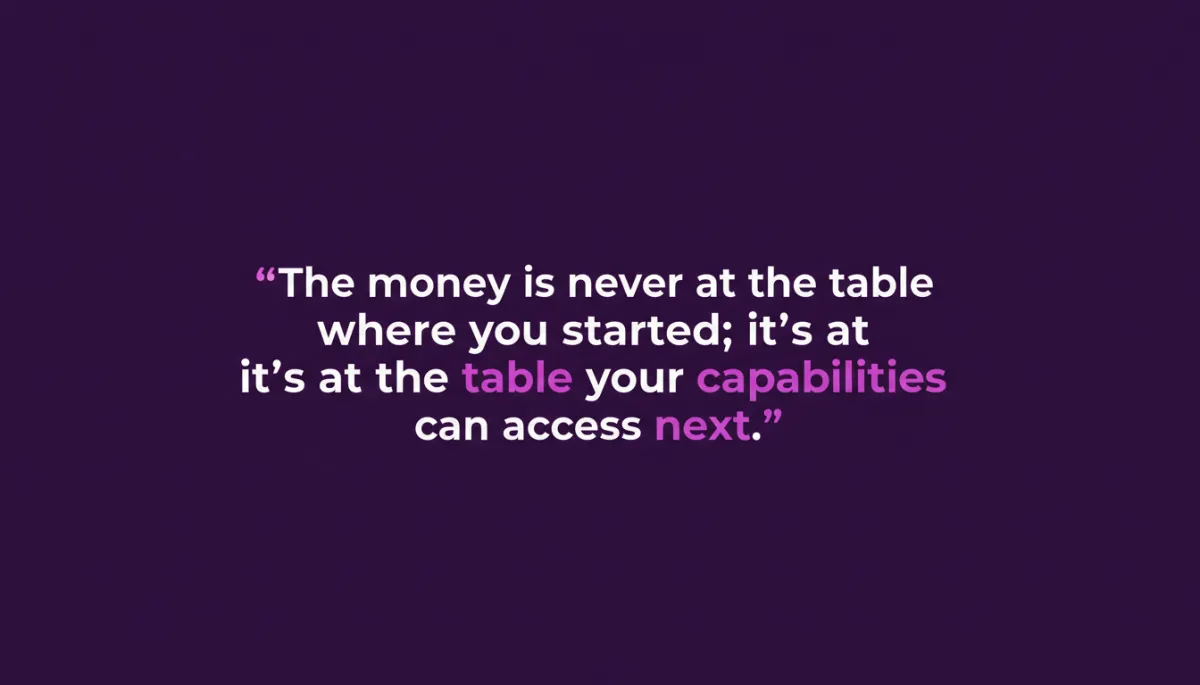
Magazine editorial, cinematic lighting, purple #7c3aed accent, bold centered quote on solid...
Founder Story
Founder A built a solid SaaS tool for agencies and spent four years polishing features, rewriting onboarding, and squeezing a few extra percentage points out of their funnel. Every quarter, the team told themselves, “Once we ship this next release, growth will unlock.” Revenue climbed slowly, but churn stayed stubborn. Competitors multiplied. By year five, they were trapped: too big to pivot easily, too small to dictate the market. They had optimized the wrong table into a dead end.
Founder B started in the same niche, but kept asking a different question: “What are our best customers trying to do that nobody is priced to solve yet?” Instead of just selling licenses, they noticed their top 5% of clients were quietly using the product as a data exhaust layer for their own AI models. That insight became a new, high‑ticket infrastructure offer — a private data and workflow backbone for AI deployments. Within 18 months, that offer was 70% of revenue.
The difference wasn’t product quality. It was that Founder B built a selling system to discover and close the next table while Founder A kept perfecting the first one. The founders who win are the ones who treat sales as a search engine for higher‑value games, not just a way to push their current offer harder.
How do you identify the highest‑value business opportunity before your competitors?
Musk’s play gives you a concrete answer. You don’t wait for the market to tell you. You use your sales conversations as a live research lab: which customers are already stretching your product into infrastructure? Who is asking for volume, exclusivity, or guarantees that go beyond your current pricing? Those are the early signals of the “next table” your capabilities can serve.
A real sales mindset for founders treats every call, every RFP, and every “crazy” inbound request as data about where the higher‑value game is forming. Musk followed that data: from launches, to Starlink bandwidth, to AI compute. The infrastructure was being built anyway; the sales system turned it into a category‑defining business.
Part 5 — The Opportunity and the Conditions
The founders who see this first will quietly reposition their companies into the highest‑payout version of their market and lock in pricing power while everyone else is still fighting over today’s demand. The ones who don’t will spend the next three years perfecting offers that the market has already decided are utilities — bought on price, churned on convenience, and forgotten when the next infrastructure layer shows up.
What separates founders who pivot successfully from those who miss the window?
It isn’t courage alone. It’s whether they’ve built a startup growth strategy that includes a deliberate selling system for testing and closing new games before they’re obvious. Musk didn’t “bet” on AI in August. By the time he told employees AI revenue would exceed everything else in September, he already had Google and Anthropic under contract and $15.8 billion in AI capex deployed. The pivot was locked in; the announcement just synchronized the narrative with the numbers.
Why do most startup founders keep selling into the wrong market?
Because their sales process is built to defend their current category, not to discover the next one. Their decks, ICP definitions, and KPIs all assume that the “right” move is to win a bigger share of the existing pie. So even when evidence of a bigger game shows up — a customer asking for infrastructure‑level commitments, a partner wanting revenue share, an enterprise asking for exclusivity — they treat it as an edge case instead of the main event.
✅ To Capture This Opportunity — You Need:
- ☐ 1. Future of Selling System — Your ability to identify the highest‑value game only matters if you can close it; FOS gives you the sales system to pitch, convert, and capture the market others haven’t priced in yet.
- ☐ 2. Pattern recognition — The ability to see the next game before consensus forms, the way Musk saw AI as SpaceX’s real future while headlines still called it a rocket company.
- ☐ 3. Speed to reposition — The discipline to reorient offers, pricing, and go‑to‑market fast, before the window where early movers have pricing power closes.
- ☐ 4. Infrastructure before demand — The willingness to build capability and distribution ahead of obvious demand, so that when the market wakes up, you’re already the default.
- ☐ 5. Narrative control — The skill to change the story you tell the market so they stop seeing you as “just” a product and start paying you like infrastructure.
The window this news created won't stay open. Condition 1 is the one you can activate right now.

Most founders satisfy conditions 2–5 by accident; condition 1 has to be built on purpose.
Part 6 — Native Ad: The Future of Selling System
Sponsored
The Future of Selling System
While most founders compete for the same customers in the same market, Musk quietly repositioned the world's dominant launch provider into the world's most valuable AI infrastructure company — the gap between “competing for today” and “owning tomorrow” is exactly what FOS was built to close. FOS gives startup founders the selling system to identify and close their highest-value game — the same system that helped Jeffrey Teo close 63 customers in 100 days, Stanley Tan close 45 buyers in 3 hours, and Leon build a $2M partnership. For $0.63/day.
Get FOS for $0.63/Day →Part 7 — The Sting
Elon Musk already moved — twice, on the same day. The only question is whether you'll read about the next move, or whether you'll be making one of your own.


