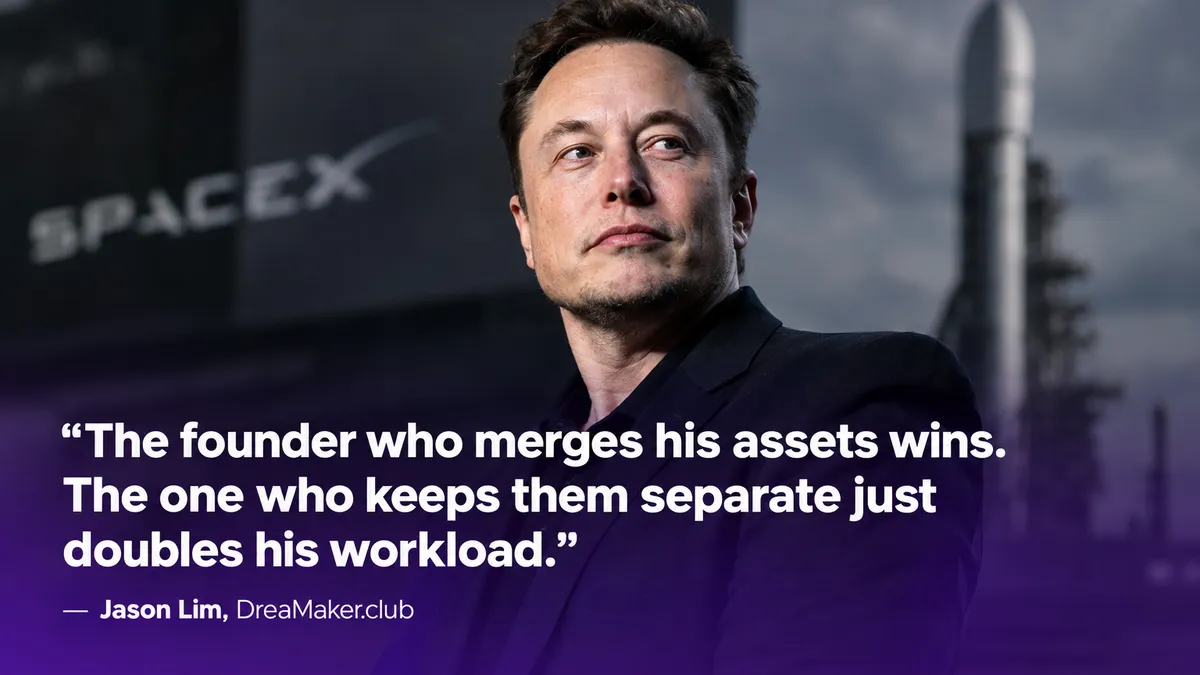
Billionaire Elon Musk Just Made His Car Fly With a Rocket — And It Changes Everything For Founders Selling Two Products Separately
Image: DreaMaker.club / AuthorJason.com
Billionaire Elon Musk Just Made His Car Fly With a Rocket — And It Changes Everything For Founders Selling Two Products Separately
By Jason Lim | DreaMaker.club | October 18, 2026
Elon Musk just made a Tesla fly using SpaceX rockets. Now a reported merger of his two biggest companies may be just weeks away. Most founders saw a stunt. They missed the lesson worth billions.
On the night of October 15, 2026, at SpaceX's rocket test site in McGregor, Texas, Musk unveiled the long-delayed Tesla Roadster — a white two-seater that drove upside-down using suction, fired cold-gas SpaceX thrusters to launch off a ramp, flipped in midair, and landed on its wheels before jumping over a truck. The crowd went wild. The internet went viral. Almost everyone missed what was actually happening on stage.
The same week, according to Yahoo Finance (October 16, 2026), Barclays analyst Dan Levy told Investor's Business Daily that a rumoured merger of Musk's two most valuable companies — SpaceX and Tesla — could be just weeks away, calling it a potential megadeal. If it closes, analysts predict Musk's net worth could reach or exceed $2 trillion.
Musk is not making a flying car. He is integrating two trillion-dollar systems into one compounding entity. And that is the lesson hiding inside this story that almost every founder will miss.
This Isn't About the Car. It's About What You're Leaving Separate.
Think about your own business for a moment. How many products, services, or offers are you running right now? Two? Three? And how many of them have their own separate sales motion — different messaging, different pitch, different follow-up sequence, different buyer journey?
Most founders treat each product like an independent island. You close Customer A on Product 1, then go back to zero and start again to pitch them Product 2. You build two pipelines. You manage two sets of objections. You run two separate conversations with the same buyer — who, by the way, is wondering why your left hand doesn't seem to know what your right hand is doing.
That is not a portfolio. That is exhaustion with extra steps.
Musk spent years being mocked for running Tesla and SpaceX in parallel. Critics said he was overextended. They said two moonshots couldn't coexist in one man's attention. What they didn't see — and what the flying Roadster proved on a livestream watched by millions — is that he was never running them in parallel. He was quietly integrating them. The moment they merged, two separate trillion-dollar assets became one compounding system. And your buyers are watching the same thing play out in your pitch — wondering when your offers will finally make sense together.
The Facts — And What They Actually Mean
Here is what is on record, cited and verifiable:
- On October 15, 2026, Musk unveiled the second-generation Tesla Roadster at SpaceX's McGregor, Texas facility in a live event that was streamed globally. The car used a fan-based suction system to drive upside down and SpaceX-developed cold-gas thrusters to launch, flip, and land. Musk told the crowd: "Turns out the future does have flying cars" — as reported by Fox Business (October 15, 2026). Production is set for 2028. (Forbes, CBS News, October 2026.)
- The "Rocket" model with the full flight system will be offered by invitation only and is not approved for public road use, per Tesla's own website as reported by CBS News (October 2026).
- A rumoured SpaceX-Tesla merger may be just weeks away, per Barclays analyst Dan Levy, who told Investor's Business Daily this could push Musk's net worth toward $2 trillion — reported by Yahoo Finance (October 16, 2026).
- As of October 16, 2026, Forbes pegs Musk's net worth at $908.5 billion, making him the world's richest person by a factor of more than 2x over second-place Jeff Bezos at $369.8 billion. (Forbes Real-Time Billionaires, October 16, 2026.)
- SpaceX went public on the Nasdaq in June 2026, briefly valuing the company at nearly $2 trillion at the close of its first trading day, making Musk the first trillionaire in world history. (Forbes, June 2026.)
- Musk described the Roadster as "what happens when you have a collaboration with the world's best car company and the world's best rocket company" — referring to Tesla and SpaceX, as reported by MSN/Agence France-Presse (October 17, 2026).
Musk didn't build two companies. He built two assets that were always designed to merge — and now, if the reported deal closes, the integration becomes official. Billionaire Elon Musk's move is one Jason has seen in 20+ years of coaching. Here's what most miss.
The Lesson Most Founders Never Extract
Beat 1 — Root Cause Reframe
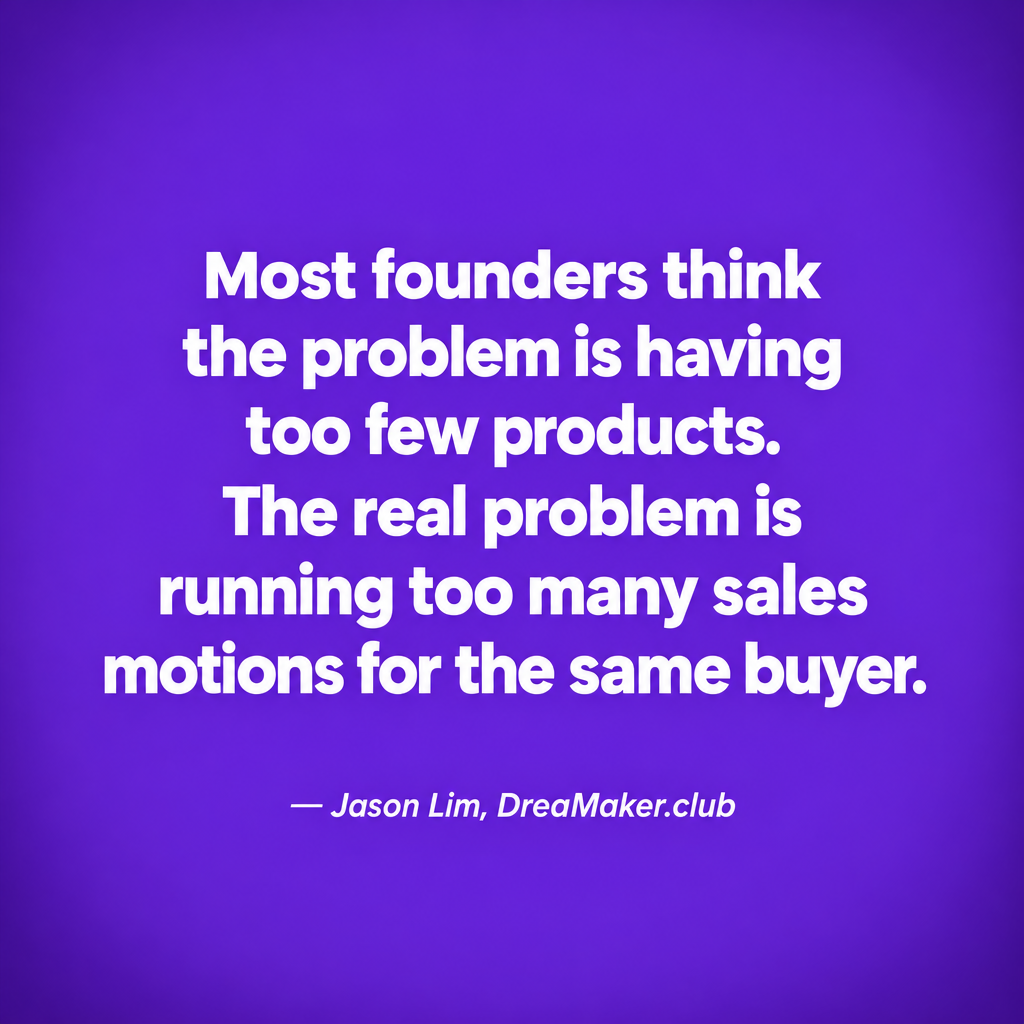
Most founders think the problem is having too few products.
So they add another offer. They launch a new service line. They build a second product. And then they run twice as hard — with two separate pitches, two separate follow-up sequences, two separate sets of objections to handle — for the same buyer who is increasingly confused about what they actually sell.
But the real problem is running too many sales motions for the same buyer.
Every disconnected product you add to your portfolio without a unified selling system is not an asset — it's a liability. Because your buyer doesn't experience your portfolio. They experience your sales conversation. And if that conversation doesn't make your full offer stack feel like one integrated answer to one deep problem, they don't buy more from you. They buy less — and they go find someone who made things simple.
Musk didn't accidentally stumble into a flying car. SpaceX's thruster technology was always going to end up in a Tesla. The integration was the point. The two companies were always designed to make each other more valuable — not to compete for his attention, not to dilute each other's market, but to compound into something neither could be alone.
That is the architecture of a winning portfolio. And it starts with having a single, coherent system underneath everything you sell.
Beat 2 — The Lesson
The quotable truth for every founder reading this: "The founder who integrates his assets wins. The one who keeps them separate just doubles his overhead."
Founder Story Card
Leon — From Stalled Growth to a $2M Partnership in Under 90 Days
Leon ran two separate offers — and sold them like two separate companies. His pipeline was chaotic, his follow-up was inconsistent, and his buyers kept going quiet. When he stopped selling products and started selling a unified system — one integrated answer to one deep problem — a $2 million partnership materialised in under 90 days. The product didn't change. The system underneath it did.
Same story. Different system. Completely different result.
The Hidden Opportunity — And Whether You're Ready For It
Beat 1 — The Hidden Opportunity
Here is what Musk's move quietly unlocks for every startup founder paying attention:
When two assets integrate, the sum becomes greater than the parts. A buyer who buys your Product 1 under a unified selling system becomes a faster, warmer buyer for Product 2 — because the system already positioned them as a natural next step. You don't start from zero. You compound.
This is the most under-leveraged opportunity in founder-led sales right now: the multi-offer integration play. Most founders have two or three legitimate offers. Almost none of them have a selling system that makes those offers feel like one coherent journey to the buyer. That gap — between what you sell and how unified your selling system is — is where revenue is leaking every single week.
The founders who close this gap in the next 90 days will compound. The ones who don't will keep working twice as hard for half the result.
Beat 2 — Are You Ready to Compound Your Offers?
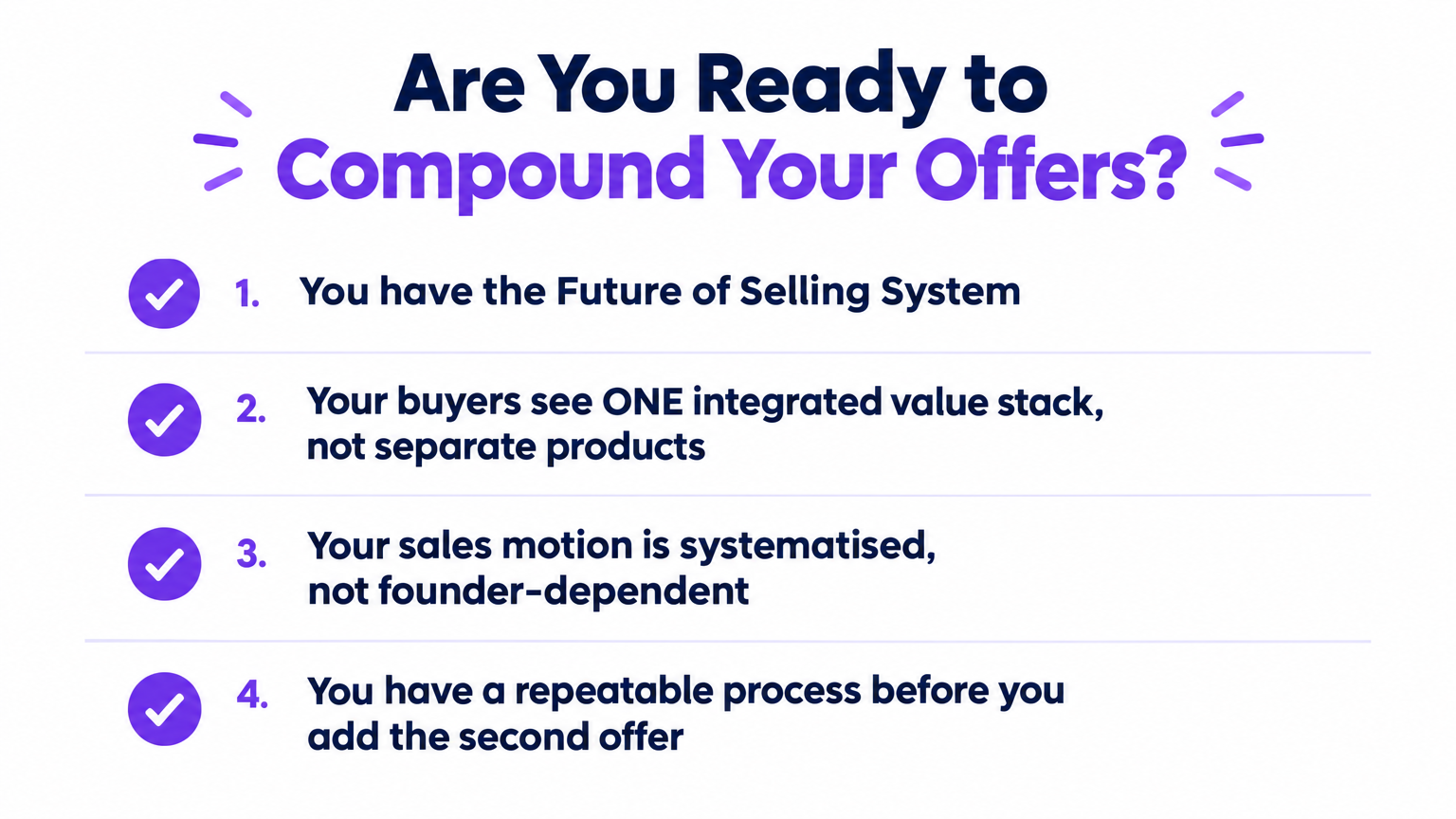
Check these four conditions honestly:
✅ Condition 1 — You have the Future of Selling System
Before you integrate two offers, you need one unified selling system underneath both. Without it, you're just duct-taping two broken pipelines together. The Future of Selling System (FOS) is the prerequisite — it's the architecture that makes integration possible and compounding inevitable. Without FOS, adding a second offer just doubles your chaos.
✅ Condition 2 — Your buyers see ONE integrated value stack, not separate products
When you pitch your second offer to an existing customer, does it feel like a natural upgrade or a completely different conversation? If they hesitate — if they say "I didn't know you did that" — your offers are islands. Integration means your buyer experiences one continuous journey, not two separate pitches.
✅ Condition 3 — Your sales motion is systematised, not founder-dependent
If your entire selling process lives in your head — if the pipeline only moves when you personally move it — you cannot compound. Integration requires a system that runs independent of your daily presence. When you're not in the room, the motion should continue.
✅ Condition 4 — You have a repeatable process before you add the second offer
A second offer on top of a chaotic first offer just creates twice the confusion. Musk spent years making SpaceX work before the thruster technology was ready to integrate into Tesla. If your first offer's sales process is still unpredictable, adding a second one is not a growth strategy — it's an expansion of the problem.
If you checked all four: you're ready to compound. If you didn't: Condition 1 is where you start.
NEW! → October 2026
Dear Founders — If your two biggest offers are running on two separate sales motions, you're not compounding. You're just getting twice as tired.
I've seen it 1,000+ times. A founder with two great products. Two separate pipelines. Two sets of objections. Two follow-up sequences. One exhausted team. The products are fine. The system underneath them is broken.
I felt that. I've felt it myself. And so have hundreds of the founders I've worked with. What I found — and what our 1,000+ graduates found — is that the selling system is always the missing piece. Not the products. The system.
According to Salesforce's State of Sales report, 76% of sales professionals say that selling in teams is key to their business — yet most founders are still selling alone, without a repeatable system, with no integration between their offers.
Here is what the Future of Selling System has produced:
- $22M+ in combined sales by graduates
- 100,000+ founders reached at events across Asia since 2016
- Jeffrey Teo — 63 customers in 100 days
- Leon — $2M partnership unlocked in under 90 days
Not ready for $19? Start free.
The Objection Playbook: 25 Word-for-Word Scripts to Close More Sales
The exact words Jason's founders use when a buyer says "too expensive", "send me info" or "I need to think about it". Free PDF, sent to your inbox.
Send Me the 25 ScriptsElon Musk already moved. The only question is whether you will — or whether you'll read about someone else who did.


