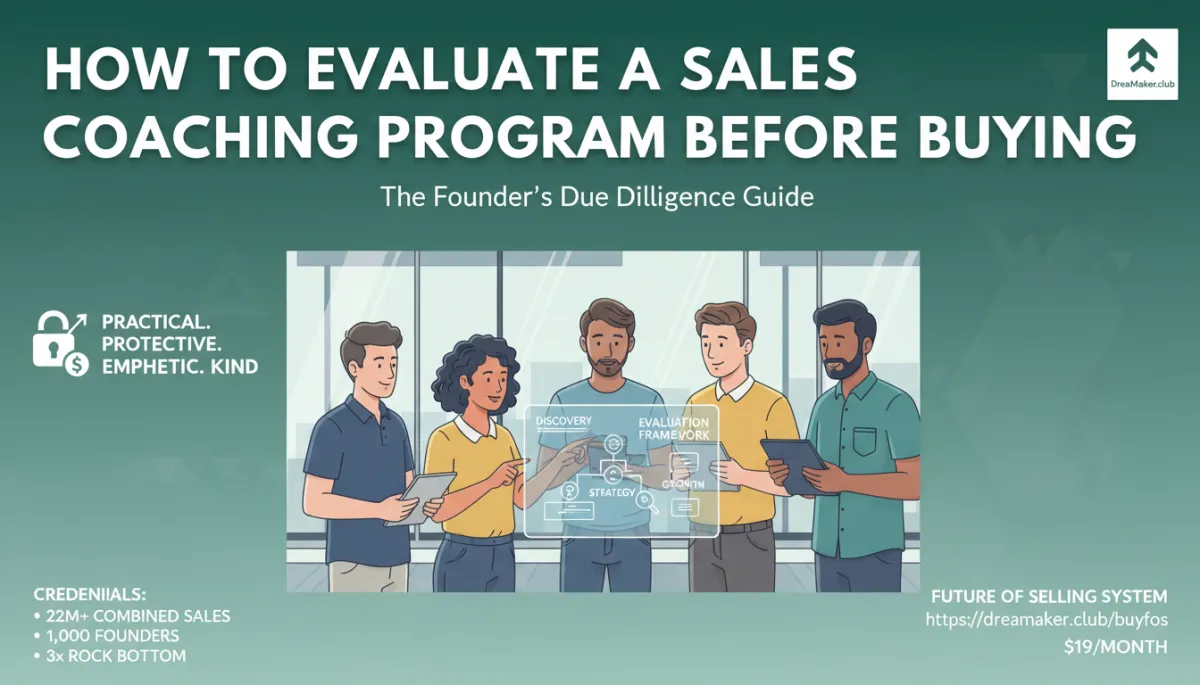
Evaluate Sales Coaching: Founder's Due Diligence
Sales Coaching, Founder Due Diligence
How to Evaluate a Sales Coaching Program Before Buying — The Founder's Due Diligence Guide (Inspired by Billionaire Jeff Bezos)
For startup founders with a growing team, the difference between a sales coaching program that quietly transforms your revenue and one that ends in refund requests and resentment is what you do before you buy. This guide walks you through a practical, protective, and empathetic evaluation process so you can invest with clear eyes, not crossed fingers.
What Jeff Bezos's Working Backwards Method Teaches About Evaluating a Programme
When Bezos greenlit new initiatives at Amazon, he didn’t start with the product. He started with a future press release: a clear, specific description of what success would look like for the customer once the product already existed. Only then did the team earn the right to build it. The lesson for you as a founder is simple and protective: evaluation should happen before commitment, not after the money is gone.
When you’re figuring out how to evaluate a sales coaching program before buying, imagine you are writing the “press release” for your own company six months after the program ends. What has changed? How does your sales pipeline look? How are your reps behaving differently? How do you, as founder, feel about your sales engine? This “working backwards” vision becomes your filter for every promise, testimonial, and guarantee you see on a sales page or in a discovery call.
If the coach cannot articulate how their process leads to your imagined future, that’s a red flag. If they avoid specifics, dismiss your concerns, or over-index on “mindset” while under-explaining the actual sales process and implementation, that’s another. Bezos’s method protects you from buying a story that cannot survive contact with your calendar, your team, or your cash runway. You’re not just buying motivation; you’re buying repeatable sales behavior that must show up in your P&L.
The 5-Step Evaluation Framework for Founders
- Read the refund policy word for word before anything else
This is the most unsexy but protective step. Before you let yourself get excited about promises, bonuses, or limited-time discounts, scroll straight to the refund and cancellation section. Read it slowly, line by line. Ask yourself:
• Is the language clear or intentionally vague?
• Are the conditions reasonable for a busy founder with a team?
• Is there a fair path to exit if the program truly isn’t a fit?
A fair policy signals confidence and integrity. A maze of conditions, hidden deadlines, or “no exceptions” language is often a preview of how conflict will be handled later. Your goal is to evaluate a sales coaching program as a long-term relationship, not a one-time transaction. - Ask for 3 client references at your exact business stage
As a founder with a team of 5+ people, you don’t need generic success stories; you need proof from companies that look like yours. Ask the coach for three founders who:
• Have a similar team size and sales cycle
• Sell at similar price points (not just low-ticket courses)
• Were at a comparable revenue stage when they joined
When you speak with them, go beyond “Did you like it?” Ask what changed in their pipeline metrics, close rates, and team behavior. This is real sales coaching program due diligence founders often skip because they feel rushed. You are allowed to slow down. - Request a sample session or content before full payment
You wouldn’t hire a sales leader without seeing them in action. The same applies here. Ask for:
• A replay of a coaching call (with client permission and anonymity where needed)
• A sample module or playbook your team would actually use
• A short live “test” session where you bring a real deal or pipeline issue
As you watch, notice: Do they give practical, field-tested guidance, or just motivational soundbites? Do they respect your time and context? A serious provider will welcome this request because they know it reduces buyer’s remorse and improves fit. - Research the coach independently — not just their own testimonials
Your goal is to triangulate the truth. Look for:
• Long-form interviews or articles where they explain their philosophy
• Guest content on reputable platforms (e.g., Harvard Business Review or Forbes)
• How they respond publicly to criticism or hard questions
This step protects you from polished funnels that hide a thin or outdated methodology. When you evaluate a sales coaching program this way, you’re checking for depth, not just volume of content. - Ask the disqualifying question: “Why would your programme NOT be right for me?”
This one question reveals more than any highlight reel. A grounded coach will be able to list specific scenarios where their program is not a fit — for example, if you have no product–market fit, no sales capacity, or you refuse to track metrics. If they insist they can help “anyone,” be careful. You want someone who protects your runway as much as their reputation, not someone who treats your startup like a quota win.
How do I know if a sales coaching program is legit?
Look for alignment between claims and structure. A legit provider shows you their process, not just their personality. They can map how your team will move from current numbers to target numbers, week by week. They welcome questions about metrics, implementation, and failure scenarios. Most importantly, they don’t pressure you to decide today. They understand that serious founders do serious due diligence.
What red flags should founders watch for before buying sales coaching?
Red flags include: income screenshots without context, guarantees that ignore your stage, refusal to provide references, or blaming past clients for poor results without owning any responsibility. Another subtle red flag is excessive focus on the coach’s lifestyle instead of their clients’ systems. You are not buying a personality brand; you are investing in repeatable behavior change for your sales team.
How long should I expect to see results from a sales coaching program?
For most founders with a team of 5+ and an existing pipeline, you should see leading indicators (more qualified conversations, cleaner follow-up, clearer offers) within 30–60 days, and meaningful revenue shifts within one to three sales cycles. Any program promising overnight miracles is either naïve or manipulative. Sustainable sales improvement feels like building a stronger engine, not scratching a lottery ticket.

Slowing down your evaluation process protects your team, runway, and future options.
What Jason Uses as His Personal Evaluation Criteria
Jason has helped generate over $22M in combined sales and supported 1,000+ founders since 2015. He has also hit rock bottom three times and climbed back three times. That history makes him deeply protective of founders’ cash and confidence. When he evaluates any program — including his own — he uses four simple criteria you can borrow immediately:
- Outcome clarity: Can we define, in one sentence, what “success” looks like in 90 days?
- Fit with current stage: Does the program assume a team, pipeline, or budget we don’t actually have yet?
- Integrity under pressure: How does the coach talk about clients who struggled or left? Do they blame or share responsibility?
- Support structure: Is there enough touchpoint frequency and implementation help for a busy founder-led team?
These filters help you evaluate a sales coaching program without getting hypnotized by charisma. They also reflect the spirit of the parent pillar at DreaMaker.club on how to choose a coach or mentor: strategy first, survival always.
The Future of Selling System and the P.I.T.C.H. Formula
Jason built the Future of Selling System (FOS) to give founders a practical, founder-friendly way to install modern sales habits across a small team. At the heart of FOS is the P.I.T.C.H. Formula, a simple structure that helps your team move from awkward, scattered conversations to clear, respectful, and effective sales calls. Instead of pushing scripts, it focuses on principles your team can adapt to different markets and personalities.
When founders apply the same due diligence framework you’ve just learned to FOS, they often comment on three things: the clarity of expectations, the grounded refund and exit terms, and the way the program acknowledges real-life constraints — school runs, investor meetings, hiring fires — instead of pretending every week is perfectly calm. That empathy is deliberate. Jason remembers what it feels like to stare at a runway spreadsheet at 2 a.m. and wonder if the next sales bet will save you or sink you.

Involving your team early makes any sales coaching investment more effective and sustainable.
Tier 1 Results: What Happens When Evaluation and Execution Align
Jason is careful about sharing client stories; they’re real people with real payrolls, not trophies. But it’s also important for you, as a founder, to see what’s possible when thoughtful evaluation meets committed implementation. Here are three Tier 1 cases from founders who did their homework before joining and then showed up fully once they were in:
- Tan — $29,693 in 16 days: Tan came in with a small but warm audience and a history of under-charging. After carefully checking refund terms and speaking with two existing clients, Tan committed to implementing one core offer structure and a simple daily outreach rhythm. In just 16 days, that clarity turned into $29,693 in booked revenue — not from gimmicks, but from consistent, respectful follow-up.
- Teo — 63 customers in 100 days: Teo’s team was talented but scattered. Before joining, Teo requested sample content, asked hard questions about stage fit, and clarified expectations around team involvement. Once inside, they implemented a simple weekly review cadence and a shared language for calls. Over 100 days, that structure produced 63 new customers and a calmer, more confident team.
- Leon — from $2.5K to $2M+: Leon had been stuck at around $2.5K/month for longer than he liked. He used the exact 5-step framework in this article to evaluate FOS, including asking, “When would this not work for me?” Once satisfied, he committed to one playbook for a full year. That decision — made slowly, then executed consistently — helped him cross $2M+ in revenue over time.
These stories are not promises; they are possibilities when a founder treats sales coaching as a serious, evaluated investment rather than a last-minute rescue. Your numbers will be your own. What you can copy, though, is the mindset: protect your downside, understand the process, and then give it a fair, focused run.
You don’t need a perfect sales coach; you need a grounded process, a safe decision, and the courage to follow through once you’ve chosen.


