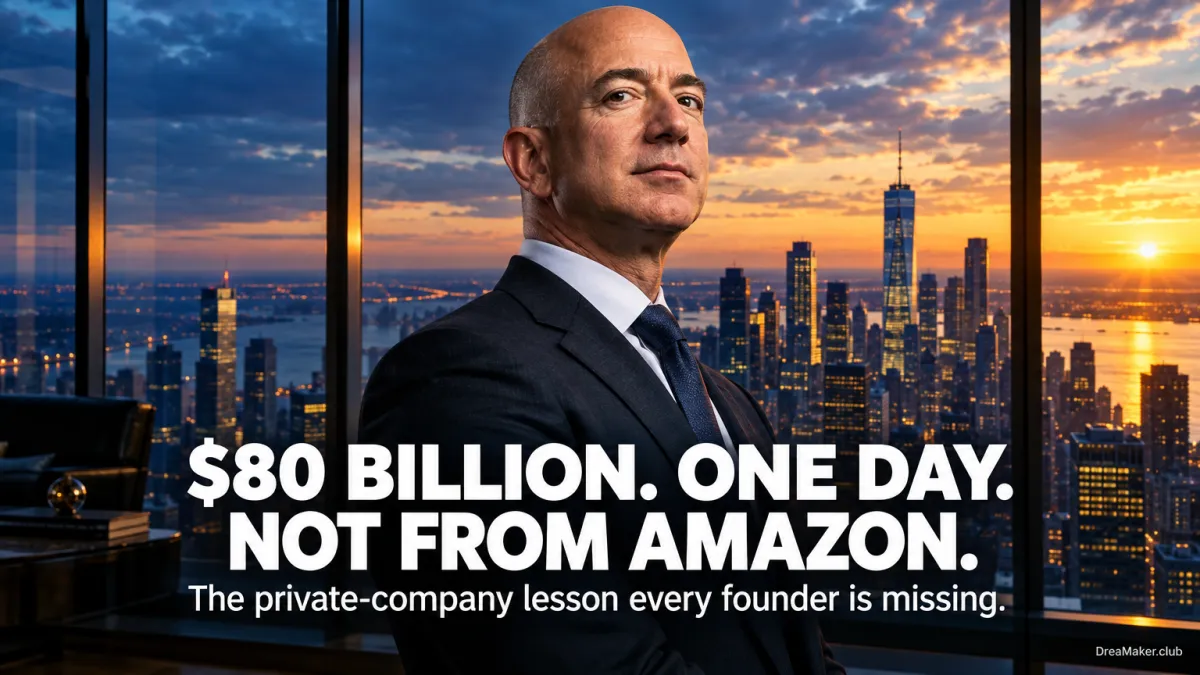
Billionaire Jeff Bezos Just Added $102 Billion Without Selling a Single Share — And It Changes Everything For Startup Founders
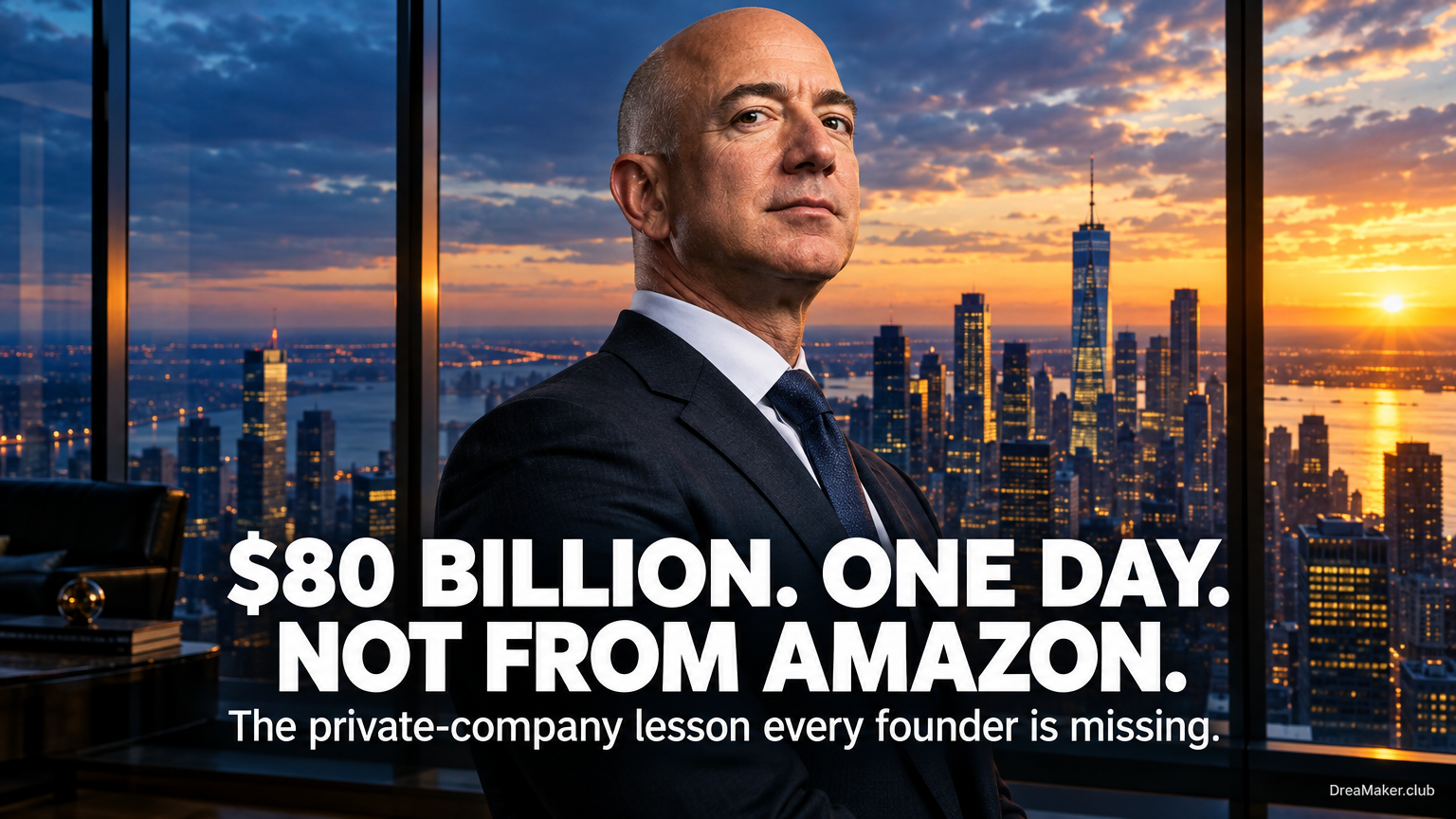
Billionaire Jeff Bezos Just Added $102 Billion Without Selling a Single Share — And It Changes Everything For Startup Founders
Jeff Bezos just gained $102 billion in a single month. Amazon had nothing to do with it.
While the press scrambled to explain his wealth surge, they missed the real story entirely. The media reported the number. Nobody reported the lesson underneath it — the one that determines whether a founder builds a business or builds a legacy.
If you are a startup founder leading your own sales right now, this story is not about Bezos. It is about the window you are either entering — or quietly closing.
Most Founders Are Working Harder Than Bezos — And Building Far Less
Think about your week. You sent proposals. You followed up. You sat in discovery calls. You chased a deal that went cold. You stayed late because the pipeline needed attention. Sound familiar?
Now consider what Bezos did last month. He did not close a single B2B deal. He did not personally pitch an investor. He did not sit on a call explaining his product roadmap. His private companies — Blue Origin and Prometheus — were valued upward by the market. $102 billion landed in his column without a single sales conversation that he had to run.
That gap is not talent. That is not luck. That is architecture. And every founder who is still personally closing every deal is missing the same architectural decision Bezos made years before the $102 billion showed up.
What Actually Happened — The Numbers Behind the Story
According to Forbes' top-10 richest ranking (October 2026), Jeff Bezos' fortune surged by an estimated $102 billion in September 2026 alone — pushing his net worth to $370 billion and moving him past Alphabet co-founder Larry Page to become the second-richest person on the planet, behind only Elon Musk at $1.02 trillion (Bloomberg Billionaires Index, October 8, 2026).
The gain came entirely from two private companies that do not trade on any public stock exchange (Yahoo Finance, October 2026):
- Blue Origin — the aerospace company Bezos founded in 2000, recently valued at $130–140 billion in its first-ever outside funding round, with Coatue Management expected to lead with a $4 billion commitment (Bloomberg, October 8, 2026).
- Prometheus — the AI startup Bezos co-founded in 2025, which raised $12 billion at a $41 billion valuation in June 2026. Prometheus employs approximately 150 people and is building what its founders describe as an "artificial general engineer" (Axios, 2026). Bezos holds approximately 35% of the company (Bloomberg Billionaires Index, 2026).
None of the $102 billion came from Amazon stock movements or corporate deal-making (Yahoo Finance, October 2026). Bezos stepped down as Amazon CEO in 2021. For five years, while he was not running Amazon's day-to-day, he was building the engines that would add $102 billion in a single month.
Billionaire Jeff Bezos' move is one Jason has seen echoed across 1,000+ founders. Here's what most miss.
The Lesson Most Founders Will Never Learn In Time
Beat 1 — Root Cause Reframe
Most founders think the problem is that they need more leads, a better pitch, or a stronger close rate. But the real problem is this: they have built a business that requires them to sell — and they have never built the system that sells without them.
Bezos did not stumble into $102 billion of private wealth. He ran Amazon for 27 years on the basis of relentless systems-thinking — processes, metrics, leadership layers, and mechanisms that compounded independently of his personal time. By the time he stepped back as CEO, those systems were running without him. That freed him to build Blue Origin seriously. Then Prometheus. His time was no longer consumed keeping the first engine alive — it was being invested into the second and third.
Most founders never get there. Not because they are not smart enough. Because they never installed the system that makes the first engine self-running. Every deal still depends on them personally. Every follow-up still depends on them. Every close still depends on their availability, their energy, their bandwidth. That is not a business. That is a job with a business card.
Beat 2 — The Lesson
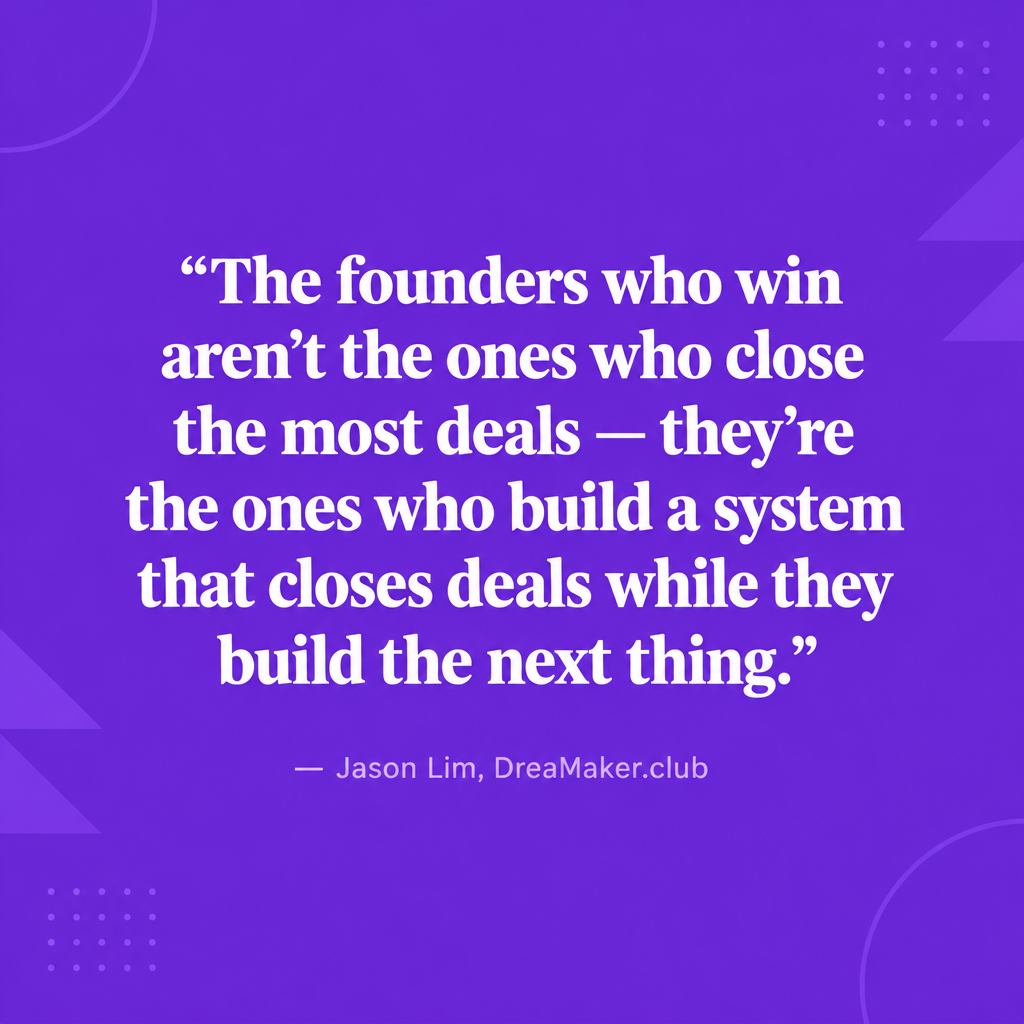
"The founders who win aren't the ones who close the most deals — they're the ones who build a system that closes deals while they build the next thing."
Bezos could build Blue Origin and Prometheus because Amazon's sales, logistics, and revenue engine was no longer dependent on his personal involvement. The compounding wealth you see in October 2026 is not September's work. It is the result of decades of system-building that freed his time to place asymmetric bets.
Founder Story
Stanley Tan closed 45 buyers in 3 hours.
Stanley was personally closing every single deal — running on fumes, unable to step away from the pipeline for even a week. After installing the Future of Selling System, he ran a single structured sales session and closed 45 buyers in under 3 hours. Not because he got better at selling. Because he finally had a system that did the heavy lifting. His next move? Building the second revenue stream he had been postponing for two years.
The Hidden Opportunity Sitting Right In Front of Founders Right Now
Beat 1 — Hidden Opportunity
Tom Callahan, CEO of Nasdaq Private Market, wrote in the firm's 2026 Outlook that "the biggest fortunes of this generation are increasingly being built away from public exchanges" — and that "some of the most consequential wealth creation of our era is happening in the private markets." (Nasdaq Private Market Secondary Scene 2026 Outlook).
The SEC's Q3 2025 Private Fund Statistics report put aggregate private fund gross asset value near $27 trillion. Private markets are no longer a billionaire-only club — they are the arena where compounding happens. But here is the catch that nobody talks about: you cannot enter that arena while you are still personally closing every deal in your business. You are too busy. You are too needed. You have not built the system that replaces your presence at the revenue layer.
The opportunity is not "invest in private markets." The opportunity is this: founders who install a repeatable sales system now are the ones who free their time to build a second engine before it is too late. Bezos built that system inside Amazon first. The $102 billion is what happens when the second engine ignites.
Beat 2 — Are you in position to make your next move? Check the conditions:
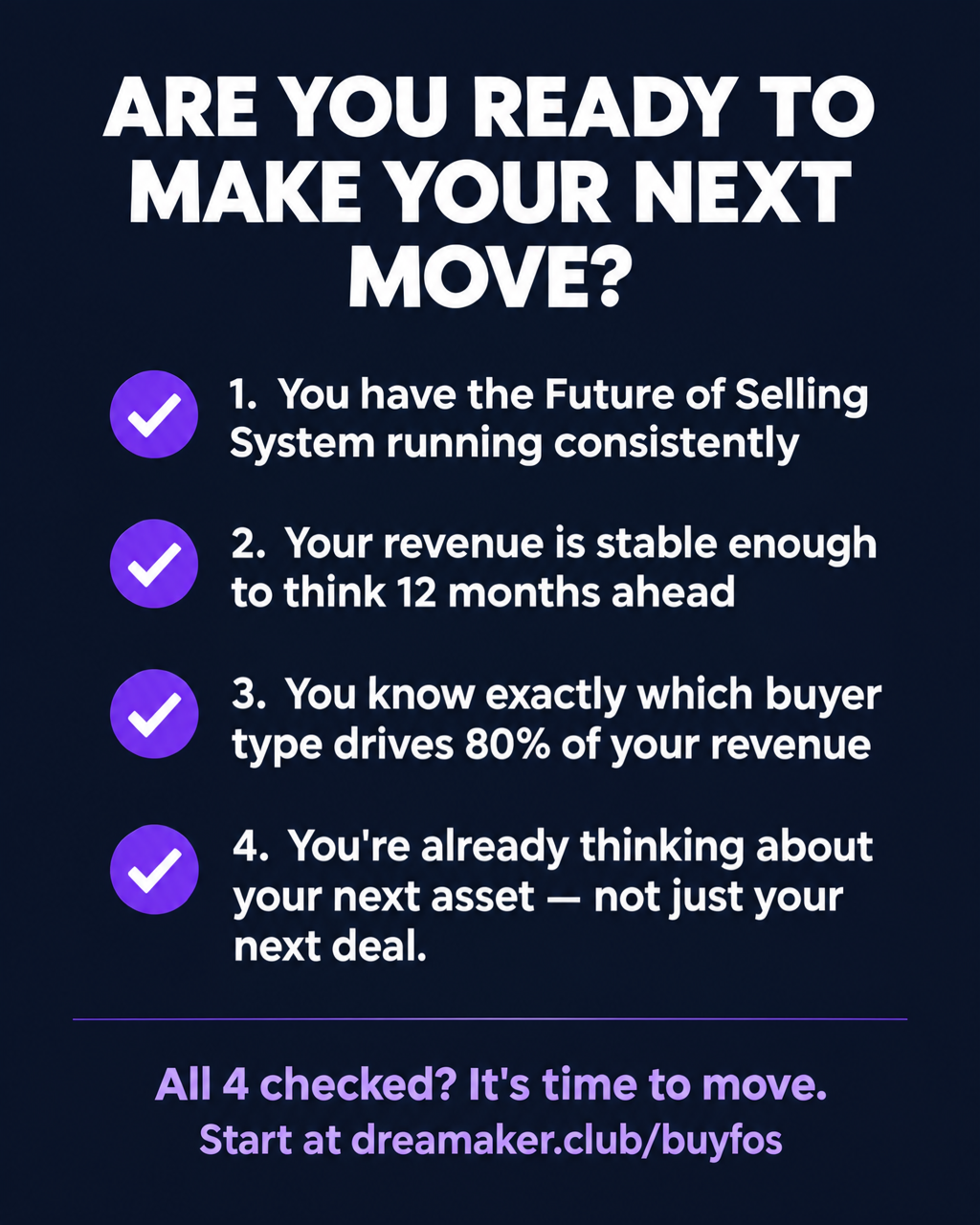
Are You Ready To Make Your Next Move?
Condition 1: You have the Future of Selling System running consistently — your pipeline is being worked by a repeatable process, not your personal heroics.
Condition 2: Your revenue is stable enough to think 12 months ahead — you are not in survival mode, chasing the next deal just to make payroll.
Condition 3: You know exactly which buyer type drives 80% of your revenue — and your system is built to find and close more of them without you reinventing the pitch every time.
Condition 4: You are already thinking about your next asset — not just your next deal. The second engine is on your whiteboard, even if it is not yet funded.
All 4 checked? The next move starts at dreamaker.club/buyfos.
NEW!
October 2026
Dear Founders,
If you are still the single point of failure in every deal your company closes — if your revenue stops every time you go on holiday, get sick, or just run out of energy — you are not running a business. You are running a trap. And Bezos' $102 billion month just made the cost of staying in that trap impossible to ignore.
I've felt it too. I know what it means to be the only one who can close — to carry the entire pipeline in your head and your calendar. Then I found what 1,000+ founders have now found.
Salesforce's State of Sales report found that 76% of sales reps say selling has fundamentally changed, yet most startup founders are still using the same improvised, founder-dependent approach they used on day one. There is a better way.
The Future of Selling System has generated $22M+ in combined sales by graduates. Jeffrey Teo signed 63 customers in 100 days. Stanley Tan closed 45 buyers in 3 hours. Leon closed a $2M partnership. Not because they got lucky — because they had a system.
Start today at dreamaker.club/buyfos
Not ready for $19? Start free.
The Objection Playbook: 25 Word-for-Word Scripts to Close More Sales
The exact words Jason's founders use when a buyer says "too expensive", "send me info" or "I need to think about it". Free PDF, sent to your inbox.
Send Me the 25 ScriptsBezos already moved — and the $102 billion shows exactly what happens when a founder builds the system first. The only question is whether you will — or whether you'll read about someone else who did.


