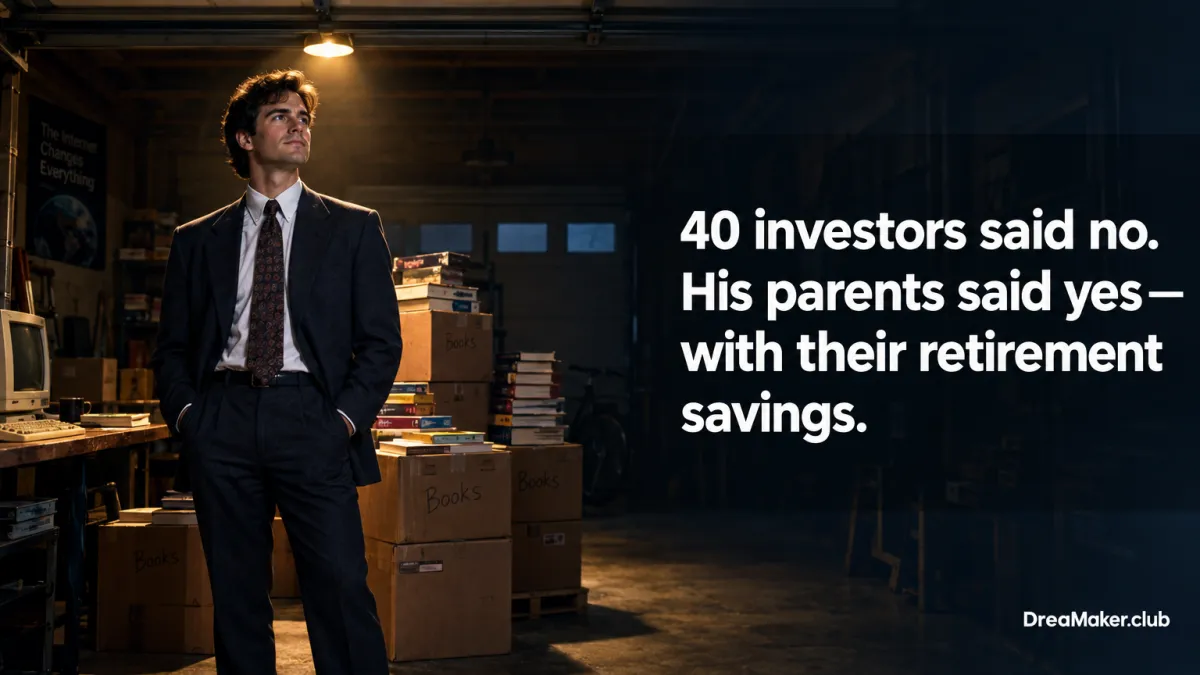
Jeff Bezos pitched 60 investors, heard 38 no's, then asked his parents to bet their retirement on a 70% chance of losing everything — and they said yes.
That sequence is being widely covered today following a Fortune report published September 22, 2026, revisiting the 1997 Amazon prospectus that documented the exact dollar amount Mike and Jackie Bezos staked on their son: $245,573 — nearly five times the $50,000 per-investor minimum he was asking for. What the coverage is missing is the lesson that actually matters to you as a founder. It's not about persistence. It's about something far more uncomfortable.
This Story Is a Mirror, Not a Museum Piece
Every founder has been in a version of that garage. You've had the pitch. You've had the meeting. You've had the polite decline or — worse — the ghosted follow-up.
The version of this story being shared today reads like inspiration: Look how many people said no to Bezos. Keep going. But that framing lets you off the hook. It turns a high-stakes lesson in buyer psychology into a motivational poster.
The real question this story asks you isn't are you persistent enough? It's: Do the people you're pitching actually trust you enough to say yes — and have you given them the right conditions to do so?
Because the 38 people who said no to Bezos weren't wrong about the odds. He told them himself there was a 70% chance they'd lose their money. They made a rational decision. His parents made a different kind of decision — and understanding the difference between those two decisions is worth more than any amount of persistence advice.
What Actually Happened in 1994
In 1994, Bezos held 60 separate pitch meetings seeking to raise $1 million, asking for $50,000 minimum investments from family, friends, and prospective investors, according to CNBC. Out of those 60 meetings, only 22 people agreed to invest — meaning 38 passed.
His parents, Mike and Jackie Bezos, were among the yes votes. According to a 1997 SEC prospectus cited by Fortune (September 22, 2026), they invested $245,573 — a sum the prospectus described as a "large fraction" of their life savings at the time. That was nearly five times what Bezos was asking each investor to contribute.
Before they wrote the cheque, Bezos made the risk explicit. As Mike Bezos recalled at a 2015 National Constitution Center event: "I want you to know how risky this is," Jeff told them, "because I want to come home at dinner for Thanksgiving and I don't want you to be mad at me." In the same Academy of Achievement interview, Bezos put the typical startup's chance of success at about 10%, and said he estimated Amazon's odds at 30% — meaning he was giving his own venture a 70% probability of failure.
His parents invested anyway. According to Fortune's September 22, 2026 calculations, if Mike Bezos still held the original 1.4 million shares, they would be worth an estimated $51.7 billion at today's stock price. Amazon shares have risen more than 208,000% since the 1997 IPO, and hit an all-time high of $287 per share last month, per Fortune.
Billionaire Jeff Bezos's move is one Jason has seen across 1,000+ founders. Here's what most miss.
The Real Lesson: It Was Never a Numbers Pitch
Most founders think the problem is that they didn't pitch enough investors. But the real problem is that they pitched the wrong people in the wrong order — before they had established the trust architecture that makes a yes possible.
Here is the quotable line that unlocks this whole story:
"The pitch didn't fail because the idea was wrong. It failed because the buyer couldn't see themselves saying yes."
Look at what Bezos actually did differently with his parents versus the 38 who said no. He didn't hide the risk. He led with it. He told his parents there was a 70% chance of total loss — not as a disclaimer buried in a pitch deck, but as an opening act of honesty designed to protect the relationship first and close the deal second.
That is the move almost every founder gets backwards. They soften the risk to make the pitch sound safer. In doing so, they destroy the very trust that would have made a yes possible. The investor sees the polish and thinks: What are they not telling me?
His parents said yes not because the numbers were good — by his own math they weren't. They said yes because of what Bezos said in an Academy of Achievement interview: his stepfather "wasn't making a bet on this company or this concept. He was making a bet on his son."
That is the distinction. The 38 people who passed were evaluating a business model for an internet bookstore in 1994. His parents were evaluating the person who had been accountable to them their entire life. The trust was already built. The sale was never really about Amazon. It was about a relationship that had been accumulating credibility for decades.
This is not a reason to go pitch only family. It is an instruction to build the kind of trust with every buyer — in every sales conversation — that makes them feel they are betting on you, not just on your product.
Founder Story Card
The visible problem: Bezos got 38 rejections from 60 investor meetings in 1994 trying to raise $1 million for Amazon.
The real root cause: Most of the 38 who passed were evaluating a risky concept they had no prior trust relationship with. They couldn't see themselves saying yes to the person, only to the idea — and the idea didn't clear the bar.
The founder lesson: Radical honesty about risk, delivered inside an existing trust relationship, converts better than a polished pitch delivered to strangers. Your buyers don't need perfect numbers. They need to believe in you — and you have to give them the conditions to do that.
The move to make now: Before your next pitch, ask: have I built enough trust with this buyer for them to bet on me — not just on my product? If not, don't pitch yet. Build the relationship first. Then pitch with full honesty about the risk.
The Hidden Opportunity Founders Are Missing Right Now
This story is breaking into the mainstream today because investors and founders alike are re-examining what makes early-stage bets work. Venture deal flow has tightened significantly in 2026. Institutional investors are leaning toward founders with established reputations and warm introductions over cold pitches. That is the same dynamic Bezos encountered in 1994, and the winners in that environment are not the founders with the slickest decks.
They are the founders who have learned to build trust before they ask for a decision — and who can communicate risk honestly without it killing the conversation.
If you are raising, selling, or closing right now, the opportunity is this: most of your competitors are still pitching strangers on logic. You can win by pitching believers on conviction. But to do that, you need the right conditions in place.
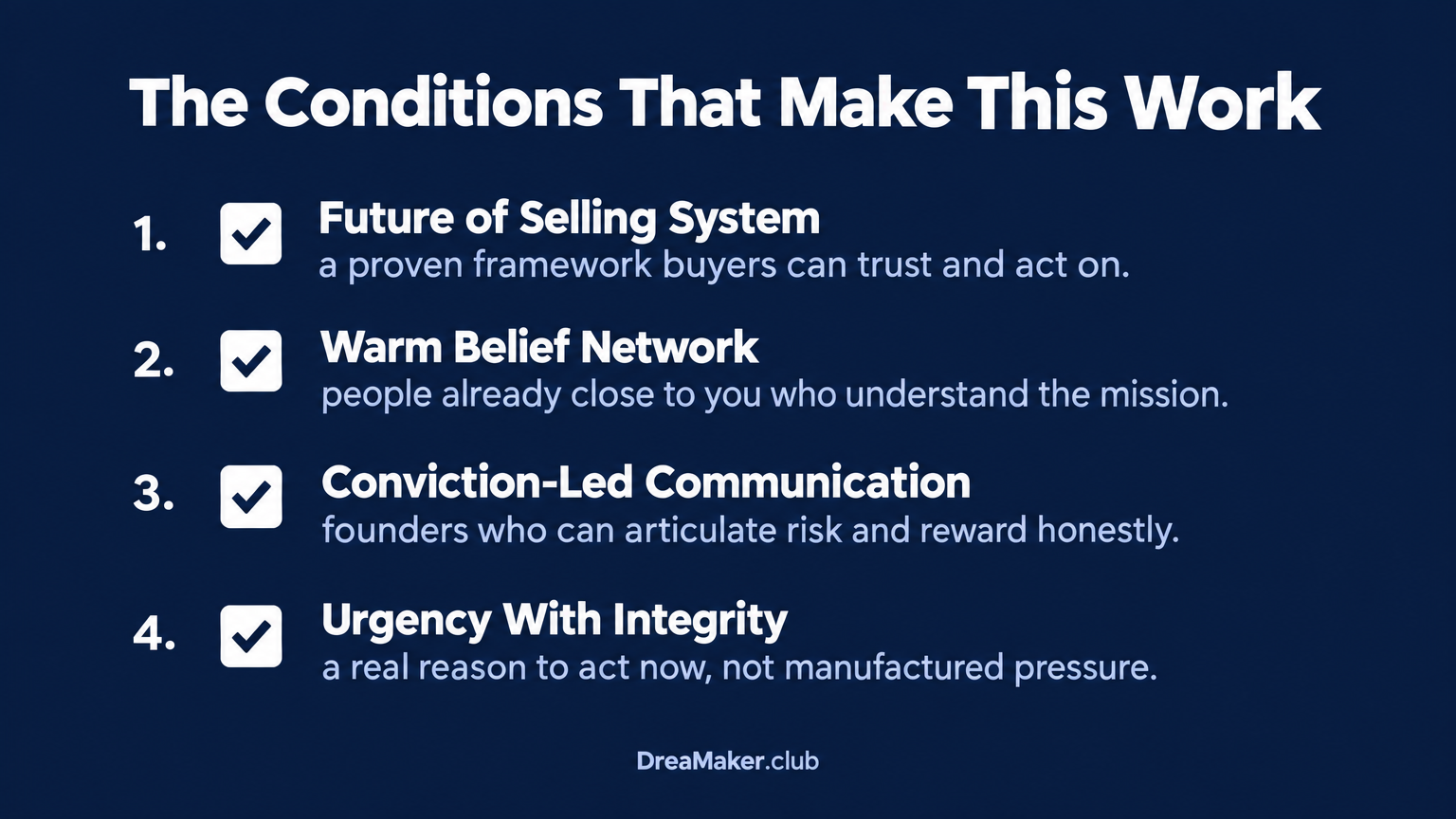
The Conditions That Make This Work
- Future of Selling System: A proven framework that teaches you how to position yourself, communicate risk honestly, and structure conversations so buyers can understand, believe, and act — without being pushed. This is the infrastructure that makes trust-based selling repeatable, not just lucky.
- Warm Belief Network: A deliberately cultivated inner circle of people — not just family, but colleagues, clients, and collaborators — who have seen you deliver. Bezos's parents weren't investing in Amazon; they were investing in a lifetime of observed character. You can build that same depth of trust with the right people over time.
- Conviction-Led Communication: The ability to name the risk before the buyer does, and frame it in a way that builds trust rather than destroys confidence. Bezos told his parents they would probably lose the money. That honesty is what made the yes credible.
- Urgency With Integrity: A genuine, specific reason to act now — tied to the real opportunity window, not manufactured scarcity. In 1994, the internet was moving fast and Bezos made sure his investors understood the timing stakes without exaggerating them.
Bezos's parents already moved — thirty years ago, on a 70% chance of losing everything. The only question is whether you will build the trust that earns that kind of yes — or whether you'll keep pitching strangers and wondering why they keep saying no.


