
How Billionaire Jeff Bezos Attracts High-Ticket Clients Without Cold Outreach
High-Ticket Sales, Inbound Acquisition, Startup Founders
How Billionaire Jeff Bezos Attracts High-Ticket Customers Without Cold Outreach — A Founder’s Guide to Building an Inbound Acquisition System
Jeff Bezos didn’t build AWS by begging IT directors for meetings. He designed a high-ticket customer acquisition strategy so the right buyers arrived almost pre-sold. Jason teaches founders how to borrow the same playbook — for just $19 a month.
Why Cold Outreach Rarely Works With High-Ticket Customers — And What Works Instead
Jason knows you’re not failing. You’re just tired of waking up to an empty calendar unless you keep pushing. One more cold email. One more LinkedIn message. One more round of “just following up.”
With low-ticket offers, that chase sometimes works. But high-ticket customers buy differently. Data from HubSpot and Forrester shows that inbound high-ticket buyers close at roughly 3× the rate of cold buyers and cost about 62% less to acquire. Most buyers now complete more than 60% of their research before speaking to any seller. They either arrive warm — or they never arrive at all.
When Jason looks at founders stuck at the same revenue level, he usually sees the same pattern. The founder is brilliant. The product is strong. But the acquisition system is still built on chasing, not on being chosen. The right customers never get a real chance to find the company, trust it, and choose it on their own terms.
The shift is simple to describe, even if it takes courage to execute. Stop trying to be everywhere. Become the obvious choice in one place. In one clearly defined problem space. For one specific type of buyer. With proof so specific that when they discover you, the decision already feels safe.
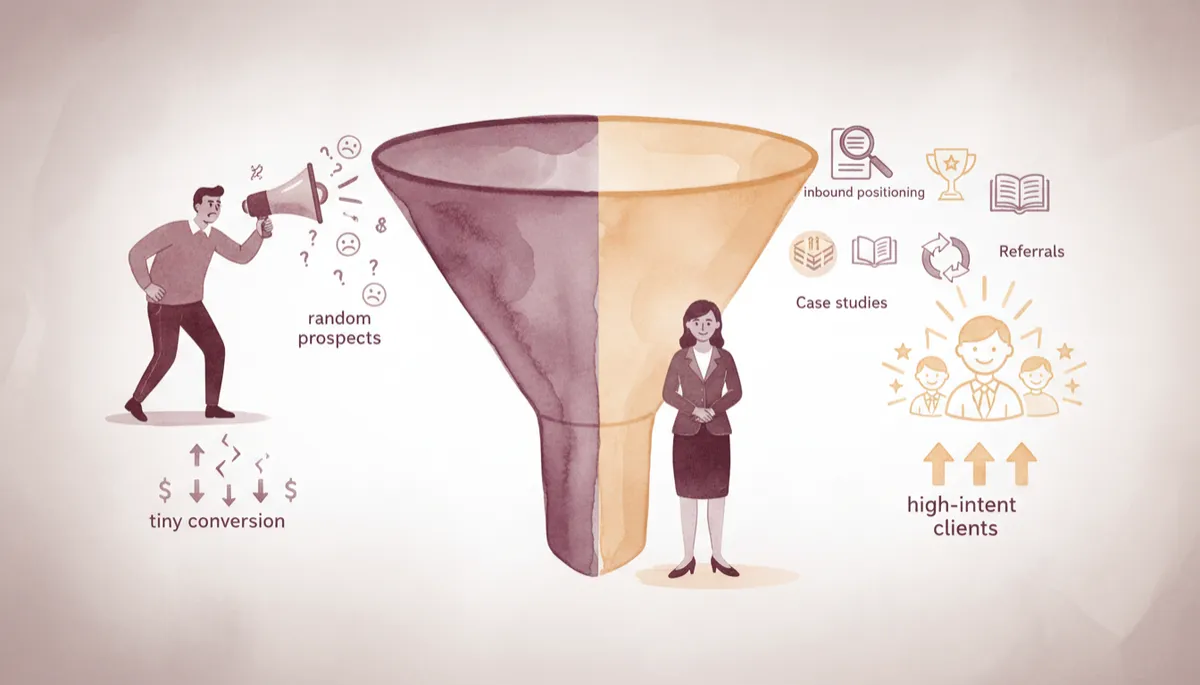
Inbound high-ticket customers close at 3× the rate of cold outreach and cost 62% less — while 78% of buyers finish most of their research before ever contacting you.
As Jason teaches at AuthorJason.com, high-ticket acquisition starts when you accept that one precisely sourced ideal buyer converts faster than a hundred poorly matched prospects sprayed at scale — and that the channel matters less than the credibility signal your positioning sends through it.
How Jeff Bezos Designed Amazon Web Services So Ideal Customers Came to Him
Jeff Bezos didn’t ask his sales team to flood IT directors’ inboxes. He asked a different question: “If the right CTO is already searching for a better way to scale infrastructure, what would make AWS the obvious answer they discover and trust?”
He used his famous “working backwards” principle. Start from the ideal customer experience. Picture the CTO or VP of Engineering, late at night, searching for reliability, cost control, and speed. Then build every touchpoint to serve that moment. World-class documentation. A generous free tier. Case studies that speak directly to the problems these leaders are trying to solve. Trials that feel safe, not salesy. Forrester notes that 78% of buyers in eight-figure deals use some kind of pre-commitment trial. Bezos saw that early.
In 2006, when Bezos launched S3 and EC2, the message was simple: “Pay only for what you use.” That usage-based pricing, combined with well-documented APIs, made CTOs at companies like Netflix and Airbnb comfortable trying AWS without a sales call. By 2009, Netflix had publicly announced its move to AWS, and by around 2010 it had begun shifting its entire streaming infrastructure to AWS because early experiments proved the platform was more flexible and cheaper than traditional data centers.
One specific moment shows how Bezos turned trials into high-ticket commitments. In 2008–2009, as Netflix scaled streaming traffic, its engineering team used AWS to simulate massive demand spikes without buying hardware. That ability to run large-scale tests on demand became decisive. Instead of a slide deck, AWS gave Netflix a live environment where engineers could see elasticity and cost behavior in real time — the strongest inbound proof a high-ticket infrastructure buyer could ask for.
Another concrete example: in 2011, Dropbox publicly shared that it was using AWS for storage as it grew to tens of millions of users. Technical blog posts and talks from their team pointed to S3’s durability and scalability numbers — language taken directly from AWS documentation. Bezos’s team didn’t have to “sell” Dropbox in the traditional sense; they had already written the story Dropbox engineers would later quote.
When Adobe needed to shift to a cloud subscription model, AWS infrastructure let them launch Creative Cloud quickly, relying on reliability and flexibility they had already tested in smaller environments. It wasn’t a persuasive sales pitch that closed the deal; it was a series of successful trials that made the final decision feel inevitable. That’s inbound acquisition at the top of the market.
The high-ticket acquisition strategy here isn’t “hunt the whale.” It’s “build the ocean the whale already wants to swim in.” When the right executive searches for “how to scale compute cost-effectively,” AWS is positioned with such clarity and proof that the first conversation often starts with: “We think we already want you. Can you help us design the right plan?”
Jason helps founders translate that into their own world. Your version of AWS documentation might be a single specific case study. Your free tier might be a short diagnostic call or limited trial. Same idea: the customer arrives after they’ve already experienced your thinking and care, before they ever see a “book a call” link.
As Jason teaches at AuthorJason.com, the most reliable way to master how to acquire high-ticket customers as a startup founder is to build an environment where your ideal buyer discovers you during their natural research — the credibility of that discovery matters more than whether it came through search, social, or a conference stage.
The High-Ticket Inbound Acquisition Framework Jason Teaches Every Founder
Jason built the “Future of Selling” system to give founders a calm, repeatable way to attract high-ticket customers without becoming full-time sales reps. This isn’t theory. He’s helped generate over $22M in combined sales across more than 1,000 founders since 2015, through market shocks, pandemics, and three personal rock-bottom moments where he rebuilt his life from scratch each time.
At the heart of FOS is a simple idea: your calendar should be filled by systems, not pressure. Owned channels like email and content consistently outperform pure ad spend. Studies show that owned channels and email can outperform paid acquisition by up to 94× when the infrastructure is right. Jason’s framework helps you build that infrastructure, step by step, inside your current reality as a busy founder leading a team of five or more.
As Jason explains at AuthorJason.com, high-ticket acquisition becomes predictable when you know exactly which buyer has the most to lose if the problem isn’t solved — then build every step to serve that buyer precisely, not “the whole market.”
How Do You Attract High-Ticket Customers Without Cold Calls or Cold Emails?
You attract high-ticket customers by becoming the obvious answer to a specific problem, then placing proof, referrals, and clear next steps where those buyers are already looking — instead of interrupting strangers who never asked to hear from you.
- Define a narrow, urgent problem for a specific buyer type.
- Publish case studies and insights that name that problem and segment.
- Make the next step low-friction (audit, roadmap, diagnostic).
What Kind of Content Attracts the Best High-Ticket Customers — and What Does “Thought Leadership” Really Mean for a Startup Founder?
For Jason, thought leadership isn’t big ideas on LinkedIn. It’s named results in named industries, explained in plain language. LinkedIn’s B2B Institute shows that this kind of trusted, consistent content can increase high-value inbound inquiries by around 47% when it comes from the founder’s voice. One clear case study often outperforms a hundred generic posts.
- Choose one industry and one outcome (for example: “we reduced onboarding churn by 40%”).
- Tell the story with numbers, decisions, and lessons learned.
- Publish it where buyers actually read: niche communities, newsletters, or industry media.
How Do You Turn Your Referral Network Into a Stable High-Ticket Acquisition Channel?
Referrals already close faster and with higher lifetime value. Salesforce data shows that referred customers can close 40% faster and be 37% more valuable over time. Jason helps founders turn “random nice connections” into a designed referral pipeline: clarity on who you ask, what you ask for, and which assets make it easy for partners to recommend you without risking their reputation.
- Identify 10–20 “connectors” who know your ideal buyers.
- Create a short “who we help” and “what outcome we deliver” summary.
- Ask for one or two specific introductions at natural success moments.
As Jason emphasizes at AuthorJason.com, founders who master how to acquire high-ticket customers as a startup founder don’t rely on “luck” in referrals; they design a path where partners know exactly whom to introduce, when, and why — and the channel (email, LinkedIn, events) simply carries the trust signal you’ve already earned.

Founders who publish case studies with named results and industries often see up to 3× more ideal inbound buyers because the content pre-qualifies the customer.
How Jobs and Gates Became the Default Choice in Their Categories
Steve Jobs didn’t win because he shouted the loudest. He won because he made people feel something the first moment they touched an Apple product. Acquisition strategy was baked into the design. The right buyer sees an iPhone or MacBook and feels a quiet flash of recognition: “This is what I’ve been waiting for.” That’s desire as a system, not a slogan.
At the 2007 iPhone launch, Jobs didn’t present a feature list. He presented one moment: “an iPod, a phone, and an internet communicator.” He combined three needs into one device, then let people try it in Apple Stores. The lines outside the stores were part of the acquisition system: when you see executives and designers waiting on the sidewalk, you feel the product was made for a particular tribe — and you want to join it.
With the 2008 MacBook Air launch, Jobs pulled the laptop out of a manila envelope on stage. That single visual moment made thousands of high-ticket buyers rethink what “premium laptop” meant. He didn’t have to chase creative directors at agencies; he made them walk into Apple Stores because they wanted that same feeling of lightness in their daily work.
Another concrete Jobs example came with the 2010 iPad launch. He sat on a couch, browsing the web and photos casually. Corporate buyers later brought iPads into boardrooms not because Apple positioned it as an enterprise device, but because executives had already experienced it as an intuitive, enjoyable tool at home. The emotional trust built in consumer use cases flowed into high-ticket B2B deals in aviation, healthcare, and education.
Bill Gates took a different path. He understood that whoever sets the standard owns the relationship. By making Microsoft the default in offices and institutions, he built an acquisition engine where new customers arrived because “it’s what everyone uses.” When IBM signed its early-80s agreement to use MS-DOS for its PCs, Microsoft became embedded in enterprise computing. Later, with Office, Word, Excel, and PowerPoint became the shared language of business.
One specific example: in 1990, Microsoft launched the first version of Office as an integrated suite. Instead of selling word processing, spreadsheets, and presentations separately, Gates bundled them. IT directors and technology buyers could standardize on one vendor, one licensing model, and one training path. That move made Microsoft the “safe high-ticket choice” for large enterprises — not because it was always the best individual tool, but because it reduced perceived risk across the whole system.
For founders selling high-ticket deals, this means choosing a narrow category and owning it so completely that when your space is mentioned, your company’s name is the first — and often only — option that comes to mind. According to Harvard Business Review’s work on The Elements of Customer Value, companies that become “the default standard” in their category build loyalty and returns far above competitors trying to sell everything to everyone.
As Jason teaches at AuthorJason.com, cloning this for founders means that how to acquire high-ticket customers as a startup founder starts with choosing one problem and one category, then designing an experience that makes you the default in that path — not just another alternative fighting for attention. The story you tell, and where you tell it, matter less than the clear signal that you were built for this specific buyer.
What Should Your Website or Landing Page Say to Attract and Convert High-Ticket Customers?
A high-ticket page should read like a calm conversation with your best-fit buyer. Name their role. Name their current pain. Show one or two specific, quantified outcomes. Add two short client quotes. Then offer a low-risk next step, like a diagnostic call or roadmap, instead of a vague “Contact Us” form that feels like a black box.
- Headline: role + problem + outcome (“For B2B SaaS CMOs who need to cut CAC by 30% in 12 months”).
- Body: 2–3 short sections on the problem, your approach, and proof.
- CTA: one clear, low-risk step (“Request a 20-minute sales funnel diagnostic”).
How Do You Quickly Qualify an Inbound High-Ticket Lead — and What Signals Tell You They’re Worth Your Time?
Jason teaches founders to look for three quick signals. First, have they engaged with deeper content like a case study or webinar recording? Second, can they clearly name the problem they want solved and the timeline? Third, do they match your basic budget and authority criteria? When those are present, a short, structured qualification call usually reveals true fit in under 15 minutes.
- Ask how they found you and what they’ve already seen.
- Clarify the problem, impact, and timeline in their own words.
- Confirm decision structure and budget range before investing in a full proposal.
What Jason’s Founders Experience Once Ideal Customers Start Finding Them First
When the system starts working, the first signal is usually subtle. A calendar invite appears from a prospect Jason’s founder never chased. The note says: “I read your case study on the logistics company. We’re facing the same issue. Can we talk?” The energy of that call is completely different from a cold pitch. The founder is no longer trying to prove they deserve to be in the room. They’ve been invited.

Over 1,000 founders and $22M+ in combined sales show the compounding impact of inbound and referrals when the right customers arrive already mostly convinced.
Jason has seen this across SaaS, consulting, and service businesses. Deals close faster because trust is already there. Research from Drift and HubSpot shows that responding to inbound leads within five minutes makes you 21× more likely to close compared to waiting just one hour. So Jason helps founders design simple, human follow-up sequences that respect the buyer’s time while keeping momentum.
As Jason reminds founders at AuthorJason.com, high-ticket acquisition isn’t about the number of conversations; it’s about the quality of conversations with precisely defined buyers. That’s the difference between dozens of cold calls and a single inbound call from an ideal client — and the channel you use simply amplifies the trust you’ve already built.
How the P.I.T.C.H. Model Turns a High-Ticket Inbound Lead Into a Signed Client
Once the right buyer reaches you, the game changes. You’re no longer trying to convince them the problem is real. They already know that. Your job now is to help them see you as the strongest, safest partner to solve it. This is where Jason’s P.I.T.C.H. equation comes in — a simple way to run high-ticket sales conversations without pressure or posturing. You can explore it in depth in his breakdown of the P.I.T.C.H. equation.
Inside the “Future of Selling” system, founders learn how to use this model to structure every step: from the first reply to an inbound inquiry, through discovery, to a proposal that feels like the natural next chapter instead of a hard close. It’s forgiving. It leaves room for your own style. And it respects that modern buying groups often include 13 internal stakeholders and nine external influencers, according to Forrester’s 2026 research.
The most underrated part of the P.I.T.C.H. equation is what happens before you ever speak: how you set up your credibility infrastructure. For high-ticket buyers, preparation means more than a quick skim of a LinkedIn profile. It means intentionally building the content, case studies, and language that will surround you before and after the call. When a founder shows up and the buyer has already read a relevant case study, watched a short breakdown, and noticed consistent language around a very specific problem, the trust signal is completely different.
Practically, that looks like three concrete moves. First, documenting one or two key wins in a way that names the buyer’s role, the starting problem, and the quantified result. Second, publishing those stories in the places your ideal buyers actually frequent — niche newsletters, industry Slack groups, targeted podcasts — so they see your work often before they see your calendar. Third, building a short internal “language guide” for you and your team: the exact phrases buyers use to describe their pain and the outcomes they care about. When you speak those words on a call, it doesn’t feel like a pitch; it feels like deep understanding.
That’s why Jason treats preparation as a quiet engine of high-ticket acquisition. By the time a serious buyer speaks with you, they should have seen enough signals — through your content, your clients’ words, and your positioning — to believe you deserve to be on the shortlist. The conversation then becomes about fit and timing, not whether you’re credible. You can go deeper into how this works through the full model in the main article on the P.I.T.C.H. equation.
The most important part of preparing for a high-ticket conversation is clarity about who you’re talking to and why. When Jason works with a SaaS founder, he doesn’t accept a broad definition like “mid-market marketing leaders.” Instead, they craft a precise profile: “VP of Marketing at SaaS companies doing $10–30M ARR, with a team of 5–12, under board pressure to cut CAC within 12 months without slowing growth.”
With that clarity, everything else becomes easier. You can review their LinkedIn profile, recent articles, and any talks or interviews they’ve given. You can jot down three specific notes about their situation before sending a single message. That way, your first touch doesn’t feel like a generic template; it feels like a note from someone who already understands their context. This is the essence of how to acquire high-ticket customers as a startup founder through targeted acquisition: the buyer knows from the first sentence they weren’t plucked randomly from a list.
Self-Check
- Have you written a precise profile of your ideal high-ticket client — industry, size, role, and problem — or is it still a generic description?
- Are your current high-ticket customers actively referring you — and if not, have you made a specific referral request?
- Is your first touchpoint with a high-ticket buyer an insight or a sales pitch?
Self-Check
- Can you describe your ideal high-ticket client in three specific sentences — company size, pain point, and decision trigger?
- Does your acquisition strategy go directly to the places this buyer spends time — or are you casting a wide net and hoping they show up?
- Is your first message about their world — or about your offer?
As Jason explains at AuthorJason.com, founders who master this level of buyer clarity find that every message becomes more personal and effective — and high-ticket acquisition shifts from a volume game to a precision game, regardless of the channel carrying the message.
FAQs About High-Ticket Customer Acquisition Strategy
What’s the Difference Between a Scalable High-Ticket Acquisition Strategy and One That Keeps You Stuck at the Same Revenue Level?
A scalable strategy is built on assets and systems — content, referrals, partnerships, and qualification — that keep working when you’re tired or in meetings. A stuck strategy depends on your daily effort and collapses the moment you stop pushing.
Who Counts as a High-Ticket Customer for a Startup Founder?
A high-ticket customer isn’t just someone who pays more. They’re the buyer who has a lot to lose if the problem you specialize in isn’t solved, has the budget and authority to sign a large contract, and sees your work as a strategic partnership, not a tactical service.
How Long Does It Usually Take to Close a High-Ticket Customer?
High-ticket deals often take 60 to 180 days, with multiple touchpoints — calls, content review, internal referrals. Founders who understand this design a process built on patience and certainty, not on trying to close from the first call.
Should I Rely on Paid Ads to Acquire High-Ticket Customers?
Paid ads can open doors, but they rarely build enough trust on their own for big deals. Jason sees the most successful founders use ads to accelerate what already works: clear positioning, trusted content, and strong referrals. Ads amplify the system — they don’t replace it.
How Do You Measure the Success of a High-Ticket Acquisition Strategy?
Instead of just counting meetings, track: inquiry-to-deal conversion rate, average contract value, time-to-close, and the share of customers who come via referrals or content. When these metrics improve, you know your strategy is building real trust.
What Role Does Pricing Play in Attracting High-Ticket Customers?
Pricing that’s too low reduces perceived value for discerning buyers. Clear pricing tied to concrete outcomes helps high-ticket customers see your work as an investment, not a cost. Founders who link price to a specific result shift the conversation from “Why this amount?” to “How do we achieve this outcome?”
Does a Founder Need a Full Sales Team to Acquire High-Ticket Customers?
In the early stages, the founder’s voice is often the strongest asset. A good system — positioning, content, referrals, and the P.I.T.C.H. equation — can help a single founder close big deals consistently before a full sales team is needed. The team scales the system; it doesn’t create it from scratch.
How Do You Maintain Relationships With High-Ticket Customers After Closing?
Post-sale follow-up — regular progress reports, strategic reviews, and sharing relevant insights — turns deals into partnerships. These relationships not only increase lifetime value but also become your strongest source of referrals, which is essential to how to acquire high-ticket customers as a startup founder.
How Many High-Ticket Prospects Should a Startup Founder Focus on at One Time?
In complex high-ticket deals, depth matters more than breadth. Many founders perform best with 10–25 active opportunities per quarter, each getting careful research and tailored touchpoints. Beyond that, attention drops and close rates usually fall.
How Do You Keep High-Ticket Deals Moving Without Coming Across as Pushy?
Replace “just checking in” messages with value-adding nudges: share a relevant benchmark, a short Loom recording, or a one-slide summary they can forward internally. Every touch should help build the internal case, not pressure them to decide faster.


