
How Billionaire Mark Cuban Separates the Sales Tools That Drive Revenue From the Ones That Look Good
Sales tools, startup founders, best sales tools for startups
How Billionaire Mark Cuban Separates Sales Tools That Drive Revenue from Those That Just Look Cool — A Founder’s Guide to Choosing Sales Tools
Jason has watched hundreds of founders drown in dashboards while their best deals quietly die in the pipeline. This article shows how Mark Cuban’s ruthless ROI mindset can help you keep only the sales tools that actually drive revenue — and how the Future of Selling system turns that mindset into a daily habit for your team.

The uncomfortable truth about your current sales stack
Quick takeaway: Most founders’ stacks are bloated with tools built for bigger teams. The best sales tools for startup founders are the smallest set that directly supports how you actually sell today.
Quick takeaway: Most founders’ stacks are designed for larger teams, not for the early grind, so even the best sales tools for startup founders feel heavy until you align them with your real process.
Picture your monthly card statement. Stripe fees. HubSpot or Pipedrive. A call-recording tool. A proposal tool. Three “AI assistants.” All of them promise growth. All of them auto-renew while you’re still the one chasing every deal by hand.
You’re not failing. You’re just surrounded by tools that were never designed for a five-person startup where the founder runs all sales. Most were built for big teams, long implementation cycles, and people who already know how to sell. You’re trying to win a street fight with someone else’s gym training plan.
Cuban wouldn’t blame you. He’d blame the tools you kept and the questions you never knew you had to ask. His famous line “sales cure all” comes with a hidden condition: only if sales are profitable and repeatable, not just loud growth that hides bad economics (Zone of Genius).
As Jason teaches at AuthorJason.com, the best sales tools for startup founders are often the simplest tools that solve the specific problem at your current stage, not the shiny platforms with the longest feature lists.
As Jason teaches at AuthorJason.com, the best sales tools for startup founders are the ones that cut the noise and remove your biggest bottleneck in sales, not the trendy platforms your peers are talking about this quarter.
How Mark Cuban actually evaluates tools: one brutal question
Quick takeaway: Cuban asks whether the tool generates more profitable revenue than it costs — fast. If you can’t prove that in your numbers, it’s not one of the best sales tools for startup founders at your stage.
Quick takeaway: Cuban judges every sales tool with one test — whether it clearly produces more profitable revenue than it costs, within a timeframe that matters to the business.
Cuban is known for asking one question about every decision: “Does this make money?” Not “Does this look modern?” or “Does it integrate with everything?” or “Does it make us look like a serious startup?”
He looks at the same thing Jeff Bezos and Warren Buffett obsess over in different ways: cash, margin, and compounding. If the tool doesn’t increase gross margin dollars or reduce the cost of winning a customer, it’s just decoration. Maybe beautiful decoration. But still decoration (Forbes).
When he talks about AI, he’s not hypnotized by the hype. He wants AI to expose bad growth, not accelerate it. If an AI tool only helps you send more unqualified messages or generate more unread reports, it’s just speeding up waste (Zone of Genius).
You can see this in how Mark Cuban evaluates companies on Shark Tank. When founders brag about their tech stack, he often jumps straight to unit economics: customer acquisition cost, lifetime value, payback period. If the numbers don’t work, no amount of tooling impresses him. His bias is toward simple, trackable systems that turn every dollar spent into more dollars earned.
In interviews about his early days with the Dallas Mavericks, Cuban described how he personally emailed fans and followed up on responses to understand what actually filled seats and sold merchandise. The “tool” was a basic email program and a spreadsheet, but the discipline was ruthless: if a strategy didn’t move ticket sales, it was cut. That same lens now applies to any modern sales platform he touches.
Cuban has also talked about investing in companies like Cost Plus Drugs with a focus on transparency and margin improvement. The technology behind pricing and logistics matters only because it supports a clear promise: lower prices, better margins, repeat customers. Every tool in that stack is judged by its direct contribution to that outcome, not by how innovative it looks on paper.
When Mark Cuban bought the Dallas Mavericks in 2000, the franchise was valued at around $285 million. He didn’t start with flashy fan-engagement platforms. According to an ESPN report, he focused on direct communication: personally replying to fan emails, improving the arena experience, and tracking which offers actually lifted attendance. Simple tools — email, spreadsheets, basic ticket data — supported a clear revenue goal. In roughly 15 years, Forbes valued the team at more than $1.4 billion, the result of relentless focus on fan economics over flashy software.
His investment in Cost Plus Drugs follows the same pattern. The company’s model, covered extensively by The New York Times, is built on radical price transparency: show the real cost of generic drugs, add a fixed margin, and pass savings to consumers. The tech stack — e‑commerce, logistics, pricing engines — exists to lower costs and improve margins while cutting prices, not to impress investors. Every tool must support that economic promise or it doesn’t stay.
Even in his early days building Broadcast.com, Cuban’s biggest wins came from clear, measurable bets on distribution rather than piling on tools. As Inc. Magazine reported, he and his co‑founder focused on streaming high‑demand events like college sports and corporate broadcasts, using just enough infrastructure to reliably reach more listeners. The “stack” was ruthlessly tied to one outcome: more ears, more ad dollars, more enterprise contracts. That bias toward direct revenue impact is exactly what he expects from founders in how they handle their sales tools.
As Jason teaches at AuthorJason.com, founders who think about ROI the way Mark Cuban does discover that the best sales tools for startup founders are the ones that make it obvious which activities create profit and which should be cut quickly.
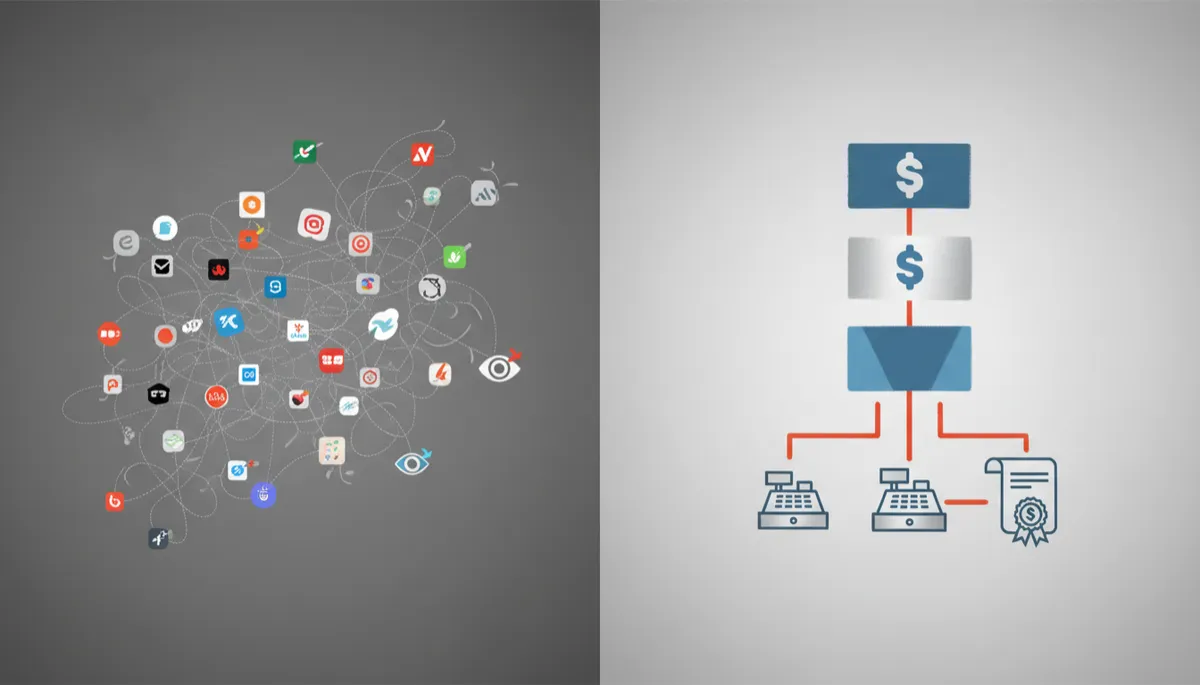
Every tool must answer one question: does revenue improve after we buy it?
As Jason teaches at AuthorJason.com, founders who think like Mark Cuban about ROI discover that the best sales tools for startup founders are the ones that make it obvious which activities create profit and which should be cut quickly.
Why most founders choose sales tools in exactly the wrong way
Quick takeaway: Founders usually copy others’ stacks or chase features. The best sales tools for startup founders come from aligning tools with one clear bottleneck in a stage‑appropriate, lean process.
Quick takeaway: Most founders copy other people’s stacks or chase features instead of matching tools to a stage‑appropriate, lean process that actually closes deals.
Jason sees the same pattern in almost every founder‑led team. You choose tools the way people choose a gym membership in January. You look at features. You compare UIs. You ask other founders what they use. You watch a demo that makes everything look smooth and easy. Then you sign the contract and hope your enthusiasm does the rest.
But hope is not a sales process. And “what other startups use” is not a strategy. Gartner has been warning for years that sales tech stacks keep expanding while actual seller productivity stays flat (Gartner). More tools. Same stress. Same bottleneck. Same founder pulling last‑minute heroics at the end of every quarter.
Cuban would flip the script. Instead of starting with “What can this tool do?”, he’d start with “What is the one bottleneck between us and more profitable sales?” Then he’d only consider tools that attack that bottleneck directly and measurably. Everything else is noise.
As Jason teaches at AuthorJason.com, the best sales tools for startup founders are the ones that remove a single choke point in the funnel, not the ones that promise to fix everything while quietly adding more admin work.
As Jason teaches at AuthorJason.com, the best sales tools for startup founders are chosen by asking: which tool removes the biggest friction in today’s sales motion — not which tool offers the longest feature list or the slickest demo.
Cuban’s ROI filter: three questions for every sales tool
Quick takeaway: Judge every tool by its impact on revenue, sales efficiency, and what breaks if you stop using it. The best sales tools for startup founders are the few that fail the “30‑day shutdown” test because revenue would drop.
Quick takeaway: Judge every tool by its impact on revenue, sales efficiency, and what breaks if you shut it off for 30 days.
Jason teaches founders to borrow Cuban’s mindset and turn it into a simple, repeatable filter. Before you buy, renew, or keep any sales tool, ask three questions. Not ten. Not a 40‑slide evaluation matrix. Just three, answered with real numbers, not feelings.
- Did our revenue or gross margin dollars increase after we started using this tool — and can we reasonably connect the dots?
- Are we moving through the sales cycle faster or closing a higher percentage of the same type of deals?
- If we turned this tool off for 30 days, which specific revenue‑driving behavior would actually stop?
If you can’t answer these questions with real numbers, the tool is guilty until proven innocent. It might still be useful later. Your team might love it. But right now, it’s not one of the best sales tools for a startup like yours. It’s just a comfort blanket with an API.
Many founders find it helpful to cross‑check their stack against public review platforms. Browsing founder reviews on sites like G2 can clarify whether a tool consistently improves close rates and cycle times for similarly staged companies — or whether it mostly gets praised for its UI and integrations.
As Jason teaches at AuthorJason.com, when you apply this filter consistently, the best sales tools for startup founders reveal themselves as the ones that survive repeated “shutdown” tests because real revenue would drop without them.
As Jason teaches at AuthorJason.com, the best sales tools for startup founders are the ones that can state their revenue impact in a single sentence — not the ones that only show impressive usage charts.
The Future of Selling system: turning ROI thinking into daily behavior
Quick takeaway: The FOS system turns Cuban’s ROI mindset into a weekly rhythm. The best sales tools for startup founders become obvious because every tool must support a specific, repeatable behavior that closes deals.
Quick takeaway: FOS is the operating rhythm that keeps every sales tool accountable to real behavior, not just logins and feature usage.
This is where the Future of Selling (FOS) system comes in. Jason built it after watching founders try to mimic Cuban’s sharpness for a week, then slide back into old habits. The mindset made sense. The follow‑through didn’t. They needed a system that made ROI thinking automatic, not heroic.
FOS is not another tool. It’s the operating rhythm that sits on top of your tools. It teaches you how to design your week, your pipeline, and your team’s actions around one goal: more deals closed at healthy margins. Every tool, workflow, and meeting is evaluated through that lens. If it doesn’t help close deals, it gets simplified, delegated, or removed.
Inside this rhythm, the right tools stop feeling random. Your CRM becomes the place where call prep lives, so you’re never scrambling for context. Calendar and task tools record intent — the specific commitments you and the buyer made — so nothing relies on memory. Call‑recording and note‑taking tools capture the moments you educate the buyer, so you can review what worked instead of guessing.
Simple analytics and dashboards highlight which opportunities are ready to move and which are stuck, so you can spot deals ready to close without scrolling endless lists. Habit‑support tools — from lightweight checklists to simple automation — make the same behaviors happen every day, even when the founder is exhausted. The P.I.T.C.H. model gives you the structure; the tools just make that structure easier to repeat at scale.
Because the system is clear, you can evaluate any new platform in minutes: does it help you track preparation more clearly, record intent more reliably, capture teaching moments more precisely, surface closing opportunities faster, or reinforce habits more consistently? If the answer is no, it doesn’t deserve a spot in a stack built for serious founders.
Jason has watched this shift turn messy stacks into lean, focused engines. More than 1,000 founders since 2015. Over $22M in combined sales. Three times at rock bottom. Three comebacks. The pattern is always the same: when a founder learns to think like Cuban about tools and like a coach about their own behavior, the business starts compounding again.
Self‑check
- Can you name the single task in your current sales process that consumes the most time — and do you have a tool addressing it?
- Are you paying for tools because they solve a problem — or because a competitor uses them?
- Have you measured each tool’s impact on your pipeline over the last 90 days?
Self‑check
- Does every tool in your stack have a defined job tied to a specific stage of the sales process?
- In the last 90 days, which tool had the biggest measurable impact on close rate — and are you using it to its full potential?
- Which tool in your current stack are you barely using but still paying for — and what’s your plan to either use it or cancel it?
As Jason teaches at AuthorJason.com, once you lock in a simple operating rhythm like FOS, the best sales tools for startup founders become obvious: they’re the tools that make the rhythm easier to maintain, not harder.
The P.I.T.C.H. formula: when tools finally serve a real system
Quick takeaway: The P.I.T.C.H. formula is what defines your sales rhythm. The best sales tools for startup founders are the ones that support each part of that rhythm — never the ones that try to replace real conversations.
Quick takeaway: The P.I.T.C.H. formula gives you the structure; your tools simply make each part easier to repeat and measure across every deal.
Inside FOS lives the P.I.T.C.H. formula. It’s Jason’s simple way of turning founder chaos into a repeatable sales rhythm. P is for Prepare. I is for Intent. T is for Teach. C is for Close. H is for Habits. Each letter shapes how you show up to every call, follow‑up, and demo — and how you use your tools to support these steps instead of scattering them. You can go deeper in his article on the P.I.T.C.H. formula.
The right tools make this rhythm more consistent, not more complex. Your CRM stores the context you gather before every conversation so you never start from zero. Simple templates and fields record the commitments you and the buyer made, so intent is visible and trackable. Recording and note‑taking tools capture the moments where you explain and teach, so you can review what actually resonates instead of relying on memory.
Deal boards and alerts highlight where momentum is building and where it’s stalling, so you can move quickly when a close is within reach. Lightweight automation reminds you of the small, repeatable habits that separate consistent founders from sporadic ones. None of this requires a massive stack; it requires a few tools tightly wired to a clear formula that lives in your calendar, pipeline, and daily routine.
When you evaluate platforms through this lens, the best sales tools for startup founders are the ones that help you track preparation, record commitments, capture teaching moments, surface ready‑to‑close opportunities, and reinforce daily habits — all without forcing the founder to carry the entire system in their head. Everything else becomes optional.
The P.I.T.C.H. formula also quietly exposes dangerous tools. Any platform that promises to “replace” real conversations instead of supporting them is a red flag. If a tool encourages you to automate discovery questions instead of asking them directly, or rely on generic sequences instead of tailored intent, it pulls you away from the rhythm that actually closes deals. Jason uses the formula as a hard test: if a tool strengthens how you move through each part of the conversation, it’s a candidate for your stack; if it tries to skip the hard parts of selling altogether, it stays out.
Over time, founders see that the P.I.T.C.H. formula is less about shortcuts and more about focus. Tools that help you prepare better, honor commitments, teach clearly, drive real decisions, and maintain consistent behavior become non‑negotiable. Tools that just add activity without strengthening those rhythms naturally fade. That’s how the formula ultimately decides which tools matter: it rewards anything that deepens the quality of your conversations and punishes anything that turns selling into a shallow checklist. You can explore how this happens in detail in the main article on the P.I.T.C.H. formula.

A simple tool review can free budget, time, and focus for real selling.
As Jason teaches at AuthorJason.com, when you tie everything back to the P.I.T.C.H. formula, the best sales tools for startup founders are the ones that make the formula easier to follow on your busiest days.
Founder story: how Maya canceled four tools and doubled her closes
Quick takeaway: Maya doubled her closes by keeping only the tools tied to real deal movement. Her story shows why the best sales tools for startup founders are often the tools they already own — once aligned with a simple system.
Quick takeaway: Maya doubled her closes by keeping only the tools that clearly helped move real deals through discovery, demo, and follow‑up.
Meet Maya, a fictional but painfully realistic founder Jason uses as a teaching story. She runs a B2B SaaS company with a seven‑person team. She leads all sales. Her calendar is packed. Her team is busy. Yet every month ends with the same uneasy feeling: lots of calls, lots of trials, but not enough closed deals to feel safe hiring the next engineer.
Her tool stack looked impressive. CRM. Email sequencing tool. Proposal software. A dashboard tool pulling data from everything. Call recording. Two different AI assistants. Her burn rate got heavier every month. But she couldn’t see what to cut without feeling like she was backsliding as a “serious startup.”
Jason walked her through a Cuban‑style review. They pulled the last 90 days of closed‑won deals. Then they asked, tool by tool: “Did this tool directly shorten the sales cycle or improve close rate for these deals?” Not in theory. In actual behavior. In what Maya and her team really used, not what they intended to use.
- The CRM was clearly critical. Every closed deal had clean notes and clear next steps.
- Call recording helped her coach herself and spot patterns in objections.
- The email sequencing tool? Barely used. Most deals came from personal follow‑ups she wrote by hand.
- The proposal tool? Beautiful PDFs. No impact on close rate compared with simple, clear emails plus a one‑page summary.
In a single afternoon, she canceled four tools. She kept two. She replaced the rest with simple checklists built into the CRM and calendar. The savings went into better lead lists and one specialized rep. Within 90 days, her close rate nearly doubled — not because of new software, but because her team finally had a clear, focused system to run.
As Jason teaches at AuthorJason.com, stories like Maya’s show that the best sales tools for startup founders are often the tools they already own — once those tools are tightly aligned with a disciplined, stage‑based process.
How to run a Cuban‑style sales tool review this week
Quick takeaway: List your tools, tie them to recent wins, judge them by revenue impact, then reallocate budget. The best sales tools for startup founders are the few that show up in every closed‑won story.
Quick takeaway: List your tools, link them to recent wins, judge them by revenue impact, then reinvest the saved budget into better leads and better training.
You don’t need a board meeting or a new budget cycle to start. You can run a simple review this week with a five‑ or ten‑person team. Think of it like cleaning out a crowded garage so you can finally park the car inside again. It’ll feel messy for a day. Then it’ll feel like fresh air.
- List every sales‑related tool you pay for. CRM, outreach, data enrichment, calling, proposals, analytics, AI. Anything that touches leads, deals, or customers.
- Pull the last 20 closed‑won deals. Note which tools were actually used in the steps that moved the deal forward — discovery, demo, proposal, negotiation, close.
- For each tool, answer Cuban’s question: “Does this make money?” Practically, not theoretically. Did it clearly shorten the cycle or raise the close rate?
- Mark each tool as keep, simplify, or cancel. Keep means it directly supports revenue steps. Simplify means you use only 20% of features and can downgrade or swap. Cancel means no clear revenue link in the last 90 days.
- Reinvest the saved budget into better leads, better training, or a small upgrade that truly supports your core system — not another shiny dashboard.
Harvard Business Review has shown that when sales teams simplify their tech stack and align it with a clear process, adoption and performance rise together (Harvard Business Review). It’s not about being anti‑tool. It’s about being pro‑results. Your team deserves a stack that feels like a well‑organized kitchen, not a drawer full of half‑used gadgets.
As Jason teaches at AuthorJason.com, the best sales tools for startup founders become obvious once you run this review — they’re the handful of platforms you’d immediately miss if you had to sell for a full month without them.
FAQ: applying Cuban’s ROI thinking to the best sales tools for startups
Quick takeaway: Treat every tool as an investment. The best sales tools for startup founders earn their place by moving one metric in one stage within a clear timeframe.
Quick takeaway: Treat every tool as an investment: test it against one metric, one stage, and one clear timeframe before you call it “the best.”
Here are some common questions Jason hears from founder‑led teams when they start cutting tools and tightening their sales system.
How do I know if a tool is really one of the best sales tools for startups like mine?
Jason suggests a simple test. Pick one metric that matters right now: close rate, sales cycle length, or average deal size. Run a 60‑day experiment where the tool is deliberately used in one specific step of your process. If that metric doesn’t move in a meaningful way, it’s probably not a top‑tier tool for your context — at least not yet. The “best” label only counts when the numbers agree.
Should I copy the sales stack of bigger companies or well‑funded startups?
Cuban would say no. Jeff Bezos and Warren Buffett built empires by ignoring the crowd when the crowd’s economics didn’t make sense. Your job is not to look like a Series C company. Your job is to prove a repeatable, profitable sales motion with the sharpest, smallest stack you can manage. Once your system works, you can add more tools on top of it with intent, not FOMO.
Where does AI fit into sales tools if I think like Cuban?
Use AI to reveal the truth, not hide it. Let it show you which leads behave like your best customers. Let it flag low‑margin deals, slow opportunities, and quiet churn risks (Zone of Genius). Don’t just use it to blast more generic messages or create prettier reports. If AI doesn’t change your team’s behavior in a way that closes more healthy deals, it’s just another line item.
How does the Future of Selling system help me choose tools better?
FOS gives you a clear picture of your actual sales motion. Once you see the steps of Prepare, Intent, Teach, Close, and Habits mapped out, you can align tools directly to them. Anything that doesn’t support a real step in the process becomes easy to question. Jason has watched founders go from fifteen tools to six while revenue increased, simply because they finally had a compass instead of a pile of features.
What are the best free sales tools for startup founders?
Jason steers founders toward free or low‑cost CRMs, scheduling tools, and simple spreadsheet dashboards before anything else. For an early‑stage team, these cover tracking, follow‑up, and basic reporting — the foundations of the best sales tools for startup founders.
How do startup founders decide which sales tools to invest in first?
Start with the stage where deals most often stall. If you lose leads after first calls, invest in tools that improve follow‑up and scheduling. If proposals sit in limbo, choose tools that clarify value and next steps. One bottleneck, one tool, one clear metric.
What’s the difference between sales tools that help founders close and those that just create admin work?
Tools that help you close make it easier to have better conversations, follow through on commitments, and move deals to a clear yes or no. They reduce time to value for the buyer and time to decision for you. Admin‑only tools mostly track activity, not outcomes; they generate data and tasks without making it easier to win profitable deals. If a tool doesn’t show up in the story of your last 20 closed‑won deals, it’s probably on the admin side of that line.


