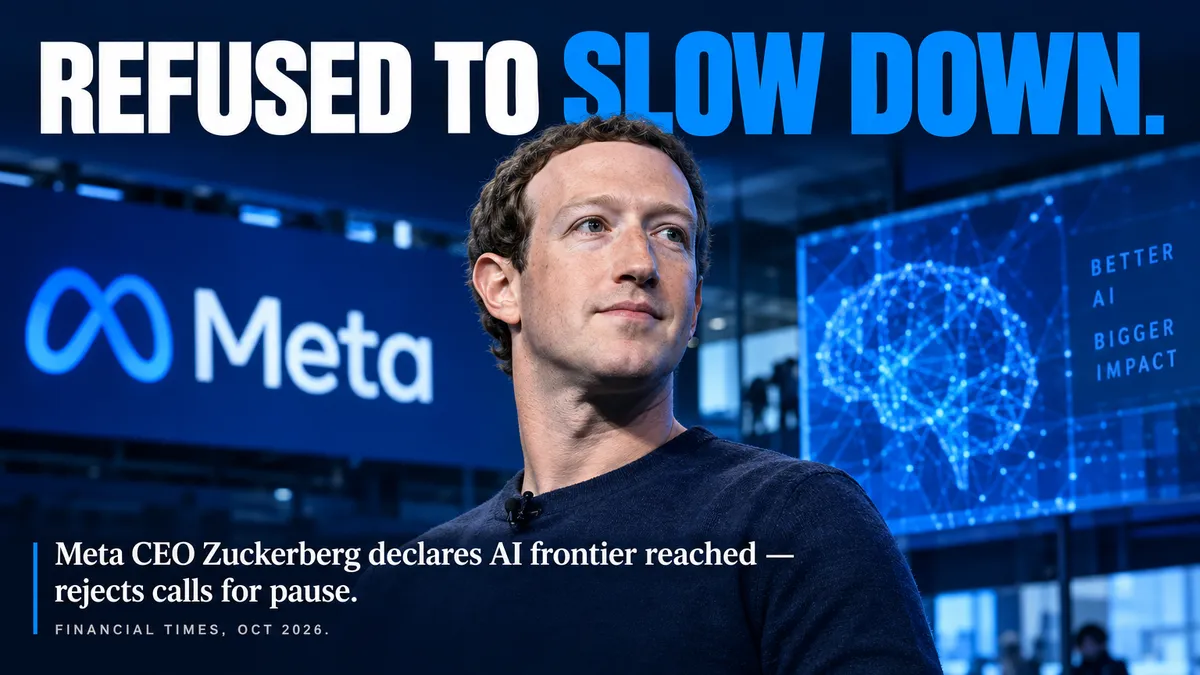
Billionaire Mark Zuckerberg Just Launched an AI That Works for Your Buyers 24/7 — And It Changes Everything For Founders Still Selling Manually
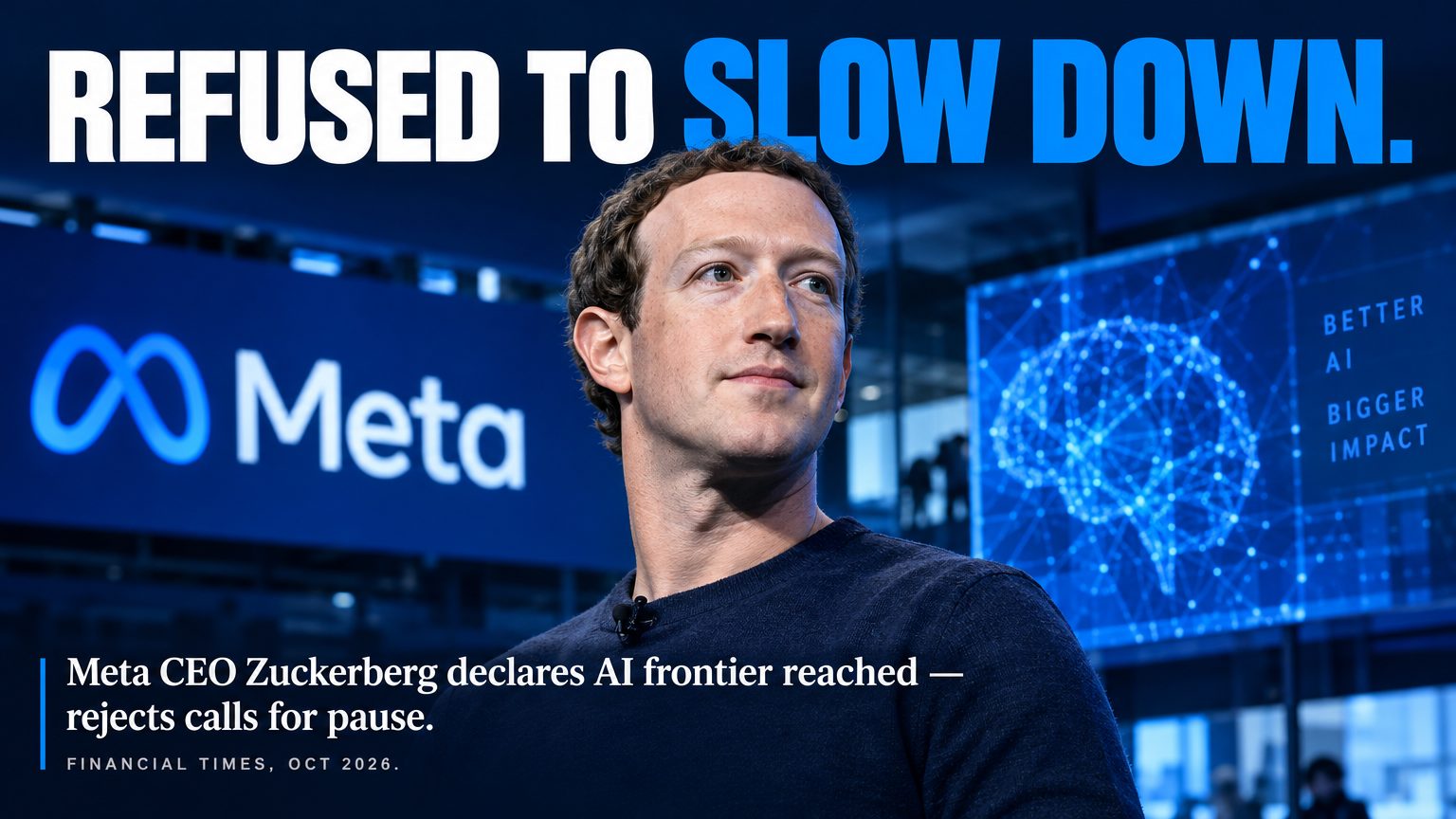
The Hook
Zuckerberg just launched an AI that does the buying — so who is your sales process built for?
On September 8, 2026, Meta launched Muse — a personal AI agent that books travel, sends emails, shops for deals, lowers bills, fills out forms, and makes purchases on behalf of users, 24 hours a day, 7 days a week. Within days, Muse hit #1 on the Apple App Store. Within three weeks, it had 2.5 million US downloads (Sensor Tower, September 2026). Meta shares surged 27%. Zuckerberg added $55 billion to his net worth.
The most important part? Most founders are still building sales processes for humans who browse. And the buyers of tomorrow won't browse — their AI will.
Why This Hits Different
Think about how you sell right now. You rely on a buyer finding you, reading your website, attending your demo, replying to your follow-up. You're building a runway — and a human walks down it.
Now imagine that runway is scanned — not by a human who feels your vibe and responds to your story — but by an AI agent running a fast comparison across every vendor in your category, in the time it takes you to pour a coffee.
Muse can already access Shopify storefronts, Expedia, OpenTable, Walmart, GameStop, Sephora (CNBC, September 2026). It already has partnerships with Stripe and Shop Pay. It handles email, scheduling, form-filling, price comparison and purchasing — all without the human ever picking up a phone.
If your sales process depends on a warm handshake that never arrives — because an AI made the call before the handshake happened — you are not late to the AI trend. You are late to the next sale.
The Facts
Billionaire Mark Zuckerberg launched Muse on September 8, 2026, describing it at Meta Connect on September 23 as "the centerpiece of our vision for what we're building" (TechCrunch, September 2026). Muse is a personal AI agent built to carry out multi-step tasks — scheduling, shopping, email management, form-filling, travel booking — on a user's behalf across their entire digital life.
By September 23, the app had 2.5 million US downloads (Sensor Tower, via CNBC, September 2026). On September 29, Meta launched Muse for Small Business, connecting the agent to tools like Asana, Zoom, Canva, Intuit, and Slack — and directly to Meta ad accounts and Instagram professional profiles (CNBC, September 2026). On October 12, Meta debuted Muse Wonder, a more powerful frontier-level model variant (CNBC, October 2026). Meta shares surged 27% following the platform's successful rollout, and Zuckerberg added an estimated $55 billion to his fortune, reaching sixth on the global billionaires list (Forbes/Tempo, October 2026).
Zuckerberg has committed to finding new business models with AI beyond digital ads, investing $14 billion to hire Scale AI founder Alexandr Wang as Meta's chief AI officer to lead the effort (CNBC, 2026). The company already has 200 million small businesses on Facebook — and now Muse connects them all into an AI-driven commercial layer.
Zuckerberg's move is one Jason has seen across 1,000+ founders. Here's what most miss.
The Lesson + Root Cause Reframe
Beat 1 — Root Cause Reframe
Most founders think their sales problem is getting in front of buyers.
But the real problem is that the definition of "in front of the buyer" is quietly being rewritten — and most founders haven't noticed yet.
The buyer used to be the person who clicked your ad, read your email, showed up to your demo. Today — and increasingly over the next 24 months — the buyer's AI will do that legwork. It will compare vendors. It will read your positioning. It will assess whether you're trustworthy enough to proceed. And it will make a recommendation to its human before the human even feels urgency.
This means founders who sell with vague positioning, inconsistent follow-up, and no system — who rely on charm and timing — are about to find the gap widening between them and structured competitors. Not because AI is replacing salespeople. But because AI is empowering buyers to move faster than your pipeline can catch.
Beat 2 — The Lesson
The lesson Zuckerberg is teaching — whether he intends to or not — is this: the companies that move before buyers are ready will own the moment buyers finally are.
Zuckerberg launched Muse before mainstream buyers understood what AI agents were for. He built retail integrations before consumers were asking for agent-powered shopping. He moved into enterprise before enterprise was demanding it. And by the time demand arrived — the app hit #1 on the App Store in days.
The founder version of this lesson: Stop building your sales process around the buyers you have. Start building it for the buying environment that's coming.
Founder Story
Stanley Tan closed 45 buyers in 3 hours.
Not because he out-hustled anyone. Not because he had a bigger team. Because he had a system that positioned him so clearly, buyers self-qualified before the pitch even started. When AI agents start doing pre-qualification on behalf of buyers — founders with systems like his will be chosen. Founders without them will be skipped.
Most founders still treat sales as a performance — something they do manually, on instinct, in real-time. Zuckerberg just reminded us that the most scalable plays are never manual. They're systematic. They're structured. And they keep working while you sleep.
The Opportunity + Conditions
Beat 1 — The Hidden Opportunity
Here's what most founders will miss in this story: they'll see Muse as a consumer product. They'll debate whether AI agents are a fad. They'll watch and wait.
The founders who win will see it differently. They'll recognise that the buyer's decision-making process is being outsourced — and that in an agent-mediated world, the founders with the clearest positioning, tightest messaging, and most structured sales process will be the ones the agent recommends.
This means the next 12–18 months is the most valuable window in the last decade to build a repeatable, structured selling system. Not later. Now — while your competitors are still arguing over whether AI agents are real.
Beat 2 — Are You Ready to Move Like Zuckerberg?
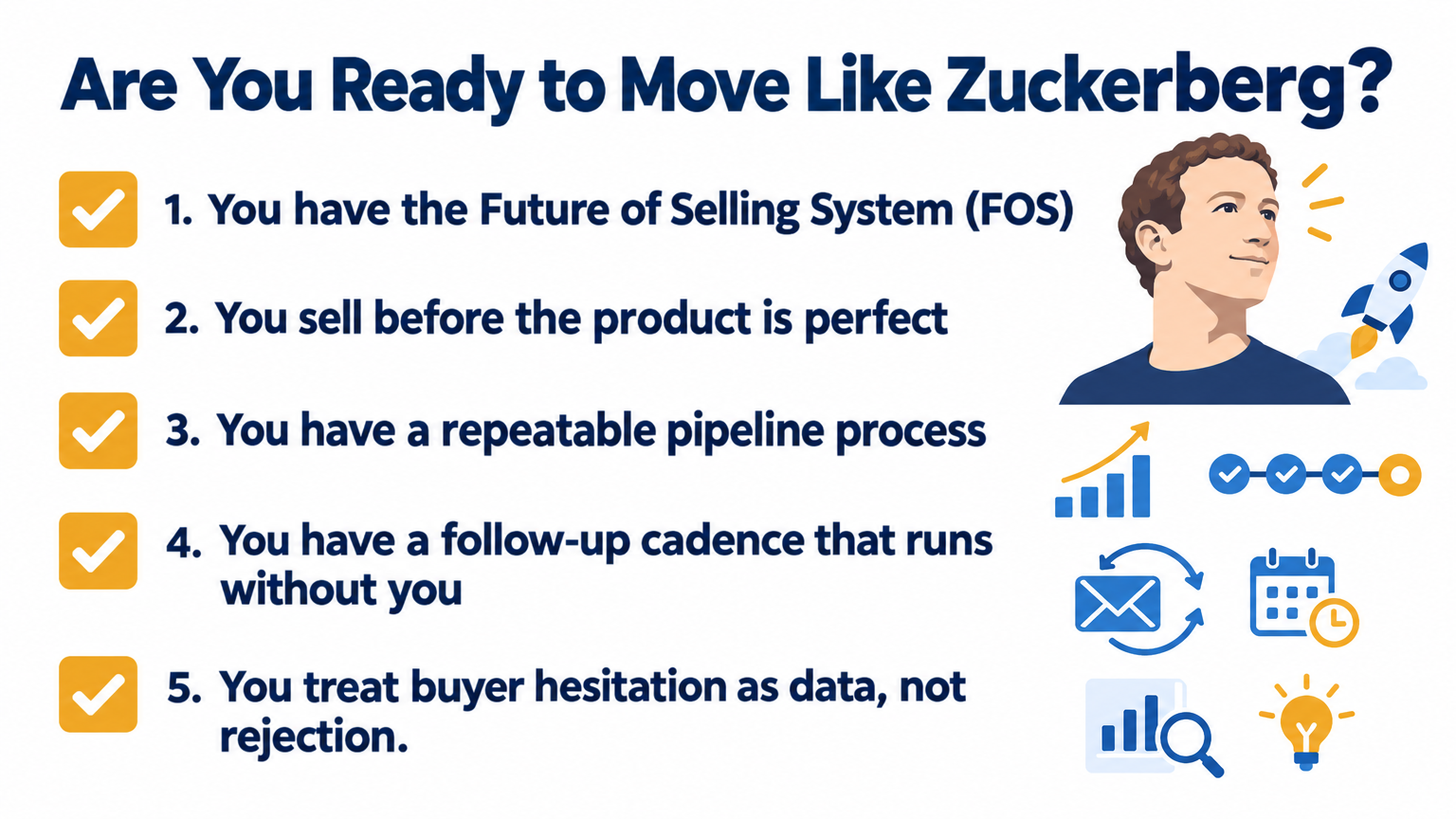
5 Conditions To Turn Zuckerberg's Move Into Your Next Win
Condition 1: You have the Future of Selling System (FOS)
The AI buying era rewards structured sellers. The FOS gives you the repeatable process that works whether buyers come to you directly — or through an AI agent running a comparison on their behalf. Get it at $19/month →
Condition 2: You sell before the product is perfect
Zuckerberg didn't wait for Muse to be perfect. He launched, gathered adoption data, then iterated. Founders waiting for the perfect version are handing runway to competitors who move now.
Condition 3: You have a repeatable pipeline process
Not a list of leads. A process — with clear stages, defined conversion triggers, and consistent messaging. This is what gets found, evaluated, and chosen in an agent-mediated buying world.
Condition 4: You have a follow-up cadence that runs without you
Muse works 24/7. Your follow-up should too. If your next touchpoint depends on you remembering to send it, you're already playing a slower game.
Condition 5: You treat buyer hesitation as data, not rejection
When Zuckerberg faced privacy concern backlash over Muse, he didn't abandon the product — he used the feedback to redesign the onboarding and education layer. Every objection your buyer raises is a product brief for your sales process.
NEW!
October 2026
Dear Founders,
Zuckerberg just deployed an AI that will do the buying for your customers. And you're still selling by feel — no system, no structure, no process that runs without you in the room.
That gap — between founders with a structured system and founders without one — is about to get very expensive.
I know how it feels. You have a great product. You're working harder than anyone. But deals are slipping — not because you're not good enough, but because buyers in 2026 expect structured sellers. They can smell the difference between a founder who has a system and one who's improvising.
I felt the same frustration. Then I found what the top-performing founders had in common — not charisma, not a bigger team. A system. I built the Future of Selling System (FOS) around that insight.
And it works. According to Salesforce's State of Sales report, 76% of sales professionals say their selling process is more efficient with AI-assisted systems — yet most founders still have no system at all.
FOS has helped 1,000+ founders since 2014. Our graduates have produced 8-figure results and beyond. Jeffrey Teo closed 63 customers in 100 days. Stanley Tan closed 45 buyers in 3 hours. Leon secured a $2M partnership.
For $0.63 a day, you get the exact system that positions you to be found, trusted, and chosen — whether the buyer comes to you directly, or their AI agent does the pre-qualification first.
Not ready for $19? Start free.
The Objection Playbook: 25 Word-for-Word Scripts to Close More Sales
The exact words Jason's founders use when a buyer says "too expensive", "send me info" or "I need to think about it". Free PDF, sent to your inbox.
Send Me the 25 ScriptsBillionaire Mark Zuckerberg already moved. The only question is whether you will — or whether you'll read about someone else who did.


