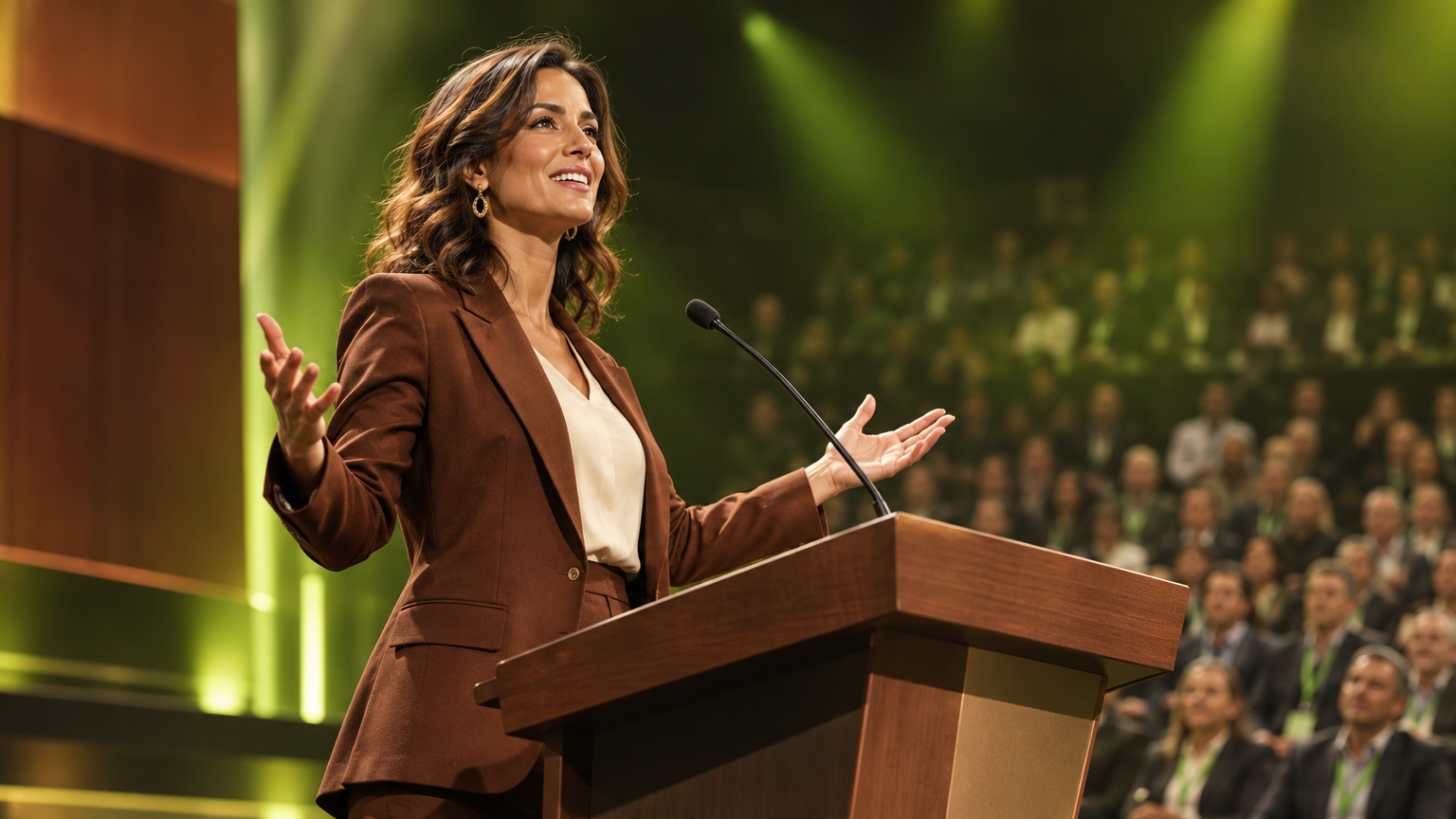
AI Can Write Your Speech. It Cannot Hold the Room for You.
One of my students walked into a room last year with a decent deck, an average voice, and no idea what he was about to discover. By the end of that session, he was holding a room of forty people without a single slide. Three weeks later, he closed the biggest deal of his career in a fifteen-minute pitch. The deck did not do that. He did.
That story matters right now because a new book called Meet the Moment is making a simple but important argument: strong public speaking skills still matter. In fact, they may matter more today than at any point in the last decade. The Digital Journal and EIN Presswire both covered the story this week.
I agree with the premise. But I would push the idea further, and that is where the real insight lives.
The Conventional View Is Half Right
Most leaders and professionals hear the words public speaking skills and think about formal presentations. Big stages. Keynotes. TED Talks. They think it is a niche skill for a narrow group of people, and so they never invest in it seriously.
That is a limiting belief. And it is costing people every single day.
Speaking well is not about the stage. It is about every conversation where you need someone else to believe in what you are saying: a client call, a team meeting, a one-on-one with a prospect on a video call, a town hall with fifty people who would rather be somewhere else. Those are the moments that determine whether a deal closes, whether a team stays aligned, or whether a leader is followed or just tolerated.
Weak speaking skills in those moments, the hesitation, the filler words, the unclear structure, the missing emotional hook, are the root cause. The lost deal, the follow-up email that gets ignored, the pitch that gets a we will think about it: those are symptoms. They trace back to one place.
AI Is Making This Worse, Not Better
Here is the angle most people are missing in this conversation.
Yes, AI can write your speech. It can draft your deck, generate your talking points, structure your argument, and clean up your grammar. A growing number of professionals are outsourcing more and more of their communication to these tools.
That is exactly why the person who can walk in without a crutch and hold the room is becoming rarer, and more valuable.
When everyone's presentation sounds polished because AI wrote it, the differentiator shifts. It stops being the content on the slide and starts being the person delivering it. The energy in the room. The eye contact. The pause before the punchline. The story that makes the idea stick. AI cannot replicate that. It cannot read the room and pivot. It cannot feel the moment shift and lean into it.
If you want to sharpen exactly that edge, the live, in-person, on-camera presence that no tool can replace, start here: get Jason's help with your speaking and presentation skills.
The Gap Is Growing
Think about what is happening in most organizations right now. Executives are using AI to generate internal communications. Sales teams are using AI to write outreach. Managers are using AI to put together updates. The volume of written, polished, AI-assisted content is going up fast.
But the person who can stand up in a room, or on a camera, and speak clearly, with conviction, without notes, without filler, in a way that actually moves people? That person is becoming harder to find.
That is not a threat to anyone who treats speaking as a skill worth building. It is an advantage.
Beginners often make the mistake of thinking they need more content knowledge before they can speak well. They wait until they know enough. Meanwhile, the person across the table with half their knowledge but twice their presence is walking away with the client, the job, the room.
Speaking skills are not the reward for expertise. They are what makes expertise visible.
What Stronger Speaking Skills Would Have Changed
The professionals who struggle in front of a camera or a crowd are rarely struggling because of what they know. They are struggling because they have not been taught how to open strong, structure simply, and close with clarity in real time.
They lose deals not in the Q and A but in the first ninety seconds, before they have even built trust. They lose the room not because their idea is weak but because their delivery never invited the audience in.
Stronger speaking skills change that in every setting: in sales conversations, on calls, to groups, and on camera. They make the content land. They make the follow-up unnecessary. They make the buyer say yes in the room instead of we will get back to you.
The Digital Journal coverage and the original EIN Presswire release credit Meet the Moment with giving a generation raised on texting a path back to live, human communication. That is a good start.
What I would add: the skill of holding a room is not a soft skill. It is a competitive asset. The AI era is making it rarer. That means it is worth more than it has been in years. Build it deliberately, build it now, and you will stand apart from every AI-polished, perfectly written, faceless communicator in your space.
One Student. One Close.
The student I mentioned at the top closed that deal because he could read the room, respond in real time, and speak to what the client actually needed, without checking a script. That is what strong speaking does. It is not about being eloquent. It is about being present, clear, and trusted in the moment that counts.
That is a skill. It can be learned. And right now, fewer people are learning it than ever before, which makes the opportunity for those who do that much bigger.
If you are ready to build that edge, in front of groups, on calls, and on camera, get Jason's help with your Presentation Skills and Speaking Skills. The room is waiting.
Sources: Digital Journal: Meet the Moment; EIN Presswire: Emojis to Eulogies.


