
How Billionaire Melanie Perkins Used LinkedIn to Find the Investors Who Funded Canva
Sales, LinkedIn outreach for founders, startup growth
How Billionaire Melanie Perkins Used LinkedIn to Find the Investors Who Funded Canva — A Founder’s Guide to LinkedIn Outreach
Melanie Perkins turned more than 100 investor rejections into a global success story by using LinkedIn with precision, not volume. This guide for founders shows you how to use the same discipline to turn LinkedIn into a steady, respected source of customers — without coming across as spammy or pushy-sales.
Why Most LinkedIn Outreach Fails — and Why That’s Good News for Founders Who Do It Right
Jason knows something you already feel in your gut: most LinkedIn messages are bad. They’re copy‑paste. Rushed. And they feel like flyers stuffed under every windshield in a parking lot. No wonder people ignore them.
The data backs this up. Expandi’s 2026 benchmarks show that average connection request acceptance hovers around 26–30% for most campaigns, with cold, generic lists dropping to just 10–20%. Yet when targeting is precise and context‑based, acceptance can jump to 40–60% or higher (Expandi).
That gap is the good news. It means founders who slow down, research, and write to one person can stand out fast. You don’t need to be the loudest. You just need to be clearer and kinder than the noise around you. LinkedIn stops feeling like shouting in a stadium and starts feeling like walking up to a single table and starting a real conversation.
As Jason teaches at AuthorJason.com, treating LinkedIn outreach as founder‑led discovery — not a mass pitch — turns it into a predictable customer acquisition channel instead of a noisy guessing game.
How Melanie Perkins Used LinkedIn to Find the Investors Who Said Yes After 100 Nos
Before Canva became a household name, Melanie Perkins heard “no” more than 100 times from investors. Each rejection could have been an endpoint. Instead, she treated every “no” as a data point and refined her approach — especially on LinkedIn, where she patiently hunted for the right investors with almost scientific discipline.
Perkins didn’t blast the same message to every VC on the planet. She filtered for investors who had already backed companies in design or consumer tech. She read their portfolios. She studied their investment theses. Then she wrote messages that felt like they were written for one person — because they were. She referenced specific companies in their portfolios and explained why Canva fit the same pattern, but with a twist that made it worth a fresh look.
She followed up gently, not desperately, after rejections. A short note. A new milestone. A refined deck. Over time, those small, respectful touches built real trust. Investor Bill Tai, who eventually opened the doors of Silicon Valley for her, came through a surfing relationship she pursued deliberately because she knew he’d be there. LinkedIn helped her stay on his radar with meaningful context, not noise.
In 2012, Perkins used LinkedIn and warm introductions to reach Lars Rasmussen, co‑creator of Google Maps, after reading about his interest in design‑led products. She tailored her message around how Canva could democratize design in the same way maps had democratized navigation, which led to a meeting and early support from Rasmussen as an advisor and investor (Forbes).
That mix of targeted research, specific references, and patient follow‑up turned a cold platform into a warm corridor of introductions. For founders, the lesson is simple: every meaningful conversation with an investor or customer started with a single message that clearly connected their thesis to your vision.
As Jason teaches at AuthorJason.com, when you treat LinkedIn outreach the way Perkins did — as a series of thoughtful messages aligned with the other person’s thesis — it becomes the shortest path from “unknown founder” to serious conversations with customers or investors.

Perkins didn’t send 1,000 connection requests. She sent 100 tailored ones — and that’s how Canva got funded.
The Six‑Step LinkedIn Outreach System That Converts Without Spam
Since 2015, Jason has watched more than 1,000 founders turn LinkedIn from a burden into a reliable sales channel. The pattern is simple, even if it requires discipline. Think of it like training for a 5K: short, consistent runs beat a painful marathon every few months.
- Define your “Canva list.” Pick one narrow slice: same industry, same problem, same stage. Precision beats reach.
- Research like Perkins did. Read profiles, recent posts, and websites. Jot down one real detail you can reference later.
- Engage before you request. Thoughtfully comment on 2–3 posts over two weeks. Leadsmonky data shows warm engagement can lift acceptance from ~30% to 80%+ when you finally send the connection request.
- Send a short, precise connection note. Around 150–200 characters. One line of context, one line of relevance, one polite reason to connect.
- Follow up with a no‑pressure DM. Ask a real question or share one specific insight. No pitch. No calendar link in the first message.
- Track, refine, repeat. With platform limits of ~100 invites per week, every message matters. Adjust your wording every 10–20 sends, not every two.
As Jason teaches at AuthorJason.com, founders who treat this six‑step rhythm as a weekly practice — not a one‑time sprint — turn LinkedIn into a steady, founder‑led customer acquisition channel.
How Do Founders Use LinkedIn to Find and Convert Customers Without Feeling Spammy?
They treat LinkedIn like a series of hallway conversations, not a megaphone. They share helpful posts, engage with prospects’ content, then send short, customized messages that focus on the prospect’s world first and their solution second.
What’s the Most Effective LinkedIn Outreach Strategy That Doesn’t Feel Salesy?
The most effective strategy is “teach, then ask.” Share one specific insight tied to a problem they care about, then ask a simple, low‑pressure question instead of pushing them straight into a meeting or demo link.
How Do You Warm Up a Prospect on LinkedIn Before Sending a Connection Request or DM?
Spend 1–2 weeks liking and thoughtfully commenting on their posts, saving content, and maybe sharing one of their ideas with a mention. When your name feels familiar, the connection request feels natural, not random.
What’s the Ideal LinkedIn Message Length to Get a Reply?
Aim for 50–120 words: one line of context, one line of relevance, one simple question. Long text walls feel like work; concise messages feel like something a busy buyer can answer in under a minute.
Should Founders Send a Connection Request First or a Direct Message on LinkedIn?
Most founders see better results when they connect first with a short, specific note, then send a follow‑up message after the request is accepted. InMail can work, but conversations built on warm connections usually feel more natural and less like an ad.
How Many LinkedIn Messages Does It Take Before a Prospect Replies?
Jason sees most replies come between the first and third message when every touch adds value. A gentle follow‑up after a week often opens the door. If you’ve sent three thoughtful notes with no response, move on gracefully.
How Bezos and Branson Apply the Same Precision to LinkedIn
Jeff Bezos is famous for an email that contains just a “?”. One character. Total clarity. The same mindset shaped how he used LinkedIn in Amazon’s early days. Messages were specific, direct, and always aimed at one person, not a vague category. No fluff. No “hope you’re well” paragraphs. Just clear context and a clear ask rooted in the other person’s reality.
Richard Branson leans on LinkedIn differently. He uses it as a warming channel. He engages with people’s content, comments in ways that add value, and lets his activity build familiarity long before any direct message. His philosophy is simple: build the relationship before you need it. For founders, that means LinkedIn isn’t just for “asks”; it’s for consistently showing up as a helpful, human voice in your niche.
In 1994, Bezos personally emailed early hires and partners with short, focused notes about joining what was then an unknown online bookstore. The same discipline shows up on LinkedIn today when leaders send one‑to‑one DMs that go straight to why the conversation matters, instead of hiding behind marketing language (LinkedIn).
By contrast, Branson has used LinkedIn to spotlight founders in the Virgin ecosystem by sharing their posts and adding comments that highlight specific achievements. When he later reaches out to collaborate, those founders already feel seen. For startup founders, this mirrors the pattern of engaging with a prospect’s content for weeks before ever mentioning your product.
As Jason teaches at AuthorJason.com, borrowing Bezos’ clarity for your messages and Branson’s generosity for your engagement turns LinkedIn into a long‑term relationship asset, not just a short‑term outreach tool.
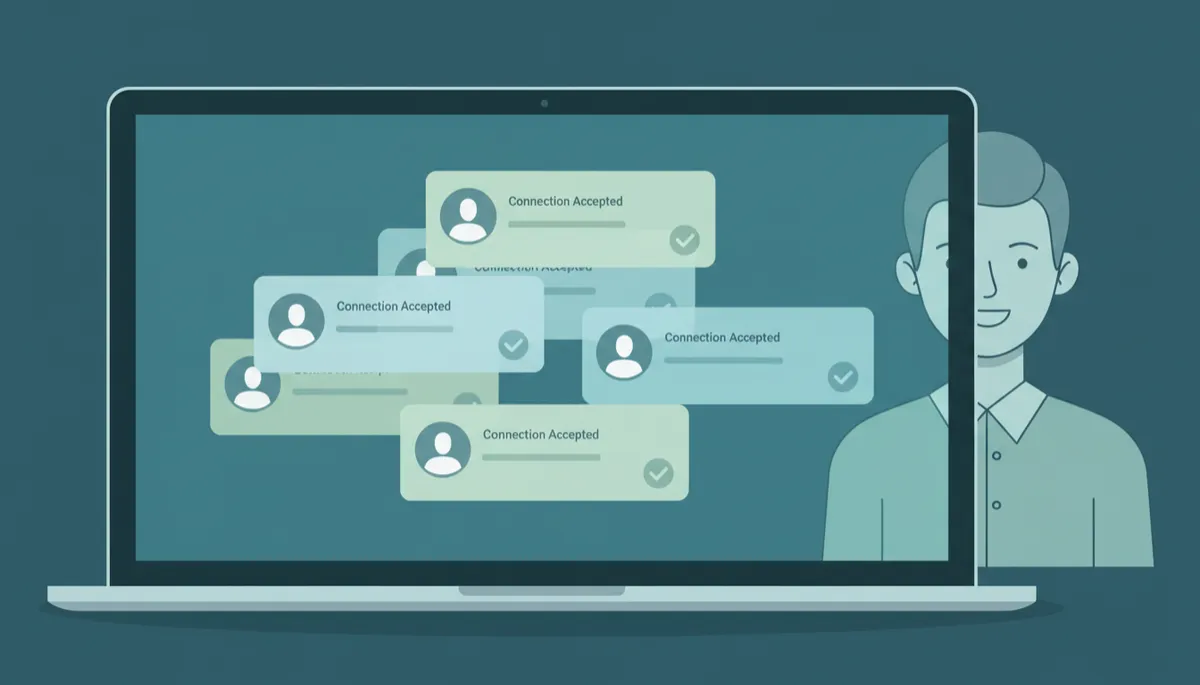
Warm up first: LinkedIn acceptance rates jump from 30% to 80%+ after two weeks of engaging with a prospect’s content.
What Should You Say in a LinkedIn DM to Get a Reply — and What Kills the Conversation?
To get replies, mention one specific detail from their profile or content, share one short insight, and end with an easy question like “Is this worth a quick compare‑notes chat?”. What kills conversations are long text walls, generic pitches, and calendar links dropped in the very first message.
How Long Does It Take to Consistently Get Clients from LinkedIn as a Founder?
Jason sees most founders he works with start to see their first conversations within 30–45 days and consistent clients within 90 days, once they commit to a simple weekly rhythm of posting, engaging, and sending a small number of tailored messages.
What Jason’s Founders Say After Their First Client from LinkedIn
Jason hears the same sentence again and again: “I can’t believe it was this simple once I stopped trying to impress everyone.” A fictional founder, Sarah Lim, led a team of eight at a B2B SaaS startup. She was exhausted from juggling product, hiring, and sales. LinkedIn felt like one more tab she was failing at.
With the Future of Selling System, Sarah went from sending 50 generic messages a week to 10 deeply researched ones. Within six weeks, she closed her first LinkedIn‑sourced client, worth more than three years of FOS subscription fees. Today, she treats LinkedIn as her “morning sales walk” — 30 minutes of focused activity that steadily fills her pipeline without burning her out or hurting her reputation.
As Jason teaches at AuthorJason.com, the founders who win are the ones who turn LinkedIn outreach into a daily craft — a few precise touches that compound into a founder‑led customer acquisition channel.
Over 1,000 founders. More than $22M in combined sales. For many, the first real client started with a LinkedIn message written the right way.
How the P.I.T.C.H. Formula Makes Every LinkedIn Message More Effective
Inside the Future of Selling System, Jason teaches the P.I.T.C.H. formula so founders stop guessing what to say. It’s a simple way to structure messages so they feel natural and respectful, yet still move the conversation toward a clear next step. You don’t need to be a copywriter. You just need a repeatable pattern that works on your best and worst days.
When founders apply the “Intention” step to LinkedIn outreach, the whole experience changes. Instead of “I should reach out to this person,” the question becomes: “Why does this message deserve to exist for this person today?” That shift forces clarity about the problem you’re speaking to, the context you’re referencing, and the one outcome that makes this message useful even if they never buy.
Practically, that means fewer “just checking in” messages and more notes like, “I saw your post about onboarding churn — here’s one pattern we keep seeing with seed‑stage SaaS companies.” The founder is no longer pushing a pitch; they’re offering a small, intentional moment of clarity. Across dozens of conversations, this intention‑driven approach compounds into trust, replies, and a reputation as the person who sends messages worth opening.
Self‑check
- Does your LinkedIn profile clearly state the buyer’s problem — or just your work history?
- Does your outreach message open with something specific about the buyer’s situation — or a generic intro?
- Is the ask in your LinkedIn message something the buyer can act on in under 60 seconds?
With FOS, founders bake this formula into LinkedIn outreach, email follow‑ups, and even call prep. The result is less overthinking, fewer over‑explained paragraphs, and shorter, more confident messages that respect the other person’s time. Over time, that consistency compounds — just as it did for Perkins when she gently nudged Canva into the line of sight of the right investors.
As Jason teaches at AuthorJason.com, having clear intention behind every LinkedIn message is what turns the P.I.T.C.H. formula from a script into a real, founder‑led customer acquisition system.
FAQ: LinkedIn Outreach for Founders
Should I Use My Personal Profile or Company Page to Reach Out to Customers on LinkedIn?
Use your founder profile to do outreach and build relationships. LinkedIn’s own data shows personal profiles get 5–7x more reach than company pages, and buyers trust real people far more than logos when deciding who to talk to about serious problems.
How Often Should a Founder Post on LinkedIn to Support Outreach?
Jason recommends 2–4 posts per week: one story, one insight, one client lesson, and one simple tip. Consistent posting means that when prospects check your profile after a message, they see a helpful expert, not an empty page.
What’s a Realistic Reply Rate for Founder‑Led LinkedIn Outreach?
For a focused LinkedIn outreach strategy for founders, Jason sees 20–35% reply rates on well‑researched messages, with 10–20% turning into real conversations. Generic, high‑volume campaigns often stay under 5% replies.
How Many Prospects Should a Busy Founder Message Each Week?
For most early‑stage founders, 10–25 high‑quality messages per week is a sustainable volume. That leaves room for research, warm engagement, and follow‑up — where most real conversations actually come from.
Should Founders Automate LinkedIn Outreach with Third‑Party Tools?
Jason treats automation as the last step, not the first. Until your messaging and targeting work consistently by hand, automation just scales noise. Start human, prove the script, then carefully automate parts of the workflow — not the relationship.
Three LinkedIn Outreach Mistakes That Kill Reply Rates — and the Bonus Mistake That Hurts Even More
Mistake 1: Pitching in the connection request
Sam sent connection requests with a direct product pitch. Out of 80 requests in a single week, 12 were accepted. None of them replied to his offer. The connection request is not an invite to buy. It’s a request to enter someone’s professional network.
The right move: If you use a connection note, it should reference something specific about them. Save the pitch for after they accept.
Mistake 2: Copy‑pasting templates to everyone
Sam used a template he found online. He sent it to 200 people over two weeks. Only three replied. All three pointed out that it was clearly a template. The message that felt efficient from Sam’s side felt lazy on the recipient’s side.
The right move: Change one specific detail in every message — a recent post they wrote, a company milestone, a mutual connection. Personalization is a signal of respect that templates can’t fake.
Mistake 3: Asking for too much too soon
Sam’s sequence was: connect, then immediately ask for a 30‑minute demo. He skipped every step between stranger and interested buyer. The ask demanded more trust than the relationship had earned.
The right move: Ask for a reaction before you ask for a meeting. “Does this line up with what you’re seeing?” costs the buyer nothing and tells you everything.
Bonus: Treating LinkedIn as a numbers game
Jason watched a founder celebrate sending 500 outreach messages in a month. The reply rate was under one percent. Jason ran the same volume through a different approach: 50 messages, each with a specific reference to something the prospect had posted or shared. The reply rate was 22%. The founder confused activity with strategy. LinkedIn outreach is not a volume game — it’s a relevance game. The more specific the message, the less volume you need.
The right move: Send 10 highly relevant messages before you send 100 generic ones. Your return on time is not linear — it’s exponential with personalization.
As Jason teaches at AuthorJason.com, avoiding these four mistakes is the fastest way to turn LinkedIn outreach from a frustrating numbers game into a focused, founder‑led customer acquisition channel.
The LinkedIn Message That Gets a Reply — Exact Script for Founders
Imagine you’re a SaaS founder reaching out to a VP of Customer Success at a 50‑person B2B company.
Connection request (two sentences):
“I saw your post about reducing onboarding churn at Acme — loved your point about success plans. I help similar CS teams tighten onboarding and would love to connect and follow your work.”
First follow‑up after acceptance (insight, no ask):
“Thanks for connecting, [Name]. Quick share: across SaaS companies from seed to Series B, we consistently see that the first 7 days of onboarding messaging predict 60–70% of long‑term retention. Teams that add just one ‘quick win’ message in that window usually see a 5–10‑point lift in activation.”
Second message (specific, low‑friction ask):
“Curious whether that lines up with what you’re seeing at Acme. If helpful, happy to walk through a few onboarding flows we’ve tightened for similar teams — would a focused 15‑minute compare‑notes chat next week be worth it?”
As Jason teaches at AuthorJason.com, this simple three‑touch sequence — context, then insight, then specific ask — is the backbone of a reliable LinkedIn outreach strategy for startup founders.
Founder’s Guide: From LinkedIn Outreach to Predictable Revenue
Looking across more than $22M in combined sales and a decade of working with founders, Jason sees one pattern: the winners treat LinkedIn outreach as a craft, not a chore. They accept that some messages will be ignored. They forgive themselves for awkward ones. Then they come back to the next precise, human message.
They use resources like the flagship LinkedIn outreach for founders playbook to build a simple system their team can follow. They respect platform limits, lean on research from tools like SmartReach and HubSpot (SmartReach, HubSpot), and remember that 80% of B2B leads still come from LinkedIn when it’s used properly.
For founders, the real win is a calm, repeatable outreach rhythm that fits into a busy week.
You don’t have to be perfect on LinkedIn. You just have to be present, precise, and willing to learn. The Future of Selling System exists to hold your hand on the hard days, organize your team’s outreach, and remind you that even the most successful founders once stared at an empty inbox and wondered if anything would ever work.
Tan saw his first enterprise deal open after a single, well‑considered LinkedIn message to a regional director who had just posted about a problem Tan’s product solves. Ian’s 63 clients in 100 days included several who first replied to a short LinkedIn note about a case study in their exact industry. Leon, building in fintech, used LinkedIn to reach a compliance officer he would never have met at conferences; one thoughtful message led to a pilot that became his anchor customer.
Across these three stories, the pattern is the same: direct, founder‑led outreach — especially on LinkedIn — opened doors that warm intros alone never would have. They treated every message as a designed asset, not a disposable note, and those assets became the bridge to their most important early customers.
As Jason teaches at AuthorJason.com, when founders weave this level of intentional outreach into a broader playbook, LinkedIn stops being “just another social network” and becomes the backbone of a predictable, founder‑led revenue engine.
Perkins found Canva’s investors by treating every LinkedIn message as if it were written for one person — because it was. Bezos built precision into everything he touched. Branson built the relationship before he needed it. For Jason’s founders, LinkedIn outreach is not a volume game. It’s a precision game. And precision wins.


