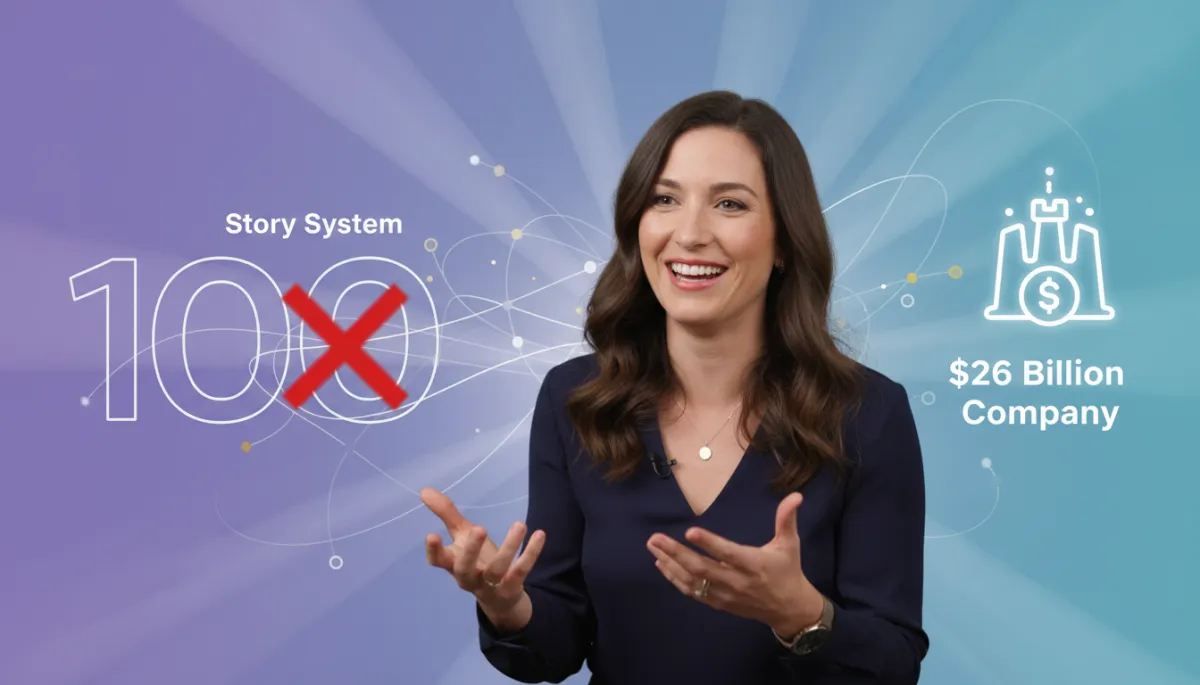
Melanie Perkins' $26B Success: Story Selling Secrets
Sales, Founder-Led Sales, Story Selling
Billionaire Melanie Perkins Was Rejected by 100 Investors Before Building a $26 Billion Company — Is Your Story System the Problem?
Founder-led sales is not about learning slick closing tricks — it is about building a repeatable story system that makes your best customers feel like you are the only logical choice, even before you open your slide deck.

You built the product. You know the problem better than anyone in the room. And yet somehow, the pipeline is thin, deals drag on forever, and the few conversations you do get never seem to close. For many founders, founder-led sales feels like a constant loading screen — calls, demos, decks… and then silence.
Here is the uncomfortable truth: buyers are not rejecting your intelligence or your product. They are rejecting a story that does not help them feel safe, seen, or certain. Melanie Perkins was rejected by more than 100 investors before Canva found its footing — she has said so in multiple public interviews. She did not escape those rejections by finding a magical closer or a secret deck template. She learned how to sell as a founder by turning her own journey into a clear, repeatable narrative about why design was broken and who she was building for. The result: a company valued around $26 billion in 2023, according to Forbes and Bloomberg, even after market corrections.
This guide gives you a practical pitch and story selling system you can use in every call, email, and P.I.T.C.H. Code | Future of Selling System | $22M+ in personally closed deals you send — so you stop guessing what to say and start closing like a founder who knows exactly why their story works.
Why Founders Fail at Founder-Led Sales — And What Is It Actually Costing You Every Quarter?
Trying to sell without a story system is like a surgeon walking into the operating theatre and relying on a textbook they skimmed once in college. They might remember the big ideas — where the heart is, what the instruments do — but in the real procedure, under real pressure, they will hesitate, skip steps, and make dangerous cuts. That is what most founder calls sound like: smart people improvising instead of operating from a tested protocol.
The market is not patient with that kind of improvisation anymore. On July 31, 2026, Forbes reported that “the window to build your personal brand is closing” — and that founders with strong personal brands see dramatically higher trust and close rates than company-only accounts. Translation: if your story is not working, every quarter you are quietly donating deals to competitors whose founders show up with a sharper narrative and a clearer identity.
Three mistakes show up again and again. First, founders pitch features instead of a story — they drown buyers in roadmaps, integrations, and AI buzzwords, but never anchor it in a human problem. Second, when conversations stall, they discount to close, training the market to see them as the cheaper option rather than the only option. Third, they treat sales as separate from their founder identity, something “a future VP of Sales” will fix, instead of understanding that, for now, they are the brand, the trust, and the proof in one person.
That is the difference between a founder who keeps pitching the wrong thing and Billionaire Melanie Perkins, who kept refining her story until the world had no choice but to say yes.
FEATURED
📢 NEW in September 2026 — Founding Member Access!
A rare window of opportunity has opened up to learn from Jason — who since 2015, has quietly helped 1,000+ founders across Asia transform their sales revenue. Founding member access: $0.63/day ($19/month). Includes 3 Case Study Breakdown Videos + 6 Sales Follow-Up Bonuses. 100% risk-free. Cancel anytime.
Start for $0.63/Day →Do you also start to feel it's very invisible to be a founder? Like building the perfect product for a market that cannot find you?
It's not your fault. Most founders feel exactly this way. They've felt like the problem is them — their offer, their confidence, their follow-up. But what they found, every single time, is that the problem was never the product. It was the system they were using to sell it.
And you're not alone. On July 31, 2026, Forbes revealed that "the window to build your personal brand is closing" — and that founders who wait are already losing deals to those who moved first.
That's why it's not easy as a founder right now. It's like trying to navigate by a map drawn for a city that no longer exists.
The good news? Since 2015, Jason has quietly helped 1,000+ founders across Asia transform their sales revenue — turning founders who used to lose deals on price into closers who walk out of rooms with signed contracts. The system he used to do it? It's now yours for $0.63/day ($19/month) — founding member access. Includes 3 Case Study Breakdown Videos + 6 Sales Follow-Up Bonuses. 100% risk-free. Cancel anytime.
See What Changes When You Have a System → dreamaker.club/buyfosThe P.I.T.C.H. Code: The 3-Layer Founder-Led Sales System That Closes Without a Sales Team
How do you do founder-led sales without sounding like you're selling?
Imagine walking into a server room where every cable is plugged in, humming, but nothing is labeled. That is what most sales calls feel like to your buyer — a tangle of points with no clear path. The first layer of the P.I.T.C.H. Code is about labeling the cables so your story feels like guidance, not a pushy sales pitch script.
The direct answer: you stop trying to “do sales” and start narrating the journey you are already on — in a structure that makes the buyer feel like they are stepping into the story with you. Melanie Perkins did this in her public interviews and early pitches. She did not open with Canva’s drag-and-drop editor or template library. She opened with the problem: design was broken, locked behind expensive tools and experts, and regular people could not participate. She was not selling software; she was selling a world where anyone could design anything, from anywhere.
Practically, this means your first three minutes follow a simple arc: Before → Breaking Point → Build. Before: the world as it was for you and your customers. Breaking Point: the moment you realized the current tools or systems were unacceptable. Build: the decision to build your product as the logical response. When you follow this arc, you sound like a human with a mission, not a founder reciting bullet points.
🔍 Founder Story
Alex Wong, 34, is a former product manager who left a SaaS unicorn to build a workflow tool for boutique agencies. For two years, he stumbled through founder-led sales — long demos, polite nods, and then nothing. Every call felt like a technical walkthrough instead of a decision conversation. His core pain was simple: he was talking but not closing, and could not tell why. One evening, after another “great chat” that went nowhere, he rewrote his opener using the Before → Breaking Point → Build arc. On his next call, he spent the first five minutes telling the story of a burned-out agency owner drowning in client work and spreadsheets, then revealed that this was his own brother. The prospect leaned in. They interrupted with their own version of that story. Alex closed that deal at full price, with no discount and no extra follow up. Over the next 45 days, he ran the same story structure on 18 calls and closed 11 of them. The product did not change. The way he told the story did — and that changed everything.
🎙️ Word-for-Word Script
“Before we talk features, can I start with why I built this? Three years ago, I was in your exact seat — juggling clients, a team, and a dashboard that never matched what was really happening. One week, a single missed update cost us our biggest account. That was the week I realized the tools were not broken — the system for running the work was. This product is simply the system I wish I had then, turned into software so you never have to go through that again.”
How do you make your story the pitch instead of listing product features?
Think of your story like a movie trailer, not a technical manual. A trailer does not list every scene; it shows the stakes, the hero, and the turning point. The second layer of the P.I.T.C.H. Code is about turning your founder journey into that kind of trailer — so by the time you mention features, they already make emotional sense.
The direct answer: you map every feature to a moment in your story. When you talk about your onboarding flow, you connect it to the moment you lost a deal because implementation dragged. When you talk about analytics, you connect it to the night you realized you were guessing instead of seeing. The product becomes the visible proof of an invisible journey your buyer can feel themselves inside. Brian Chesky personally met with every early Airbnb host and guest. According to LinkedIn analytics reports from 2024, his personal posts consistently outperform Airbnb's official company page. The founder's story is the company's most valuable sales asset — and he behaves that way every time he shows up online or in a room.
For you, this means your deck and calls follow a simple rhythm: Story Slice → Feature → Outcome. You share a brief moment from your build journey, reveal the feature that came out of that moment, and then anchor it in a clear outcome — saved time, increased revenue, fewer price objections, or faster approvals. This is what story selling for founders looks like in practice: every feature is justified by a lived experience, not a buzzword.
🔍 Founder Story
Priya Shah, 41, is a leadership coach who built a small software tool to help clients track commitments between sessions. She hated selling and defaulted to listing modules, worksheets, and call structures. Prospects nodded, praised her content, and then chose cheaper options. Her turning point came when she realized every powerful feature in her program came from a specific client crisis — a missed promotion, a failed board presentation, a team on the edge of collapse. She rewrote her pitch so each “feature” was introduced by a true story: the Sunday night call from a client in tears, the exact conversation they rehearsed, the metrics that changed 90 days later. Her program became the movie trailer of those transformations, not a menu of deliverables. Within one quarter, she went from closing 1 in 7 calls to 4 in 7, at a higher price point. The only change was this: she made her story the pitch, and suddenly her buyers could see themselves as the next chapter.
How do you close with proof instead of pressure as a first-time founder?
Closing with pressure is like forcing a software update mid-presentation — everything freezes, and people start looking for the exit. The third layer of the P.I.T.C.H. Code replaces pressure with proof. You are not trying to “force install” your solution; you are showing that people just like your buyer have already installed it and are running better because of it.
The direct answer: you design your close as a series of calm checkpoints, each backed by evidence. Instead of “So, are you ready to sign?”, you ask, “Does this solve the specific issues you shared around talking but not closing?” Then you stack proof — client stories, numbers, screenshots, and sales objection scripts that address the fears you know are coming. The buyer does not feel chased. They feel guided through a checklist that ends in a decision they own.
This is especially important in high ticket sales. When the stakes are larger, people are not buying your charm; they are buying your track record. Your job as a first-time founder is to borrow credibility from every small win you already have — the pilot that renewed, the client who upgraded instead of asking to close without lowering price, the user who sent you an unsolicited thank-you email. You close by walking through those proofs like a checklist, then giving a clear next step and a calm silence.
🔍 Founder Story
Daniel Ruiz, 29, built a niche analytics tool for e‑commerce brands. Early on, he panicked at every pricing question and offered discounts before prospects even asked. His revenue grew, but margins collapsed. After losing a dream account that chose a rival at twice his price, he decided to change how he closed. He documented three client stories where his product had increased revenue by at least 18% within 90 days. On his next big call, when the CFO asked about price, he did not flinch. He calmly walked through those three stories, showed the dashboards, and asked, “If we produced a similar lift for you, would this be a good trade?” The CFO paused, then nodded. They signed at list price. Over the next six months, Daniel replaced pressure with proof in every call. He closed fewer “maybe” clients and more ideal ones — and his average deal size increased by 37%. Nothing about his personality changed. The way he used proof did — and that changed how buyers behaved.
🪞 Quick Self-Check
Be honest with yourself. Check off what applies right now:
- ☐ Prospects say your product is “interesting” but go quiet after the call.
- ☐ You rely on discounts or extra bonuses to get deals over the line.
- ☐ You feel confident about your product but unsure what to say first on calls.
- ☐ Your calendar is full of conversations, but revenue does not match the effort.
- ☐ You keep telling yourself you will “fix sales later” once the product is perfect.
If you checked 2 or more — keep reading. Your story is your system. You just haven't built it yet.
Jeffrey Teo used the Future of Selling System — the exact P.I.T.C.H. Code framework — to go from losing deals on price to making $100,000 in 90 days. Stanley Tan made $29,963 in 16 days. Leon closed a $2M partnership. The system is $19. Start here →
Related Reading for Founder-Led Closers
- how to overcome price objections as a founder
- close deals without lowering your price
- high ticket sales for founders

When founders script their story as a system, close rates rise without adding pressure.
Founder-Led Sales FAQ
What is founder-led sales and why does it matter?
Founder-led sales is when the founder personally drives early revenue by selling to customers, investors, and partners. It matters because your credibility, story, and speed of learning are highest at this stage. Done well, it becomes the template your future team scales. Read the full guide: founder-led sales blueprint →
Why do founders fail at selling their own product?
Most founders fail because they talk like builders, not buyers. They lead with features, skip the problem story, and avoid clear asks. Without a repeatable narrative and follow up system, calls feel good but do not convert. Read the full guide: founder-led sales blueprint →
How did Melanie Perkins sell Canva after being rejected 100 times?
Perkins refined her story through more than 100 investor rejections, as she has shared in public interviews. She focused on the problem of inaccessible design and the size of the opportunity, not just features. Over time, that story aligned with market timing and capital. Read the full guide: founder-led sales blueprint →
What is story selling and how does it work for founders?
Story selling is using structured narratives — your journey, client wins, and turning points — to frame your offer. For founders, it shifts conversations from specs to stakes, helping buyers see themselves as the next success story instead of another lead. Read the full guide: founder-led sales blueprint →
How do I know if the P.I.T.C.H. Code will work for my type of business?
The P.I.T.C.H. Code is built around human decision patterns, not one niche. If you sell to humans — software, consulting, or services — you can adapt the structure. The proof: founders from SaaS to coaching have applied it successfully. Read the full guide: founder-led sales blueprint →
Turn Your Story into a System That Closes for You
Picture a version of you six months from now. Prospects join your calls already warmed up by your content. They reference your posts, your founder journey, even your early failures. By the time you share numbers, the decision is mostly made — your story has done the heavy lifting before the calendar invite was sent. That is what a working founder-led sales system feels like: momentum that starts before you speak.
Right now, your reality may look different. You are still improvising your opener. You are still unsure when to talk about price. Some weeks feel like a technical issue in your own pipeline — leads load, calls happen, but revenue stalls on the final screen. The contrast is simple: founders with a story system see each call as another run of a tested script. Founders without one treat every call like a new experiment and wonder why results are inconsistent.
Melanie Perkins endured more than 100 investor rejections, according to her public interviews, while she refined how she framed the Canva problem and opportunity. She paid that price in time, energy, and doubt until the story clicked. The question for you is direct: what is it costing you to keep using the wrong system — in lost deals, delayed hires, and a brand that still feels invisible when it should be leading your category?
The Future of Selling System is not theory. Jeffrey Teo used it to generate $100,000 in 90 days, including a $10,500 single day. Stanley Tan used the same structure to collect $29,963 in 16 days. Leon used it to close a $2M partnership that would have once felt out of reach. These are not lucky breaks; they are the result of running a clear, repeatable founder story on every channel and every call.
Behind this system sits $22M+ in personally closed deals. That matters because you are not buying inspirational quotes — you are licensing a playbook that has already been pressure-tested in rooms where “maybe” was not an option. You get the P.I.T.C.H. Code framework, three case study breakdown videos that show you exactly how founders like you applied it, and five Billionaire Bonus Packs that help you adapt the system to your niche and offer size.
| Sales Coach | Workshop | Future of Selling System | |
|---|---|---|---|
| Cost | $500 / hour | $5,000 – $15,000 | $19 |
| Format | Appointment-based | One-time event | Instant access |
| System included | Generic advice | Limited scripts | P.I.T.C.H. Code — complete |
| Proven results | Varies | None documented | Jeffrey Teo · Stanley Tan · Leon |
| Access | Ongoing cost | Ends same day | Lifetime |
The urgency is real. Forbes has already warned that the window to build a founder-led personal brand is closing. Every month you delay, competitors are training your market to trust their story more than yours. The longer you wait to install a system, the longer you stay stuck in manual mode — guessing what to say, reacting to objections, and hoping the next quarter will finally “click.”
Get the Future of Selling System for $19 →
Melanie Perkins was rejected 100 times. She refined her story and built $26 billion. You have been rejected less than that — and the system that fixes it is $19.


