Mikhail Fridman just filed a €15 billion lawsuit against a government — and walked free.
That sentence probably feels like geopolitics. It is not. It is the cleanest demonstration of buyer leverage you will see this decade — and almost every founder reading it will completely miss the lesson inside it. Read that again: one man, with frozen assets, under sanctions from an entire economic bloc, found the one move that made a government blink. Not charm. Not begging. Not waiting. A consequence so large that inaction became more expensive than capitulation.
Why This Should Make Every Founder Deeply Uncomfortable
Think about the last deal you lost. Or the last time a prospect said "we'll circle back" and never did. Or the proposal that sat in someone's inbox for three weeks while they "got alignment." You probably did what most founders do: followed up politely, waited patiently, and eventually accepted the silence as a verdict.
Here is the part that should sting: the real reason your prospect did not move was not budget, not timing, and not competing priorities. It was because you gave them no cost for saying no. There was no consequence for their inaction. No lawsuit. No expiry. No asymmetric risk. Just you, waiting, hoping, and slowly becoming less and less relevant.
Fridman's story is a mirror. Not because you should sue your clients — you should not. But because the underlying psychology is identical. Buyers, whether they are sovereign governments or mid-market procurement managers, move when the cost of NOT acting exceeds the cost of acting. Full stop. That is not cynicism. That is how decisions get made at every level of power.
What Actually Happened — And What The Headlines Buried
On September 22, 2026, the Council of the European Union voted to remove two names from its Russia sanctions list, according to Eastern Herald (September 25, 2026). One of those names was Mikhail Fridman, the Ukrainian-born banker who co-founded Alfa-Bank, one of Russia's largest private lenders (Eastern Herald, September 25, 2026). Fridman had been under EU sanctions since March 2022, weeks after Russia launched its military operation in Ukraine (Eastern Herald, September 25, 2026).
His assets across EU jurisdictions had been frozen (Eastern Herald, September 25, 2026). His freedom of movement inside Europe had been severely curtailed. And yet, on September 22, the bloc that froze him quietly deleted his name from the list. The mechanism that unlocked it: Luxembourg cited a €15 billion lawsuit filed by Fridman against it as the rationale for backing his removal (Eastern Herald, September 25, 2026).
The decision was not unanimous, and the internal negotiations that preceded it were, by several accounts, bitter (Eastern Herald, September 25, 2026). An unnamed European diplomat described the moment plainly: "It really sends the signal that you can blackmail your way to delisting" (Eastern Herald, September 25, 2026). Ukraine's Foreign Minister Sybiha called it "shameful and unjustifiable" (Eastern Herald, September 25, 2026).
Set aside the geopolitics. Look only at the mechanism. A man with frozen assets, facing one of the world's most powerful regulatory bodies, found a lever large enough to change the cost-benefit calculation of his largest opposing stakeholder. Billionaire Mikhail Fridman's move is one Jason has seen across 1,000+ founders. Here's what most miss.
The Root Cause Most Founders Never Diagnose
Most founders think the problem is that buyers keep saying no. But the real problem is that they have given buyers zero consequence for saying no.
When there is no consequence for delay, delay is free. When there is no consequence for rejection, rejection is safe. When there is no consequence for inaction, inaction becomes the path of least resistance — and your prospect will take it every single time.
The engineered lesson from this story is this:
"Your buyer's 'no' is only permanent when you've given them no cost for saying it."
Now, here is the nuance most people will get wrong when they hear this. Creating consequence does not mean threatening people. It does not mean manufactured scarcity or fake deadlines. It means building real asymmetry into your positioning — so that the cost of NOT buying your solution, NOT engaging your offer, NOT making a decision right now, is genuinely higher than the cost of saying yes.
Fridman did not invent a consequence. He quantified one that was already real: Luxembourg's exposure to a €15 billion legal liability. He simply made the cost of inaction explicit, enforceable, and impossible to ignore.
That is exactly what the best-positioned founders do. They do not beg. They do not follow up for the eighth time. They build offers where the cost of not acting is so visible, so specific, and so credible that the buyer's internal dialogue shifts from "should I?" to "can I afford not to?"
This is positioning as leverage. And it is the skill that separates founders who close from founders who follow up.
Founder Story Card
The visible problem: Prospects keep saying "not now" and deals stall after the first meeting.
The real root cause: The founder's offer carries no consequence for inaction — the buyer's world is identical whether they say yes or no.
The founder lesson: Fridman did not beg Luxembourg for removal. He filed a lawsuit that made inaction more expensive than capitulation. Founders must build the equivalent in their sales positioning: a credible, specific cost for the buyer who delays or declines.
The move to make now: Audit your current offer. Ask: what does my prospect lose — specifically, measurably — every week they do not engage? If you cannot answer that in one sentence, your positioning has no leverage, and your buyer has no reason to move.
The Hidden Opportunity Inside This Story
Right now, most of your competitors are selling on features, outcomes, and testimonials. They are pitching the upside of saying yes. That is a crowded lane.
The founders who will break through in the next 12 months are the ones who learn to make the cost of inaction visible, specific, and credible. Not manipulative. Not hypey. Credible. Rooted in real business consequence: market share eroding, competitor advantage compounding, talent lost, revenue delayed, quarter missed.
When every other founder is selling the dream of saying yes, you become the one who holds up a mirror to the cost of saying no. That is not a tactic. That is a positioning revolution — and it is available to any founder who is willing to do the diagnostic work to find the real asymmetry in their offer.
The window for this is narrow. As more founders learn consequence-based positioning, the advantage it creates will narrow. The founders who move first, build it cleanly, and systematise it will own the positioning advantage for years.
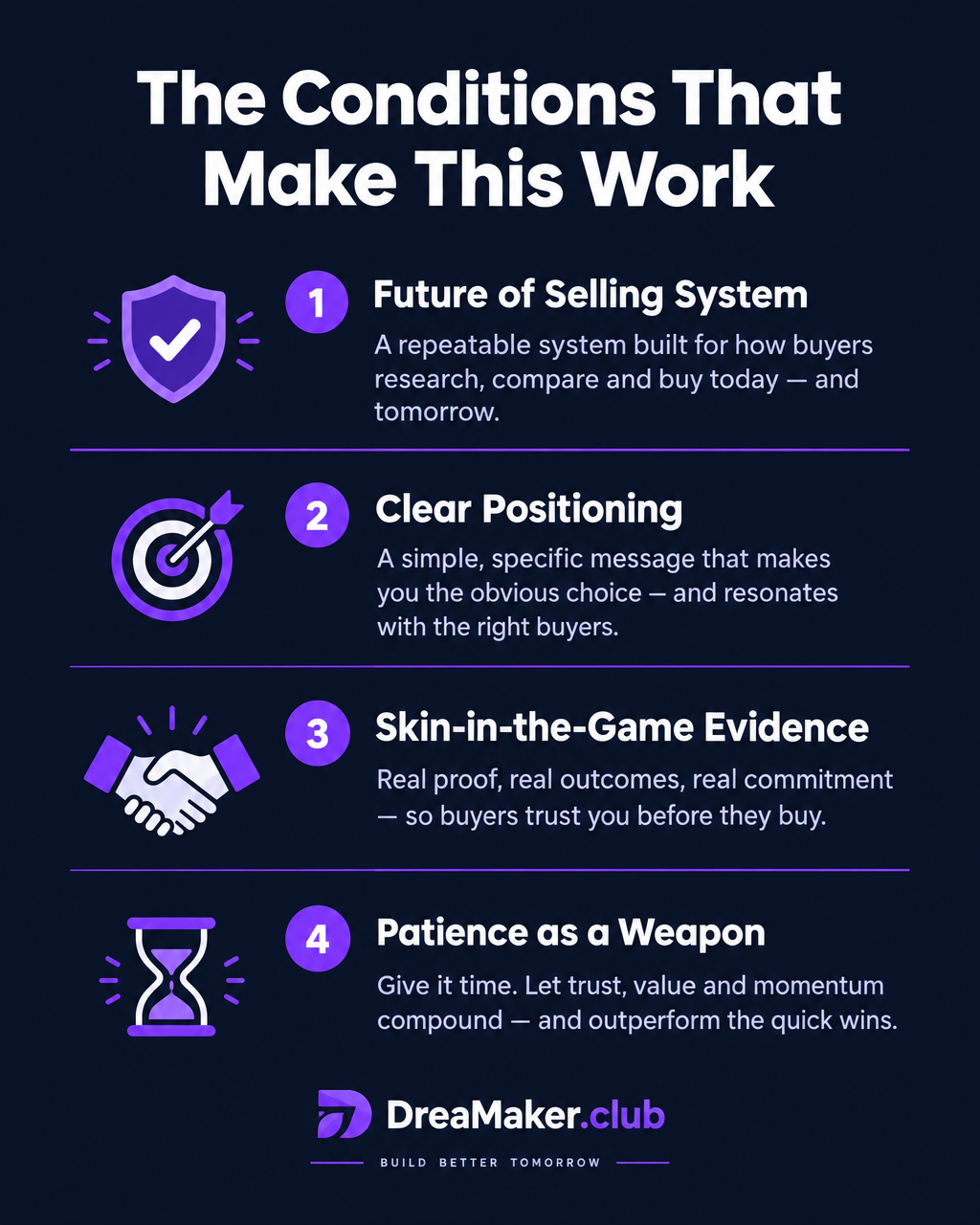
The Conditions That Make This Work
- Future of Selling System: Without a structured framework for turning your expertise into a leverage-based sales system, consequence-based positioning becomes a one-off tactic instead of a repeatable engine. FOS is the foundation that makes everything below it scalable.
- Clear Positioning: You must know precisely what your buyer loses without you — not in vague terms, but in specific, time-bound, quantifiable business language. Vague positioning cannot carry consequence. Precise positioning can.
- Skin-in-the-Game Evidence: Fridman's lawsuit was credible because it was real. Your consequence must be credible too — backed by case studies, data, or a track record that makes the cost of inaction undeniable rather than theoretical.
- Patience as a Weapon: Fridman's play unfolded over months of behind-the-scenes lobbying before the vote (Eastern Herald, September 25, 2026). Leverage-based positioning is not a one-call close. It is a system you build, hold, and let compound — while competitors panic and discount.
Fridman already moved. The only question is whether you will — or whether you'll read about someone else who did.


