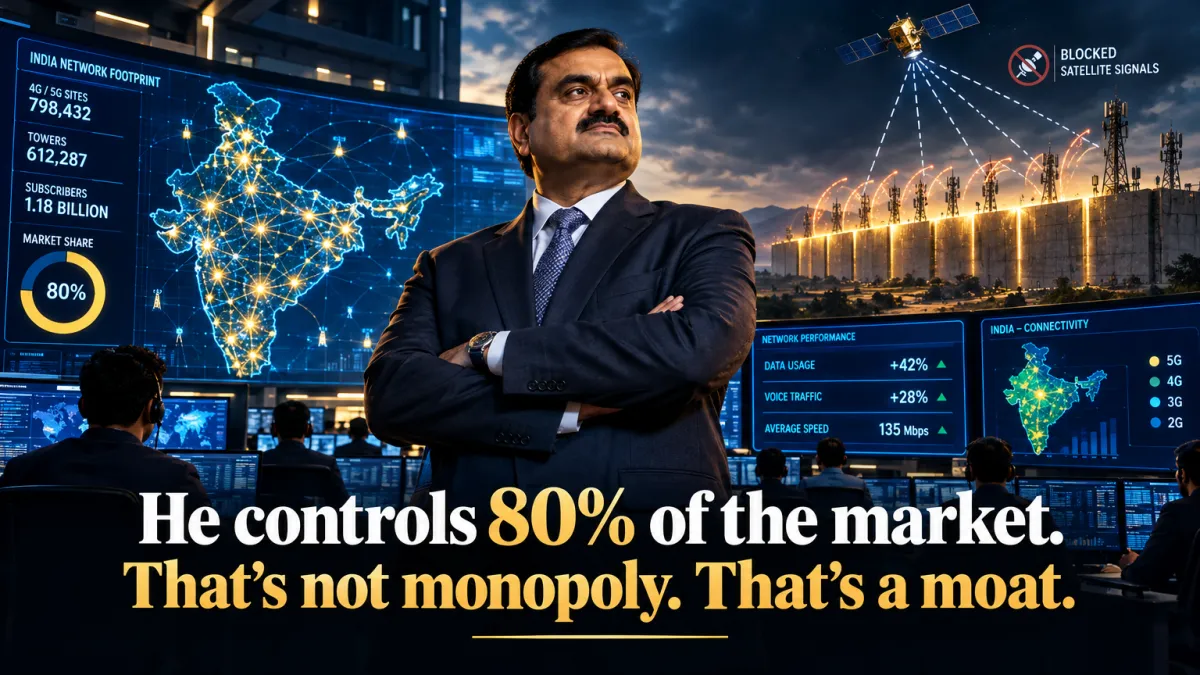
Billionaire Mukesh Ambani Just Made Elon Musk Beg — And It Changes Everything For Founders Who Don't Own Their Distribution
Part 1 — The Hook
The world's richest man just publicly begged Mukesh Ambani for permission to operate in India — and Ambani didn't even reply.
On October 9, 2026, Elon Musk posted on X addressing Ambani as Dear Prime Minister Ambani — a mocking title that accidentally revealed a devastating truth. Musk, whose Starlink is licensed in over 166 countries, cannot get final commercial clearance to launch in India. He has been trying since 2022. Ambani said nothing. His 520 million Jio subscribers said everything.
Part 2 — Why This Should Make You Uncomfortable
Read that again slowly. The world's richest man — a person worth over $1 trillion at his peak — is publicly pleading on social media for the right to compete in a market. And the man he's pleading with didn't even pick up the phone.
Now ask yourself this: where are you renting your customers from?
If your revenue depends on a platform you don't control — an algorithm, a marketplace, a referral partner, a landlord's foot traffic — you are in the same position as Elon Musk right now. Except you don't have a trillion dollars in reserve while you wait. You have a payroll to meet next month. The founders who feel this most acutely are the ones whose pipelines dry up the moment one channel goes quiet. They've been renting distribution for years and calling it a business. The clock on that model is ticking.
Part 3 — What Actually Happened
Billionaire Mukesh Ambani's Reliance Industries is India's largest privately-owned conglomerate, spanning oil-to-chemicals, telecommunications, retail, media, and green energy (Reuters, October 9, 2026). The telecom arm, Reliance Jio, served over 520 million subscribers as of March 31, 2026, making it India's leading internet service provider (Forbes, October 8, 2026). Together with Bharti Airtel, Jio controls approximately 80% of India's telecom market (Semafor, October 10, 2026). Ambani's estimated net worth is nearly $80 billion (Forbes, October 8, 2026).
SpaceX has spent five years trying to launch Starlink in India. It holds an Indian telecom license. It received spectrum allocation approval after India chose the administrative route — a decision Musk's side lobbied for and won (TechCrunch, October 9, 2026). Jio had pushed for an auction and lost that policy fight. But Starlink still has not launched commercially, awaiting final security clearance from the Indian government (Al Jazeera, October 11, 2026). Meanwhile, Jio itself is building a 1,600-satellite LEO network and its parent, Jio Platforms, is targeting a $106 billion valuation in India's largest-ever IPO — with the filing timed precisely as this public war of words erupts (Al Jazeera, October 11, 2026). Roughly 500 million Indians still lack internet access (Forbes, October 8, 2026) — a market so large it is, in Musk's own words, a generational opportunity.
Ambani didn't threaten Musk. He didn't lobby publicly. He didn't post on X. He simply owned the road so completely that the most powerful disruptor on Earth had to ask for a lane.
Billionaire Mukesh Ambani's move is one Jason has seen replicated across 1,000+ founders. Here's what most miss.
Part 4 — The Lesson Most Founders Are Missing
Root Cause Reframe
Most founders think the problem is competition. A cheaper rival. A better-funded newcomer. A platform that changes the rules. So they panic, they discount, they hustle harder, they post more content and hope the algorithm rewards them this week.
But the real problem is distribution dependency. You don't own the road your customers travel on. Someone else does — and the moment it serves their interests to close the gate, you're standing outside asking for permission to compete. Just like Elon Musk.
This is why founders with decent products still lose to founders with weaker products. The winner rarely has the best offering. The winner has the deepest, most owned distribution — the most direct relationship with the buyer that no platform or gatekeeper can revoke.
Ambani didn't build a moat by being smarter than everyone. He built one by owning 520 million relationships so deeply that any competitor trying to reach those people has to go through him. That's not monopoly. That's the end state of a distribution strategy executed at scale.
You don't have decades. But you can start this week.
The Lesson
The founder who controls the road controls who gets to drive on it. Build your own distribution or rent someone else's forever.
Founder Story
Jeffrey Teo had no platform advantage. He had a system.
When Jeffrey Teo went through the Future of Selling System, he wasn't worried about algorithms, referrals, or gatekeepers. He installed a direct, structured selling process and used it to acquire 63 customers in 100 days — without spending on ads and without relying on any single channel. Distribution you own is the only kind that compounds. Everything else is a lease.
Part 5 — The Hidden Opportunity Right Now
The Hidden Opportunity
Every major platform — from search engines to social media to app stores to industry directories — is in the middle of a tightening cycle right now. Organic reach is down. Paid costs are up. Referral partners are consolidating. Marketplace algorithms are being repriced quarterly. The founders who act before their primary channel shifts are the ones who land safely. The ones who act after are the ones posting their panic on LinkedIn and calling it a pivot.
The opportunity right now: most of your competitors are still renting their distribution. They are platform-dependent, algorithm-dependent, or referral-dependent. The moment you install your own direct selling system — one that generates, converts, and closes buyers through a repeatable, owned process — you become ungatekeeper-able. No one can block you. No one can revoke your license to compete.
That window is open now. It will not stay open forever. Ambani built his moat over two decades. You can build yours in 90 days.
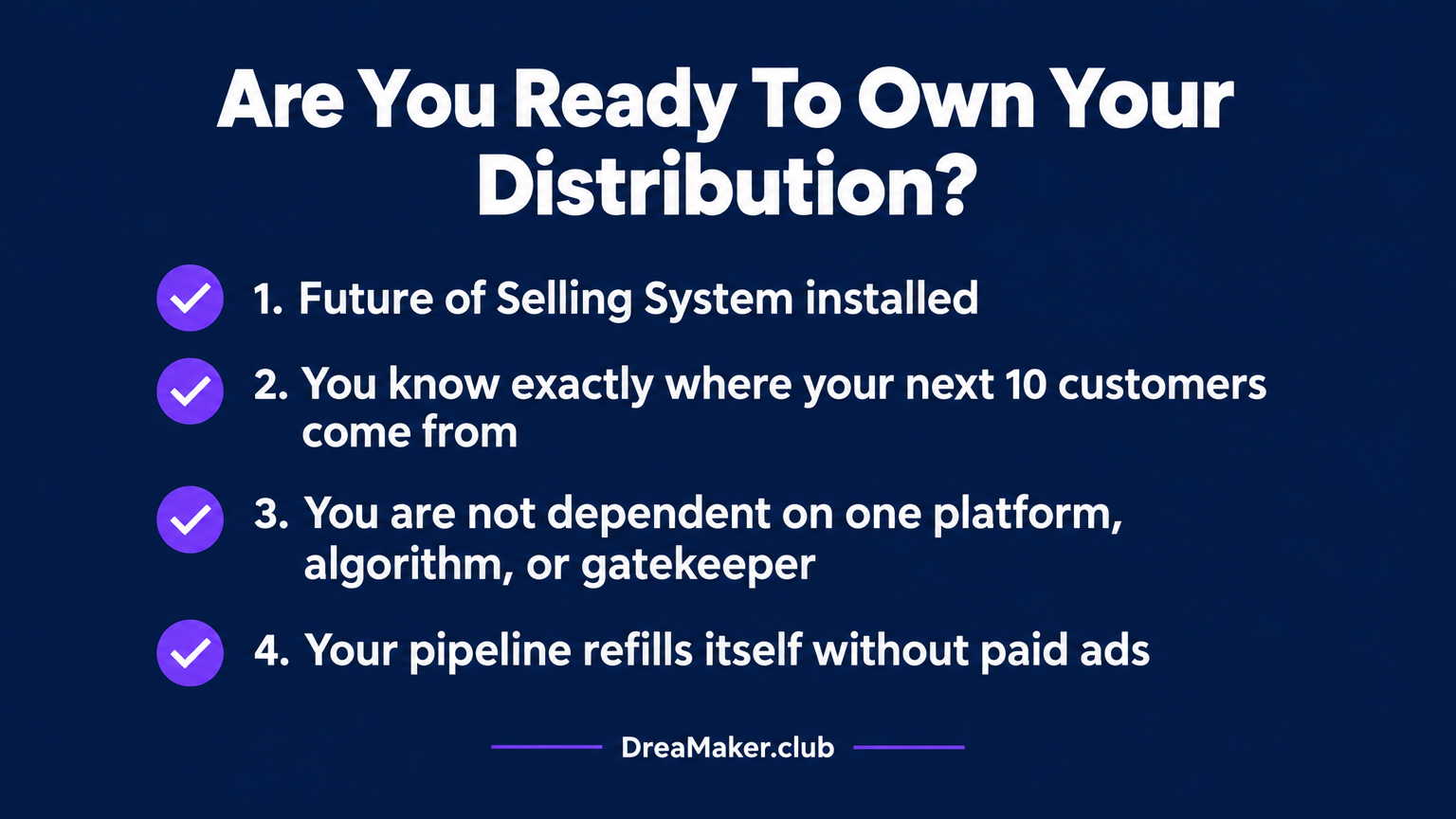
Are You Ready To Own Your Distribution? Check All 4 Conditions.
Conditions Checklist — All 4 Must Be True
✅ Condition 1: You have the Future of Selling System installed. A repeatable, step-by-step process for generating, nurturing, and closing buyers — one that works regardless of what any platform decides to do next. Get it at dreamaker.club/buyfos
✅ Condition 2: You know exactly where your next 10 customers are coming from. Not somewhere online. Not referrals hopefully. A named, specific source you control and can activate on demand.
✅ Condition 3: You are not dependent on any single platform, algorithm, or gatekeeper. If your main channel went dark tomorrow, your pipeline would still refill. If the answer is no, this is your most urgent problem.
✅ Condition 4: Your team of 5 or more is selling, not just you. Owned distribution does not scale if only the founder can run it. Your system must be teachable and transferable — or it is still a dependency, just a different kind.
NEW!
October 2026
Dear Founders — if your next customer depends on a platform you don't control, you're one algorithm change away from zero.
Elon Musk has over 12 million Starlink subscribers and a trillion-dollar empire — and he still could not get a single paying customer in India without Ambani's permission. You don't have Musk's runway. You need to own your pipeline before someone closes the gate.
I know how that feels — watching a competitor enter your market and realising your whole pipeline is built on someone else's infrastructure. I've felt it. Here's what I found: founders who install a direct, owned selling system stop competing on someone else's terms. They set their own.
Salesforce's State of Sales report found that 76% of sales professionals say their sales tools and processes need to be updated — meaning most of your competitors are operating a broken or borrowed system right now. This is your window.
Since 2015, Jason has worked with 1,000+ founders who have generated $22M+ in combined sales using the Future of Selling System. Jeffrey Teo: 63 customers in 100 days. Stanley Tan: 45 buyers in 3 hours. Leon: $2M partnership. These weren't lucky — they were systematic.
Not ready for $19? Start free.
The Objection Playbook: 25 Word-for-Word Scripts to Close More Sales
The exact words Jason's founders use when a buyer says too expensive, send me info or I need to think about it. Free PDF, sent to your inbox.
Send Me the 25 ScriptsBillionaire Mukesh Ambani already built the road. The only question is whether you will build yours — or whether you will spend the next five years asking someone else for permission to compete.


