
Billionaire Peter Thiel Is Lecturing on the Antichrist — And It's The Most Powerful Sales Lesson Founders Are Missing
Billionaire Peter Thiel Is Lecturing on the Antichrist — And It's The Most Powerful Sales Lesson Founders Are Missing

Part 1 — Hook
Peter Thiel is running secret antichrist lectures — and the real lesson has nothing to do with theology.
The man who co-founded PayPal, made the first outside bet on Facebook, and built Palantir into a government intelligence giant does not make theatrical moves without a framework underneath them. His four-part Nashville Antichrist Lecture series — closed-door, invite-only, launching September 28, 2026 — looks like eccentricity on the surface. Founders who stop there are missing the signal entirely. This is a live demonstration of the rarest and most commercially powerful force in any market: the willingness to hold a belief most people will not go near.
Part 2 — Press
Here is what should make you uncomfortable if you run a startup.
Thiel does not pitch. He does not soften his views for a broader audience. He does not hedge his theology, his politics, or his investment frameworks to avoid losing people. He held a conviction about monopoly capitalism when every business school was teaching competition as virtue. He backed Trump when Silicon Valley treated it as career suicide. He built Palantir on a philosophy of information asymmetry that most founders would be afraid to articulate in a pitch deck.
And now, while he is one of the world's wealthiest people — co-running Founders Fund with portfolio companies including Stripe, valued at $159 billion as of February 2026, and SpaceX, which is planning to go public at a valuation of $1.75 trillion — he is hosting closed-door lectures about the antichrist in Nashville, as reported by Cybernews on September 16, 2026.
The question is not whether you agree with him. The question is: what does your business believe strongly enough to say out loud — even in a room full of people who might not like it? Most founders cannot answer that. And that silence is precisely what is costing them sales.
Part 3 — Play
The facts here are verifiable and they matter.
Peter Thiel co-founded PayPal alongside Elon Musk, then went on to co-found Palantir Technologies, the data analytics firm that has become a cornerstone of government and enterprise intelligence work, according to Forbes. In 2004, he made the first significant outside investment in Facebook, per Forbes. His venture firm, Founders Fund, has backed Stripe and SpaceX among others. His Thiel Foundation provides $100,000 fellowships over two years to young entrepreneurs willing to skip college and build companies instead, also per Forbes.
As reported by Cybernews on September 16, 2026, Thiel is staging a four-part closed-door lecture series in Nashville titled The Nashville Antichrist Lectures, beginning September 28, 2026. The lectures follow earlier sessions he ran in San Francisco and Rome. Thiel has previously described the antichrist, per Cybernews citing The Guardian, as an evil king, tyrant, or anti-messiah tied to end-times theology. Each Nashville session will feature an hour-long lecture followed by discussion and Q&A, and is invite-only.
A Deutsche Welle profile published September 20, 2026 described Thiel as someone who is hard to pin down — and that is precisely his power. He has never been a product of consensus. He has always been a product of conviction.
Billionaire Peter Thiel's move is one Jason has seen across 1,000+ founders. Here is what most miss.
Part 4 — Lesson + Root Cause Reframe
Root Cause Reframe
Most founders think the problem is that buyers do not understand their offer. But the real problem is that the founder does not hold a belief strong enough for buyers to feel.
Buyers do not buy products. They buy certainty. And the fastest way to transfer certainty to a buyer is to carry so much of it yourself that the room changes when you speak. That is not charisma. That is conviction. And conviction is built on a clear, defensible worldview — not a list of features.
Thiel has been demonstrating this principle since at least 2014, when he wrote in the Wall Street Journal that competition is for losers — arguing that lasting value accrues to companies that escape competition and establish durable monopolies through proprietary technology, network effects, economies of scale, or brand moats. That was not a soft, consensus-friendly take. That was a declared worldview. And it made people lean in or push back — which is exactly what high-conviction positioning does.
The engineered lesson for founders:
Conviction is the most powerful sales system ever built — and the one most founders are too afraid to deploy.
Most founders build messaging designed to offend nobody. They round off every sharp edge, add qualifiers, and use phrases like we help businesses and tailored solutions and we work with a wide range of clients. That language is designed to avoid rejection — and it succeeds perfectly. It also avoids connection, recall, referral, and close.
Thiel's antichrist lectures are not a distraction from his business thinking. They are an extension of it. He is someone who holds a distinctive worldview and shares it without permission-seeking. That behavior — practised in business, theology, philosophy, and politics — is what makes him someone buyers of capital want to be near. Founders who operate from that same posture build businesses that attract their ideal client and repel everyone else. That is not a bug. That is the feature.
Founder Story Card
The visible problem: A SaaS founder's conversion rate on discovery calls had dropped to 12%. He was speaking to the right prospects but nothing was landing. He kept being told we will think about it.
The real root cause: His pitch was designed to be liked by everyone — which meant it was felt by no one. He had filed off every sharp edge that would have made his worldview clear and his offer undeniable to the right buyer.
The founder lesson: Conviction is transferable. When you hold a clear point of view about why the status quo is broken and what the world looks like on the other side of your solution, buyers do not need to think about it — they either see it immediately or they do not. Either answer is useful.
The move to make now: Identify the one belief at the core of your business that your best clients already hold — and your worst fits reject. Lead with that belief. Build your messaging from conviction outward, not from features inward.
Part 5 — Opportunity + Conditions
The Hidden Opportunity
The market is flooded with safe pitches. Every competitor your prospects are talking to is using polished, inoffensive, interchangeable messaging. The opportunity right now is not to be better — it is to be believable. To show up with a declared worldview and a sales system built around transferring your conviction to the exact buyers who already lean toward it.
Thiel's Nashville lectures are closed-door and invite-only. That exclusivity is not accidental. It is a precision filter — ensuring that only people already aligned with the worldview gain access. That is the same principle that makes conviction-based selling so powerful: you do not close everyone, but you close the right ones at a dramatically higher rate, and you spend zero energy managing indifference in the sales cycle.
Founders who move now — who use this moment to build a sales posture around conviction rather than comfort — will own the differentiated position in their market before the next wave of polished, forgettable competitors arrives.
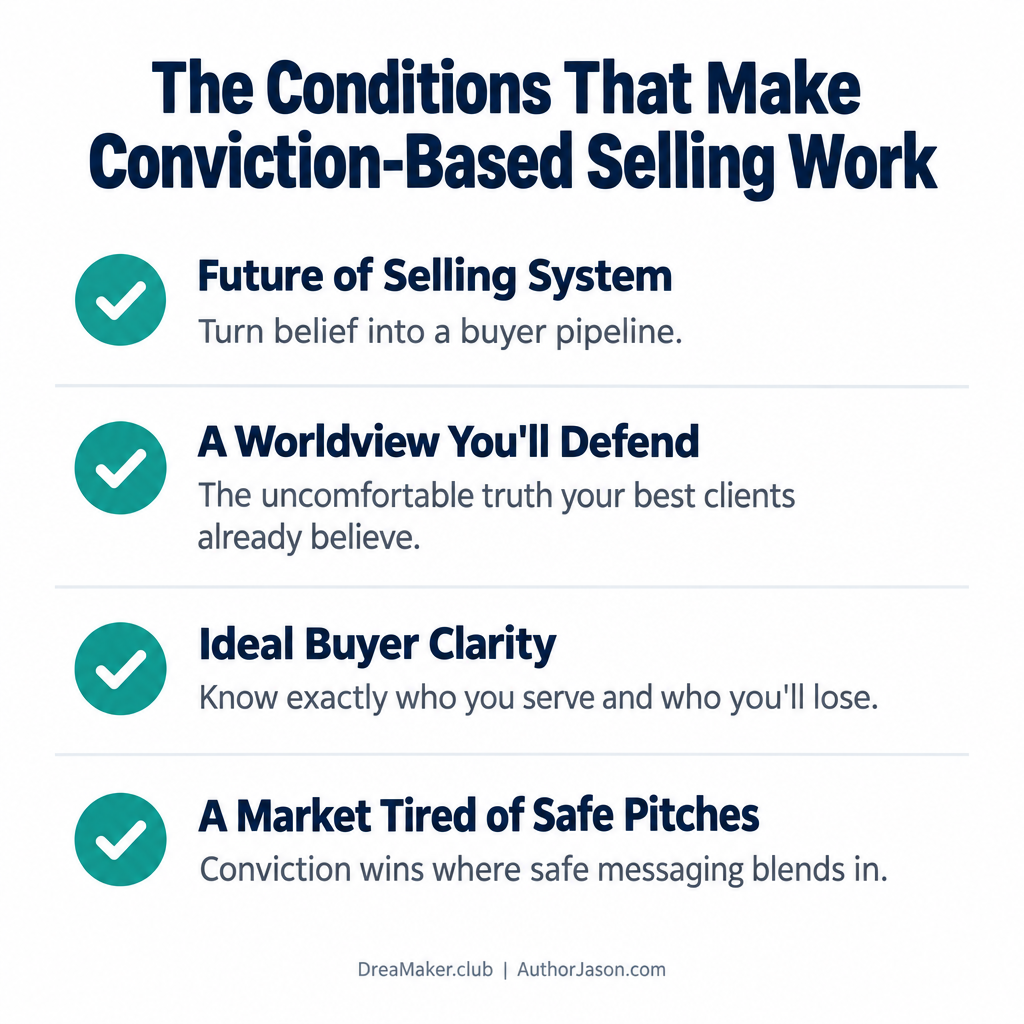
The Conditions That Make Conviction-Based Selling Work
- Future of Selling System: You need a structured framework to convert your conviction into a buyer pipeline — one that generates trust before the first sales conversation begins. FOS gives you that system. Without it, conviction stays in your head and never reaches your market.
- A Worldview You Will Defend: Identify the uncomfortable truth your best clients already believe and your worst fits reject. If your positioning offends nobody, it compels nobody.
- Ideal Buyer Clarity: Thiel's lecture series is invite-only. Your market positioning should operate the same way — not by being exclusive for the sake of it, but by being clear enough that the right people self-select toward you and the wrong ones self-select away.
- A Market Tired of Safe Pitches: Conviction wins precisely where safe messaging blends in. If your competitors all sound the same, a clear worldview is not a risk — it is the lowest-risk move available.
Part 6 — Native Ad
Part 7 — Sting
Thiel already moved. The only question is whether you will — or whether you will read about someone else who did.


