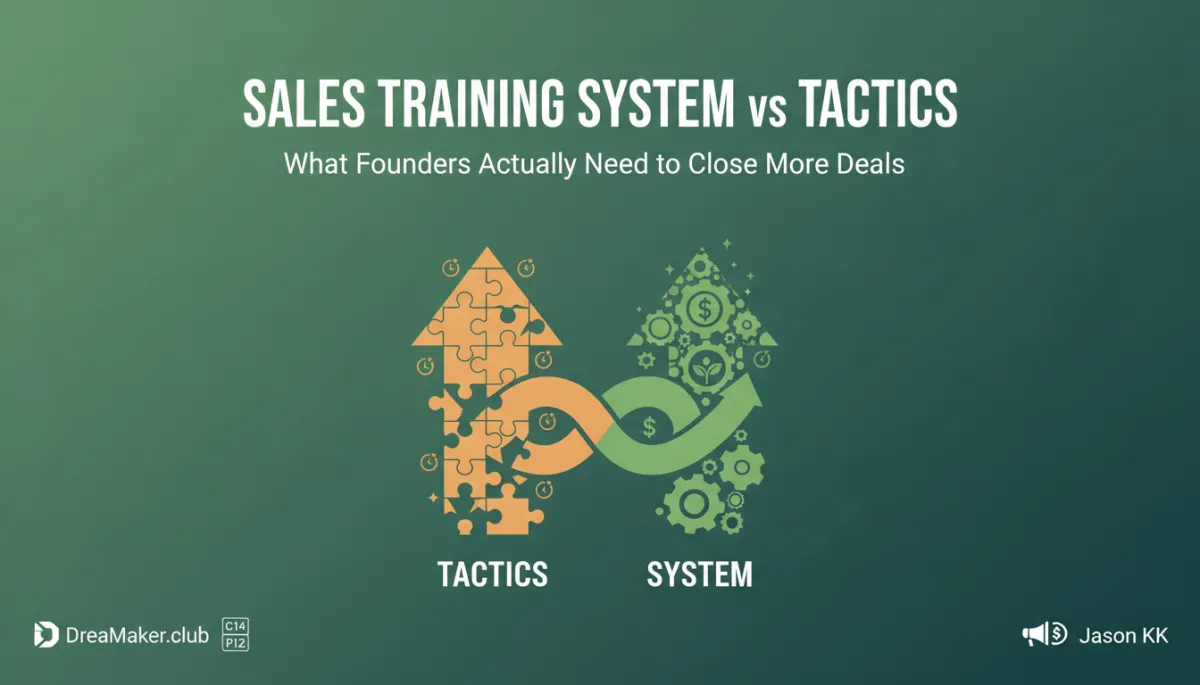
Sales Systems vs Tactics: Lessons from Steve Jobs
Sales Systems, Startup Growth, Founder Coaching
Sales Training System vs Tactics — What Billionaire Steve Jobs Quietly Understood (and What Founders Miss)
You don’t have a leads problem. You have a system problem. This guide shows startup founders why chasing tactics stalls revenue, how a real sales training system compounds, and what to do if you’re the only closer on your team right now.

Why Most Founders Get Stuck in Tactics While Systems Quietly Compound
If you’ve been leading a team of five or more, you’ve already felt this: you collect scripts, objection handles, “perfect” cold email templates, yet every quarter feels like a reset. Revenue spikes, then dips. Your best month still feels like an accident. That’s the hidden cost of living in tactics. They’re seductive because they promise fast wins. But for founders, especially those building real companies, the question isn’t “What trick closes this next deal?” — it’s “How do I build something my team can run without me?” That’s where a true sales training system vs tactics for founders becomes the real dividing line between hustling and scaling. Tactics expire. Systems compound. Jason has watched this play out across $22M+ in combined sales and 1,000+ founders since 2015 — including his own three rock-bottom crashes and three comebacks. The pattern is always the same: when founders rely on tactics, they burn out. When they install a system, the business finally starts compounding without them having to white-knuckle every deal.
What a Sales Tactic Is — and Why It Expires
A sales tactic is a context-dependent move. It’s the clever line you drop at the end of a call. The limited-time bonus. The new DM opener you grabbed from a thread. Tactics can work — sometimes spectacularly — but only inside a narrow window: the right channel, the right buyer sophistication, the right timing. They are period-specific. What crushed on LinkedIn in 2021 feels spammy now. What sounded fresh in your market last year is background noise today. Buyers adapt. Competitors copy. Platforms change rules. Your once-brilliant tactic decays in real time. That’s why founders who live in tactics feel like they’re always chasing the next “hack.” They’re stuck in an arms race against buyer resistance. The deeper issue? Tactics don’t stack. You can’t just bolt twenty tricks together and call it a sales machine. Without an underlying structure, each new tactic introduces more randomness, not more predictability. So your revenue graph ends up looking like a heart monitor — up, down, up, down — and you can’t explain why.
What a Sales System Is — and Why It Compounds
A sales system is different. It’s a repeatable, teachable sequence that produces similar outcomes regardless of who runs it. Think of it as an operating system for how your company sells. In a real system, you can describe your process in clear stages: from how strangers first hear about you, to how they book a call, to how that call is run, to how follow-ups and decisions happen. Each stage has a defined purpose, a clear “done,” and a small set of behaviors that anyone on your team can learn. That’s why a system compounds. When you tweak one stage — say, your discovery questions — the improvement ripples through every future call, no matter who runs it. Over time, your close rates, deal sizes, and sales cycle all improve in ways you can actually measure. A true sales system vs tactics for founders also has another crucial property: it doesn’t depend on personality. You don’t need to be the loudest, the funniest, or the most charismatic person in the room. You need a framework that makes ordinary team members reliably effective. That’s what lets founders finally step back from being the bottleneck and step into being the architect.
What Steve Jobs’s Launch System Shows
It’s tempting to look at Jobs on stage and think, “Well, that’s just charisma.” But study Apple’s major launches across years and you’ll notice something more interesting: a repeatable framework. The pattern shows up again and again. First, a clear, painful problem in the current world. Then, a simple, almost inevitable solution. Next, the story — why this matters now, why this product exists. Then the live demo that makes the abstract tangible. Finally, the close: pricing, availability, the moment of decision. Vision → design → story → simplicity → demo → close. Different products, same underlying structure. That is a system. It’s no accident that Apple could train others to present, demo, and sell inside stores worldwide. The magic wasn’t in a single clever line; it was in the sequence. For founders, this is the quiet lesson: if your pitch changes completely every time you talk about your product, you’re not running a system. You’re improvising. Jobs didn’t rely on improvisation. He relied on a launch system so repeatable that almost anyone in Apple could deliver it and still move billions in product.
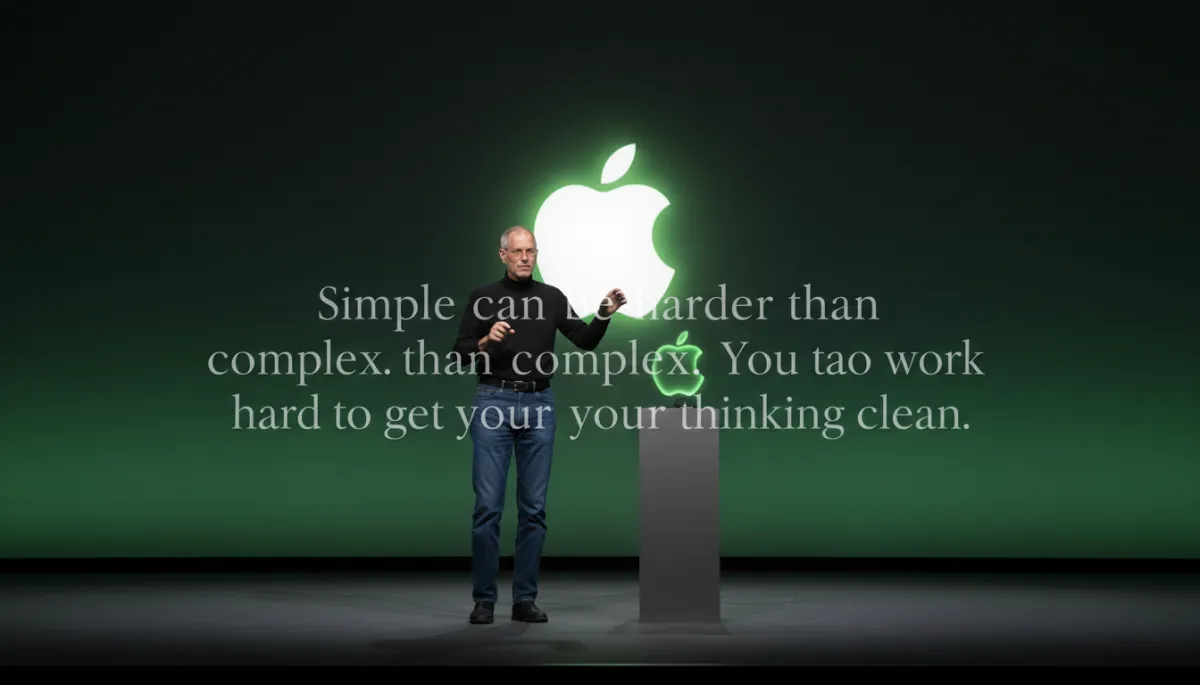
Jobs’s launches followed a consistent problem-solution-demo-vision-close pattern, not random tricks.
The Signs You Are Running Tactics Not a System
- You cannot describe your process in 5 steps. When someone asks, “How do you sell this?” you ramble for ten minutes or shrug. There’s no simple map, just a cloud of moves you “sometimes” use.
- Your results change every month unpredictably. One month is record-breaking, the next is quiet, and you can’t pinpoint why. You’re flying on vibes, not a controllable process.
- Only you can close — no one else on the team can replicate it. You keep telling yourself, “I’ll train them later,” but when you try, you realize you don’t actually know what you do differently. It just “feels right” when you do it.
- Every sales conversation feels improvised. You and your team wing it. No consistent discovery questions, no shared structure for handling objections, no defined close. Every call is jazz, no sheet music.
- You keep buying new tactics hoping one will fix everything. New course, new script, new framework every quarter. The stack of PDFs grows, but the pipeline doesn’t stabilize. That’s the clearest sign you need a sales system vs tactics rethink.
What is the difference between a sales training system and tactics for founders?
For founders, the difference is existential. Tactics help you close a deal this week. A sales training system helps your team close deals this year and next year. Tactics focus on “what do I say now?” A system focuses on “what happens before, during, and after every conversation — and how do we make that predictable?” When you think in systems, you design touchpoints, scripts, discovery flows, follow-ups, and metrics so that your company can keep selling even when you’re deep in product or fundraising. That’s why why founders need a sales system not tactics becomes obvious the moment they try to scale beyond their own calendar.
Can a small startup really afford to build a sales system?
The better question is: can you afford not to? Research from firms like Harvard Business Review shows that companies with defined sales processes consistently outperform those without. For a team of five or more, the real cost isn’t the software or training — it’s the opportunity cost of every deal that dies because there was no structured follow-up, no clear discovery, no aligned messaging. A simple, founder-led system can start as a one-page map and a few call frameworks. From there, you iterate. The earlier you start, the easier it is to train your next hire and avoid building your entire revenue engine around your personal heroics.
How do I transition my team from tactics to a system?
Start by documenting what already works when you sell. Record a few calls. Note the questions you always ask, the way you frame the problem, the order you present options. Then, compress that into a simple, step-by-step flow your team can follow. Next, choose one metric to improve — for example, the percentage of calls that move to proposal — and run experiments inside the system, not outside it. Finally, train your team on the framework, not just lines. Encourage them to understand why each step exists. Over a few cycles, your company moves from “everyone doing their own thing” to “everyone playing the same playbook,” which is the essence of a real sales training system vs tactics for founders who want to scale.
Why Jason Built a System — the P.I.T.C.H. Formula
Jason didn’t set out to create another collection of tactics. After three cycles of hitting rock bottom and rebuilding — across $22M+ in combined sales and over 1,000 founders since 2015 — he noticed the same pattern: founders who won long term weren’t the ones with the flashiest scripts. They were the ones with quiet, boring systems that their teams could run without them. That’s why he built the Future of Selling System (FOS) around the P.I.T.C.H. Formula — a framework designed specifically for founders who are ready to move from heroic selling to scalable selling. Instead of dumping dozens of disconnected plays on you, FOS gives you a structured way to design how you Position, Investigate, Teach, Clarify, and Handle decisions across your entire funnel. You don’t need to memorize every line; you need to understand the sequence. That’s the difference between having a framework vs collecting tactics. Inside FOS, Jason walks founders through turning their own “founder magic” into a documented, teachable system that team members can follow. You can explore how the Future of Selling System and its P.I.T.C.H. Formula work together in more depth in the master post, but the core shift is simple: stop asking “What tactic should I try?” and start asking “What system am I building?”

The real leverage starts when your entire team shares one clear sales playbook.
Tier 1 Results: What a Real System Makes Possible
Systems talk loudest through results. Jason’s work with founders isn’t about theory; it’s about what happens when a team of five or more finally has a shared framework. Consider Tan. Instead of chasing yet another outreach hack, he installed a simple, P.I.T.C.H.-based flow for how his team ran calls and follow-ups. The result? $29,693 in 16 days, without adding a single new traffic source. Or Teo, who used to rely on his own energy to push every deal across the line. Once he turned his personal style into a documented system his team could follow, they brought in 63 customers in 100 days. No viral moment. Just consistent execution inside a clear framework. Then there’s Leon. For years he hovered around low four-figure months, convinced he just needed “better leads.” What he actually needed was a system. With a structured, team-friendly process in place, he went from $2.5K to over $2M+ in revenue. These are Tier 1 results — but they weren’t driven by secret tactics. They were driven by founders who finally stopped treating sales like a slot machine and started treating it like an operating system. As firms like McKinsey often highlight, the compounding effect of process discipline is what separates outlier companies from the rest. The same is true at your scale. Once a system exists, every hire, every experiment, every win has a place to land and build on itself.
Tactics are what you use when you don’t have a system. A system is what you use when you’re ready to scale.


