Billionaire Sergey Brin Just Spent $102M to Stop a $13B Bill — And It Changes Everything For Startup Founders
Billionaire Sergey Brin Just Spent $102M to Stop a $13B Bill — And It Changes Everything For Startup Founders
Part 1 — The Story That Changes the Frame
Sergey Brin just spent $102 million to block a $13 billion tax bill. Not a product launch. Not an acquisition. A calculated bet on arithmetic. With California's November 2026 vote on Proposition 40 now weeks away, the Google co-founder has rewritten the rulebook on asymmetric decision-making — and most people reading the headline are drawing entirely the wrong conclusion.
Part 2 — Why This Is Your Mirror, Not His Problem
Here is what every founder misses when they scan this story: they see a billionaire protecting wealth. What they should see is a mirror.
Every week, startup founders make the exact opposite of Brin's calculation. They underprice their offer because they fear pushback. They delay closing the deal because they are not sure the buyer is ready. They absorb a slow, painful revenue leak — month after month — because the alternative feels too bold, too expensive, or too risky to execute.
Brin looked at a $13 billion exposure and said: spending $102 million now is the correct move. He did the math. He moved on the math.
When did you last do the math on what your inaction is actually costing you?
Part 3 — The Play: What Actually Happened
California's Proposition 40, known as the Billionaire Tax Act, would impose a one-time 5% tax on the net worth of California residents with a net worth exceeding $1 billion, based on residency as of January 1, 2026, according to TechCrunch (August 10, 2026). Ninety percent of the revenue would fund California's healthcare programs, with the remaining 10% directed toward education and food assistance, per Fortune (August 11, 2026).
Brin, whose net worth hovers near $270 billion according to Fortune, faced a personal exposure of more than $13 billion under the measure — a figure estimated by Bloomberg and reported by NPR (August 20, 2026). Rather than accept the bill or simply move state, he co-founded Building a Better California alongside former Google CEO Eric Schmidt, per NPR, and has contributed $102 million to the organisation this election cycle, according to data from the California Secretary of State reported by the Los Angeles Times (August 2026).
By August 2026, Building a Better California had raised $118 million in total, with Brin's $102 million representing the dominant share, per Wikipedia's 2026 California Proposition 40 article (updated September 22, 2026). The group backed Propositions 41 and 42, two counter-ballot measures that, if approved by more voters than Proposition 40, would legally nullify the billionaire tax, per the California Legislative Analyst's Office as reported by Breitbart News (August 12, 2026). Californians will vote on all three measures in November 2026.
Brin also relocated his official residence to Nevada, according to state records reported by Fortune, and purchased a $51 million home near Miami Beach in March 2026, per Fortune. His Google co-founder Larry Page similarly incorporated his family office in Delaware in December 2025, according to Fortune.
Billionaire Sergey Brin's move is one Jason has seen across 1,000+ founders. Here's what most miss.
Part 4 — The Lesson: Root Cause Reframe
Most founders think the problem is not having enough money to make bold moves. But the real problem is not running the math on what staying passive actually costs.
Brin did not spend $102 million because he is reckless. He spent it because the arithmetic was obvious: $102 million to potentially block $13 billion is a 127-to-1 return on investment if the campaign succeeds. Even a 20% chance of success means the expected value of that bet is positive. Any founder who has ever pitched a VC round understands this logic — but somehow, when it is their own business on the line, the logic evaporates.
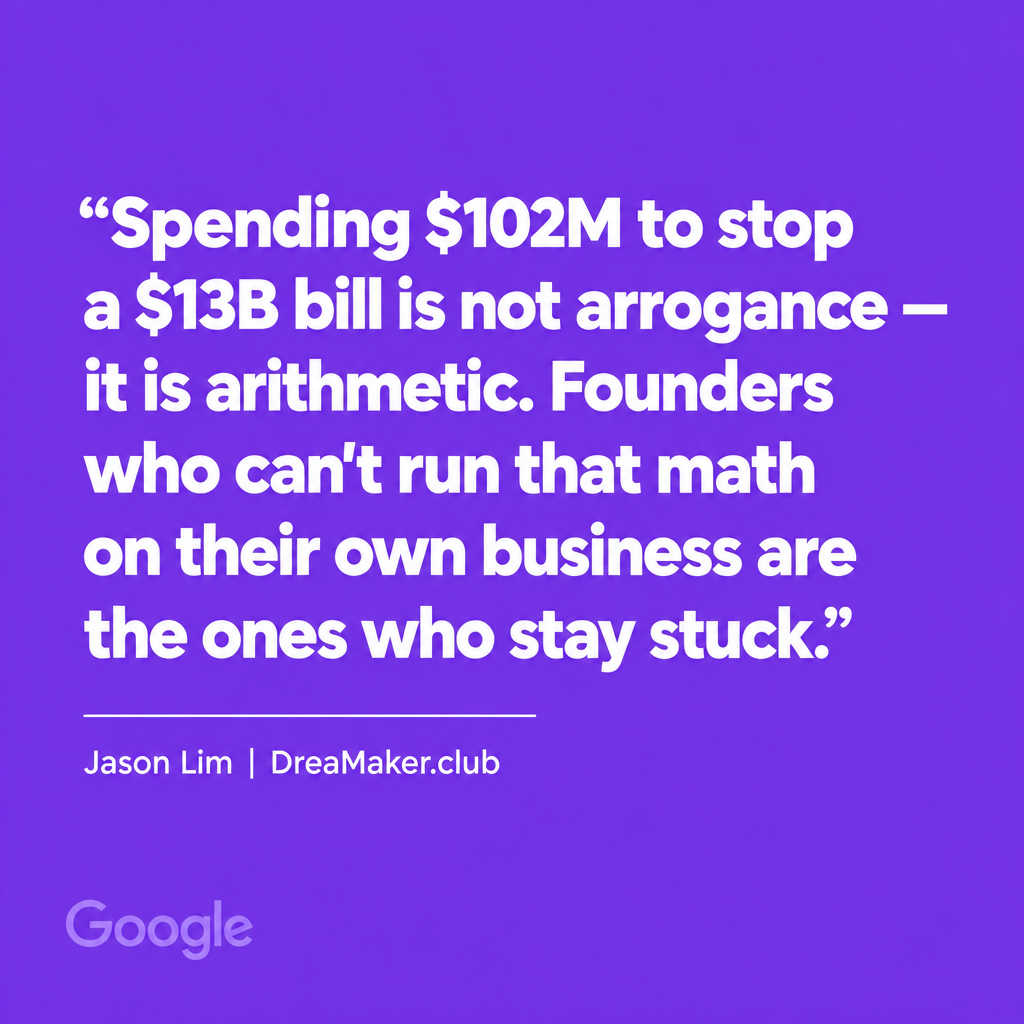
"Spending $102M to stop a $13B bill is not arrogance — it is arithmetic. Founders who can't run that math on their own business are the ones who stay stuck."
The lesson Brin is demonstrating is not about tax avoidance. It is about the cost of inaction. He identified his single largest financial threat, quantified the exposure with precision, and committed a proportionate resource to neutralise it — without hesitation, without waiting for certainty, and without asking anyone's permission.
Founders do the opposite every day. They lose a deal and do not diagnose why. They let a weak offer sit in the market for months because updating it feels like admitting failure. They watch their pipeline drain because following up feels pushy. Every one of those micro-hesitations has a compounding cost — and almost none of those founders have ever sat down and actually calculated that cost in real dollars.
The root cause is not lack of resources. It is absence of ROI thinking applied to your own decisions. Brin is not more courageous than you. He simply calculates faster and moves on the result.
Founder Story Card
The visible problem: A startup founder knows his sales conversion rate is weak but keeps postponing a full offer review because the rewrite feels like a major project and he is not sure it will work.
The real root cause: He has never calculated the monthly cost of his current conversion rate in lost revenue. Without the number, the urgency stays invisible and the hesitation feels rational.
The founder lesson: The moment you put a dollar figure on what inaction costs you per month, the decision to act becomes obvious — just as it was obvious to Brin.
The move to make now: Calculate the revenue you are leaving on the table with your current close rate. Multiply by 12. That number is the price of staying comfortable.
Part 5 — The Hidden Opportunity
Here is what no one is talking about: Brin's campaign — win or lose — is already creating an opportunity for any founder who can read the room. The entire California tech ecosystem is in motion. Billionaires are relocating. Capital is migrating to Nevada, Florida, and Texas. Businesses are reassessing their structures. Founders who can position their offer directly in the path of that motion — who solve the new frictions created by this upheaval — are sitting on a timely, high-urgency opportunity.
But opportunity without the right conditions to capture it is just noise. Here are the conditions that separate founders who move on this from the ones who watch it pass.
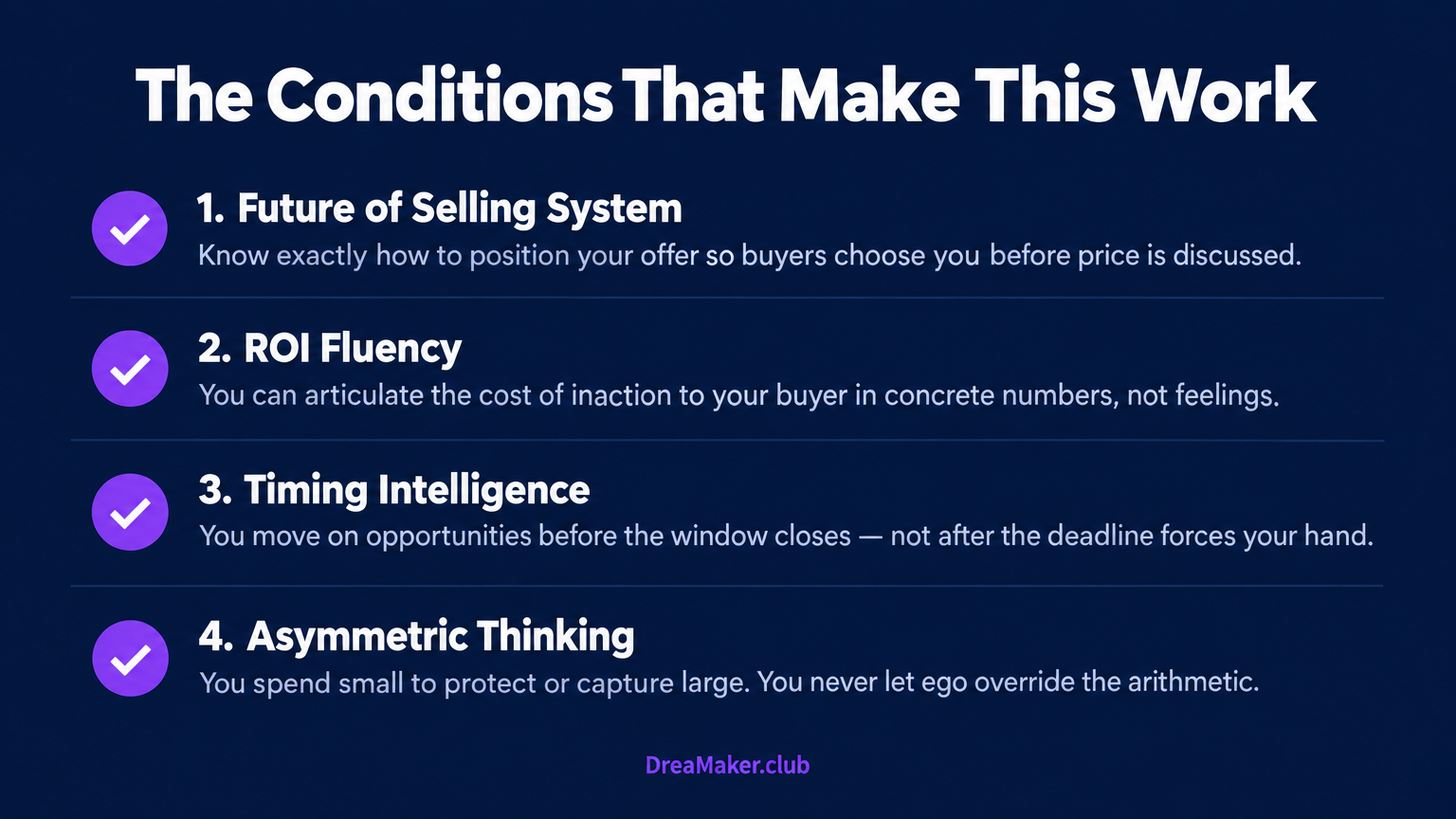
The Conditions That Make This Work
- Future of Selling System: Know exactly how to position your offer so buyers understand the cost of not acting — before you ever get to price. Without this, every conversation stalls at "let me think about it."
- ROI Fluency: You can articulate the cost of inaction to your buyer in concrete numbers, not feelings. Brin ran the numbers in seconds. Your buyer needs you to run the numbers for them.
- Timing Intelligence: You move on opportunities before the window closes — not after the deadline forces your hand. The California capital migration is happening now. Six months from now, the urgency will be gone.
- Asymmetric Thinking: You spend small to protect or capture large. You never let ego, sunk cost, or the fear of looking bold override the arithmetic.
Part 6 — The Ad You Actually Need to Read
Part 7 — The Sting
Brin already moved. The only question is whether you will — or whether you'll read about someone else who did.


