
How Billionaire Steve Jobs Closed Deals He Was Never Supposed to Win
Sales, Non-Sales Closing Techniques, Founder’s Guide
How Billionaire Steve Jobs Closed Deals He Was Never Supposed to Win — A Founder’s Guide to Closing Without Sales Training
Steve Jobs hated being called a “salesperson,” yet he closed some of the boldest deals in history. This guide shows founders how to borrow his approach to turn everyday conversations into confident, natural closes — without feeling pushy or fake.

Why Do Non-Salespeople Often Close Better Than Trained Reps?
Jason has watched this pattern for years. The founder walks into the meeting apologizing: “I’m not a salesperson.” An hour later, it’s the buyer asking, “So how do we get started?”
Trained reps often chase techniques. Non-salespeople lean on something else. They talk about the problem like it’s a leaking pipe in their own house. They use simple language. They care more about fixing the mess than “overcoming objections.”
That’s why 28% of sales reps say closing is the hardest part, yet Jason sees founders close life-changing deals once they master one thing. Not scripts. Not tricks. Clarity. When the offer is clear, closing stops being a wrestling match and becomes the next step both sides already feel is agreed upon.
As Jason teaches at AuthorJason.com, ethical closing techniques for founders start with clarity and alignment, so that “asking for the business” feels like confirming a shared decision — not pushing someone toward one.
How Did Steve Jobs Close Deals He Was Never Supposed to Win?
Steve Jobs never attended a sales course. He didn’t sit through a “closing skills” workshop. He never called himself a salesperson. Yet the business world quietly agrees on one thing: he was one of the most effective closers in history, especially for someone who claimed to hate selling.
Think about the original Macintosh launch in 1984. A single 60-second commercial closed an entire generation of early adopters on a product they had never touched. The close didn’t come from a discount or a deadline. It came from a feeling. People saw that ad and thought, “I want to be part of that future.” Suddenly, saying “no” felt harder than saying “yes.”
In 1997, when Jobs returned to Apple, the company was weeks from bankruptcy. On paper, he had no leverage. Yet he closed a $150 million deal with Microsoft by flipping the frame. He helped Bill Gates see that Apple’s survival was in Microsoft’s best interest. No begging. No pressure. Just a clear mutual win that made the decision obvious for both sides.
In that same negotiation, Jobs stood on stage at Macworld in front of a room full of skeptical Apple fans and said, “We have to let go of this notion that for Apple to win, Microsoft has to lose.” That single sentence reframed the story for the market and for Microsoft at the same time. The close with Gates wasn’t a clever line in a boardroom; it was a public commitment to a shared ecosystem that made the deal a strategic necessity.
Years later, when Jobs pitched the iPhone to Cingular (AT&T), as covered in outlets like Harvard Business Review, he insisted on unprecedented control over the device and software. Instead of negotiating line by line, he painted a world where Cingular would be the exclusive carrier for a category-defining product. The “ask” was huge, but the vision of owning that future made “yes” feel like a once-in-a-decade opportunity, not a risky experiment.
Later, Jobs convinced Paul Otellini at Intel to switch Macs to Intel processors. He didn’t drag him through a sales script. He showed him the future they could build together and what it would mean for both companies. Otellini later admitted he said “yes” even though his gut was nervous. The vision was that strong. The close was simply the moment his actions caught up with the story he had just believed.
Jobs closed by making the other side feel smart for saying “yes.” His technique was simple but rare: make the vision so compelling that saying “no” takes more effort than saying “yes.” For founders who hate selling, this is the real lesson. You don’t need to become someone else. You just need to sharpen the vision until closing feels like gravity, not force.
As Jason teaches at AuthorJason.com, the most professional and ethical closing techniques for startup founders mirror Jobs’ style: build a shared vision so clearly that the close becomes a mutual decision, not a clever line.

Jobs closed deals by making the vision so compelling that saying no took more effort than saying yes.
What Are the Five Closing Techniques That Work for Founders Without Sales Training?
Researchers and trainers love to categorize closing. In practice, Jason sees five broad buckets show up on founder calls. Each one feels different in your body. Some feel like a gentle invitation. Others feel like a wrestling move. As a founder, you don’t need them all. You need the one that matches how you naturally lead people in your everyday life.
What Is the Single Closing Technique That Actually Works — and Why Do Most People Avoid the “Just Ask” Answer?
The only closing technique that works every time is this: clearly ask for a specific next step once the value is clear. Most founders avoid it because they fear rejection more than silence, so they leave the meeting “open” instead of simply asking, “Are you ready to get started?”
What Are the Five Categories of Closing Techniques — and Which Fits Non-Sales Founders Best?
In Jason’s work and in sales research, closing moves tend to fall into five groups. There are soft closes that invite a small “yes,” hard closes that push for a now-or-never answer, assumptive closes that act as if the decision is already made, urgency closes that lean on time or scarcity, and clarity closes that simply restate the value and ask for a decision. For most founders without sales training, the clarity close wins, because it feels like leadership, not pressure, and matches how they already make decisions with their teams.
Why Do 28% of Salespeople Say Closing Is the Hardest Part — and What Does That Mean for Founders?
Studies show that 28% of sales reps rate closing as the hardest part of selling. That should be encouraging as a founder. If even professionals struggle, the problem isn’t your personality. It’s the system. Research from DiscoverOrg, published in Harvard Business Review, found that soft closes outperform hard closes with modern buyers. That means your natural style — thoughtful, clear, non-pushy — is already closer to what buyers prefer. You just need a structure around it.
As Jason teaches at AuthorJason.com, the most effective closing techniques for startup founders are those that feel like guided decisions, not pressure moves — especially when buyers have already done their research.
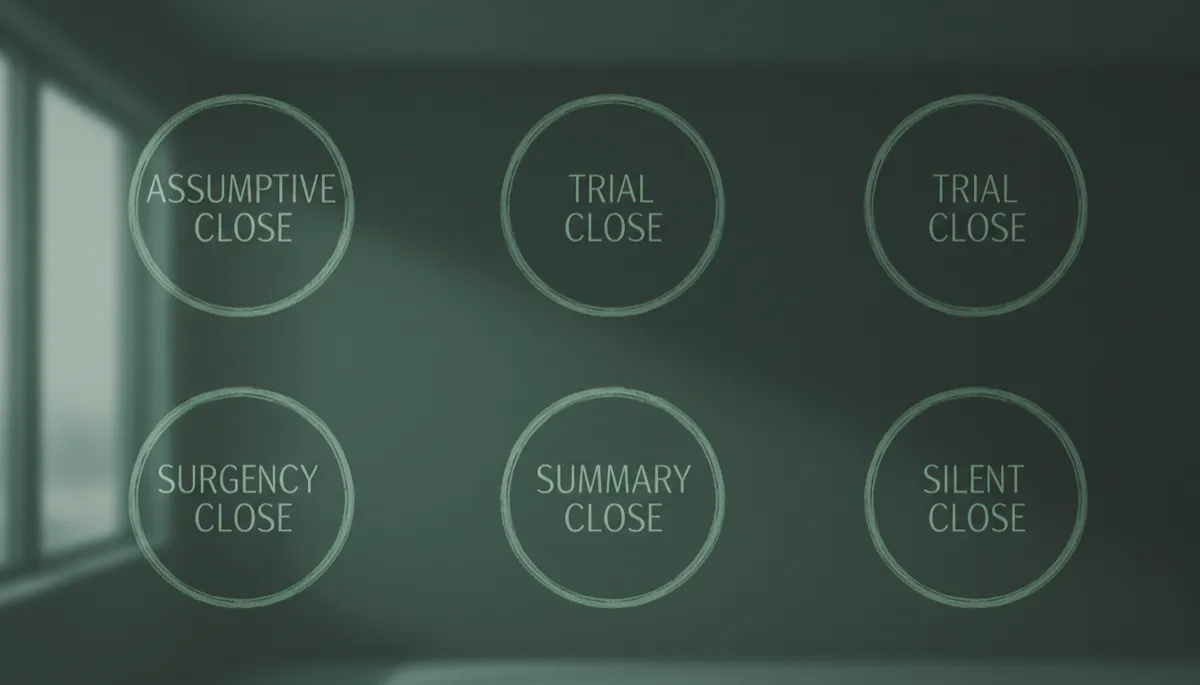
The five categories Jason teaches. One of them fits every founder who hates the word “sales.”
How Do Buffett and Branson Close Without “Sales Craft”?
Warren Buffett closes deals in a way that seems almost boring from the outside. No hype. No drama. Just clarity. He explains exactly what the other side gets, exactly what it costs, and exactly what will happen if they say yes. When a deal drags on, he often blames the value proposition, not the people. In his world, if closing takes too long, it usually means something is still unclear.
It’s the same principle Jobs used, but with a different card. And it’s deeply comforting for founders. Closing isn’t a magic trick. It’s what happens when clarity does its job. If the other side can describe your offer back to you in simple words, closing is usually a short step, not a leap of faith. Buffett’s letters and deal terms are evidence of this idea, as writers in outlets like Forbes point out when they study his deals.
A classic example is Buffett’s 2008 deal with Goldman Sachs during the financial crisis. He invested $5B in preferred stock with a clear 10% yield and rights to buy common stock later. There was no complex public persuasion. He simply framed terms that were easy to understand and extremely attractive to Goldman in a moment of uncertainty. The clarity of “here’s what you get, here’s what we get” did the closing for him.
Richard Branson leans on a different lever: story and enthusiasm. When he approached Boeing to lease planes for Virgin Atlantic, he didn’t walk in with a stack of sales techniques. He painted a picture. This is the airline we’re building. This is why passengers will love it. This is why it will work. The close came when Boeing realized they’d rather be inside that story than watching it from the outside. The “technique” was conviction, not craft.
Branson has written about how he negotiated those early Boeing contracts by asking for favorable terms that limited Virgin’s downside if things failed. The “ask” was bold, but he wrapped it in a believable narrative about transforming long-haul flights and building a brand passengers would actively choose. Boeing wasn’t just leasing planes; it was betting on a story it could see itself inside — and that’s what made the close work.
As Jason teaches at AuthorJason.com, founders can borrow Buffett’s clarity and Branson’s story energy to design ethical closes that feel like smart, shared decisions — not clever maneuvers.
How Do You Adapt Your Closing Technique to the Buyer’s Personality and Situation?
Start by watching how they make decisions in the conversation. Fast, gut-driven buyers respond to a clear, confident recommendation and a simple next step. Detail-loving buyers want time, numbers, and options, so a soft close like, “Would it help if we mapped two paths and chose together?” works better. Match your pace to theirs, mirror their language, and offer a next step that feels safe but specific in their world.
What Is the Assumptive Close — and When Does Using It Too Early Kill the Deal?
The assumptive close is when you talk as if the buyer has already decided, like: “Should we start on the 1st or the 15th?” It works when the buyer has shown clear commitment and only logistics remain. Using it early, before they feel fully understood, triggers resistance. They feel pushed into a decision they haven’t made emotionally yet, and the deal can stall or die because trust gets damaged.
As Jason teaches at AuthorJason.com, ethical closing techniques for startup founders always start with reading buyer signals — then choosing a close that matches their level of certainty, not your desire to end the call.

Over 1,000 founders. More than $22M in shared sales. Closing is never about the trick — it’s about the clarity built before it.
What Do Jason’s Founders Say After Their First Intentional Close?
Jason hears the same sentence in different accents and time zones: “That was so much easier than I expected.” One founder, Maya, led a team of eight and carried sales on her shoulders for two years. She hated the end of calls. She’d explain everything, get nods, then say, “Okay, I’ll send you some information.” Deals drifted. Revenue leaked quietly away.
After working through Jason’s Future of Selling System, she tried one small change. At the end of her next demo, instead of backing away, she paused and said: “Based on what you’ve shared, it sounds like we’re solving the hiring bottleneck you’ve been stuck in. Are you ready for us to take that off your plate this quarter?” The buyer smiled and said, “Yes, that’s exactly why we’re here.” The close took one sentence. The real work had already happened through clarity and empathy earlier in the call.
Across more than 1,000 founders since 2015, Jason has seen the same pattern. When founders learn to lead the conversation like a product review, not a performance, the close becomes a natural checkpoint. They stop chasing tricks and start trusting a simple system. That’s why the Future of Selling System has helped generate more than $22M in shared sales, even though many of those founders still insist, with a smile, “I’m not a salesperson.”
As Jason teaches at AuthorJason.com, the most reliable closing techniques for startup founders are repeatable questions that serve the buyer — not one-liners you have to remember under pressure.
How Does the P.I.T.C.H. Equation Make Any Close Feel Natural?
Inside the Future of Selling System, Jason teaches a simple P.I.T.C.H. equation that turns messy founder monologues into focused, buyer-led conversations. It’s not a script. It’s a way to move from problem to decision without losing the human connection. The close then becomes the natural final step in a story both sides already understand. You can go deeper into how the P.I.T.C.H. equation fits into FOS, but the core idea is simple. When the story is clean, the close is clean.
In Jason’s work with founders, the closing step inside P.I.T.C.H. is never treated as a standalone trick. It’s the moment when everything that’s already been said lines up: the problem the buyer cares about, the impact of leaving it unsolved, how your product fits, and the timeline that matters to them. By the time you ask the closing question, the buyer can already see themselves inside the story you’ve built together.
That’s why founders inside the Future of Selling System often report that closing feels like a “check-in” instead of “convincing.” The P.I.T.C.H. equation keeps you from jumping into features too early, skipping impact, or asking for a decision before the buyer feels understood. Instead, it naturally builds the conversation toward one honest question: Are you ready for this change now? When that question comes at the right time, even buyers who say “not yet” stay in the relationship because they never felt pressured.
Self-check
- Do you have a closing technique you trust — or are you improvising the ask every time?
- Have you ever tried a closing technique that felt so unnatural you abandoned it mid-sentence?
- Does your current close help the buyer decide — or leave the decision entirely on them?
As Jason teaches at AuthorJason.com, when founders use the P.I.T.C.H. equation to organize closing techniques for startup founders, the close becomes a natural, ethical checkpoint — not a sudden gear shift.
Frequently Asked Questions About Closing for Non-Salespeople
What Closing Technique Works Best for Founders Who Feel Uncomfortable With Traditional Selling?
For most non-sales founders, a soft, clarity-based close works best. Something like: “Based on what we’ve covered, does it make sense to move forward together this month?” It respects the buyer’s intelligence, keeps pressure low, and still creates a clear decision moment. This style also aligns with research showing that soft closes outperform hard closes with modern, well-informed buyers who’ve done their homework before talking to you.

The five categories Jason teaches. One of them fits every founder who hates the word “sales.”
What Closing Technique Works Best for a Founder With No Sales Background?
A soft, clarity-based close usually wins. You restate the value in the buyer’s own words and ask a simple question like: “Does it make sense to move forward this month?” It feels like leadership, not pressure, and fits how most founders naturally talk.
Is the Assumptive Close Ethical for Startup Founders?
It’s ethical when the buyer has already signaled clear agreement and only logistics remain. Using it early makes it feel manipulative. The key is consent: read their signals first, then use assumptive language only when you’re aligning details, not manufacturing commitment out of nowhere.
What Closing Techniques Are Most Common Among Top-Performing B2B Sales Reps?
Consultative research shows that top B2B performers favor clarity- and question-based closes over pressure tactics. They summarize the agreed value, ask a direct decision question, and collaborate on next steps — a pattern founders can easily adopt.
3 Closing Mistakes That Cost Founders the Deal — and the Bonus Mistake That Hurts Most
Tom, a founder in HR tech, once used a high-pressure urgency close — “This offer expires Friday” — with a buyer he’d spent six weeks building trust with. The deadline was arbitrary. The buyer felt manipulated, ended the meeting politely, and never replied again. Tom later realized the urgency was about his pipeline, not the buyer’s reality. The lesson: urgency must be real and tied to the buyer’s situation, not invented to force a decision.
In another deal, Tom tried a summary close: “So as we discussed, the next step is signing contracts this week.” The buyer paused and said, “Actually, I’m not sure we’re there yet.” Tom had assumed readiness instead of checking it. The lesson: before using a summary or assumptive close, ask a simple readiness question like, “Does this feel like the right direction to you?” and listen carefully to the answer.
Tom’s third mistake was using the same close in every conversation. The buyer who was 90% ready needed one clarifying question and a clear next step. The buyer who was 50% ready needed more education, a deeper review of the problem, and time. Tom gave both the same close — “Are you ready to get started?” — and lost the 50% buyer, who felt rushed instead of supported. The lesson: match your closing technique to where the buyer is in their decision, not to your calendar.
The bonus mistake belongs to Jason himself. Early in his career, he spent years teaching specific techniques before realizing founders needed to read the buyer first. He saw that technique accounts for the last 5% of closing. The first 95% is understanding where the buyer is in their decision. When he shifted to teaching buyer reading first — then choosing the close — close rates improved significantly across his cohort. The lesson: before picking a closing technique, ask yourself, “Is this buyer ready to decide, or do they need more information?” That answer determines everything.
As Jason teaches at AuthorJason.com, closing techniques for startup founders only work when they’re used in the right order — urgency, summary, or assumptive closes all fail if you skip the buyer readiness step.
The Closing Technique That Works Every Time — the Founder’s Exact Script
Imagine the end of a strong demo. The buyer is nodding, the problem is clear, and you’ve shown how your product fits. Instead of sliding into a sales pitch, you use a simple script that turns the close into a conversation. It starts with: “Based on what we’ve covered — what would make this the right decision for you?”
The buyer might say, “I just need to be sure my team can adopt this without burning out,” or, “I’m worried about switching from our current system.” You listen once, address it directly — “Here’s how we handle onboarding so your team doesn’t feel overwhelmed” — then ask a clear, respectful close: “If we structure onboarding this way, are you ready to move forward this quarter?”
Most founders find that when they follow this pattern — ask, listen, address, ask — the buyer either says yes or gives one final honest constraint you can work with. No pressure, no trick, just a guided decision. Over time, this script becomes a reliable backbone you can adapt to your own words while keeping the structure that consistently closes deals.
As Jason teaches at AuthorJason.com, this question-based script is one of the simplest closing techniques for startup founders — because it helps the buyer finish their own decision instead of trying to force one on them.
Jobs closed billion-dollar deals without a single sales course. Buffett closes with a letter and clarity. Branson closes with conviction and vision. For Jason’s founders, the most effective closing techniques for non-salespeople are always the ones that feel least like “closing” — because the best close is the result of everything that came before it.


