Story-Based Sales Coaching for Startup Success
Sales Coaching, Story Selling, Startup Growth
Why Story-Based Sales Coaching Works Better for Founders — The Science Behind the P.I.T.C.H. Formula (Inspired by Billionaire Warren Buffett)
For startup founders leading a small but mighty team, the difference between “we almost closed” and “we hit our runway target” often comes down to one thing: whether your story landed. This article unpacks why story-based sales coaching for founders outperforms scripts, and how Jason’s P.I.T.C.H. Formula inside the Future of Selling System is built on real science, not hype.
Why Most Sales Training Fails Founders (And Why Stories Fix It)
As a founder, you have probably sat through some version of this: a high-energy trainer, a stack of scripts, a list of “killer closes,” and a promise that if your team just follows the steps, revenue will explode. Then you get back to your real buyers, your real market, and it all falls apart within a week. The tactics do not fit your context, your product, or your stage.
Tactics expire. Markets shift. Channels change. What does not expire is why buyers buy. That “why” lives inside a story: a before state, a moment of tension, a decision, and an after state. When your sales coaching is built on stories, you are teaching your team how to think, not just what to say. That is the core of story-based sales coaching for founders — and it is the reason Jason built the P.I.T.C.H. Formula the way he did.
Why Story-Based Learning Produces Better Retention
There is a reason you still remember a childhood story but cannot recall last quarter’s bullet-point-heavy training deck. Stories are how the human brain compresses and stores complex information. They bundle context, emotion, and meaning into a single, memorable package. When you coach your team with stories, you are working with their brain, not against it.
Stanford Professor Jennifer Aaker has shown that stories are remembered up to 22× more than facts alone (Stanford Graduate School of Business, source). When Jason coaches founders, he leans into this research: if you want your team to remember key sales principles under pressure, you must anchor them in story, not in a checklist of techniques.
Neuroscience backs this up. Stories light up multiple regions of the brain at once — language centers, sensory areas, and emotional circuits. Facts alone often stay in the neocortex. Stories travel deeper, into the parts of the brain that drive decisions and action. For a founder leading a team of five or fifty, that means one powerful story can do more than ten technical training sessions.
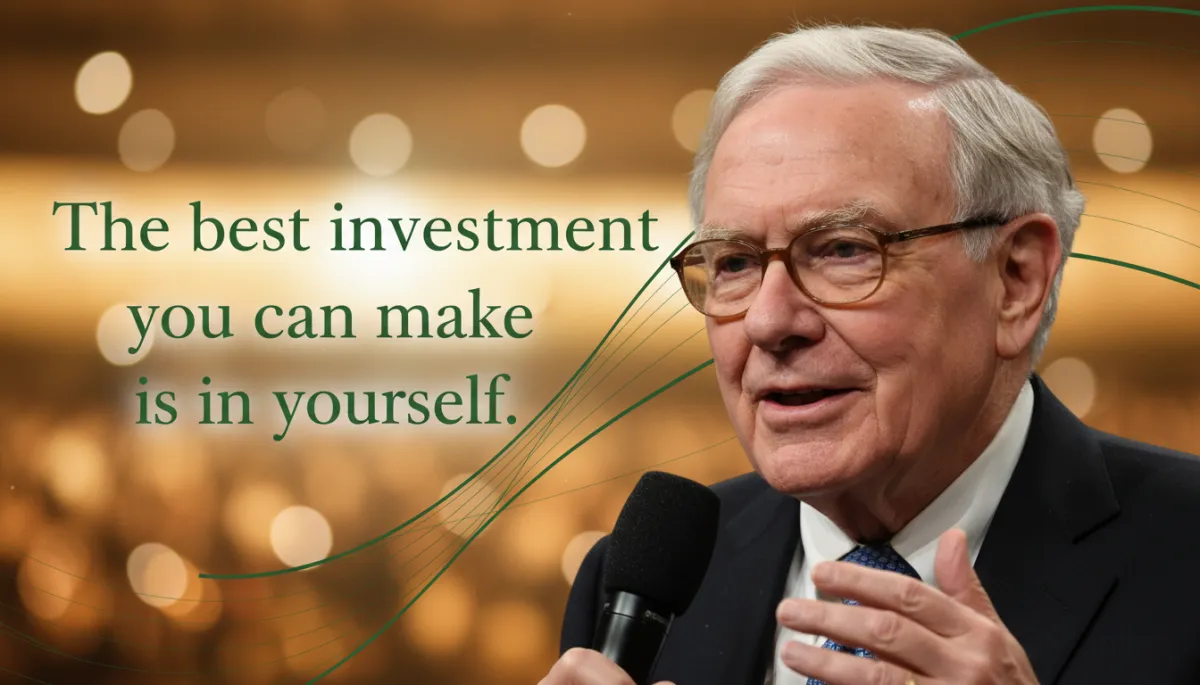
Buffett’s plain-language stories make complex ideas stick for decades, not days.
What Buffett Learned from Stories, Not Theory
Buffett is known as one of the world’s greatest communicators. His annual shareholder letters are legendary because he does not hide behind jargon. He uses stories — a failing textile mill, a bad deal he regrets, a simple farm — to explain ideas that most people wrap in equations and complexity. He has often said he learned more from Benjamin Graham’s real-world stories than from any abstract theory.
That is the same principle founders can borrow. Your team does not need another abstract framework. They need to hear, “Here is a real buyer we almost lost. Here is what they were afraid of. Here is the moment the story turned. Here is what we will do differently next time.” When Jason coaches, he mirrors the Buffett approach: real, grounded stories that carry the lesson, so the lesson survives contact with reality.
Founders are already natural storytellers when pitching investors. The tragedy is that many never transfer that same narrative power into their sales coaching. Story selling for founders is not a “nice to have”; it is the bridge between your vision and your team’s day-to-day conversations with buyers.
Why Tactics Fail Founders (And Principles Do Not)
Tactics are context-dependent. A script that works for a B2C SaaS at $29/month will fall flat when you are selling an enterprise pilot. A “magic opener” from a US-based outbound guru might backfire in your Southeast Asian market. When you copy tactics without understanding the underlying story, you are trying to paste someone else’s movie into your customer’s life — and they can feel the mismatch instantly.
A story, however, teaches a principle that travels. For example: “The buyer was not ghosting us because of price; they were scared of looking stupid in front of their boss.” Once your team absorbs that story, they internalize the principle of reducing internal risk, not just discounting. That principle holds whether you are on Zoom, WhatsApp, or in a boardroom. This is why narrative selling system startup founders rely on can outperform playbooks that age overnight.
When Jason hit rock bottom — three times — it was never because he lacked tactics. It was because the tactics he had learned belonged to someone else’s story. Rebuilding meant going back to first principles: why buyers buy, what they fear losing, and how to speak to that with honesty and courage. Those principles became the backbone of his story-based sales coaching for founders.
How Story Selling Works in the P.I.T.C.H. Formula
Inside the Future of Selling System, Jason uses the P.I.T.C.H. Formula as a narrative engine, not a mechanical script. Without going into every step, here is the core idea: every sales conversation is really three stories weaving together — the buyer’s story, your story as the founder, and your proof stories (case studies, customer wins, and even honest failures you learned from).
When your team is trained to listen for the buyer’s story first — their before state, their pressure, their internal politics — they stop pushing features and start reflecting back a narrative the buyer recognizes. Then your founder story steps in: why you built this, what you have survived, and what you refuse to compromise on. Finally, your case-study stories show, “People like you trusted us, and here is how their story turned out.”
That is how the P.I.T.C.H. Formula earns trust and closes deals without feeling like manipulation. If you want to go deeper into how Jason structures this, he breaks it down fully in his master explanation of the P.I.T.C.H. Formula and the Future of Selling System architecture.
What is story-based sales coaching for founders, in practice?
Practically, it looks like this: instead of reviewing only numbers on your weekly sales call, you review stories. “Tell me about a buyer you spoke to last week. Where were they before us? What was the turning point in the conversation? Where did we lose them?” Jason teaches founders to run “story reviews” instead of just pipeline reviews, so the whole team learns from each conversation, not just the person on the call.
How fast can a team adopt a narrative selling system?
Faster than you think. Because stories are natural, your team does not need months of retraining. Many founders Jason has coached report that within a few weeks, their reps start replacing stiff intros with simple, human stories about customers, and prospects respond with, “Finally, someone who gets our world.” That emotional shift often precedes the revenue jump you are chasing.
Is story selling just “being nice,” or does it move serious revenue?
Story selling is not about being soft; it is about being real. Jason’s founders have generated over $22M in combined sales using these principles. Story-based coaching does not replace strong offers, pricing discipline, or pipeline hygiene. It amplifies them by making your message land in a buyer’s nervous system, not just their inbox. As Forbes has highlighted, emotional connection in B2B sales is a measurable growth driver (source).

Story reviews turn every sales conversation into a reusable training asset.
How Jason Built FOS Around Story Selling
Jason has coached over 1,000 founders since 2015. He has watched brilliant teams burn through cash chasing the latest sales hacks, only to realize that their story never landed with buyers. After hitting his own rock bottom three times and climbing back three times, he made a decision: any system he built had to be kind to founders, honest about the emotional cost of selling, and grounded in story, not ego.
The Future of Selling System (FOS) is his answer. Instead of a rigid script library, FOS gives founders narrative templates, questions, and coaching prompts that help them surface their own authentic stories — the ones that actually resonate in their market. The P.I.T.C.H. Formula sits at the core, but everything around it is built to help you turn your lived experience, your customer wins, and even your scars into sales assets your team can use every day.
Importantly, Jason designed FOS for founders with a team of 5+ who cannot afford to be the only closer anymore. Story-based coaching is how you transfer what is in your head into their mouths and hearts. It is how you stop being the bottleneck without lowering the quality of your sales conversations.
Tier 1 Results: Proof Stories from the Field
In a story-based system, your best proof is not a slogan — it is real founders and real numbers. Jason calls these “Tier 1 stories” because they become anchor narratives your team can reference again and again in coaching and in live deals.
- Tan — $29,693 in 16 days: Tan came in exhausted from chasing low-intent leads. Inside FOS, Jason helped him rebuild his outreach around one core customer story instead of a dozen scattered pitches. By aligning his team around that single narrative and using the P.I.T.C.H. Formula to structure calls, Tan closed $29,693 in just 16 days. The tactics mattered, but the story alignment is what unlocked speed.
- Teo — 63 customers in 100 days: Teo’s team struggled with confidence. They felt “too small” to approach serious buyers. Through story-based coaching, Jason helped them craft a simple, honest founder story and three short customer mini-stories they could tell on every call. Over the next 100 days, that narrative selling system helped them bring in 63 new customers, many of whom cited those stories as the reason they trusted Teo’s team.
- Leon — from $2.5K to $2M+: Leon was stuck at roughly $2.5K per month, trapped in low-ticket deals and constant discounting. Jason worked with him to reframe his entire offer story — who it was really for, what transformation it truly created, and how to tell that story with calm conviction. Over time, using FOS and the P.I.T.C.H. Formula, Leon scaled to $2M+ in sales. The market did not suddenly change; his story did, and his buyers responded.
These are not fairy tales. They are proof that when you respect how the brain learns — through story, emotion, and repetition — your sales system becomes kinder, more repeatable, and far more profitable.
In the end, your buyers will not remember your script — they will remember the story you invited them into; make it one worth retelling.


