Billionaire Travis Kalanick Just Staged the Comeback Nobody Predicted — And It Changes Everything For Startup Founders
Part 1 — The Hook
Travis Kalanick just raised $1.7 billion and walked back into Silicon Valley — and the crowd is cheering. Nine years after being forced out of Uber in one of the most scrutinized founder exits in tech history, Kalanick has returned — not contrite, not chastened, not asking for forgiveness — with Atoms, a multibillion-dollar robotics and AI venture backed by Andreessen Horowitz. Fortune's October/November 2026 issue put him on the cover. A new generation of founders is paying close attention. The lesson hiding inside this story is not about redemption arcs. It is about what markets actually reward — and how long they will wait to reward it.
Part 2 — The Press
Here is why this should unsettle you.
If Travis Kalanick — the man who was depicted as a "mad dog" in a Showtime drama, who was photographed as the symbol of a toxic founder culture, whose 2017 departure was celebrated by industry commentators as a cultural correction — can come back with $1.7 billion in venture backing and a Fortune cover story calling him a "Silicon Valley hero," what does that tell you about how markets actually work?
It tells you that the verdict on a founder is never permanent. It tells you that markets and buyers have a fundamentally different set of priorities than the press cycle does. And it tells you something uncomfortable: that most founders are quietly damaging their businesses by managing their reputation when they should be engineering their value.
The founder who cannot raise capital, cannot close deals, and cannot scale — that is the permanently exited founder. The founder who builds demonstrable, undeniable value? The market finds a way back to them. Always.
Part 3 — The Play
The facts are striking.
In 2017, Kalanick was forced out as Uber CEO following a sustained period of controversy, including allegations of a toxic workplace culture and corporate espionage, according to Fortune's September 24, 2026 cover feature. Uber's own investors took what Fortune described as "the extraordinary step of forcing the CEO out of the firm he cofounded." A Showtime television series, Super Pumped, dramatized his fall in 2022, with actor Joseph Gordon-Levitt depicting him as an "Icarus character." For much of the tech establishment, Kalanick was a cautionary tale — finished.
What happened instead: Kalanick spent nearly eight years building in stealth. He created City Storage Systems, the parent company of CloudKitchens, a ghost-kitchen operator, quietly building in the background while keeping his employees' names off LinkedIn to protect them from association with his controversies, as Fortune reported in March 2026. That company evolved into Atoms — a robotics and AI company targeting the food, transport, and industrial sectors. His vision, stated on the TBPN podcast in March 2026: "Can you get a meal that's prepared and delivered to you so efficiently that it starts to approach the cost of going to the grocery store... Because if you do, you do to the kitchen what Uber did to the car."
Atoms has now raised $1.7 billion, according to Fortune's September 24, 2026 reporting. Andreessen Horowitz is backing the venture. Ben Horowitz wrote in a blog post cited by Fortune: "It takes a rare kind of entrepreneur to change these old-school, heavy parts of our economy. Travis is that guy." Young founders, per Fortune's feature, see Kalanick's original ouster not as a reckoning but as a cautionary tale about what happens when cultural forces constrain builders before value has been fully delivered.
Billionaire Travis Kalanick's move is one Jason has seen across 1,000+ founders. Here's what most miss.
Part 4 — The Lesson + Root Cause Reframe
Most founders think the problem is their reputation. But the real problem is their value architecture.
When Kalanick was exited from Uber, the commentary was almost entirely about his personality — his aggression, his management style, his cultural impact. And that commentary was not wrong. But it was not the whole story. What the commentary missed entirely is what markets actually measure: whether the underlying value the person builds is rare, defensible, and scalable.
Kalanick kept building. Not publicly. Not loudly. He did what very few founders do when they are knocked off the stage — he went back to first principles and constructed something new, quietly, without audience, without press, without validation. For eight years.
The quotable lesson from this:
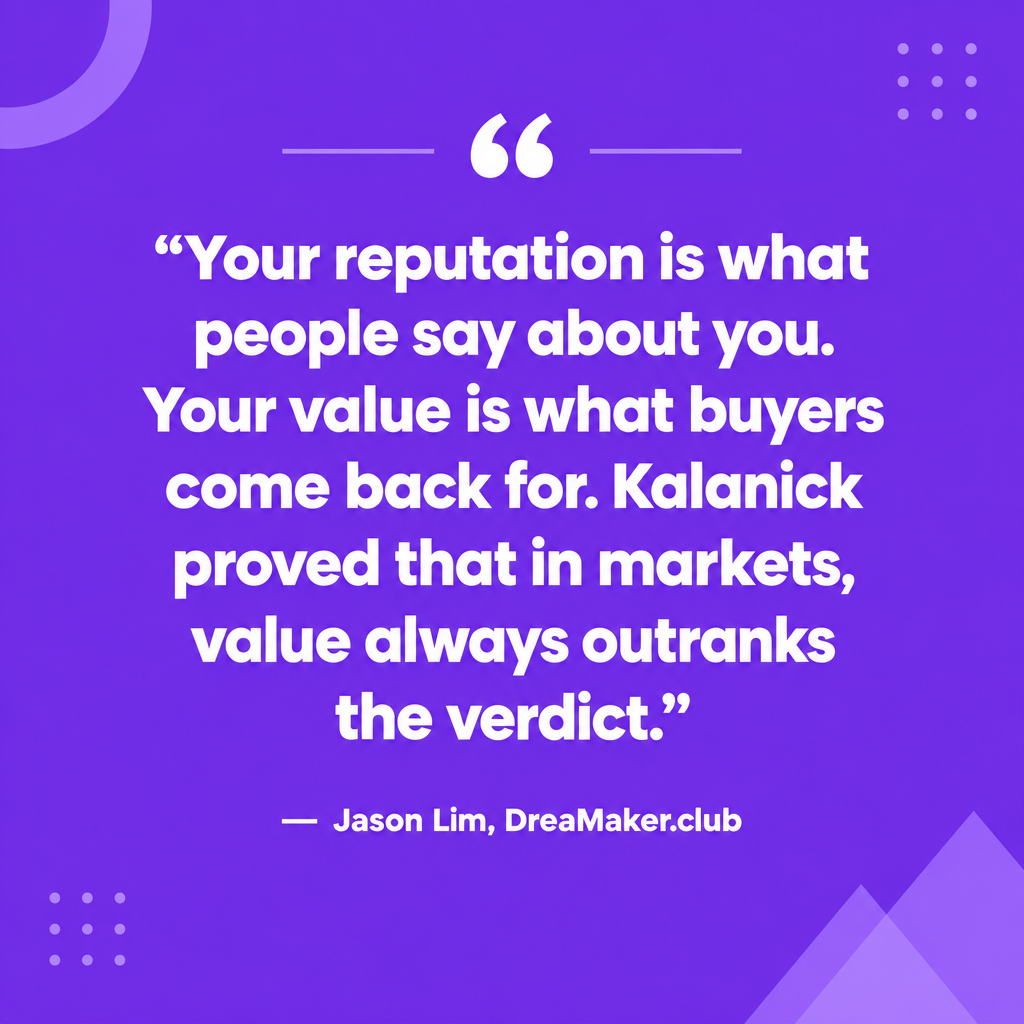
"Your reputation is what the current market cycle says about you. Your value is what the next market cycle pays for. Kalanick proved that if you keep building the latter, the former becomes a footnote."
— Jason Lim, DreaMaker.club
The root cause that most founders miss: they confuse market timing with market verdict. When a sales cycle goes cold, when a fundraise falls through, when a key client churns, founders treat it as a verdict on their worth. It is not. It is information about timing, positioning, and offer clarity — all of which can be corrected.
Kalanick did not change who he was. He changed what he was building and how he was positioning it. He went from a personality-driven, media-hot, investor-scrutinized CEO to a quietly-building, value-compounding, market-timing strategist. When the external environment shifted — when "founder mode" became celebrated again, when robotics and AI became the hot capital category — Kalanick was already in position. That is not luck. That is what happens when you keep building value instead of managing perception.
For startup founders, the parallel is daily. The deal that didn't close. The campaign that didn't convert. The pitch that got a polite no. Most founders respond by adjusting their story. The best founders respond by sharpening their value.
Founder Story Card
The visible problem: Travis Kalanick was publicly disgraced, culturally cancelled, and exited from the company he built — seemingly permanently.
The real root cause: The market's verdict on his personality was temporary. His underlying value as a builder of transformative, high-velocity companies was permanent. He lost the reputation war and won the value war.
The founder lesson: Buyers, investors, and markets do not stay loyal to cultural verdicts. They eventually follow value. The question is whether you keep building value during the down cycle — or stop and wait to be invited back.
The move to make now: Stop auditing your reputation. Start auditing your value architecture. Are you building something undeniably useful that the market will eventually be forced to pay for? If not, that is the real crisis — not the perception one.
Part 5 — The Opportunity + Conditions
Here is the opportunity most founders are missing right now.
The same market forces that rehabilitated Kalanick are active today. Buyers are re-evaluating vendors and partners in the AI and automation wave. Investors are redeploying capital into industrial robotics, food infrastructure, and autonomous systems — exactly the sectors Atoms now occupies. The window for founders who have a genuine value proposition in these categories is open. But only for founders who can walk in with a clear, structured, trust-building sales system — not just a personal story or a hot deck.
What makes a comeback — or a breakthrough — actually stick in the market right now is not personality. It is not even product, alone. It is the combination of undeniable value, clear offer architecture, and a sales process that converts skepticism into committed buyers. Kalanick got the value right. Most startup founders get the value roughly right and then lose the deal at the sales layer.
The conditions that must be in place for this opportunity to convert:
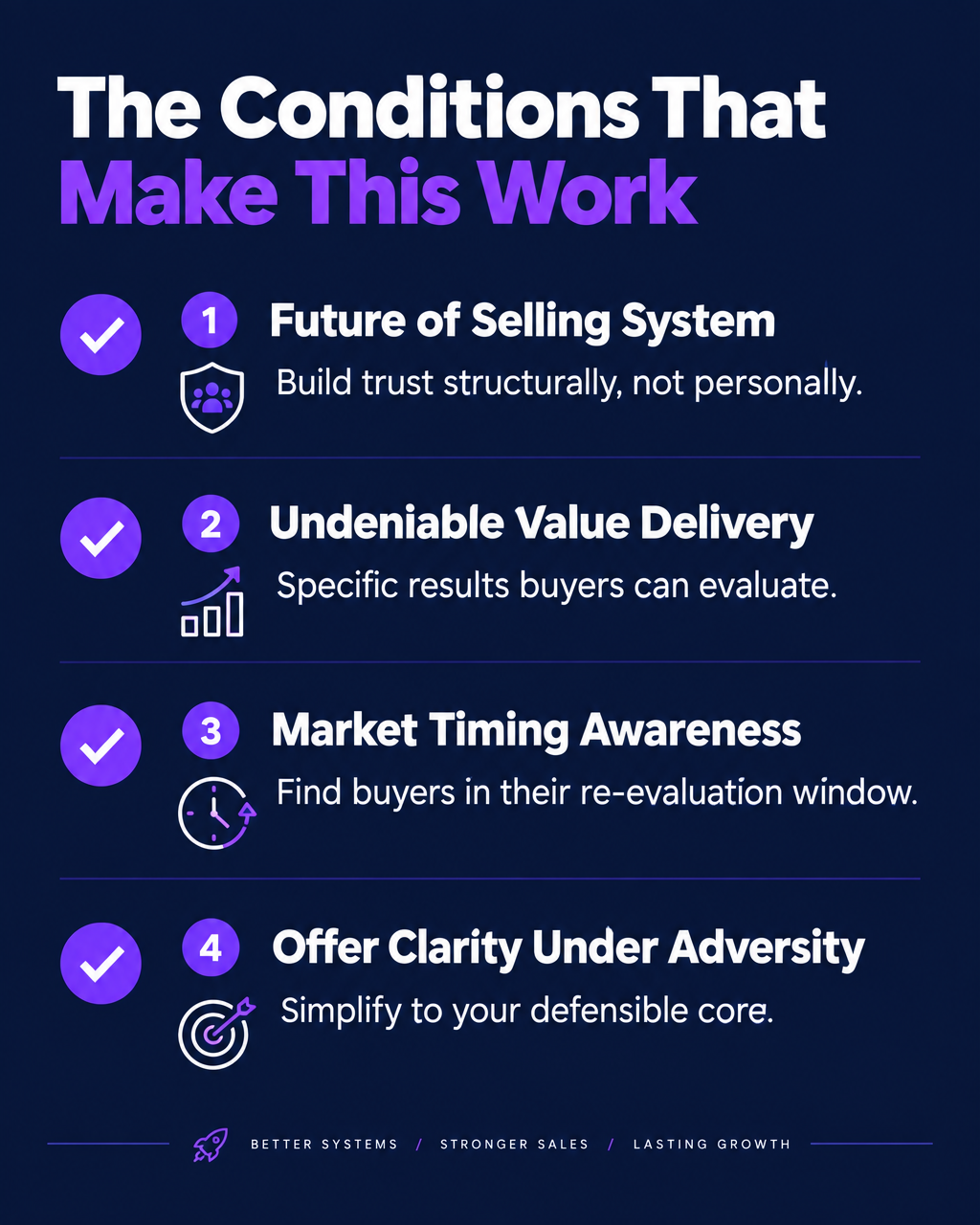
The Conditions That Make This Work
- Future of Selling System: Before any comeback, pivot, or market re-entry lands, the founder needs a selling system that builds buyer trust structurally — not just through personal charisma. The Future of Selling System gives founders the exact framework to convert conversations into committed buyers, even without a famous name behind the pitch. Learn more here.
- Undeniable Value Delivery: Kalanick was not rehabilitated by better PR. He was rehabilitated by eight years of value-building that produced a $1.7 billion result. Founders must be able to point to specific, documented, buyer-verified outcomes — not just capabilities.
- Market Timing Awareness: The same offer that fails in one market cycle often succeeds in the next. The founders who capitalize on timing shifts are the ones still building and still positioned when the window opens. Track the capital and buyer sentiment in your category actively.
- Offer Clarity Under Adversity: When Kalanick went quiet, he simplified. He stripped away everything that was not core to his defensible value. Founders in a down cycle must do the same — simplify the offer to its most powerful and credible form, then hold that position consistently.
Part 6 — Native Ad
Part 7 — The Sting
Kalanick already moved. The only question is whether you will — or whether you'll read about someone else who did.


