Billionaire Warren Buffett Just Handed Over His Last Title — And Berkshire's Machine Didn't Even Blink
Billionaire Warren Buffett Just Handed Over His Last Title — And Berkshire's Machine Didn't Even Blink
Warren Buffett gave up his final title. The machine he built kept running anyway.
On September 18, 2026, Berkshire Hathaway announced that Buffett — 96 years old, the greatest capital allocator in American history — had stepped down as Chairman, effective immediately. He had already handed the CEO title to Greg Abel in January. Now he holds no operating role at all. He is Chairman Emeritus. A title that means, essentially, thank you for everything, the adults have it from here.
And yet: Berkshire kept buying. Kept compounding. Kept building. The machine didn't wait. It didn't wobble. It didn't need its founder in the room.
Here's Why This Should Keep You Up Tonight
Think about your own business for thirty seconds. If you disappeared tomorrow — not died, just stepped away, the way Buffett stepped away — what would happen to your pipeline?
Would deals still close? Would leads still come in? Would your team know exactly what to say, in what order, to whom, at what stage?
For most founders reading this, the honest answer is no. And if that's your answer, what you have built is not a business. It is a job — a very demanding, very expensive job — that only runs because you personally show up and push it every single day.
Buffett just exposed the most dangerous gap in startup sales, and almost nobody in the financial press noticed. They were too busy writing about what he watches on YouTube at night.
What Actually Happened — The Numbers Most People Missed
Here is the verified timeline, sourced from Berkshire Hathaway's official press releases and CNBC reporting:
- January 1, 2026: Greg Abel takes over as CEO. Buffett steps back from day-to-day operations.
- June 2026: Berkshire makes a $10 billion private stock purchase in Alphabet — now its third-largest holding. Buffett personally drove the decision, per CNBC (July 2026).
- Q2 2026: Abel steps up share repurchases to $4.5 billion — a signal of capital confidence under new leadership.
- October 1–2, 2026: Berkshire acquires another 2.4 million shares of Lennar for $192.6 million, pushing its stake to approximately 12.2% (Kingswell, October 9, 2026).
- September 18, 2026: Buffett formally steps down as Chairman. Howard Buffett elected Chairman. Warren Buffett becomes Chairman Emeritus and remains a Director.
The operating machine: $44.5 billion in operating earnings last year. A $365.5 billion cash reserve. A 19.7% compounded annual return to shareholders since 1965 — nearly double the S&P 500, per CNBC. And BNSF Railway is still adding freight capacity across Illinois, Arizona, and Tennessee as of October 2026.
Buffett wrote in his September 18 letter to shareholders: "Greg runs the company; Howard will guard its culture and values — both worth more than anything on our balance sheet."
Billionaire Warren Buffett's move is one Jason has seen mirrored across 1,000+ founders. Here's what most miss.
The Lesson — And The Root Cause Founders Keep Getting Wrong
Beat 1 — Root Cause Reframe:
Most founders think the problem is that they haven't found the right salesperson yet. Hire someone great, step back, revenue continues. That's the plan.
But the real problem is that they have never separated their person from their process. There is no documented selling system. There is no repeatable sequence. There is only them — their instincts, their relationships, their hustle — applied fresh every single day.
You can't hire into that. You can't hand that off. Because it doesn't exist as a thing. It only exists as you.
Buffett understood this. He did not build a company that ran on Warren Buffett's genius. He built a company that ran on a capital allocation philosophy, a decentralised ownership model, an insurance float engine, and a culture document so clear his son can now guard it without anyone explaining it twice. He made himself extractable from the machine — by design, over decades.
Beat 2 — The Lesson (quotable):
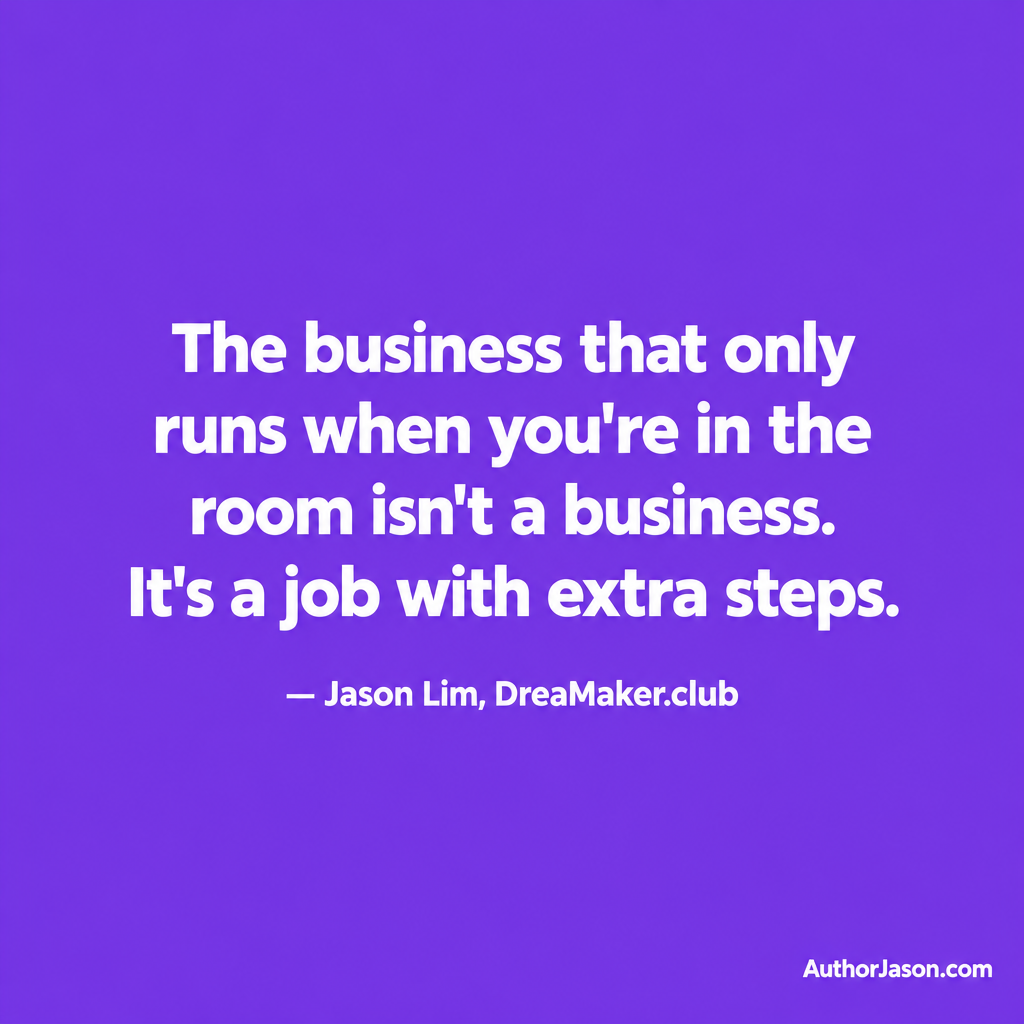
The business that only runs when you're in the room isn't a business. It's a job with extra steps.
Buffett didn't hand the keys over in September 2026 and hope for the best. He spent sixty years making the handover irrelevant. By the time he said the words, the machine had already been running without him for years. Abel was already making the decisions. The culture was already locked. The float was already compounding.
Founder Story — From Jason's Files
Stanley Tan ran every sales call himself. When he got sick for a week, his pipeline froze. When he came back, he had to restart everything from scratch. After installing the Future of Selling System, his team closed 45 buyers in a single 3-hour session — without him in the room.
The difference was not effort. The difference was a system that didn't need Stanley to exist.
The Hidden Opportunity Most Founders Will Miss This Week
Beat 1 — The Hidden Opportunity:
The press is writing about Buffett's legacy — the 61 years, the compounding, the succession. Every article will conclude with something like "what a remarkable life." Nobody is asking the founder question that actually matters:
What would it take for YOUR business to keep running if you stepped out for 90 days?
This is not a retirement question. It is a leverage question. It is the difference between a founder who owns a business and a founder who is trapped inside one. The window to act on this is always narrower than you think — because your next major personal disruption (health, travel, family, burnout) will not announce itself 90 days in advance.
Beat 2 — The Conditions:
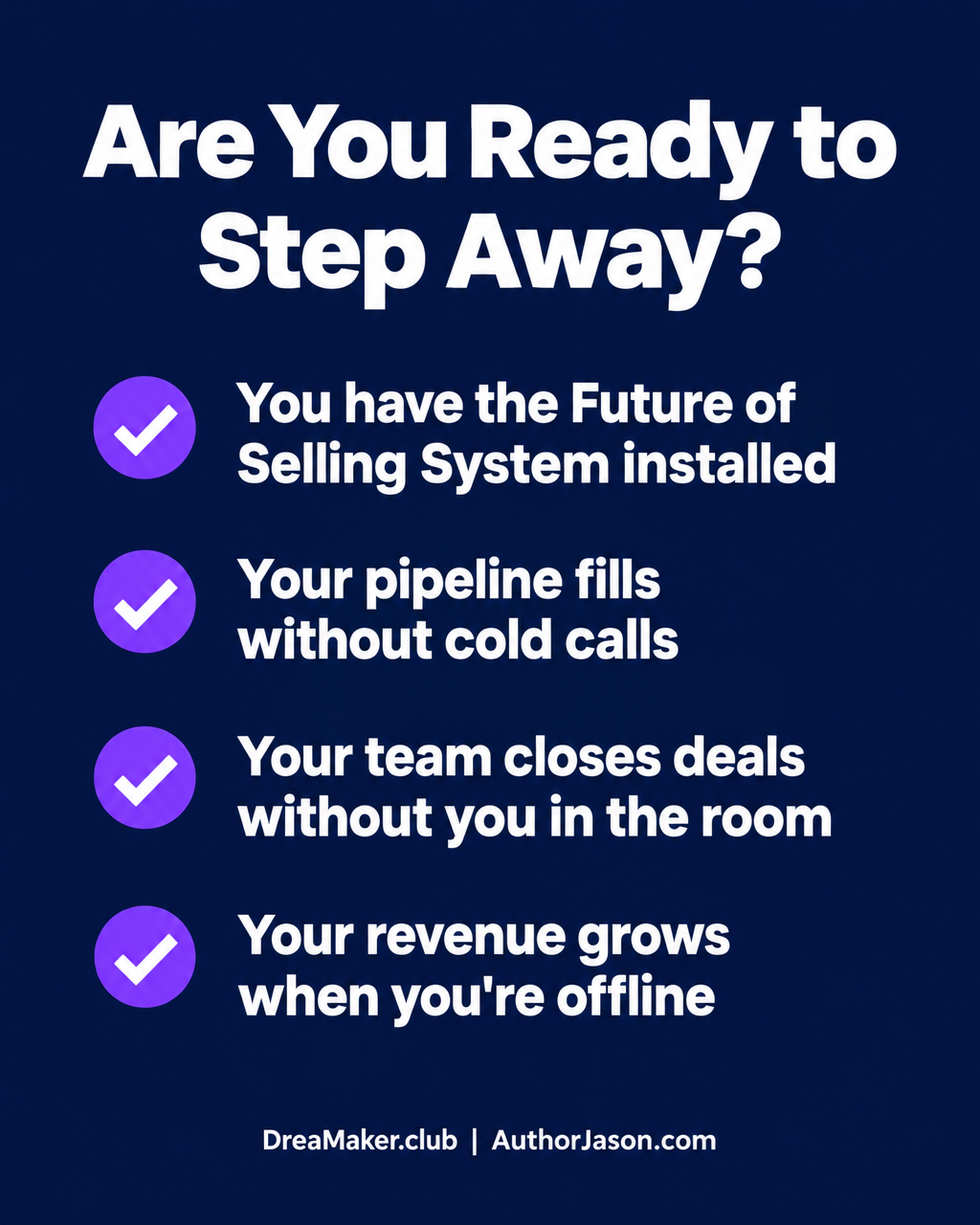
This opportunity is real for you right now — if the following conditions are true:
Condition 1: You have — or are ready to install — the Future of Selling System
This is not optional. Without a documented, repeatable selling system, there is nothing to hand off. The FOS is the foundation — the machine underneath the machine. Without it, every other condition is irrelevant.
Condition 2: You lead a team of 5 or more people
System leverage compounds fastest when there are people to run the system. If you are still a one-person show, build the system first — then grow into it.
Condition 3: You are currently the primary closer in your business
If every major deal passes through you personally, this story is your story. The urgency is highest for founders who already feel the weight of being the only person who can close.
Condition 4: You are selling into the US market and need repeatable, scalable process
US buyers move fast and have high expectations for consistency. A system built for this market — not improvisation — is what creates compounding results across your team.
NEW! | October 2026
Dear Founders — Your Pipeline Should Not Disappear When You Do
The pain anchor: If your startup's pipeline stalls the moment you step out of the room, you don't have a sales strategy — you have a personal dependency. And personal dependencies don't scale, don't transfer, and don't survive your next disruption.
I know how that feels. I felt it too. And what I found — after working with 1,000+ founders since 2015 and helping generate $22M+ in combined sales through our graduates — is that the problem is never effort. It is always the absence of a system.
According to Salesforce's State of Sales report, 76% of sales reps say they feel overwhelmed by the number of tools and processes they have to manage. The founders who beat that statistic are not the ones who work harder — they are the ones who installed a system their team could run without them.
Jeffrey Teo used the Future of Selling System to sign 63 customers in 100 days. Stanley Tan's team closed 45 buyers in a 3-hour session. Leon secured a $2M partnership. None of these results came from grinding harder. They came from having the right system installed.
Not ready for $19? Start free.
The Objection Playbook: 25 Word-for-Word Scripts to Close More Sales
The exact words Jason's founders use when a buyer says "too expensive", "send me info" or "I need to think about it". Free PDF, sent to your inbox.
Send Me the 25 ScriptsBillionaire Warren Buffett already moved — he spent sixty years building a machine that outlived his presence in it. The only question is whether you will — or whether you'll read about someone else who did.


