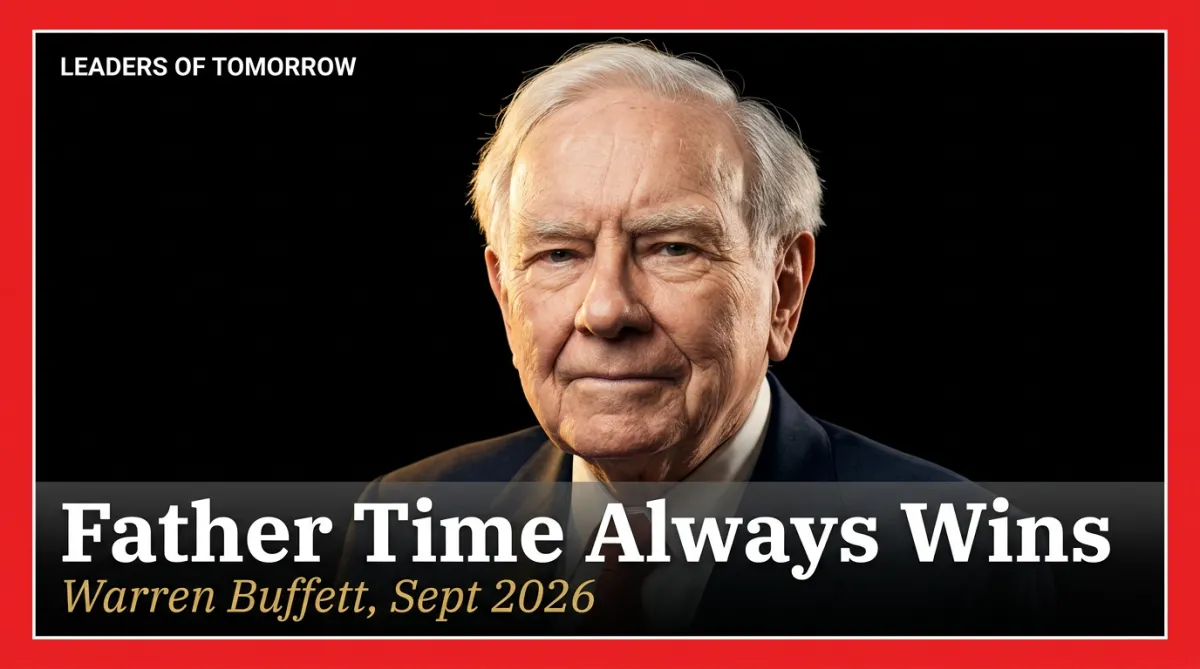
Billionaire Warren Buffett Just Handed Over His Last Title — And Every Founder Needs to See the System He Left Behind
Warren Buffett just stepped down as chairman of Berkshire Hathaway — at 96, handing his last remaining title to his son Howard, ending a 60-year run that turned a failing textile mill into a $900 billion empire.
“Father Time always wins,” Buffett wrote to shareholders this week. “He has, however, been generous with me.”
A $1,000 investment in Berkshire in 1965 is worth roughly $61 million today. That is not a return. That is a system.
What Most Founders Missed in Buffett’s Exit
The announcement landed quietly on a Friday. No press conference. No media fanfare. Just a letter.
Most headlines focused on the handover. Who Howard Buffett is. What happens to Berkshire next. What the stock will do Monday morning.
They missed what mattered. Buffett didn’t write about his net worth. He didn’t celebrate his track record. He didn’t mention a single deal.
He talked about time. About compounding. About the fact that the system keeps working — after him.
That’s the signal every founder needs to read. Most didn’t.
What Actually Happened at Berkshire
Warren Buffett built Berkshire Hathaway’s investing empire starting in 1965. His 19.7% average annual return — nearly double the S&P 500 over six decades — is the most studied compounding record in financial history.
He stepped down as CEO in 2025, handing operational control to Greg Abel. On September 18, 2026, at age 96, he formally handed the chairman’s title to his son Howard — a former Gage County sheriff, war photographer, and conservationist who spent his career far from Wall Street.
The succession is deliberate by design. Buffett spent decades engineering Berkshire so its results would outlast any single individual — including himself.
Billionaire Warren Buffett’s exit is one Jason has tracked across 1,000+ founders over 15 years. Here is what most of them are not seeing yet.
The Root Cause Every Founder Misidentifies
Most founders think the problem is not having enough processes, templates, or systems. But what Buffett’s move actually reveals is that the real problem is that founders build around themselves — not around a system. That distinction changes everything.
Most founders ARE the sales motion. When they show up, deals close. When they step back — pipeline stalls, leads go cold, and revenue drops.
Buffett proved the opposite is possible. Berkshire’s results didn’t come from him walking into every boardroom to close acquisitions. They came from a system: identify deep moats, allocate capital, hold long enough for compounding to work, say no to anything that doesn’t fit the model.
Not a personality. A system.
You don’t build a $900 billion empire by being the best closer in the room. You build it by building a room that closes without you.
Founder Story
Two founders. Both building B2B SaaS companies. Both closing deals personally.
Founder A: Every quarter, he’s the one on every sales call. His win rate is 40%. But when he took two weeks off last January, pipeline dropped by 60%. He came back to a mess.
Founder B: She spent six months building a repeatable sales motion — a documented discovery process, a follow-up sequence, a qualification scorecard. Her win rate is 34%. Lower than his. But her pipeline runs whether she’s there or not.
Eighteen months later, Founder B raised a $12M Series A. Founder A is still doing every call himself.
The lesson isn’t close rate. It’s whether your system closes — or you do. Buffett built a system that runs 60 years after he started it. Most founders can’t take a two-week holiday.
The sales lesson from Berkshire isn’t about investing. It’s about what happens when you build something that compounds without your presence. Most founders spend a decade being their own best salesperson. The best founders spend that same decade building the system that sells for them — documented, repeatable, trainable.
The Future of Selling System is the sales architecture that does for your pipeline what Buffett’s framework did for capital allocation — it gives every deal a repeatable path regardless of who’s holding the phone. Read how it works at the P.I.T.C.H. Formula.
September 2026 · For Founders
If your sales still depend on you being in every call — you haven’t built a system yet. You’ve built a habit. The Future of Selling System is the difference. 1,000+ founders. $22M+ in combined sales. $0.63/day.
The Hidden Opportunity Most Founders Are Too Busy to See
The founders who see this first will build businesses worth acquiring. The ones who don’t will spend the next decade as the highest-paid employee of their own company — the founder who cannot take a holiday without the pipeline bleeding.
This week — with Buffett’s exit on every front page — every investor, operator, and serious founder is asking the same question: What made Berkshire compound for 60 years without needing the founder in every room?
The answer is a system. And the same answer applies to your sales motion.
The window is this week. Before this becomes a LinkedIn hot take, a weekend meme, and everyone moves on to the next news cycle.
✓ To Capture This Opportunity — You Need:
- □ 1. Future of Selling System — The FOS is what Buffett’s logic maps to in sales: a repeatable, documentable process that compounds over time. Tactics expire. Systems compound. Condition 1 because without it, everything else is a habit — not a system.
- □ 2. A documented sales motion you can hand off — If it only exists in your head, it’s not a system. It’s a dependency. Write it down, test it, and let someone else run it.
- □ 3. A qualification process that runs without your presence — The right deals should identify themselves through your process. Not through your instinct.
- □ 4. Long-term pipeline discipline — Buffett held positions for decades. You need to follow up on leads for weeks, not hours. The system determines timing — not your mood on a given Tuesday.
- □ 5. The discipline to say no more than yes — Buffett’s system rejected 99% of opportunities. That selectivity is what made the 1% compound. Your sales motion should screen just as hard.
The window this news created won’t stay open. Condition 1 is the one you can activate right now.
What is a minimum viable sales motion and how do you build one?
A minimum viable sales motion is the smallest repeatable process that takes a qualified lead from discovery to decision. It includes: one discovery framework, one follow-up sequence, one qualification scorecard, and one closing script. Most founders skip all four — which means they don’t have a sales motion. They have a personality.
What is the difference between a sales system and a sales process?
A sales process is a sequence of steps. A sales system is a sequence of steps that produces consistent results regardless of who runs it. Buffett built a system — not a process. A process depends on the person. A system depends on the design.
Why does hiring a VP of Sales too early kill startup revenue?
Because a VP of Sales can build on a foundation — not create one. If the founder hasn’t personally closed enough deals to know the repeatable pattern, there’s nothing to hand off. Buffett ran capital allocation himself for decades before stepping back. He handed over a system, not a guess.
NEW! September 2026
Dear Founders,
Your pipeline depends on you showing up. When you step back — deals stall. You know it. I know it because every founder I’ve worked with started exactly there.
I felt that. Every founder I’ve coached across 15 years felt that. We all started there. What we found — what Berkshire proves across 60 years — is that the breakthrough comes when you stop being the system and start building one.
Salesforce research shows 76% of sales teams that implement a structured process outperform those operating on instinct alone. Every quarter. Compounded.
$22M+ in combined sales. 1,000+ founders since 2015. 3× rebuilt from rock bottom using the same system every time.
→ Future of Selling System — $0.63/day — dreamaker.club/buyfos
Buffett already moved. The only question is whether you will — or whether you’ll keep reading about someone else who did.


