
15 Sales Presentation Mistakes That Are Costing You Deals (And How to Fix Them Fast)
Sales, salespresentation, salespitch, salesfollowup
Read the full framework: the P.I.T.C.H. Formula inside the Future of Selling System.
15 Sales Presentation Mistakes That Quietly Kill Your Pitch (And How To Fix Them)
A strong salespresentation can feel almost effortless from the outside. The reality is usually less glamorous: slides tweaked at midnight, a salespitch that sounded better in rehearsal, and a salesfollowup that never quite lands. What separates the deals you win from the ones that drift away is often not a single, dramatic blunder, but a series of small, avoidable mistakes. This guide unpacks those mistakes, shows you why they matter, and offers practical ways to correct them so your sales presentations consistently move buyers toward a clear decision.
Stop making these mistakes with one repeatable system. Jeffrey Teo used it to win 63 customers in 100 days. Get the Future of Selling System and use the same step-by-step framework on your next sales call.
📌 Summary: In this article, you’ll learn how to avoid 15 common sales presentation mistakes, turn your salespitch into a conversation, and use effective salesfollowup to move from presentation to decision.
🔍 At a Glance: Common Sales Presentation Mistakes
Monologue-style sales presentation instead of a dialogue
Feature-heavy slides with weak outcomes and stories
Generic sales pitch that ignores the buying committee
Poor sales followup that kills momentum after the meeting
Mistake 1: Treating Your Salespresentation Like A Monologue
Many salespeople still approach a salespresentation as a performance: they speak, the prospect listens, and questions are politely saved for the end. The result is predictable. Attention drifts, objections remain unspoken, and the salespitch never quite connects with what the buyer actually cares about. You may finish on time, but you finish alone; the prospect has not travelled with you.
A more effective approach is to design the session as a structured conversation. Plan deliberate pauses to ask, “Does this reflect your current situation?” or “How does this compare with what you are using now?” Invite disagreement early. When the prospect contributes examples and corrections, the salespresentation stops being a broadcast and becomes a joint exploration of whether there is a fit at all.
📌 Key Takeaway: If you have spoken for more than five minutes without hearing the prospect’s voice, you are probably presenting, not selling.
Mistake 2: Starting With Yourself Instead Of Their World
“Let me start with a quick overview of our company.” For many buyers, this is the moment they quietly reach for their phone. A salespitch that opens with your history, your awards, and your office locations signals that the presentation is about you, not them. It also forces the audience to do the mental work of translating your story into their reality — work they are unlikely to do for long.
Reverse the order. Begin by summarising what you understand about their situation. “From our earlier conversations, it sounds as though your team is under pressure to shorten onboarding time without hiring more staff.” When you open this way, you demonstrate that the salespresentation has been built around their context. You earn the right to explain who you are later, once it is clear you have been listening.
💡 Pro Tip: Limit your “about us” section to a single slide and link every point to a concrete benefit for the buyer.
Mistake 3: Confusing Features With Outcomes
It is easy to fill a salespresentation with features: dashboards, integrations, automation rules, custom fields. Features feel tangible and safe; they show that your product is “real”. The difficulty is that buyers do not purchase features. They purchase outcomes: fewer errors, faster reporting, more reliable compliance, less stress on a Monday morning. When your salespitch lingers on what the product does rather than what changes, it forces the prospect to guess at the value.
A simple correction is to pair every feature with a “so that” statement. “This reporting automation runs every night, so that your managers arrive to a complete set of numbers without chasing spreadsheets.” The language may feel almost obvious, but it shifts attention from the mechanics of your solution to the experience of using it. Over the course of a salespresentation, that shift accumulates into a much clearer sense of value.
Mistake 4: Overloading Slides And Underloading Stories
A dense slide can feel reassuring when you are preparing. It shows that you have done your homework. During the actual salespresentation, however, that same slide becomes an obstacle. The prospect tries to read while you are speaking, divides their attention, and emerges with a blurred impression of both. When every slide is crowded, nothing stands out; the salespitch becomes a wall of words and numbers that is difficult to recall an hour later, let alone a week later when they are comparing options.
Instead, allow each key idea a moment on stage. Use fewer words, larger fonts, and clear visuals to anchor the message. Then wrap each point in a short story: a client who faced a similar issue, what they tried before, and what changed after adopting your approach. People rarely remember bullet points; they remember the scene in which someone like them solved a problem they recognise. If you want your salespitch to travel through a buying committee, stories are easier to retell than statistics alone.

A clear, simple slide gives your central message room to land and be remembered.
Mistake 5: Ignoring The Buying Committee Behind The Room
You may only see two or three people in the room, but most significant purchases involve a larger circle of influence: finance, IT, operations, sometimes a regional office or global team. A salespresentation that only speaks to the concerns of your visible audience leaves that invisible committee to fill in the gaps themselves. When they do, they naturally focus on risk and disruption, not on the benefits you carefully explained in the salespitch.
Before you present, ask explicitly who else will need to be comfortable with the decision. Build at least one slide for each major group: a simple view of costs and savings for finance, security and integration notes for IT, practical day‑to‑day changes for end users. Provide a concise version of the salespresentation that can be circulated afterwards. When the wider committee reviews your proposal, they should feel that you anticipated their questions rather than overlooked them.
Mistake 6: Skipping The Context Of Change
Even when a solution is clearly better on paper, change carries friction. People must learn new systems, adjust routines, and explain the shift to others. A salespresentation that focuses solely on the end state — the improved metrics, the new capabilities — can feel detached from the messy reality of getting there. Decision‑makers then worry that you have underestimated the disruption, or that you will disappear once the contract is signed.
To avoid this, build a short “journey” segment into your salespitch. Outline the first 90 days after purchase: what happens in week one, who is involved, what support is available, and how you handle setbacks. Honest acknowledgement of challenges does not weaken your case; it strengthens your credibility. It also sets up a more meaningful salesfollowup, because you have already framed the relationship as something that extends beyond the initial presentation.
Mistake 7: Using Generic Examples That Could Belong To Anyone
“One of our clients increased efficiency by 20%.” On its own, this statement is both impressive and oddly thin. Which part of their process improved? Over what period? What did they have to change to reach that figure? When examples in your salespresentation are vague, the prospect may assume you are hiding complexity, cherry‑picking data, or simply repeating a marketing line that has not been tested in situations like theirs.
Make your stories specific, even if you need to anonymise the client. “A regional hospital trust in the Midlands reduced average discharge time by 18 minutes per patient within six months, mainly by removing manual re‑entry of data.” The numbers are similar, but the story is more concrete. It gives the audience something to picture, and something to question. If they ask for more detail, your salespitch has succeeded in drawing them into the narrative rather than leaving them as passive observers.
📌 Key Takeaway: The more precisely you describe the before‑and‑after, the easier it is for buyers to imagine themselves in your story.
Mistake 8: Dodging Difficult Questions Or Objections
When a prospect raises a tough question — about price, integration, or a previous implementation that went wrong — it can be tempting to smooth it over and return to the safety of your slides. The presentation feels more controlled that way. Unfortunately, unaddressed concerns do not disappear; they simply move to the private discussion after you leave the room, where you are not present to respond. An otherwise polished salespresentation can be undone by one unresolved doubt.
A more useful habit is to pause and acknowledge the weight of the question. “That is a fair concern, and it has come up with other clients as well.” Then offer a clear, concise answer, even if it is not perfect. If you genuinely do not know, say so and commit to covering it in your salesfollowup, specifying when and how you will respond. Prospects are more likely to trust a salespitch that tolerates scrutiny than one that appears to glide past anything uncomfortable.
Mistake 9: Assuming Enthusiasm Equals Commitment
It is pleasant to hear, “This all looks great,” at the end of a salespresentation. The danger is that such comments can be mistaken for a decision. In many organisations, the person in front of you may be a champion but not the final approver. They might genuinely like your salespitch yet still need to secure internal support, budget, or technical sign‑off. If you leave the meeting with only positive sentiment, you leave without a clear path to a signed agreement.
Before you close, shift the conversation from “Do you like this?” to “What would need to happen next for this to move forward?” Listen for concrete steps: a procurement review, a pilot project, a comparison with another supplier. Then agree on specific responsibilities and timescales. This clarity will shape your salesfollowup and help you distinguish between genuine opportunities and polite interest that is unlikely to convert.
Mistake 10: Neglecting The Emotional Temperature In The Room
Sales training often emphasises logic: business cases, return on investment, risk reduction. These are important, but decisions are rarely made on logic alone. A prospect who feels rushed, patronised, or cornered will find reasons to delay, no matter how strong the numbers appear. A salespresentation that ignores the emotional undercurrent — anxiety about change, pride in existing systems, fear of making a visible mistake — leaves a large part of the decision process untouched.
Pay attention to micro‑signals: folded arms, minimal responses, glances between colleagues when certain topics appear. Pause occasionally to ask, “How does this feel from your side?” or “What would worry you about making this change?” These questions invite emotional as well as rational responses. Addressing those feelings directly — for example, by offering a phased rollout or a pilot with clear exit criteria — can be as important as any feature you show in the salespitch itself.
Mistake 11: Delivering The Same Deck To Every Audience
Re‑using a proven slide deck is efficient, but it becomes a liability when the context changes. A salespresentation that worked well with a mid‑sized technology firm may feel misaligned in a public‑sector environment with different constraints and vocabulary. Prospects quickly sense when they are being walked through a standard salespitch with their logo pasted on the title slide. It suggests that you are more interested in moving through your process than understanding theirs.
Customisation does not require rebuilding everything from scratch. Small adjustments — replacing generic industry examples with ones from the prospect’s sector, re‑ordering sections to match their priorities, including a slide that references a recent event in their organisation — signal that you have prepared with them in mind. When a buyer sees themselves reflected accurately in your salespresentation, they are more inclined to believe your claims about future results.
💡 Pro Tip: Create a modular deck: core slides that rarely change, plus flexible sections you tailor for each audience.
Mistake 12: Losing Momentum With Weak Salesfollowup
Many deals do not fail inside the meeting; they fade afterwards. The salespresentation goes well, the prospect asks for more information, and then the pace slows. Perhaps your salesfollowup is delayed, or your email simply attaches the slide deck with a vague “Let me know if you have questions.” In the meantime, other priorities compete for attention, and your once‑vivid salespitch becomes just another file in a crowded inbox.
Treat the end of the presentation as the start of a new phase. Agree, in the room, what the next communication will contain and when it will arrive. Use your salesfollowup to add value rather than merely restate what you have already shown. This might include a short summary tailored to the decision‑maker who was not present, a checklist of steps to move from interest to pilot, or answers to the most significant questions raised. A thoughtful follow‑up extends the clarity and energy of your salespresentation into the days when internal conversations are taking place without you.
Mistake 13: Overlooking Practical Next Steps For End Users
Decision‑makers care about strategy and numbers, but they also listen carefully for signs that their teams will accept and adopt a new solution. A salespresentation that glides past the day‑to‑day experience of end users creates uncertainty. Managers imagine resistance, training burdens, and the possibility that a theoretically sound purchase will sit under‑used because staff quietly revert to old habits. Even a persuasive salespitch can be undermined by this unspoken worry about adoption.
Build practical detail into your story. Show what a typical Monday morning looks like for a user before and after implementation. Explain how long it usually takes for teams to feel confident, and what support you provide during that period. If possible, include a short testimonial or quote from someone in a similar role who has already made the transition. When your salespresentation acknowledges the human side of change, it reassures leaders that they will not be left to manage that transition alone.
Mistake 14: Treating Time As A Rough Guideline Rather Than A Commitment
Overrunning a meeting is one of the quieter ways to damage your credibility. When you promise a 30‑minute salespresentation and still have “just a few more slides” at the 40‑minute mark, you send two signals: that your planning is loose, and that your priorities may override theirs. Even if the content is strong, the final impression is one of fatigue and mild frustration. That mood can colour how the entire salespitch is remembered later.
Design your presentation with deliberate margins. If you have 30 minutes, prepare 20 minutes of content and expect questions to fill the remainder. Decide in advance which sections you can skip or shorten if time tightens. Mention at the start that you will keep an eye on the clock and adjust as needed. Then do so. Respecting time boundaries demonstrates discipline, which buyers often extend in their minds to the way you are likely to handle projects and commitments after the sale.
Mistake 15: Forgetting That You Are Also Being Assessed As A Partner
While you are focused on the content of your salespresentation — the slides, the narrative, the numbers — your prospect is quietly evaluating something broader: what it might be like to work with you. Do you listen? Do you respond thoughtfully? Do you react defensively to feedback? The salespitch offers a preview of the relationship. If that preview feels rushed, inflexible, or transactional, even a well‑designed solution can be set aside in favour of a competitor who seems easier to collaborate with over time.
This does not mean adopting artificial warmth or forced humour. It simply means allowing your behaviour in the meeting to reflect the kind of partner you intend to be. If you promise to send an additional case study by the afternoon, do so. If you disagree with a point, do it calmly and with evidence. If you need to say “I do not know”, follow it with a clear plan to find out. When your salespresentation is consistent with the reliability you promise in your materials, trust begins to form long before a contract is signed.
“Buyers rarely remember every slide, but they almost always remember how you made decisions feel.”
— An observation shared quietly in many debrief meetings
Bringing It All Together: Designing Salespresentations That Respect Reality
When you look across these mistakes, a pattern emerges. The problem is rarely a single catastrophic error. It is the accumulation of small misalignments: a slide that speaks more to your needs than theirs, a question left half‑answered, a salesfollowup that arrives without context. Each on its own might seem trivial. Together, they gradually erode confidence in your salespitch and make it easier for a committee to delay or default to a safer, more familiar option.
Improving your salespresentation is therefore less about dramatic reinvention and more about consistent attention to detail. Start by reviewing an upcoming pitch through three lenses: clarity, relevance, and continuity. Is your central message unmistakable? Does every section relate directly to the prospect’s world rather than your internal structure? And does the presentation naturally lead into a meaningful sequence of next steps, supported by thoughtful salesfollowup that adds something new rather than repeating what has already been said?
It can help to invite a colleague to act as a critical observer. Ask them not only whether the slides look tidy, but whether your salespitch feels like a conversation or a recital. Encourage them to note where their attention drifts, where jargon appears, and where a concrete example would make the point easier to grasp. Often, the adjustments that follow are modest — a re‑ordered slide, a tighter story, a clearer question — yet they have outsized impact on how the salespresentation lands with a real prospect.
📌 Key Takeaway: The goal is not a flawless performance, but an honest, structured conversation that makes a decision easier rather than harder.
From Presentation To Decision: Your Next Practical Steps
To translate these ideas into practice, choose one upcoming opportunity and deliberately redesign three elements:
Opening: Replace any generic “about us” introduction with a concise summary of the prospect’s situation, using their own language wherever possible.
Stories: Identify two or three points in the salespresentation where a specific client example would make the benefit more tangible, and prepare those stories with clear before‑and‑after detail.
Follow‑up: Draft a brief, tailored summary email in advance, ready to send within a few hours of the meeting, outlining agreed next steps and addressing any unresolved questions.
As you refine these pieces, notice how they influence the tone of the entire salespitch. Prospects are likely to respond with more specific questions, clearer feedback, and a stronger sense that you are paying attention to the realities of their organisation. Over time, these small shifts accumulate into a reputation: the team whose salespresentations are not just polished but genuinely useful in helping people make considered decisions.
Sales will always involve uncertainty. Not every well‑constructed salespresentation will lead to a “yes”, and not every hesitant meeting is destined to end in a “no”. Yet by avoiding the common mistakes outlined here — and by treating each salespitch as part of a longer, more thoughtful conversation supported by deliberate salesfollowup — you give your prospects something valuable: the sense that their time has been respected, their concerns have been heard, and their decision, whatever it may be, has been made with clarity rather than pressure.
💡 If you want a deeper, practical roadmap for modernising how you sell, you can explore the Future of Selling, where I break down these ideas into step‑by‑step habits you can apply across your pipeline. And if you are new here and wondering who is behind this approach, you are welcome to read more of my background at authorjason.com/about.
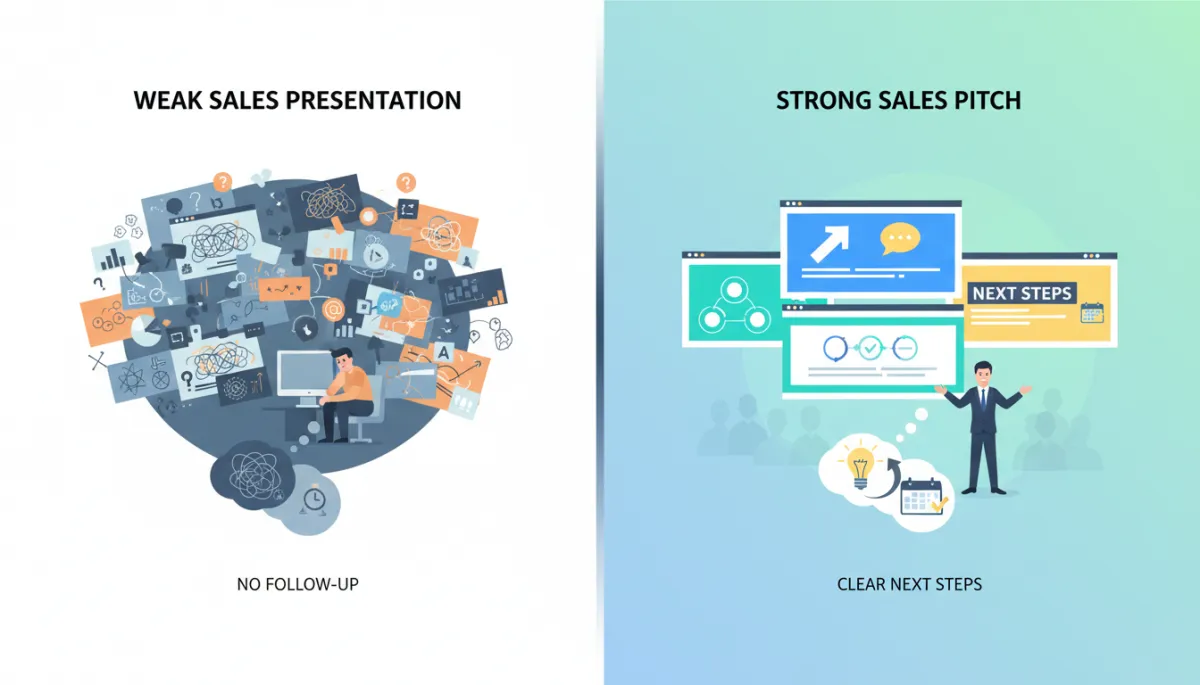
Quick Visual: Strong vs Weak Sales Presentation
📊 Summary Box: How To Improve Your Next Salespresentation
Turn your salespitch into a two-way conversation within the first five minutes.
Lead with the buyer’s world, not your company overview.
Connect every feature to a business outcome and a concrete story.
Plan specific salesfollowup while you are still in the room.
Reader Questions: Applying These Ideas To Your Own Salespitch
As you think about your own salespresentation, it can help to pause and ask yourself a few practical questions:
Where does my current salespitch turn into a monologue? At what slide or moment do prospects usually stop asking questions?
Which parts of my deck could be replaced with a story? Where would a real before‑and‑after example make the benefit clearer?
Is my salesfollowup doing any real work? Does it move the deal forward, or simply recap what the prospect has already seen?
If a buying committee reads only my follow‑up email, would they understand the value, the risk, and the next step?
💬 Your Turn: Which single change to your salespresentation do you think would have the biggest impact on your next deal?
Call To Action: Turn This Salespresentation Checklist Into Your Next Win
Do not wait for the “perfect” opportunity to overhaul your salespitch. Pick one real meeting in your current pipeline and:
Remove one slide that is about you, and replace it with a clearer view of the buyer’s world.
Add one specific client story that illustrates the outcome you are promising.
Write your salesfollowup email before you present, so you can send it the same day with clear next steps.
🚀 Ready to go deeper? Use this article as a working checklist alongside your next salespresentation, and compare the response you receive with previous pitches. Small, deliberate changes in how you present — and how you follow up — compound quickly across an entire pipeline.


