
How Billionaire Bill Gates Sold to IBM and Built Microsoft’s Enterprise Empire
High-ticket sales, enterprise customers, startup founders
How Billionaire Bill Gates Sold to IBM and Built Microsoft — A Guide for Founders Selling to Enterprise Customers
Bill Gates walked into IBM as the smallest player in the room… and walked out with the deal that built Microsoft. Here’s how startup founders who already know how to sell can learn how to sell to enterprise customers — without turning into someone they don’t recognize.

Why Selling Your Solution to Enterprise Customers Feels Impossible — And What Changes When You Get the Right Model
Jason knows exactly which founder this article is for. A team of five people or more. Product in market. Revenue coming in. And you are still the one taking the big calls, writing the proposals, and jumping into late-night demos because the prospect is “too important to miss.”
You’re not failing. You’re just tired of feeling small when a giant logo lands in your inbox. You know how to sell to startups and the mid-market. But when you think about how to sell to enterprise customers, it suddenly feels like a different sport with hidden rules and a clock you can’t see.
The numbers say you’re not imagining it. Gartner and others report that a single enterprise B2B deal involves on average about 11 decision-makers and takes 9–12 months to close, sometimes longer for deals above $50k in annual value ( Sales Kriya, Gartner via CEB). This is not a sales call. It’s a spreadsheet-backed political campaign.
Founders who map stakeholders before they pitch close enterprise deals about 67% faster than those who don’t (Forrester). 74% of enterprise buyers choose the first provider who adds real value and sets the agenda (CEB/Gartner). Enterprise accounts with an internal champion close at 2× the rate of those without one (RAIN Group). And 84% of deals are influenced by a referral or an existing relationship inside the buyer’s network (Salesforce).
When Jason teaches founders how to sell to enterprise customers, he is not asking them to become “killer closers.” He’s helping them change the model in their heads. From “I have to convince this giant company to trust my tiny startup” to “I have to understand their biggest blocker and make choosing us safer than doing nothing.”
As Jason teaches at AuthorJason.com, the founder who understands internal politics, risk, and incentives often wins the enterprise deal that the technically better product quietly loses.
How Bill Gates Walked into IBM as a Nobody and Walked Out with the Deal That Built Microsoft
In 1980, IBM needed an operating system for its new personal computer. They were the giant. Microsoft was tiny. IBM knew Microsoft as a programming languages company, not an operating system provider. On paper, this deal was not supposed to be Microsoft’s.
What mattered was this: IBM had an urgent timeline. They couldn’t build internally fast enough. They needed a partner who could move quickly and handle complexity without blowing up their risk profile. Gates understood that before he walked into the room. He studied their problem before he proposed any solution.
When IBM asked for an operating system, Microsoft didn’t have one. Gates didn’t say, “We can’t help you.” He said he knew who could. Then he went and bought QDOS from Seattle Computer Products for $50,000, licensed it to IBM, and kept the right to license it to others. The genius wasn’t just technical. It was structural. He made the enterprise deal low‑risk for IBM while making it transformative for Microsoft.
Gates didn’t walk in as a begging startup founder. He walked in as a problem analyst who understood IBM’s constraints: speed, risk, internal politics. He positioned Microsoft as a fast‑moving, low‑risk partner. This move is available to every founder reading this — even if your logo fits on a business card while theirs wraps a skyscraper.
In the first meetings, Bill Gates and Paul Allen focused less on dazzling IBM with technology and more on reliability and control. They agreed to IBM’s strict product development timelines and documentation standards, signaling that Microsoft would behave like an enterprise‑ready partner, not a hobbyist software shop. This reduced political risk for IBM executives whose careers depended on the success of the new PC launch.
More importantly, Gates negotiated to retain the licensing rights to what became MS‑DOS. IBM got what looked like exclusivity for its PC line, but Microsoft quietly kept the ability to sell the same system to other manufacturers. This one structural decision turned a single enterprise deal into the foundation for the entire clone PC market — and a recurring revenue engine that dwarfed the original contract value ( Harvard Business Review).
Later, when IBM launched the PS/2 line with its proprietary Micro Channel Architecture in 1987, Gates used structure as a weapon again. Microsoft pushed Windows and DOS as the de facto standard for clone manufacturers who rejected IBM’s more closed ecosystem. By favoring broad licensing over exclusivity, Microsoft became the safe, scalable choice for an entire industry — not just a single flagship customer ( HBR on platform strategy).
When the U.S. Department of Justice later challenged Microsoft’s practices, internal memos revealed how deeply the company thought about ecosystem control — “a computer on every desk and in every home running Microsoft software” wasn’t just a slogan; it was a structural sales goal. The IBM deal was the first proof that a single well‑designed enterprise agreement could set the standard for an entire market.
For startup founders, the lesson is not “be as smart as Bill Gates.” It’s that a smart enterprise sales strategy for startup founders goes beyond just winning the logo. It asks: how can this deal reduce the enterprise’s decision risk today while multiplying our strategic leverage over the next decade?
As Jason teaches at AuthorJason.com, the founder who studies the enterprise’s constraints and designs the deal to serve both politics and profit often outperforms the big players who only talk about features.
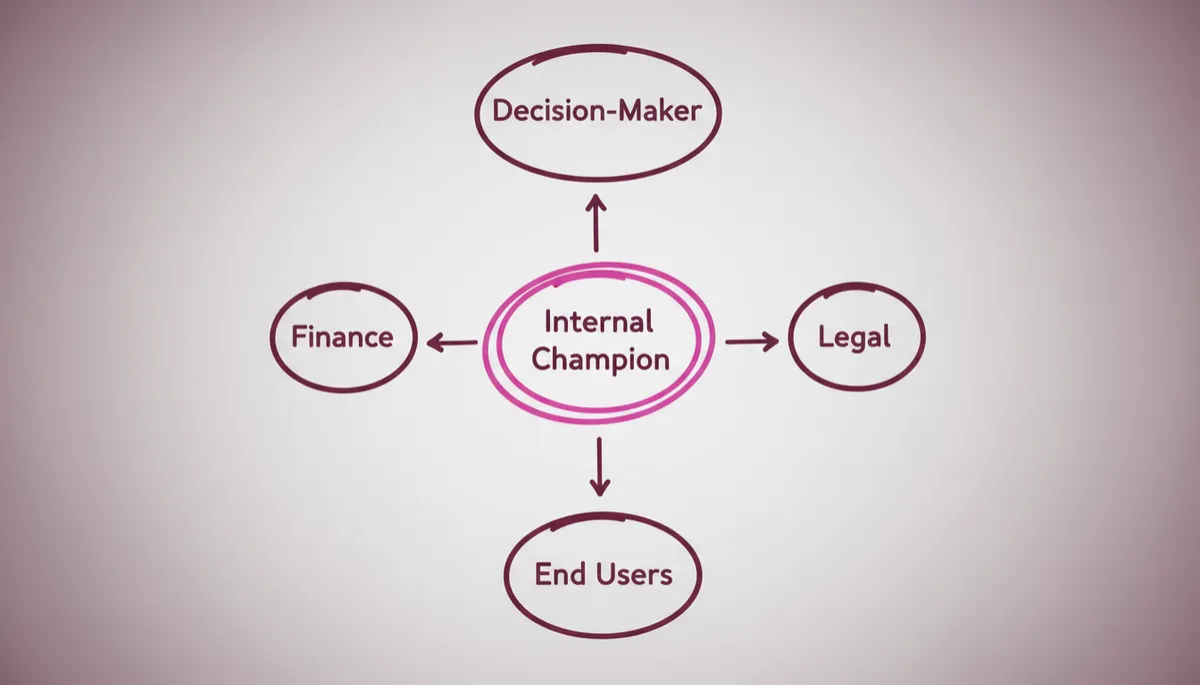
The average enterprise deal involves 11 decision‑makers. Enterprise accounts with an internal champion close at 2× the rate of those without one. The demo is the beginning. The champion is the close.
The Enterprise Sales Framework Jason Teaches Every Founder Who’s Ready for Big Accounts
Jason built the Future of Selling (FOS) system for founders who already close five‑figure deals and are ready for six‑ and seven‑figure enterprise contracts. It’s not theoretical. He has guided more than 1,000 founders to over $22M in combined sales across SaaS, services, and complex B2B products since 2015.
FOS treats enterprise sales as a system, not a personality test. It helps founder‑led teams map the real buying committee, build internal champions, and write proposals that speak to strategic priorities, not just features and roadmap. And it is deliberately forgiving. You’re allowed to be human, to learn, and to restart a stalled deal without shame.
Inside FOS, Jason teaches a simple formula called P.I.T.C.H that structures every enterprise sales conversation so the buyer feels safer with you than with their current chaos. If you want the full breakdown, he walks through it in detail here: the P.I.T.C.H formula.
Self‑check
- Do you know who the economic buyer is in your current enterprise opportunity — or are you only talking to the person who accepted the meeting?
- Do you have an internal champion who is selling your solution to the committee when you’re not in the room?
- Have you offered a pilot or smaller first engagement — or are you starting with the full contract as your first ask?
Self‑check
- In your current enterprise prospects, do you know who the economic buyer is — the person funding the decision from their budget?
- Do you have a champion inside the account who is actively selling for you when you’re not in the room?
- Does your proposal to the economic buyer speak to their metrics — or is it the same deck you use with your operational contact?
As Jason adapts the P.I.T.C.H formula for enterprise sales, he pushes founders to treat every member of the decision unit like a different classroom. Operations cares about workflow disruption. IT cares about security and integration. The economic buyer cares about margin, risk, and how the decision will look in front of the board.
That means the “teaching” moment in your conversations can’t be one‑size‑fits‑all. With operations, you teach how their day gets easier. With IT, you teach how your solution fits their existing architecture and compliance standards. With the economic buyer, you teach how your offer moves a specific needle — revenue, cost, churn, or risk — on a timeline that matters to them.
A strong enterprise sales strategy for startup founders uses the same core story but tunes examples, numbers, and language to each audience. Jason’s founders use the P.I.T.C.H formula as a backbone, then swap in evidence, questions, and next steps based on who’s in the room — and who will be talking about you when you’re not there. He explains how to do this in the main article on the P.I.T.C.H formula.
As Jason teaches at AuthorJason.com, founders who tune how they teach to each stakeholder’s incentives are the ones whose deals stay alive after the internal meeting they’re never invited to.
How Do You Get the First Meeting with an Enterprise Decision‑Maker When You’re a Small Startup?
- Start lower in the organization with someone close to the problem you solve and earn their trust by fixing one concrete problem quickly.
- Turn that early win into a simple, numbers‑backed story your contact can share internally.
- Use that story plus a warm internal referral to reach the executive who owns the strategic priority.
You rarely “win from cold” with the decision‑maker. You earn the first meeting by starting lower in the organization, solving one concrete problem quickly, and using that proof plus a warm internal referral to reach the executive who owns the strategic priority.
What Is an Internal Champion — And Why Does Every Enterprise Deal Need One?
- Identify the person who wins politically or professionally if your solution succeeds.
- Equip them with clear language, proof, and answers to likely objections.
- Treat them as a selling partner, not as a “contact” who just forwards messages.
The internal champion is the person inside the company who wins if your solution works. They are your teacher, your translator, and your defender. Without a champion, your proposal quietly dies in a folder when the committee gets anxious or distracted.
How Long Does It Take to Close an Enterprise Deal — And What Do You Do While You Wait?
- Expect 9–12 months for serious deals, sometimes longer for complex implementations.
- Use the time to map stakeholders, sharpen your proof, and help your champion prepare internal materials.
- De‑risk legal, security, and implementation questions before they become blockers.
Nine to twelve months is normal. While you wait, you keep adding value: mapping more stakeholders, sending insights, helping your champion prepare internal presentations, and de‑risking legal, security, and implementation questions before they turn into roadblocks.
As Jason teaches at AuthorJason.com, founders who treat the long cycle as an organized project — not a verdict — are the ones who stay calm enough to win the internal campaign.
How Bezos and Cuban Approach Enterprise Customers to Win Before the Meeting
Jeff Bezos didn’t build AWS by asking, “What features can we sell?” but by asking, “What pain do we already carry internally that every enterprise customer will eventually want to stop feeling?” Amazon had already solved scalable, reliable, cost‑effective infrastructure for itself. AWS turned that internal solution into an external promise: you will never worry about servers again ( McKinsey).
AWS didn’t sell compute units. It sold the removal of an entire class of operational risk. No more procurement delays. No more capacity‑planning nightmares. No more 3 a.m. hardware failures. For a founder learning how to sell to enterprise customers, Bezos’s pattern is simple: find the burden your prospect wants to delete from their calendar forever… and sell the deletion, not the dashboard.
In the early 2000s, Bezos personally pushed AWS teams to speak the language of CFOs and CIOs, not just developers. Instead of opening with “elastic compute,” they led with “turn capital expenditure into operating expense” and “stop buying hardware you may never use.” This reframed AWS as a financial and strategic decision, not a tech experiment — a classic version of enterprise sales strategy for startup founders you can copy: translate features into balance‑sheet impact.
When Amazon signed early enterprise customers like Netflix and Dropbox onto AWS, the pitch was rarely “more servers.” It was “you won’t apologize to your board for downtime again.” By backing that promise with clear SLA s and transparent pricing, AWS turned infrastructure from a capital headache into a predictable operating line item — exactly the kind of shift CFOs and boards get rewarded for adopting.
Bezos also embedded a “working backwards” culture through press releases: teams write a hypothetical launch press release and FAQ before building anything. In an enterprise context, that meant clarifying which executive metric the offer would move and which objections buyers would raise — long before the first sales call. This level of preparation is what founders can borrow when designing enterprise proposals.
Mark Cuban, on the other hand, talks about a mistake he sees founders repeat over and over. They rush to pitch the top executive. They treat the big meeting as a magic key. But enterprise sales is an inside game. Cuban’s advice: before you pitch the decision‑maker, find the person with the biggest upside if your solution works and invest in turning them into an expert. Let them sell internally. Your job is to equip the champion, not replace them.
Cuban has shared stories of deals where the founder never met the CEO until after the contract was signed. The real work happened with a mid‑level leader who was tired of broken processes. By rehearsing objections with that insider — “What will procurement say?” “What will IT worry about?” — the founder turned a frustrated manager into a confident internal salesperson. The CEO’s signature at the end was almost a formality.
In a well‑known example from one of his Shark Tank companies, Cuban backed a startup selling enterprise communication tools. Instead of pushing for CEO time, the founders focused on the head of customer support who lived the daily pain. Together they mapped how the tool would reduce ticket resolution time and improve employee retention. That leader walked into the executive meeting with a clear internal case — and Cuban’s founders mostly joined to answer final questions and contract terms.
Cuban’s pattern is consistent: he tells founders “know your numbers better than anyone else,” then transfer that confidence to the insider who will actually face the buying committee. The founder’s charisma matters far less than how comfortable the champion feels answering hard questions when budgets are on the line.
As Jason teaches at AuthorJason.com, Bezos wins by deleting risk from the calendar; Cuban wins by upgrading insiders into champions. Founders who combine both perspectives outperform competitors still chasing “the big meeting.”

Cuban’s rule: before you pitch the decision‑maker, find the insider with the biggest upside. Equip them to sell internally. Let the champion push the deal across the finish line.
How Do You Write an Enterprise Sales Proposal That Speaks to the Decision‑Maker’s Priorities?
- Start with their stated strategic priority in their own words — quoted from public documents or internal decks.
- Show how your solution advances that priority, reduces visible risk, and fits their budget, timeline, and political constraints.
- Move feature details to the appendix; let the first page speak to outcomes and trade‑offs.
Start with their named strategic priority in their own words, then show how your solution pushes that priority forward, reduces a visible risk, and fits their budget, timing, and political constraints. Features live in the appendix. The executive story lives on the first page.
What’s the Biggest Mistake Startup Founders Make When Pitching Enterprise Customers?
- Pitching too early and too high before understanding the decision unit.
- Skipping champion‑building and stakeholder mapping in favor of “one big pitch.”
- Failing to tie language to a named strategic initiative and measurable outcomes.
They pitch too early and too high, with no champion, no stakeholder map, and no language tied to a named strategic initiative. The result is a “beautiful presentation” that nobody internally knows how to defend once procurement and risk teams start asking hard questions.
As Jason teaches at AuthorJason.com, the founder who respects the decision unit — and equips their champion for every internal objection — wins far more often than the one who merely “nails the demo.”
What Jason’s Founders Close When They Stop Pitching and Start Solving
Jason has watched this shift happen in real companies. A founder named Maya entered FOS leading a team of eight. Good product. Strong pipeline. Mostly mid‑market. Every time a global brand name showed interest, she felt the same tightening in her chest. “We’re not ready. We’re too small. We’ll mess it up.”
Inside FOS, she learned to slow down before the pitch and speed up after. She mapped her enterprise accounts. She found internal champions in operations, not just innovation labs. She rewrote her proposals to open with the company’s own strategic language instead of product features. Within four months, she closed her first six‑figure annual contract and turned that logo into three more warm referrals. Same founder. Same product. Different game plan.

Over 1,000 founders. More than $22M in combined sales. 74% of enterprise buyers choose the first provider who adds value and sets the agenda. Show up prepared. Speak to their priority. Win the room.
Other founders Jason mentors have seen similar shifts. Tan generated $29,693 in 16 days by reframing his offer for an enterprise buyer. Teo signed 63 customers in 100 days by building champions in operations and finance. Leon grew from $2.5k to over $2M by learning how to handle multi‑party decisions with a five‑person team. None of them grew by “acting big.” They grew by getting more specific about whose problem they solved and how the enterprise would defend choosing them.
When Jason deconstructs Tan’s $29,693 in 16 days, the pattern looks simple. Tan identified an operations leader drowning in manual reporting. Instead of pitching a full platform, he offered a focused pilot to automate one report for one business unit. That small win gave his champion a concrete story — “we saved four hours a week per manager” — to take to finance and IT.
Then Tan built an internal slide with his champion that translated those hours into annual cost savings and reduced error risk. By the time the economic buyer saw the proposal, it was framed as a low‑risk productivity play, not “another tool.” This is what a practical enterprise sales strategy for startup founders looks like: one specific problem, one clear champion, and one key metric that matters to the budget holder.
In Tan’s case, the buying committee included operations, finance, and IT. He started with operations, then used pilot results to secure a joint call with finance. Before that call, he sent a one‑page brief translating time saved into annual cost reduction, which his champion circulated internally. When IT raised security questions, Tan had already prepared a short Q&A sheet with his CTO. Because each stakeholder saw their concerns addressed in their own language, the committee agreed to expand within weeks instead of quarters.
The $29,693 in 16 days wasn’t a lucky close — it was the result of mapping the buying committee, selling a pilot first, and equipping an internal champion with the exact language needed to move the deal forward at each step. This is what a disciplined enterprise sales strategy for startup founders looks like in execution.
As Jason teaches at AuthorJason.com, founders like Maya, Tan, Teo, and Leon don’t win because they shout the loudest; they win because they quietly become the safest internal story their champion can tell.
How the P.I.T.C.H Formula Structures an Enterprise Sales Conversation
Enterprise deals collapse in the gaps — between meetings, between departments, and between what the founder thinks they said and what the champion actually repeats in the internal room. Jason built the P.I.T.C.H formula inside the Future of Selling system to close those gaps and give every conversation a clear job.
Instead of improvising on every call, founders learn to walk into each interaction knowing exactly what to clarify, what to commit to, and which leave‑behind to give the champion. The formula is simple enough to remember under pressure and strong enough to survive a nine‑month sales cycle. Jason lays out the steps in this article on the P.I.T.C.H formula, so founders don’t have to guess what to say next.
In an enterprise context, preparation for each interaction changes completely. Preparation no longer means “review the deck and show up.” It means mapping the full buying architecture before the first serious meeting: who will decide, who will influence, who will block, and who is most likely to be the champion. Gartner’s research shows that modern B2B purchases are driven by complex buying groups with multiple “jobs” that must be completed ( Gartner on B2B buying complexity).
At this level, preparation looks like: reviewing public reports to spot named initiatives, scanning LinkedIn to understand reporting lines, and drafting different versions of your core story for operations, IT, and the economic buyer. You enter the first call with hypotheses about the buying committee and use your questions to confirm or correct them. That way, every subsequent interaction is designed with the real decision‑makers in mind — not just the person who replied to your email.
Founders who prepare this deeply rarely get stuck in endless proof‑of‑concept loops. Because they know who needs to say yes, what each stakeholder fears, and which metrics matter, they can frame pilots, proposals, and follow‑ups as steps in a single coherent internal case. Founders who skip this work often end up with enthusiastic users but no budget — a painful place in enterprise sales.
Practically, founders using the P.I.T.C.H formula plan each interaction based on who will hear about it later. The discovery call with operations is designed to extract internal friction and language you’ll reuse with finance. The technical review with IT is designed to produce a short, confident email they can send to security. The meeting with the economic buyer is designed to make defending the spend in a budget meeting you’ll never attend easy.
The “teaching” moments in your enterprise conversations stop being random slides and become deliberate stories that travel well inside the organization — stories your champion can retell in three minutes without losing the point. That’s how founder‑led teams win enterprise deals long before the contract ever hits DocuSign.


