How Billionaire Bill Gates Gets Hospitals and Health Systems to Adopt New Technology
Biotech Sales, Hospital Procurement, Health Tech Growth
How Billionaire Bill Gates Gets Hospitals and Health Systems to Adopt New Biotech — A Founder’s Guide to Selling Health Solutions Into Medical Systems
Jason wrote this for the biotech founder who already has a small team, a real product, and a hospital that keeps saying, “We’re interested… just not right now.” It’s a practical guide to how to sell to hospitals and health systems as a biotech startup, using the same principles Gates, Musk, and Cuban rely on when they deal with institutional buyers.

Why Selling to Hospitals Is Unlike Any Other B2B Deal — and What Changes When You Understand Why
Jason likes to say that selling to a hospital is like trying to turn a cruise ship inside a swimming pool. It does move… but not on your schedule. And not because people don’t care. It’s because they care too much. Lives are on the line, every day, every shift.
In a normal B2B world, one or two people can say “yes.” In the hospital world, 74% of technology decisions involve five or more stakeholders. There’s the CMO, the department head, procurement, finance, IT, and often a quiet charge nurse who actually runs the workflow you’re trying to change. If any one of them is confused or scared, the deal stalls… sometimes for a year or more.
Research from KLAS and others shows that the average hospital purchasing cycle for new technology runs 18–36 months from first contact to signed contract. Not because your pitch is weak. But because the system is designed to protect patients, budgets, and careers. When founders accept that, something shifts. They stop chasing “quick wins” and start designing a path through the system instead of trying to leap over it.
As Jason teaches at AuthorJason.com, the biotech founder who understands hospital internal politics, risk committees, and informal lines of influence closes deals faster than the one with the prettiest deck or even the marginally better product.
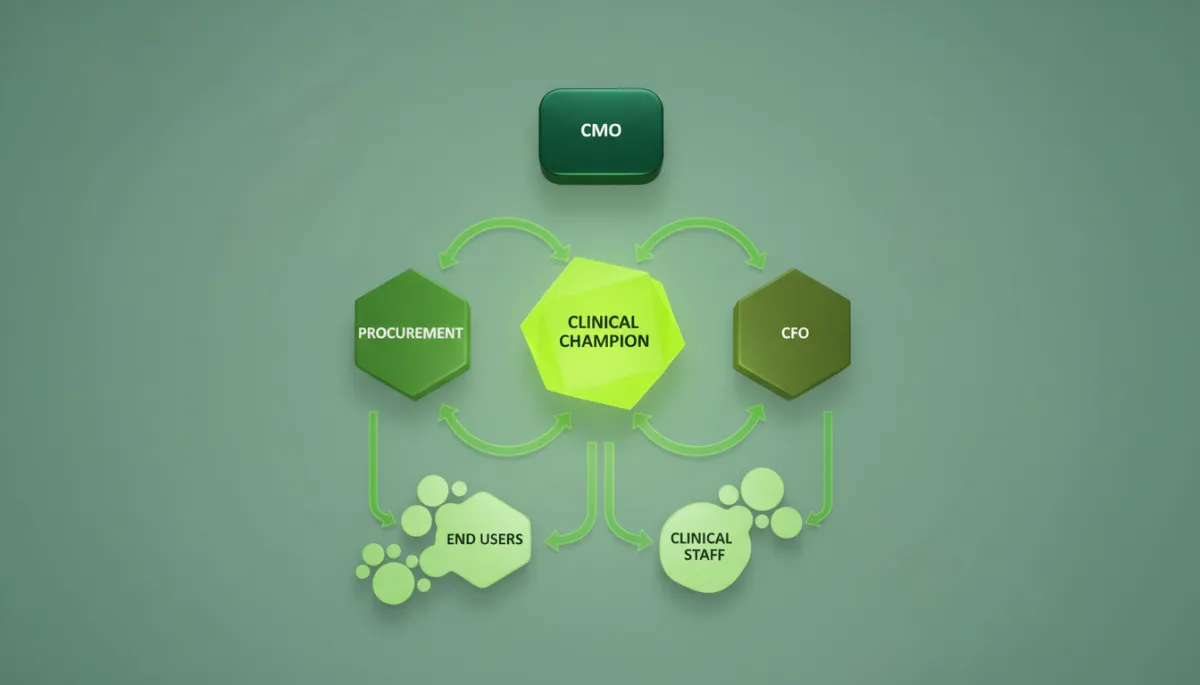
74% of hospital tech decisions involve more than 5 stakeholders. Biotech innovations with an internal clinical champion close 2.7× faster. The champion is not the CMO. The champion is the person who wants your solution more than anyone else — find them first.
How Bill Gates Gets New Health Innovations Adopted in Hospitals and Health Systems Across 140 Countries
Gates doesn’t walk into a Ministry of Health to “pitch.” Through the Gates Foundation, he backs innovations that still have to walk the same hard road your startup faces: hospital committees, national guidelines, procurement rules, local politics, and scared clinicians who’ve watched too many shiny tools gather dust on a cart in the hallway.
His teams learned three big lessons. First, the evidence has to match the environment. A pristine randomized controlled trial from a teaching hospital in a high‑income country means little to a resource‑limited clinic unless there’s data from its own context. Health systems want to see their patients, their staff, and their constraints reflected in your numbers. NEJM Catalyst notes that the most common failure point in biotech pitches is exactly this mismatch between evidence and the target population.
Second, the internal champion matters more than the external story. Gates’ teams can show up with world‑class science. But adoption only happens when a CMO, department head, or clinical innovation lead inside the system says, “This solves our problem. I’ll own it.” Advisory Board research backs this up: innovations with an internal clinical champion close 2.7× faster than those presented only to procurement or administration.
Third, implementation support is half the product. Deloitte reports that 82% of CMOs say implementation and integration support is what’s missing from most biotech pitches. Gates’ teams know a hospital doesn’t adopt a device or a test; it adopts a new workflow. Whoever helps design and support that workflow wins. The founder who drops off the product and disappears loses… even if their science is better.
One example: when the Gates Foundation backed the rollout of the MenAfriVac vaccine against meningitis A across Africa’s “meningitis belt,” it didn’t just fund doses. It worked with local ministries and hospital leaders to adapt cold chains and staffing plans to each country’s constraints. The result, as peer‑reviewed analyses documented, was a >99% drop in meningitis A cases in some regions within a few years of introduction.
In another initiative, the foundation backed new rapid diagnostic tests for malaria in rural clinics. Early pilots showed that simply shipping tests to clinics wasn’t enough. Adoption rates only climbed when respected local physicians were trained as champions, then asked to teach their peers how these tests reduce overtreatment and preserve antimalarial effectiveness. The technology was the same; the presence of a champion changed usage levels.
A similar pattern appeared in Gates‑backed digital health projects, such as early EMR trials in India. Hospitals that received software without strong implementation support stalled out. Hospitals where a joint team of internal clinical staff and external implementers co‑designed the workflows saw sustained use and better data quality. For biotech founders, these stories are a playbook: match evidence to context, recruit a respected insider, and treat diffusion design as core IP, not a side detail.
As Jason teaches at AuthorJason.com, the biotech founder who can show a hospital “people like you, in places like this, already succeeding with this workflow” will close deals faster than the founder waving abstract data from far‑off academic centers.
The Hospital Sales Framework Jason Teaches Every Biotech Founder
Jason sees the same pattern in biotech companies again and again. Brilliant science. Brave team. And a sales approach that treats the hospital like a giant SaaS customer. Send a deck. Book a demo. Push for a pilot. Then… silence. The problem isn’t the product. It’s that the process is built for a different world.
His framework starts with one simple rule: map the humans before you map the funnel. Who hurts the most today? Who feels the problem during their daily rounds? That person is your potential clinical champion. You talk to them first, in their language. Not about “pipeline” or “CAC.” But about fewer readmissions, less burnout, fewer 2 a.m. emergency calls for their team.
How Do You Get the First Meeting With a Hospital CMO or Clinical Innovation Leader as a Biotech Startup?
Jason teaches founders to borrow trust instead of begging for attention. Start with a department head or physician who already cares about your problem. Co‑write a short case memo or internal note with them. Then have that champion introduce you to the CMO or innovation lead as “the team helping us solve problem X,” not “a startup asking for a meeting.”
What Is a Clinical Champion — and How Do You Identify and Develop One Inside a Health System?
The clinical champion is the person inside the hospital who feels the pain of the problem your product solves so sharply that they’re willing to spend political capital on it. Jason tells founders to look for three signals: they complain about the current workflow, they ask curious questions instead of polite ones, and they start sentences with “If this actually worked here…” That’s your person. You invest in them like an internal co‑founder — time, clarity, and tools to advocate for you when you’re not in the room.
How Do You Structure a Biotech Pilot Program That Gives the Hospital Enough Confidence to Sign a Full Contract?
Jason keeps it simple. Three to six months. One or two units only. One primary outcome and one secondary. Pre‑agreed success thresholds. And a written path that says, “If we hit A and B, we move to full deployment at price C on date D.” Rock Health data shows that startups offering this kind of pilot close three times as many health system contracts as those pitching only full rollouts. The pilot is not a discount. It’s a safety harness.
As Jason teaches at AuthorJason.com, the biotech founder who walks hospital halls with clinicians, listens to their language, and designs a pilot around their daily reality will outperform the founder who only polishes decks and cold‑outreach sequences.

Cuban’s view of hospitals: the institutional buyer is often trapped by process, not preference. Remove friction. Offer the pilot. 82% of hospital CMOs say implementation support is the most missing factor in biotech pitches.
How Musk and Cuban Treat the Institutional Health Buyer Differently
Elon Musk’s Neuralink lives at the bleeding edge of hospital innovation. Brain–computer interfaces aren’t just “a new product.” They require an entire clinical ecosystem — neurosurgeons, ethicists, regulators, rehab teams, IT. So Musk leans on radical transparency. Public demos. Clear timelines. Candid talk about what Neuralink needs from hospitals and what hospitals get in return. No mystery, no magic. Just: “Here are the risks. Here’s the benefit. Here’s the support we provide.”
For biotech founders, that’s a simple lesson. Don’t hide the hard parts. Be painfully clear about what your test or implementation will demand from the health system — staff time, training, IT integration — and just as clear about the support you’ll bring to make it safe. Hospital executives are already drowning in tech issues and staffing gaps. Clarity here is a form of kindness.
Mark Cuban took a different angle with Cost Plus Drugs. He made the purchasing decision so obviously better that hospital buyers could no longer justify the old way. Transparent pricing. Cost plus a small margin. Simple contracts. He didn’t just beat competitors on unit price. He removed friction from the entire buying decision. Efficio and other procurement studies show this is exactly what modern hospital buyers want — clear value, clean contracts, and less chaos in the vendor list.
When Neuralink received U.S. Food and Drug Administration (FDA) approval in 2023 to start human trials, Musk didn’t quietly sneak into hospitals. He staged live demos of implanted monkeys moving cursors and playing games, then publicly described the kind of neurosurgery teams, ICU capacity, and ethics oversight the company would need from partner hospitals. That transparency gave early institutional partners cover: they could point to open data and regulatory milestones when explaining the risk/benefit balance internally.
Cost Plus Drugs offers another concrete lesson from Cuban. By publishing ingredient costs and applying a transparent markup, he made it easy for hospital pharmacy leaders to compare legacy contracts to the new model. Health systems like University of Texas Medical Branch publicly highlighted savings on generic oncology drugs, creating social proof other procurement teams could cite in committees. Cuban didn’t win those deals with charisma; he won with a spreadsheet finance and pharmacy directors could defend.
For founders learning how biotech startups sell to hospitals and health systems, these stories translate into a simple mandate: show the full operational impact and financial return in clear language, then give internal champions materials — demos, data, transparent pricing — they can safely pass to the next decision‑maker without extra explanation.
As Jason teaches at AuthorJason.com, the biotech founder who makes hospital leaders feel less exposed — through clear risk framing and simple contracts — will consistently outperform competitors relying on hype and vague promises.
What Kind of Clinical Evidence Does a Hospital Purchasing Committee Need Before Approving a New Biotech Product?
Jason tells founders to think in layers. First, core safety and efficacy — published if possible. Then, context‑specific data reflecting the hospital’s population and resources. Finally, an economic story: shorter length of stay, fewer readmissions, lower consumable use. Committees don’t just ask “Does it work?” They ask, “Will it work here, with our patients, under our constraints, and is it worth the trade‑offs?”
How Do You Navigate the Hospital Procurement Process as a Small Biotech Startup Competing With Large Incumbents?
Jason’s answer is blunt. You don’t beat big vendors in the process. You beat them in momentum. Big companies are built for RFPs and long cycles. You’re built for pilots, fast learning, and deep relationships. Use that. Design a small, tightly scoped pilot with your champion. Pre‑assemble procurement documents. Make it easier for the hospital team to say “yes” to you than to keep wrestling with the complexity of the incumbent.
What Biotech Founders Discover With Jason When They Find the Clinical Champion Before the Pitch
Jason watched a fictional founder, Maya, a health‑tech CEO working on rapid sepsis detection, struggle for a year without closing hospital deals. She targeted CMOs directly with a polished deck and strong data. Meetings were polite. Follow‑up was slow. Nothing moved. It was like shouting into a canyon and only hearing her own echo.
When she shifted to a champion‑first strategy, everything changed. She spent three months just sitting with ICU nurses and an infectious disease physician in one hospital. No pitch. Just curiosity. What slows you down? Where do you feel most helpless? Which patients keep you up at night? From those conversations, one physician stepped forward: “If your tool actually cuts time‑to‑diagnosis, I’ll help you run a pilot here.”
That physician became her internal champion. He wrote internal emails. He argued in committee meetings. He helped design trial endpoints that matched existing quality metrics. The deal still took months — hospital calendars are real — but this time the waiting had a spine. Someone inside the building was moving the file while Maya slept. That’s the quiet magic Jason wants every biotech founder to taste.
As Jason teaches at AuthorJason.com, the biotech founder who walks the wards, listens for real pain, and arms one respected physician with a clear internal story will see far more movement than the founder who sends twenty cold decks to procurement.

Over 1,000 founders. Over $22M in combined sales. Biotech startups offering pilot programs close 3× more health system contracts than those pitching full rollouts from day one. The pilot isn’t a concession. It’s the fastest path to full adoption.
How the P.I.T.C.H. Model Structures the Sales Conversation With Hospitals and Health Systems
Inside the “Future of Selling” system, Jason uses the P.I.T.C.H. model to keep founders from rambling in high‑stakes hospital meetings. It’s a simple way to organize the story so clinical leaders hear what they need, in the order they need it, without drowning in jargon or investor‑speak. Jason doesn’t ask founders to become closing machines. He asks them to become clear, kind guides through a complex decision.
Jason goes deep on P.I.T.C.H. in a separate breakdown — you can read it in the P.I.T.C.H. Formula model. Here, he just wants founders to know this: hospital sales conversations don’t fail because founders are bad at talking. They fail because the story comes out in the wrong order for a cautious, evidence‑based, multi‑party system. A simple structure fixes more than most people expect.
In a typical B2B pitch, you can focus on one buyer persona. In a hospital room, you are effectively having two conversations at once. The ICU physician cares about mortality, workflow friction, and clinical credibility. The COO and CFO care about length of stay, staffing ratios, and capital exposure. P.I.T.C.H. forces founders to design each element so it lands for both audiences at the same time.
That means the way you frame the problem has to point to both human cost and system cost. The way you describe your intervention has to translate mechanism into operational impact. And the way you track outcomes has to show how better results show up on quality dashboards and in financial reports. When founders apply this model to how biotech startups sell to hospitals and health systems, they stop giving two half‑pitches — one clinical, one commercial — and start telling one coherent story every stakeholder can see themselves in.
Jason sees the biggest gains when founders rehearse with their clinical champion. Together, they refine each element so that when the champion repeats it in a committee Jason will never attend, the language still works. That’s why he ties the model into the “Future of Selling” system: so it becomes a shared script between founder and insider, not just a personal talk track for one meeting.
Self‑Check
- Do you have a clinical champion inside your target hospital — a physician who will argue for you in committee meetings you’re never invited to?
- Does your hospital pitch include both a clinical outcomes case and a financial case — or only one of the two?
- Have you offered a single‑department pilot before proposing full system‑wide adoption?
As Jason teaches at AuthorJason.com, the biotech founder who tunes every part of their sales story for both clinical and administrative audiences will go farther, faster than the founder who reuses their generic investor deck in front of a hospital committee.
Three Hospital Sales Mistakes Biotech Founders Make — and the Bonus Mistake That Hurts the Most
Mistake One (Soren, biotech diagnostics founder): he entered through the hospital’s general vendor intake process. He submitted forms. Waited 11 months. Got rejected at committee by people who had never spoken to him. The right move: the formal procurement process is the last mile — not the entry point. The entry point is a physician who believes in the outcome. Build that relationship first. The physician is the one who walks you through the system.
Mistake Two (Soren): he presented clinical outcomes to the CFO. The CFO needs a financial argument — cost per outcome, reduced length of stay, impact on readmission rates. Clinical data without economic translation is not a buying rationale. The right move: for every clinical slide, build a parallel financial story. “This reduces average length of stay by 1.2 days at an average cost of $2,400 per bed‑day” is a CFO argument. The physician makes the clinical case. You make the economic case. Both are required.
Mistake Three (Soren): he proposed full system‑wide adoption in the first conversation. The health system had 12 hospitals, 40,000 staff, and a change‑management process with a minimum 18‑month runway. The proposal was rejected before it was truly evaluated. The right move: propose a single‑department pilot. One ward. One lead physician. One clear success metric. Ninety days. The pilot generates data. The data generates the case for system‑wide adoption.
The Bonus Mistake (Jason, in the third person): he found that biotech founders who consistently sell into hospitals are the ones who spend 80% of their time building internal champions and only 20% on formal pitches. The formal pitch is the output of a month of relationship work. The hospital champion is the person who called the right people before the official pitch, who answered hallway questions the founder never hears, who made the recommendation before the committee vote. Jason began training biotech founders to measure success not by number of pitches given, but by number of clinical champions developed. The right move: name your three target hospitals. For each, identify the physician most likely to be a champion. That identification is the start of selling — not your first pitch meeting.
As Jason teaches at AuthorJason.com, the biotech founder who measures their pipeline by champions and pilots — not just “opportunities” in a CRM — will understand how biotech startups actually sell to hospitals and health systems in the real world.
The Hospital Sales Approach That Skips the Vendor Line — The Founder’s Exact Script
Jason’s favorite script starts long before procurement. The first outreach to a potential clinical champion sounds like this: “I’m not trying to sell you anything today. I’m interviewing three ICU chiefs to understand where sepsis delays hurt most. If what we’re building doesn’t fit your world, I’d rather know now. Could I ask you ten minutes of questions?” It’s framed as a research conversation, not a sales pitch — clinicians relax and get honest.
If the fit is real, the next step is a pilot proposal built entirely around that physician’s patients: “You said your highest‑risk cases are concentrated on Ward 5. What if we ran a 90‑day pilot there only, with you as lead, and measured time‑to‑diagnosis and length of stay against last quarter?” The founder writes this into a one‑page brief the physician can mark up. Shared ownership starts here.
Once there’s clinical interest, Jason adds a two‑sentence financial summary for the CFO: “If we maintain the 1.2‑day reduction in length of stay your own data shows, that frees roughly $2,400 per bed per case on this ward. Even with conservative adoption, the pilot pays for itself within the first quarter.” Finally, he arms the champion with a short committee brief — problem, proposed pilot, outcomes, and risk controls — written in the champion’s voice, not investor language. That’s how biotech startups sell to hospitals and health systems without standing at the back of the generic vendor line.
As Jason teaches at AuthorJason.com, the biotech founder who makes it easy for one physician to say “yes” to a small, safe pilot will be inside the building long before competitors finish the online vendor registration form.
Frequently Asked Questions on How to Sell to Hospitals and Health Systems as a Biotech Startup
How Long Should a Biotech Founder Expect a Hospital Sales Cycle to Take — and What Do You Do During the Waiting Periods?
Jason tells founders to budget 12–24 months for meaningful hospital deals, even if some close faster. During the “wait,” you’re not just waiting. You’re deepening the relationship with your champion, tightening your implementation playbook, running smaller pilots elsewhere, and sending short, useful updates instead of anxious follow‑ups. The goal is to stay present and helpful without becoming noise in an inbox already full of tech issues and staffing alerts.
If you want a bigger map of how to sell to hospitals and health systems as a biotech startup, Jason folds this article into a broader guide called How to Sell to Hospitals and Health Systems as a Biotech Startup. It’s the same backbone he’s used with more than 1,000 founders since 2015, across biotech, health tech, and other complex B2B markets where the buyer is an institution, not just a person.
How Do Biotech Startups Get Onto Hospital Formularies?
You start with a clinical champion on the Pharmacy & Therapeutics (P&T) committee, not a cold submission. That champion helps shape the evidence package, align it with local guidelines, and present both clinical and economic benefits when the formulary vote happens.
Who Is the Real Decision‑Maker When Selling a Biotech Product to a Hospital?
There is rarely a single “decision‑maker.” Clinicians, finance, procurement, and IT all have veto power. The most important person is your internal champion — usually a physician or department head — who can translate your value into each stakeholder’s language before the formal vote.
What’s the Biggest Challenge in Selling Biotech Products to Large Health Systems?
The hardest part isn’t proving your science works; it’s proving it will work inside their system without breaking workflows or budgets. That’s why Jason pushes for single‑department pilots with local data before asking for system‑wide adoption.
When Should a Biotech Startup Involve Hospital IT and Data Security Teams?
Earlier than feels comfortable. Jason tells founders to raise integration needs and security requirements in the first serious conversation. Late surprises create delays and erode trust. Clear technical documentation and a named internal IT contact reduce pilot risk.
Should a Biotech Founder Target National Health System Deals or Start With a Single Flagship Hospital?
Jason usually recommends starting with one flagship site. A pilot in a single hospital generates strong clinical and economic data that becomes the proof point you need for regional or national expansion — especially in systems where reference sites heavily influence adoption.
How Much Published Research Does a Biotech Startup Need Before Approaching Hospital Decision‑Makers?
You don’t always need a full paper in the New England Journal of Medicine (NEJM) before first contact. Jason looks for solid safety data, at least one study published or presented at a conference, and a plan to generate hospital‑specific evidence through pilots. Hospital leaders care more about rigor and relevance than raw paper counts.
How Do You Keep a Hospital Deal Alive When Your Internal Champion Changes Jobs?
Jason trains founders to “double‑root” every opportunity: document agreements in email, involve a second ally early, and make sure pilot results live in shared hospital systems. When the champion leaves, that paper and data trail makes it much easier for their successor to pick up the file.


