
How Billionaire Bill Gates Built a Sales Follow-Up System That Never Lets a Deal Go Cold — The Founders' Playbook
Sales, Follow-up, Startup Founders, Systems
How Billionaire Bill Gates Built a Sales Follow-Up System That Never Lets a Deal Go Cold — A Founders’ Guide
Imagine that every serious buyer in your pipeline gets a touch from you at the right time, with the right message, without you needing to remind yourself of anything. That’s what an effective sales follow-up sequence actually does — and it’s how the best founders quietly win the deals everyone else forgets about.
Why Random Follow-Up Fails While a System Quietly Wins?
Summary: Random follow-up relies on memory and mood. A sales follow-up sequence designed for startup founders keeps every qualified deal moving, even when the founder is busy, tired, or distracted.
Jason meets founders who care deeply about their product and their buyer. They show up for the first call. They deliver a sharp demo. They promise to send a follow-up “later today.”
Then life happens. A delivery issue. A team crisis. Another investor meeting. The follow-up shifts from “today” to “tomorrow” to “when I get a minute.” The deal doesn’t die in one big moment. It just cools, one forgotten touch at a time, like a cup of coffee left on the corner of the desk.
The numbers here are harsh. Aberdeen Group found that companies with a formal follow-up process close 47% more deals than those without one. And HubSpot notes that automated sequences can increase replies by 250% compared to random chasing. This isn’t a small edge. It’s a completely different outcome of work (HubSpot).
Jason has seen this repeat across more than 1,000 founders since 2015. Those who rely on memory end up with peaks and valleys. Great months followed by dry ones. The ones who build a system see something quieter but far more powerful: a pipeline that keeps moving, even on the days they’re tired, distracted, or dealing with chaos at home.
As Jason teaches at AuthorJason.com, a designed follow-up sequence behaves like infrastructure: once it’s built, it delivers consistent touches on a defined schedule, while ad‑hoc follow-up always mirrors the founder’s current energy instead of the buyer’s decision timeline.
How Did Bill Gates Turn Follow-Up into a Hidden Edge at Microsoft?
Summary: Bill Gates treated follow-up as a product problem. He built simple tracking systems so every prospect had a next step, turning consistent, sequenced follow-up into a quiet competitive advantage.
Long before modern CRMs, Bill Gates treated follow-up as a product problem, not a personality trait. Microsoft’s early growth didn’t come from heroic memory. It came from internal tracking systems that told the team exactly who they were talking to next, and what needed to happen to move the deal forward.
Gates had structured ways to track IBM, hardware vendors, software partners, and enterprise customers. Every prospect was recorded. Every next step was written down. Every follow-up had a place in a sequence, not just a reminder in someone’s head. The culture was simple: a deal only goes cold if someone allows it — and the system’s job is to make sure no one allows it.
In the early 1980s, when Microsoft was closing its pivotal deal to supply IBM with the operating system for its first personal computer, Gates insisted on meticulous tracking of every technical and commercial question IBM raised. Internal documents specified who owned each follow-up, when it was due, and how it would be answered. That discipline helped Microsoft ship MS‑DOS on IBM’s schedule — and cemented a relationship that dominated the PC era (Harvard Business Review).
Later, when Microsoft shifted from boxed software to large enterprise licensing agreements, Gates pushed for “red/green” account reviews where every major customer had clearly defined next actions. Instead of vague notes like “stay in touch,” account teams documented specific follow-ups tied to renewal dates, deployment milestones, and executive briefings. That structure helped Microsoft maintain high renewal rates while expanding seat counts inside Fortune 500 accounts.
In interviews, he talked about the danger of relying on memory. A company that runs on “I’ll remember to follow up” will always lose to a company that builds a structure making follow-up inevitable. For Jason, this is the heart of the Future of Selling (FOS) system. Follow-up isn’t about willpower. It’s about design. If the founder forgets, the answer isn’t “try harder.” It’s “fix the system.”
As Jason teaches at AuthorJason.com, founders who treat their follow-up sequence the way Gates treated Microsoft’s product roadmap — documented, versioned, and improvable — consistently outperform peers who rely on memory, because the system keeps compounding even when the founder is away from the keyboard.
New! September 2026
Dear founders,
Do you also find that your follow-up has no sequence — just a string of disconnected emails that feel unrelated, because each one was written in isolation without knowing what came before or what comes next?
Many founders feel exactly that. The founders Jason works with felt the same — organized people whose follow-up was reactive instead of designed. What they discovered is that a follow-up sequence is not a series of reminders; it’s a deliberate story that builds buyer trust one touch at a time.
Salesforce reports that 76% of sales reps say they don’t get enough training for the role — and for founders without a designed follow-up sequence, every touch starts from zero instead of building on what came before. The system organizes every touchpoint with a clear intent.
The “Habits” step in the Future of Selling system builds a complete follow-up sequence: the right rhythm, the right type of content at each stage, and the right signal to watch for to know the buyer is ready. Read the P.I.T.C.H. equation. Visit dreamaker.club/buyfos — $19/month. $0.63/day.
Jason has worked with more than 1,000 founders since 2015. Over $22M in combined sales. Built from zero three times.
What Is the Five-Touch Follow-Up Sequence Jason Teaches Every Founder?
Summary: The five-touch follow-up sequence Jason teaches startup founders runs over 21 days, with each message doing a different job so it builds value, proof, and a clear “close the loop” moment toward a decision.
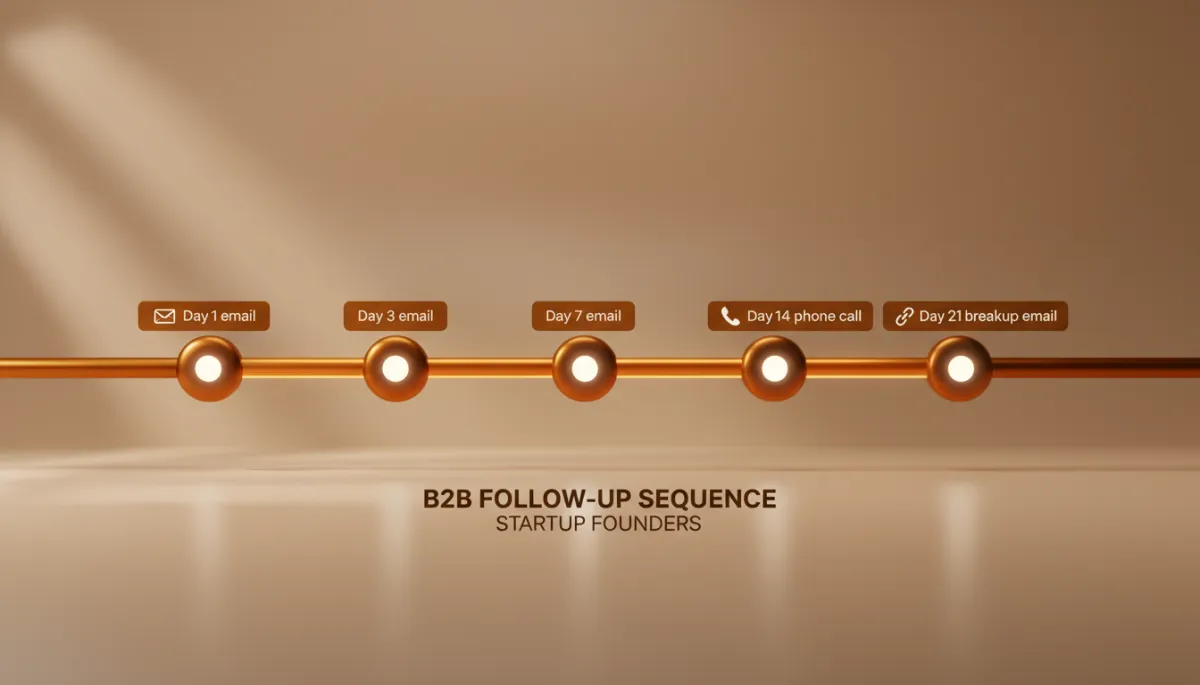
A clean horizontal timeline in deep amber #92400e shades showing a five-touch B2B follow-up sequence…
Companies with a formal follow-up process close 47% more deals than those without. Gates built this into Microsoft before CRMs existed. The system closes the deals. The founder who relies on remembering does not.
Jason keeps the core sequence simple so a busy founder can actually run it. Think of it as a train schedule. Same track. Same stations. Every prospect just boards from a different station:
Day 1 – Summary email: Thank them, confirm the problems, restate the plan, and clearly define the next step.
Day 3 – Added value: Share a short resource that answers a question they already asked. No pressure, just help.
Day 7 – Proof: Send a case study or short story about a similar client and the result they achieved.
Day 14 – Call plus email: Make a brief, respectful call, then follow it with a concise email summarizing what happened, whatever the outcome.
Day 21 – Break-up email: Give them an easy out while leaving the door open. Many “silent” buyers reply here.
Yesware’s analysis of more than a million emails shows that a sequence around days 1, 3, 7, 14, and 21 is close to optimal for B2B (Yesware). And Salesforce found that reps who use a written template or script, instead of improvising every time, close 33% more deals (Salesforce). Multi-touch, multi-channel sequences consistently outperform one-off follow-ups because they match how real buyers make decisions over time.
As Jason teaches at AuthorJason.com, the power of the five-touch follow-up sequence doesn’t lie in any single message — it lies in the designed rhythm that carries the buyer from initial interest to a clear decision point without leaving gaps where doubt or distraction can take over.
What Does a High-Converting Sales Follow-Up Sequence Look Like — and How Many Touches Does It Include?
For most B2B founders, a 5–7 touch sequence over 14–21 days works best, mixing email, calls, and social to keep value flowing without feeling pushy.
What’s the Right Spacing Between Follow-Ups — and Does the Interval Matter?
Spacing follow-ups every 2–7 days usually wins: shorter gaps at the start, then wider later. The intervals matter, because messages that are too close feel desperate, and ones that are too far apart make them feel like you forgot them.
Should Every Follow-Up in the Sequence Be by Email, or Should You Mix Calls and LinkedIn?
Mix channels. Email, phone, and LinkedIn together outperform email‑only sequences, because buyers notice you in more than one place and feel more human connection.
How Do Bezos and Cuban Think About Designing Sequence and Timing?
Summary: Jeff Bezos and Mark Cuban both do the work upfront. They design sequences and decision paths in advance so every buyer interaction automatically triggers the next touch, not a late, reactive response.

A startup sales leader at a laptop in deep amber #92400e tones, building a follow-up plan in a spreadsheet…
Cuban’s rule: build the sequence before the pitch, not after. The moment the pitch ends, follow-up has already begun — whether you’re ready or not.
Jeff Bezos turned Amazon into a follow-up machine. Abandoned cart emails. Reorder reminders. “You might also like.” None of this is random. It’s all built around one idea: the right message, to the right person, at the right time — based on what they’ve already done, not what the company hopes they’ll do later.
For a B2B founder, that means watching behavior. What did they click? Which slide did they linger on? Did they ask about integrations, pricing, or internal rollout? Every signal should change what you send next, and when. Bezos didn’t guess. He measured, then designed sequences around the data.
When Amazon launched “customers who bought this also bought…,” it wasn’t just a clever widget. It was a follow-up engine that turned every purchase into a new sequence of relevant prompts. The company tracked click‑through and conversion rates closely, then optimized the timing and content of those prompts to maximize repeat purchases and average basket size.
Mark Cuban comes from a different angle. He says the difference between a good salesperson and a great one is what happens after the pitch. Most founders pour all their energy into the meeting, then leave follow-up to chance. Cuban’s view: design the sequence before you pitch. Know exactly what you’ll send on day 3, day 7, and day 14. When the meeting ends, the sequence has already started.
On Shark Tank, Cuban repeatedly backs founders who already have a structured sales process. In follow-up interviews, many of his founders describe how he pushed them to write post‑meeting sequences: specific follow-up emails, calendar invites, and proof points ready before investor or buyer meetings. That pre‑design helped them move fast while competitors were still “thinking about what to send next.”
As Jason teaches at AuthorJason.com, Bezos and Cuban share a quiet conviction: the founder who decides the sequence in advance is the one who wins. A designed rhythm that responds to buyer behavior will always beat a string of random “just checking in” messages sent whenever the founder happens to remember.
What Should Each Part of the Follow-Up Sequence Say That’s Different from the Last?
Every touch should add new value: summary, then insight, then proof, then human connection, then a respectful “close or pause” so buyers don’t feel harassed or chased.
How Do You Build a Follow-Up Sequence When You Only Have 10 Contacts in the Pipeline?
Start with a simple 5‑touch plan in a spreadsheet, then go deep on personalization for each of the ten. A small pipeline means you can be more thoughtful with every single message.
What Do Jason’s Founders Close When They Replace Guesswork with a Structured Sequence?
Summary: When founders tie deals to a written follow-up sequence for startup sales, they see calmer pipelines and measurable lifts in revenue, close rates, and speed to decision.

A founder in deep amber #92400e tones reviews a sales pipeline dashboard with deals moving between stages…
Over 1,000 founders. More than $22M in combined sales. Automated follow-up sequences lift reply rates by 250% compared to random manual chasing. The sequence closes the deal.
Jason has watched founders move from “I’ll follow up when I get a chance” to “every deal runs on a defined track.” The emotional shift alone is huge. Less guilt. Less second‑guessing. More calm. But the numbers matter too — and they’re real.
Inside the Future of Selling system, Tier 1 founders have seen results like:
Tan added $29,693 in 16 days by putting warm but silent prospects into a structured sequence instead of letting them drift.
Teo signed 63 customers in 100 days after finally standardizing the team’s follow-up instead of letting every rep “do it their own way.”
Leon went from a few thousand a month to over $2M in revenue, largely by making sure no serious prospect went more than a week without a meaningful touch.
One fictional persona Jason talks about often is Maya, the CEO of a 12‑person SaaS company. She wasn’t failing. But she knew her pipeline was leakier than it should be. After wiring in a five‑touch sequence, she didn’t suddenly become a different person. She just stopped dropping balls. After six months, her close rate on qualified deals was up about 40%. Same product. Same team. Different follow-up.
When Jason talks about Ian Teo’s 63 customers in 100 days, the story isn’t about one heroic email. Ian started with a spreadsheet mapping five touches for every prospect: summary, value, proof, human connection, and a clear loop‑closing message. Once that startup follow-up sequence was in place, every new prospect automatically stepped onto the same track. Ian spent his energy on conversations, not on deciding what to send next — and the system quietly compounded small wins into that 100‑day result.
As Jason teaches at AuthorJason.com, founders like Tan, Teo, and Leon don’t outperform because they care more; they outperform because their follow-up sequences are written, repeatable, and measurable, turning every deal into data instead of individual guesswork.
How Does the P.I.T.C.H. Equation Give Your Sequence a Backbone?
A timeline without a message is just dates on a page. The Future of Selling system uses Jason’s P.I.T.C.H. equation to shape what you actually say at each step, so your follow-up feels clear, confident, and respectful instead of needy or vague.
Jason doesn’t ask founders to become copywriters. He gives them simple, fill‑in‑the‑blanks language that maps to each touch in the sequence. Founders often tell him, “It feels like the follow-up writes itself now.” That’s the point. When the backbone is strong, the founder can focus on the conversation, not on fighting the blank page at 11 p.m.
Inside the Future of Selling system, the “Habits” step is where the follow-up sequence actually lives. This is where founders turn ideas into a repeatable pattern: the same five or seven touches, in the same order, with the same intent behind each message. Instead of waking up wondering, “Who should I follow up with today?” the founder opens a calendar or CRM that already knows which touch is due and what it should say.
The “Habits” step ties the P.I.T.C.H. equation to specific days and channels. It turns abstract messaging into a concrete schedule: this email on day 1, this proof point on day 7, this loop‑closing message at the end. Over time, that schedule becomes muscle memory for the team. New hires can step into the system and run the same rhythm without reinventing it. The result is a startup follow-up sequence that feels personal to buyers but runs like a system in the background.
Self‑check
Do you have a written follow-up sequence for every outreach campaign — or do you decide what to send based on how you feel that day?
Does every message in your sequence serve a different purpose — or are they just copies of the same ask?
Does your sequence include a deliberate loop‑closing message — or does it just fade out when you run out of things to say?
As Jason teaches at AuthorJason.com, the “Habits” step is where founders stop “trying harder” and start letting the designed sequence do most of the work, so every touch moves the buyer one step closer to a clear decision instead of circling around the same vague ask.
FAQ About Follow-Up Sequences That Actually Work
When Should You Automate the Follow-Up Sequence — and When Should It Stay Manual?
Automate the structure early — timing, core templates, and reminders — so nothing slips through the cracks. Keep high‑stakes touches manual, like late‑stage deals or complex stakeholder chains, where nuance and empathy matter more.
What Is a Sales Follow-Up Sequence and Why Does It Matter?
A sales follow-up sequence is a pre‑planned series of touches — emails, calls, messages — sent after the first contact. It matters because structured, multi‑touch follow-up closes far more deals than sporadic, memory‑based chasing.
How Do You Build a Follow-Up Sequence That Doesn’t Feel Automated or Generic?
Start with a simple template for each touch, then customize 10–20% using the buyer’s own words, context, and goals. The structure stays consistent, but the details show you were paying attention in the last conversation.
What’s the Best Multi-Channel Follow-Up Strategy for B2B Startup Founders?
Use email as the backbone, then add LinkedIn and short calls. For example: a summary email, then a LinkedIn connection request, then a proof email, then a quick call, then a loop‑closing email. Buyers see you in multiple places without feeling hunted.
As Jason teaches at AuthorJason.com, good FAQs don’t just clarify concepts; they pull founders back to the system — a written, repeatable follow-up sequence — instead of isolated tactics that can’t scale.
New! September 2026
Dear founders,
If you’ve ever looked at a prospect who’s been “in your pipeline” for three months and realized you’ve sent five emails with no thread connecting them — this is the system that builds the thread before the first message goes out.
Many founders feel exactly that. The founders Jason works with felt the same. What they discovered is that the right system — not a higher number of touches — is what made every follow-up feel like a continuation of a conversation the buyer wanted to stay in.
Salesforce research shows that 76% of sales reps feel undertrained for modern selling. For founders without a follow-up sequence, every touchpoint is a cold start. The Future of Selling system turns every touchpoint into a warm continuation.
Ian Teo signed 63 customers in 100 days — because the system gave him a sequence that moved buyers forward at every step, not a pile of “just checking in” emails. Visit dreamaker.club/buyfos — $19/month. $0.63/da
y.
Jason has worked with more than 1,000 founders since 2015. Over $22M in combined sales. 3× zero. 3× comeback.
Billionaire Bill Gates built Microsoft’s sales engine on structured processes — because a logically built follow-up sequence isn’t nagging; it’s a system that carries the buyer from interest to decision without losing the thread.
3 Follow-Up Sequence Mistakes — and the Bonus Mistake That Hurts Most
Summary: Leo’s story shows the real danger: repeating the same ask, using a single channel, and having no defined end quietly kills deals a clear, multi‑channel, time‑bounded sequence could have closed.
Mistake 1 (Leo, B2B ops software founder): he built a five‑email follow-up sequence where every message basically said the same thing in different words. Each email re‑pitched the offer. Each ended with “let me know if you’d like to connect.” The buyer deleted all five. Move: every part of the sequence must do a different job. Email 1 delivers value. Email 2 mirrors the buyer’s words. Email 3 asks a specific question. Email 4 shares proof. Email 5 closes the loop. Five jobs. Five messages. Not one job repeated five times.
Mistake 2 (Leo): he used only email. His prospect had low email engagement but was active on LinkedIn. Every message went to a folder the buyer rarely opened. Move: build the sequence across channels. Email 1, then a LinkedIn message, then a call, then email 2. A buyer who ignores one channel is often perfectly reachable on another.
Mistake 3 (Leo): he had no defined endpoint. The sequence continued until Leo got tired. Some prospects received three emails. Others got nine. There was no system — just effort applied unevenly based on how excited Leo felt about each deal. Move: every sequence has a clear end. Five messages. Seven‑day intervals. Then done. Consistency across deals creates data. Data tells you which sequences work.
The bonus (Jason, in the third person): he’s built follow-up sequences with dozens of founder cohorts. The most consistent result: founders who wrote the sequence before sending the first message closed far more deals than those who improvised. Not because the prewritten sequence had perfect wording — but because it existed. When email 2 was already written, email 2 got sent. When email 2 required the founder to sit down and think of something new, it often never went out. Design removed the decision. The decision was made once, upfront, when the founder had clarity and energy — not on a Tuesday afternoon after three other meetings.
Move: the next time you start a follow-up campaign, write the entire sequence first. All five messages. Then set calendar reminders for each one. You’re not deciding whether to follow up in the moment. You’re just hitting “send.”
As Jason teaches at AuthorJason.com, the biggest mistake isn’t “bad copy”; it’s failing to design the sequence in advance. A written, bounded rhythm turns follow-up from a draining decision into a simple habit you execute.
The Five-Touch Follow-Up Sequence — The Founder’s Exact Blueprint
Summary: Here’s a concrete five‑touch blueprint: each touch has a clear job, channel, and sample line so you can plug real deals into a repeatable sequence today.
Touch 1 – Email, new idea. Job: summarize and add one sharp idea. Example: “Here’s a two‑slide summary of what we discussed, plus a quick framework our best customers use to launch this internally.”
Touch 2 – LinkedIn note, reference to email 1. Job: light human contact. Example: “I sent over that launch framework on Tuesday — thought it might help your Q4 planning either way.”
Touch 3 – Email, in the buyer’s own words. Job: show you listened. Example: “You mentioned ‘reducing handoffs between sales and ops’ — here’s how another founder tackled that exact thing.”
Touch 4 – Call, 3‑part structure. Job: direct alignment. Structure: 30 seconds to restate their goal, 60 seconds to share one relevant win, 30 seconds to propose the next step. Then follow with a short summary email.
Touch 5 – Email, clean loop‑closure. Job: give them an easy exit. Example: “If the timing isn’t right now, I’ll close the loop on my side — if this becomes a priority later, just hit reply and we’ll pick up where we left off.”
As Jason teaches at AuthorJason.com, giving every touch in a startup follow-up sequence a distinct job is what makes the whole system feel respectful and useful, not like the same pitch repeated five times.


