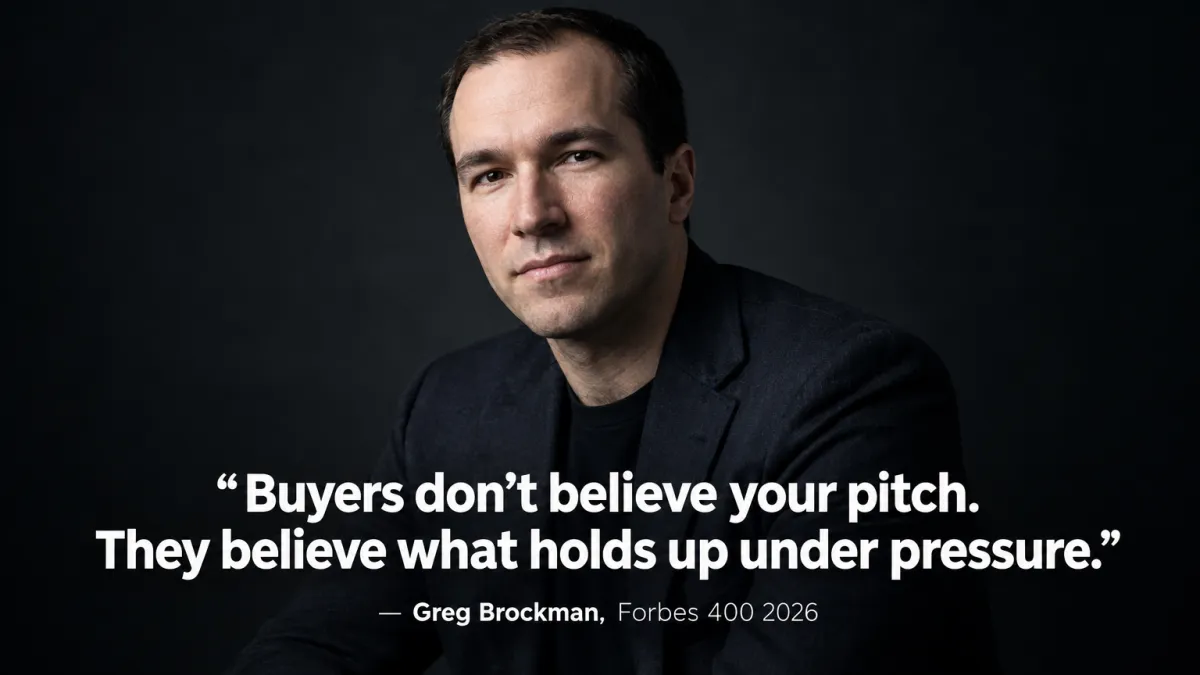
Billionaire Greg Brockman's $25.5 Billion Secret Was Only Revealed Under Oath — And It Changes Everything For Founders Who Think a Better Pitch Is the Answer
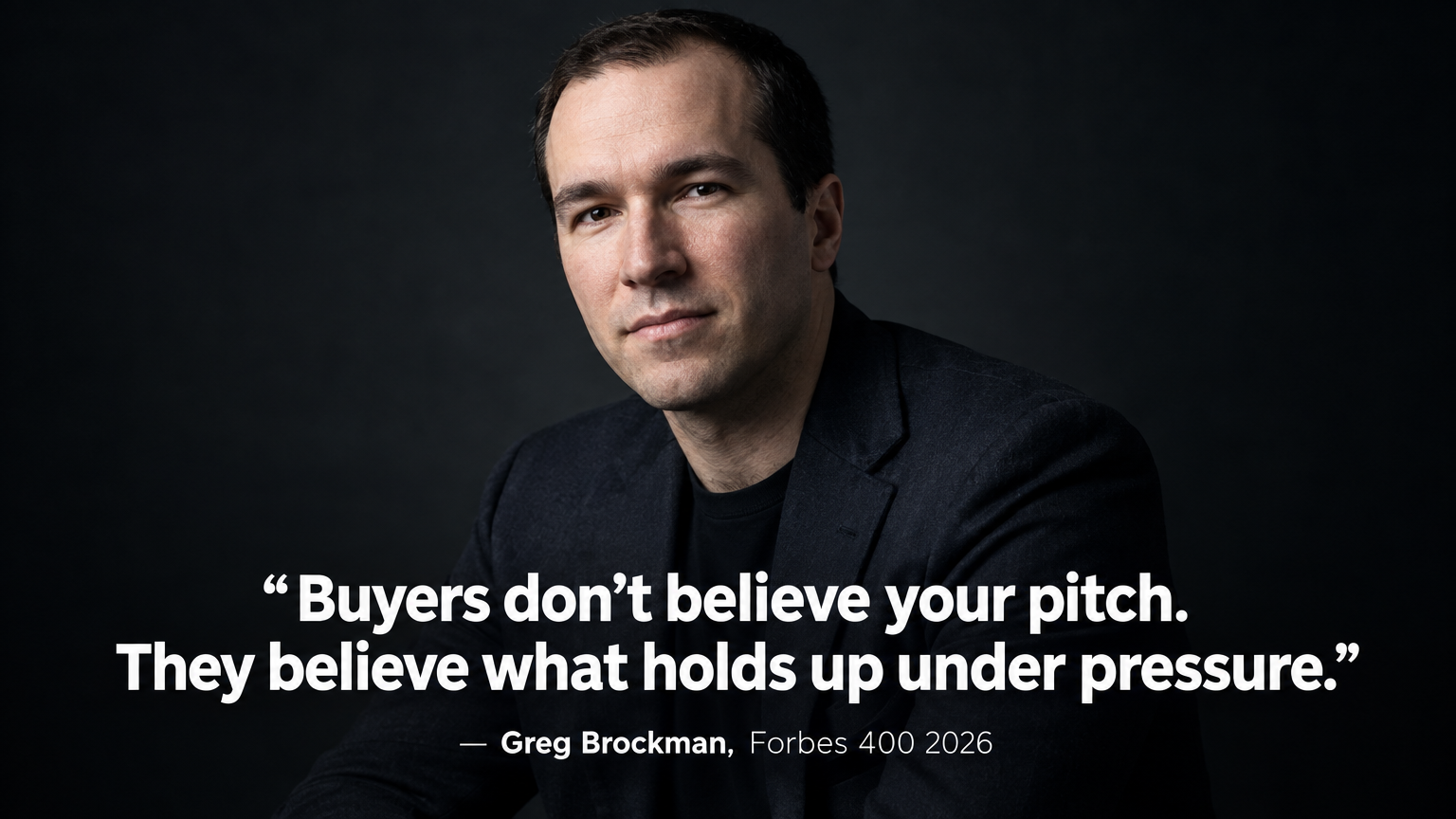
Greg Brockman, OpenAI Co-founder and Forbes 400 2026 Richest Newcomer | AuthorJason.com
PART 1 — THE HOOK
Greg Brockman did not announce his $25.5 billion net worth in a press release. A federal judge got it out of him.
Forbes named him the richest newcomer on the Forbes 400 today — September 30, 2026 — but the number only became public in May, when Brockman sat in a courtroom during the OpenAI vs. Elon Musk civil trial and admitted it under cross-examination. No marketing. No announcement. No carefully crafted narrative. Just a man answering hard questions in a room where lying has consequences.
That single detail is the most important sales lesson of 2026. And almost every founder is walking right past it.
PART 2 — THE STAKES
Think about the last pitch you gave.
You prepared your deck. You rehearsed your numbers. You led with your best client story. You felt ready. And then the buyer asked a hard question — and something shifted. Maybe you softened your answer. Maybe you oversold. Maybe you felt the energy leave the room and you were not sure why.
Here is the uncomfortable truth: your buyer does not distrust your pitch because it is bad. They distrust it because it is a pitch. Every buyer over the age of thirty has sat through hundreds of pitches. They know what a pitch looks like when it is being managed. And the moment they sense that you are managing the narrative — choosing which facts to lead with, softening the ones that do not look great, framing everything in your favour — their skepticism activates.
You did not lose the room because your slides were wrong. You lost it because you did not give them proof that holds up when it is challenged.
That is what Brockman just showed the world — accidentally — and what it means for every founder who needs to close their next deal.
PART 3 — THE PLAY
On September 30, 2026, Forbes published the 45th annual Forbes 400 list — the definitive ranking of America's wealthiest individuals. Greg Brockman, co-founder and President of OpenAI, debuted as the list's richest newcomer with a net worth of $25.5 billion (Forbes, September 2026).
But the $25.5 billion figure was not the headline. The headline was how it became public.
During the OpenAI vs. Elon Musk civil trial in May 2026, Brockman was called to the stand. Under cross-examination — not in a prepared statement, not in a press release, not in a Forbes interview — he confirmed his ownership stake in OpenAI. The math that followed put his net worth at $25.5 billion. The courtroom, not the PR machine, produced the number that now leads the Forbes 400 newcomer ranking.
OpenAI was last valued at $300 billion following a $40 billion funding round led by SoftBank in March 2026 (Reuters, March 2026) — making it the most valuable private startup in history at that time. Brockman's stake, confirmed in federal court, translates directly to that valuation.
No spin. No positioning. No crafted narrative. A judge asked. A witness answered. The world believed it instantly — because it survived pressure.
Billionaire Greg Brockman's move is one Jason has seen across 1,000+ founders. Here is what most miss.
PART 4 — THE LESSON
Root Cause Reframe
Most founders think the problem is: my pitch is not compelling enough.
The real problem is: your pitch is designed to survive your own comfort zone — not your buyer's skepticism.
Most founders spend their prep time polishing the story they want to tell. They refine the deck. They sharpen the intro. They memorise the case study. What they almost never do is deliberately stress-test the claim from the buyer's perspective — to ask: what is the hardest possible question this buyer could ask, and does my answer hold up under real pressure?
Brockman's $25.5 billion was believed instantly — globally, by every financial journalist in the world — not because Forbes vouched for it, but because it came out of cross-examination. The adversarial format is the credibility mechanism. The harder the challenge, the more the answer that survives it is believed.
This is why your smoothest pitch sometimes closes the least. Buyers who receive a frictionless presentation often feel something is being hidden. The ones who push back hard — who challenge your pricing, your timeline, your results — and get a calm, specific, evidence-backed answer are the ones who sign. Because you just passed the cross-examination.
The founders Jason works with who close the most are not the best storytellers. They are the ones who have built a proof system — a structured way to respond to buyer challenges with specificity, calm, and verifiable evidence. Not a comeback. Not a reframe. Proof.
The Lesson
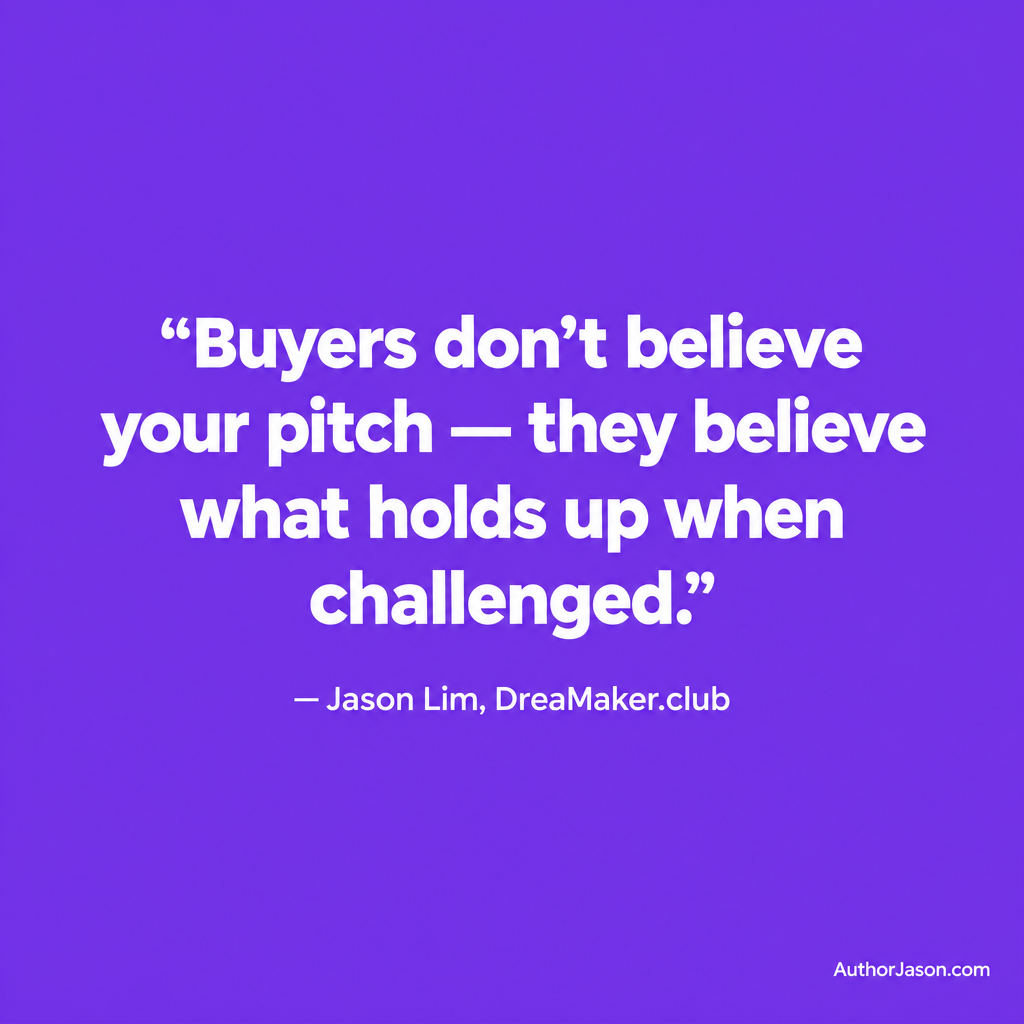
Buyers do not believe your pitch — they believe what holds up when challenged.
That means building a proof system before your next pitch, not after. It means knowing your three hardest objections cold — and having case studies, numbers, and timelines that survive a cynical buyer's best shot.
Founder Story
Stanley Tan — 45 Buyers in 3 Hours
Stanley had been pitching for months. Good conversations, warm responses — but deals stalled the moment buyers asked hard questions. When he built his proof system inside the Future of Selling System, he stopped managing the narrative and started letting evidence speak. At his next event, 45 buyers committed in 3 hours. Not because the pitch got better. Because the proof got pressure-tested first.
PART 5 — THE OPPORTUNITY
The Hidden Opportunity
Here is what almost every founder misses in this story: the courtroom did not just reveal Brockman's wealth. It revealed that the entire world's media, investment community, and public accepted a $25.5 billion valuation in a single news cycle — because the source was adversarial.
Your buyers are running their own internal courtroom every time you pitch. They are cross-examining your claims in real time — silently. Every vague answer, every avoided question, every framing-heavy response adds a point to the prosecution's case. Every specific, calm, evidence-backed answer adds a point to yours.
The opportunity right now — today — is that almost no founder is deliberately building a proof system. They are building better decks. Better intros. Better pricing pages. The founders who shift from pitch systems to proof systems in the next 90 days will outclose their market before their competitors even notice the difference.
The Conditions
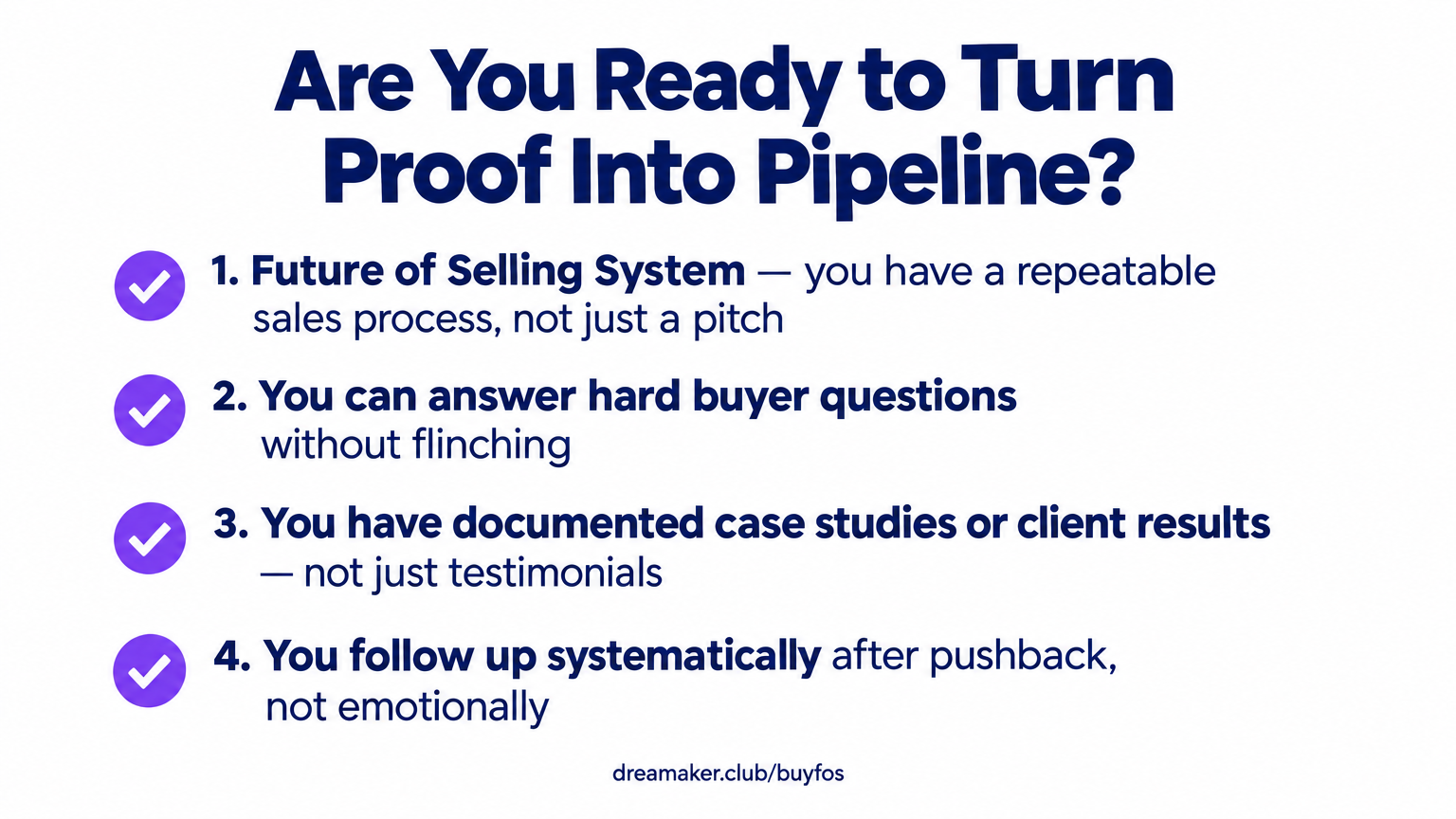
Are You Ready to Turn Proof Into Pipeline?
- Condition 1 — Future of Selling System: You have a repeatable, structured selling process — not just a pitch deck. Without this, proof has nowhere to live. Get FOS at $0.63/day at dreamaker.club/buyfos
- Condition 2 — Cross-examined answers: You have rehearsed your three hardest buyer questions out loud — and your answers are specific, calm, and evidence-backed.
- Condition 3 — Documented proof: You have at least two client case studies with measurable outcomes — numbers, timelines, before and after — that you can cite mid-conversation without hesitation.
- Condition 4 — Systematic follow-up: When a buyer goes quiet after pushback, you have a structured re-engagement sequence — not a gut-feel email you write when you feel ready.
NEW! — September 2026
Dear Founders — your pitch is not the problem. Your proof system is.
If you pitch well but lose the room the moment buyers push back with hard questions, the issue is not your story — it is that you have never built a system that turns buyer pressure into buyer belief.
I know how that feels. You walk out of a pitch thinking it went well — and then silence. Or worse, you get a follow-up question you were not ready for and you can feel yourself losing ground in real time. I have seen it across 1,000+ founders.
What I found: it is not the pitch. It is the absence of a proof system. No structure for handling challenges. No documented results. No repeatable way to turn skepticism into conviction.
You are not alone. Salesforce State of Sales found that 76% of buyers expect sellers to understand their needs before first contact — yet most founders pitch around their own comfort, not the buyer's hardest question. (Salesforce, State of Sales, 2024.)
The Future of Selling System is the structured, repeatable framework Jason built across $22M+ in combined graduate sales and 1,000+ founders since 2015. It includes the proof-system architecture that helped Jeffrey Teo land 63 customers in 100 days, Stanley Tan close 45 buyers in 3 hours, and Leon secure a $2M partnership.
Not ready for $19? Start free.
The Objection Playbook: 25 Word-for-Word Scripts to Close More Sales
The exact words Jason's founders use when a buyer says too expensive, send me info or I need to think about it. Free PDF, sent to your inbox.
Send Me the 25 ScriptsGreg Brockman already moved — and the world believed every word the moment it survived pressure. The only question is whether you will build a proof system before your next pitch, or whether you will read about someone else who did.


