Billionaire John Poindexter Is Pouring His Fortune Into a Texas Ghost Town — And It Reveals the Business Lesson Most Founders Will Never Learn
Billionaire John Poindexter Is Pouring His Fortune Into a Texas Ghost Town — And It Reveals the Business Lesson Most Founders Will Never Learn
John Poindexter just went viral for all the wrong reasons. The 81-year-old built a $2.7 billion manufacturing empire from scratch — and now, with no heirs to leave it to, he is pouring his fortune into a Texas ghost town of 25 people. Most people are reading this as a quirky philanthropy story. They are missing everything that actually matters.
Because the real story is not about a ghost town. It is about what happens when a builder gets to the end of the road and realises the most valuable thing he created cannot be passed on, handed off, or continued without him.
If you are a founder still leading sales in your own company, this story is directly about you.
This Is Not a Legacy Story. It Is a Warning.
The $124 trillion Great Wealth Transfer is underway right now. Baby boomers are passing down fortunes to heirs who are already debating how fast to give it away. That is the backdrop to the Poindexter story — and it makes what he is doing even more jarring.
He built one of the most dominant manufacturing businesses in America — a company that produces 66% of the step vans used by US class-five delivery services, including the UPS trucks you see every single day. He did it through 40+ acquisitions over three decades, growing from $40 million in revenue to over $2.7 billion.
And now, at 81, the wealth goes to a ghost town. Not because he lacked vision. Not because he lacked discipline. But because the business was built around him — and there was no mechanism to hand the torch to the next person who was supposed to carry it.
Ask yourself: if you stepped away from your company tomorrow, who would close the next deal? Who would open the next conversation? Who would know what to say when a buyer pushes back? If the answer is nobody — or just you — then you already know what this story is really about.
What Actually Happened — And What Everyone Is Getting Wrong
Here are the verified facts, published September 27, 2026 in Fortune and September 28, 2026 in CEOWORLD magazine.
John Poindexter served in Vietnam and received two Silver Stars and two Purple Hearts. He spent 14 years in finance before founding J.B. Poindexter & Co. in 1985. He remains its sole owner. His company built from $40 million in revenue in 1994 to more than $2.7 billion in annualized revenue through more than 40 acquisitions — a fact recognised in his 2024 EY regional Entrepreneur of the Year award. The company builds the bodies of UPS's brown delivery trucks and accounts for 66% of step vans in the US class-five delivery market. [Fortune, Sep 27, 2026]
Now 81 and with no descendants, he is channelling his wealth into Shafter, Texas — a ghost town of roughly 25 people in Presidio County, where the population fell 11.4% between 2020 and 2025, median household income sits at $43,802, and nearly one in five residents lives in poverty. [Yahoo Finance / Fortune, Sep 27, 2026]
His vehicle is the Tidewater and Big Bend Foundation, established in 2020, which will eventually own his properties — including the 30,000-acre Cibolo Creek Ranch, where Supreme Court Justice Antonin Scalia died in 2016. The plan is to turn Shafter into a living history museum, described by an officer of the foundation as “kind of the same as Colonial Williamsburg.” [CEOWORLD, Sep 28, 2026]
Every outlet is covering this as a quirky philanthropy story. None of them are asking the only question that matters for builders: why does a man who spent 40 years constructing a $2.7 billion company end up with nothing to hand to the next generation of that business?
Billionaire John Poindexter's move is one Jason has seen across 1,000+ founders. Here's what most miss.
The Lesson — And the Root Cause Nobody Is Talking About
Most founders think the problem is succession planning. They think: I need a will, a trust, a foundation, a board. They focus on the container. Poindexter built the container — the Tidewater and Big Bend Foundation. He had four decades to prepare.
But the real problem is that the business was never separated from the founder. The relationships, the deal-making instincts, the ability to win customers and close acquisitions — that lived in John Poindexter. Not in a system. Not in a process anyone else could run. And when a business is built that way, there is no one to pass it to, because no one else knows how to run the engine that made it worth anything in the first place.
This is why the ghost town story hurts so much if you read it correctly. It is not about a quirky old man. It is a monument to a $2.7 billion machine that only one person knew how to operate.
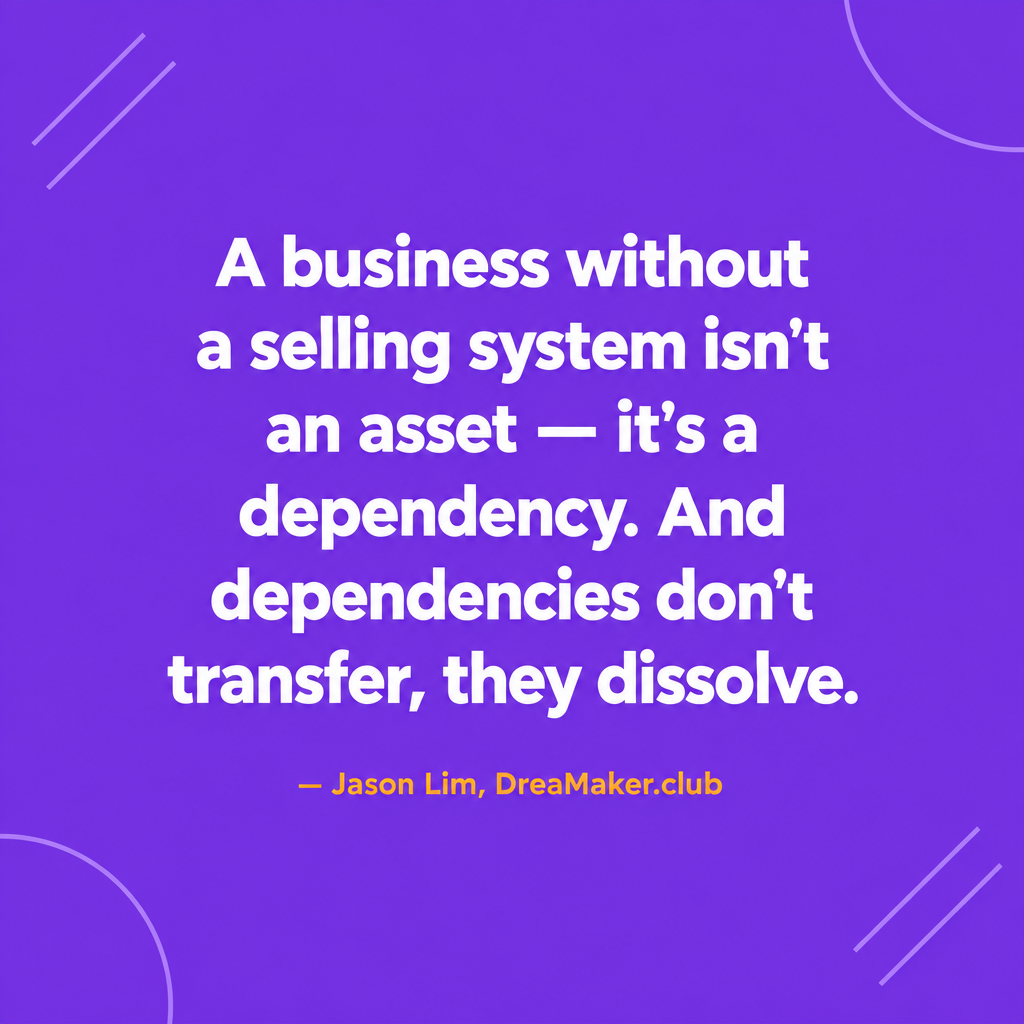
“A business without a selling system isn’t an asset — it’s a dependency. And dependencies don’t transfer, they dissolve.” — Jason Lim
Here is what most founders get wrong: they confuse being great at sales with having a sales system. Being great at sales is a talent. A sales system is a process — documented, repeatable, teachable to a team of five or fifteen or fifty — that works whether or not the founder is in the room.
Poindexter completed over 40 acquisitions. He clearly knew how to win deals. But did anyone else in his company know how to do what he did? Could they explain his framework? Run his process? Close at his level without him in the room? If the answer was yes, the business would have found a buyer, a successor, a continuation. Instead, the wealth goes to a West Texas ghost town — not because Poindexter failed, but because the system that drove his success was never extracted from his head and built into his company.
Founder Story Card
Stanley Tan — 45 buyers in 3 hours
Stanley Tan is a multi-award winner with Guinness World Records to his name. But none of that converted into sales until he replaced his personal instinct with a repeatable system. Using the P.I.T.C.H. Formula from the Future of Selling System, Stanley closed 45 buyers in 3 hours — because the system ran, not just the man. That is the difference between a business and a dependency.
The Hidden Opportunity Right Now
While every media outlet is running the Poindexter story as human interest content, a narrow group of founders is reading it differently. They are asking: Is my company a business or a dependency? And they are making a move — right now — to answer that question before it gets answered for them the hard way.
The opportunity is not about succession planning. It is about building a selling system that can outlast, outscale, and outperform the founder. Not because you are planning to leave — but because a business that requires you to be present for every deal is a business that cannot grow beyond you. It cannot attract co-founders who believe in the machine. It cannot be handed to a great sales leader. It cannot be sold at a premium. It cannot be your legacy.
The window to do this is now — while the market is buying, while your team is small enough to train, and while you are still the one who knows the system best. Waiting until 81 is not a plan. It is a ghost town.
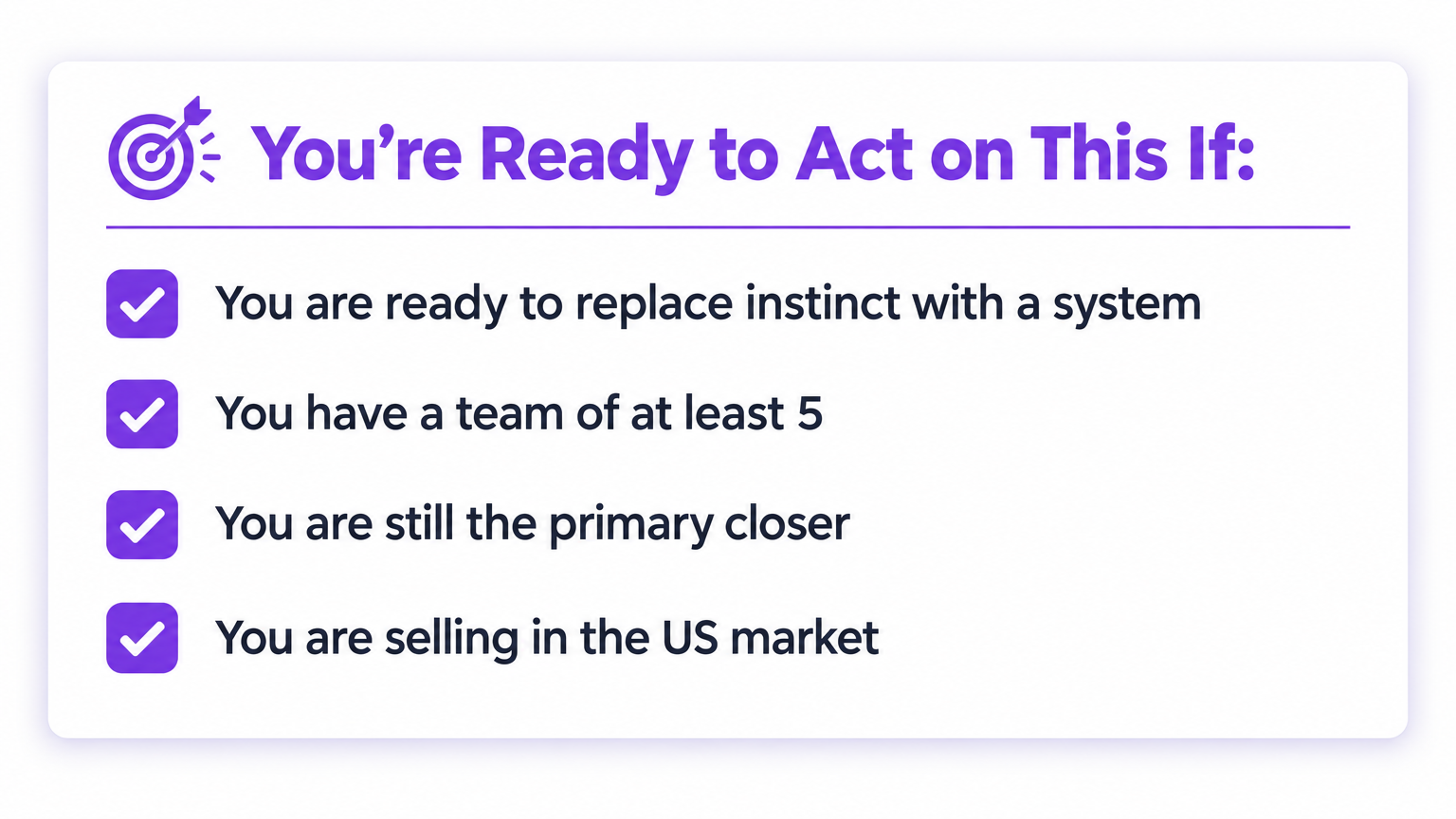
You Are Ready to Act on This If:
- Condition 1: You are ready to replace founder instinct with a documented selling system — specifically the Future of Selling System
- Condition 2: You lead a team of at least 5 people and are ready to install a sales process they can run
- Condition 3: You are still the primary closer — and you know this is a bottleneck, not a badge of honour
- Condition 4: You are selling in the US market and need a system built for how US buyers actually decide
NEW! — September 2026
Dear Founders…
If you are still the only one who can close deals in your company, you do not have a business — you have a job that depends entirely on you showing up. And that job ends the day you stop.
The Future of Selling System is a documented, repeatable, teachable sales process built specifically for startup founders leading teams of 5 or more in the US market. It is the P.I.T.C.H. Formula — used by 1,000+ founders since 2015, generating $22M+ in combined sales across graduates.
I know how you feel. Every founder I have worked with felt the same way — like they were the only one who could do it, that their instinct was the secret weapon, that hiring a great salesperson would somehow solve the problem.
What they found — after working through the Future of Selling System — is that the instinct was never the problem. It was the absence of a system that anyone else could run. Once the system was in place, deals closed without them in the room.
Salesforce State of Sales research found that 76% of sales professionals say their sales process needs significant improvement. Most founders already know their process is broken — they just do not know what to replace it with.
Credentials that matter:
- $22M+ in combined sales by graduates
- 1,000+ founders trained since 2015
- Jeffrey Teo: 63 customers in 100 days
- Stanley Tan: 45 buyers in 3 hours
- Leon: $2M partnership in under 90 days
Not ready for $19? Start free.
The Objection Playbook: 25 Word-for-Word Scripts to Close More Sales
The exact words Jason's founders use when a buyer says "too expensive", "send me info" or "I need to think about it". Free PDF, sent to your inbox.
Send Me the 25 ScriptsBillionaire John Poindexter already moved — into a ghost town. The only question is whether you will build the system that keeps your business alive after you, or whether someone will one day read about your company the same way they are reading about his.


