Billionaire Michael Dell Just Lost $36 Billion In Two Days — And What He Did Next Changes Everything For Founders Who Go Dark When Sales Slow Down
Billionaire Michael Dell Just Lost $36 Billion In Two Days — And What He Did Next Changes Everything For Founders Who Go Dark When Sales Slow Down
Michael Dell lost $36 billion in 48 hours — then passed Mark Zuckerberg anyway. Two days. Two brutal drops. Barclays downgraded the stock. Inflation data hit. The Nasdaq posted its worst week since June. Dell's personal fortune fell from a peak of $270 billion to $237 billion. And then — without an announcement, without a press tour, without a single founder pep talk — his company kept moving. Demand kept flowing. Revenue kept building. And by Monday his net worth was climbing again. Most founders read that as a market story. It is not. It is a system story. And if you are leading your own sales right now, you need to understand why.
The $36 Billion Question Every Founder Should Be Asking Themselves
Here is what no one is asking: when the market turned on Dell Technologies in October 2026, what happened to the pipeline? Did the sales team stop showing up? Did account executives go quiet, waiting for the stock to recover? Did founders of companies supplying Dell's ecosystem pull their proposals, delay their follow-ups, and wait to see how things played out?
That is what most startup founders do. And most of the time, they do not even notice they are doing it. A bad week in the market becomes a bad week in outreach. A downgrade in the news becomes a downgrade in their own confidence. A nervous quarter becomes a reason to wait — for things to feel more certain, more stable, more right. They go dark. They tell themselves they are being strategic. They are not. They are letting the weather control the harvest.
The question is not whether the market goes up or down. The question is: does your selling system run when you do not feel like running it? Because Dell's did. And that — not the stock price — is the lesson.
What Actually Happened — The Numbers, The Context, The Move
On October 15, 2026, Barclays analyst Tim Long cut Dell Technologies' stock rating from overweight to equal-weight before markets opened, according to Forbes. Shares fell 11.1% — their biggest intraday drop since July — wiping more than $20 billion off Michael Dell's net worth in a single session. The following day, a continued global tech selloff — driven by Consumer Price Index data showing annual inflation at 3.7%, above economist forecasts — sent the stock down another 9%, costing Dell an additional ~$15.2 billion, per Forbes. His net worth fell to approximately $237 billion, dropping him from fourth to sixth on Forbes' Real-Time Billionaires list. At one point, $36 billion had evaporated in two trading days.
And yet. By Monday October 19, Dell's fortune had risen $4.3 billion to $241.3 billion as tech stocks rebounded and investors bought back into AI-linked infrastructure, per Billionaires.africa (October 20, 2026). He passed Zuckerberg by $600 million. Not because the downgrade was reversed. Not because the inflation data improved overnight. But because the underlying machine — the one that sells AI servers and data centre equipment to every major cloud provider on Earth — never stopped.
For context: Dell started this company in 1984 with $1,000 in his University of Texas dorm room. He now owns approximately 40% of a company whose stock has grown by over 321% in 2026 alone, according to Forbes. His wealth grew from $97.7 billion in September 2025 to a peak of $270 billion — a $170+ billion gain in one year — almost entirely driven by demand for the AI servers and data centre infrastructure Dell sells to companies building the AI economy. When the market turned on him, the orders did not stop. The demand did not stop. The system did not stop. Billionaire Michael Dell's move is one Jason has seen at his events, which since 2016 have reached 100,000+ founders across Asia. Here is what most miss.
The Lesson Most Founders Miss — And The Root Cause Nobody Talks About
Root Cause Reframe:
Most founders think the problem is motivation. When they go dark during a bad stretch — when they stop following up, stop pitching, stop showing up — they diagnose it as a mindset problem. Not enough discipline. Not enough resilience. They read another book about Stoicism, listen to another podcast about cold exposure, and promise themselves they will do better next quarter.
But the real problem is not motivation. The real problem is that their selling depends entirely on how they feel. There is no system. There is no process that runs independently of their emotional state. The moment the market gets nervous, or a deal falls through, or an analyst says something unkind — the whole pipeline stalls. Not because the founder gave up. Because the founder was the system. And the system went to bed.
Dell Technologies did not stop selling because Barclays downgraded the stock. Its servers were already in the data centres. Its proposals were already in the procurement queues. Its account executives were already in motion. The system was running before the crisis. Which is the only way a system can save you during one.
The Lesson:
“The system that keeps running when you feel like stopping is the only system worth building.”
— Jason Lim | AuthorJason.com
📋 Founder Story Card
The Scenario: A founder leading their own sales for a B2B startup with 7 team members. Their pipeline was growing. Then Q3 hit. A big prospect went cold. Two deals pushed to Q1. The team got quiet. The founder stopped doing outreach. Six weeks passed.
The Shift: When Jason worked with Jeffrey Teo, he did not tell him to get more confident. He built Jeffrey a system — a structured, repeatable approach to finding, qualifying, and closing customers. Jeffrey went on to sign 63 customers in 100 days. Not because the market was perfect. Because the system kept running.
The Question: If you were not available for a week — sick, travelling, emotionally spent — would your pipeline still move? If the honest answer is no, you do not have a sales system. You have a sales habit. And habits break under pressure.
The Hidden Opportunity — And The Conditions You Need To Capture It
The Hidden Opportunity:
Here is what almost every founder misses in this story: when markets are nervous, buyers do not stop buying. They become more selective. They stop responding to founders who feel uncertain. They start gravitating toward the ones who show up — consistently, professionally, without apology — regardless of what the Nasdaq did last week. A down market does not shrink your opportunity. It eliminates your weakest competitors. The founders who built real systems before the downturn are the ones who clean up during it. This is not theory. This is what $241 billion of recovered net worth in 96 hours looks like.
The window is now. Your competitors who do not have a system are going dark right now. They are waiting. They are reassessing. They are doing anything except selling. Which means the buyers in your market are hearing less — not more. If your system is running, you have the floor.
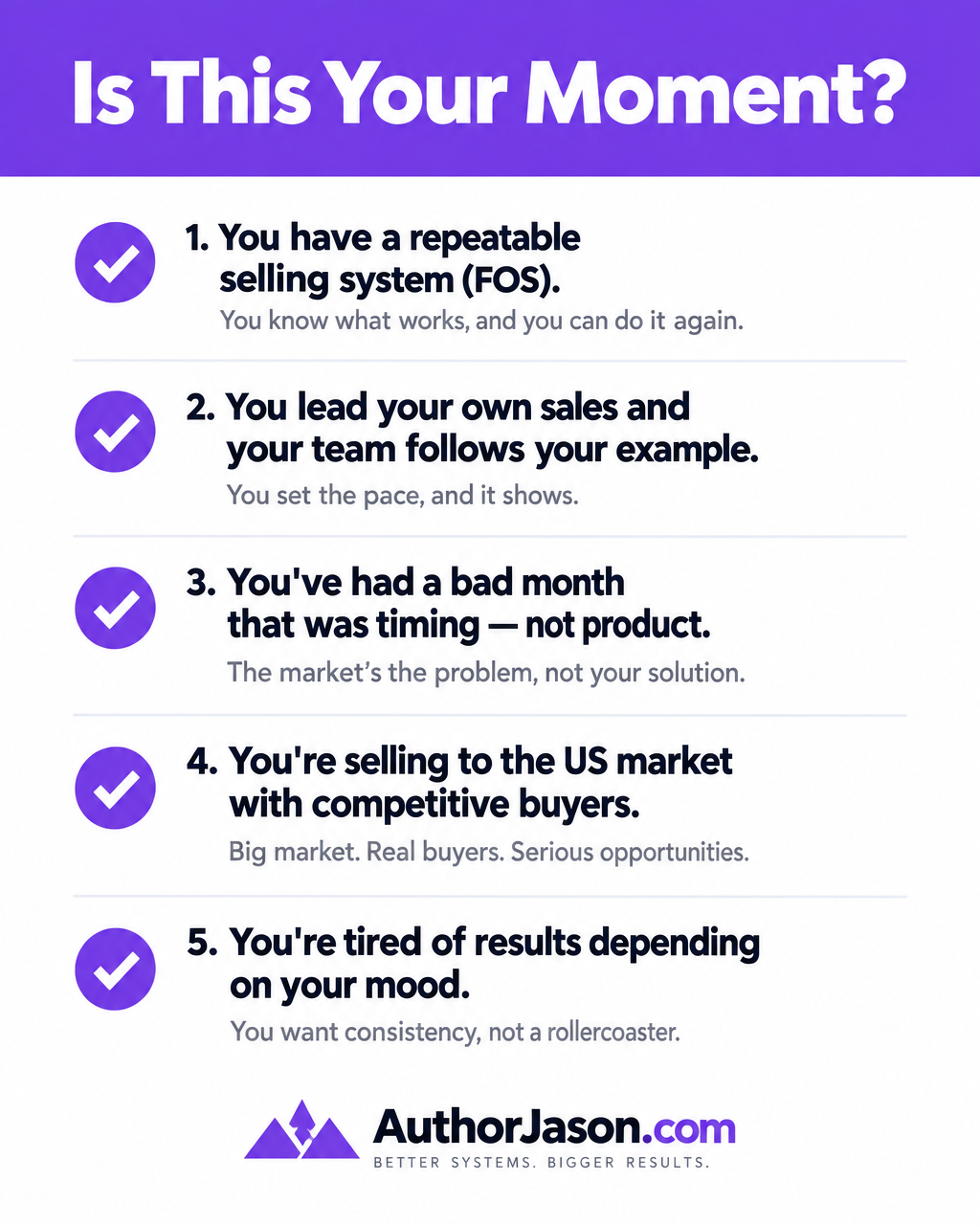
✅ Is This Your Moment? Check These Conditions:
Condition 1 — You are ready to build a repeatable selling system (Future of Selling System)
Not “try harder this week.” A structured, step-by-step system for finding, qualifying, pitching, and closing — that runs whether you are in the room or not. If you have never had one, you have been selling on willpower. That breaks.
Condition 2 — You lead your own sales with a team of 5 or more
You are not a solopreneur. You have people watching how you respond under pressure. When you go dark, they go darker. When your system is visible, they follow it. Your consistency is the team's culture.
Condition 3 — You have had a slow month that was timing, not product
If your product works but your pipeline is inconsistent, the variable is not the market — it is the method. Inconsistent input always produces inconsistent output. A system fixes the input.
Condition 4 — You are selling to the US market with competitive, informed buyers
US buyers do not respond to effort. They respond to conviction, clarity, and process. If your pitch changes based on how you slept, you are not selling — you are performing. The system gives you the same pitch every time, regardless of your mood.
Condition 5 — You are tired of results depending on your energy level
Great months followed by dead months. A streak followed by silence. You know your product deserves better than a rollercoaster. So do your customers. The system is what makes the revenue as reliable as the value you deliver.
NEW! — October 2026
Dear Founders,
If your pipeline dries up every time the market gets nervous — you do not have a sales problem. You have a system problem. And the cost of that problem compounds every single week you do not fix it.
Get the Future of Selling System — $19/month ($0.63/day) →
I know what it feels like to watch a good pipeline go cold because the energy was not there. I felt it. I have heard it from thousands of founders at my events across Asia — founders who are brilliant, committed, and talented, who lose deals not because they lack skill, but because they lack a structure that runs independently of how they feel on a given Tuesday morning.
What I found — and what my graduates have proven — is that a properly built selling system changes everything. According to Salesforce's State of Sales report, 76% of sales professionals say their company's sales process needs improvement. Most founders I meet are operating in that 76%. They are winging it with talent. Talent is not a system.
The Future of Selling System (FOS) is the structured, step-by-step approach Jason has refined across $22M+ in combined graduate sales. Jeffrey Teo used it to sign 63 customers in 100 days. Leon used it to build a $2M partnership. Stanley Tan used Jason's pitch deck and pitch consult to pitch his paid webinar to 203 people — 90 showed up. These are founders with teams of 5 or more, leading their own sales, in competitive markets. The system worked when the market was up. It kept working when the market was not.
Not ready for $19? Start free.
The Objection Playbook: 25 Word-for-Word Scripts to Close More Sales
The exact words Jason's founders use when a buyer says “too expensive”, “send me info” or “I need to think about it”. Free PDF, sent to your inbox.
Billionaire Michael Dell already moved — $36 billion down, system still running, net worth climbing again by Monday. The only question is whether you will — or whether you will read about someone else who did.


