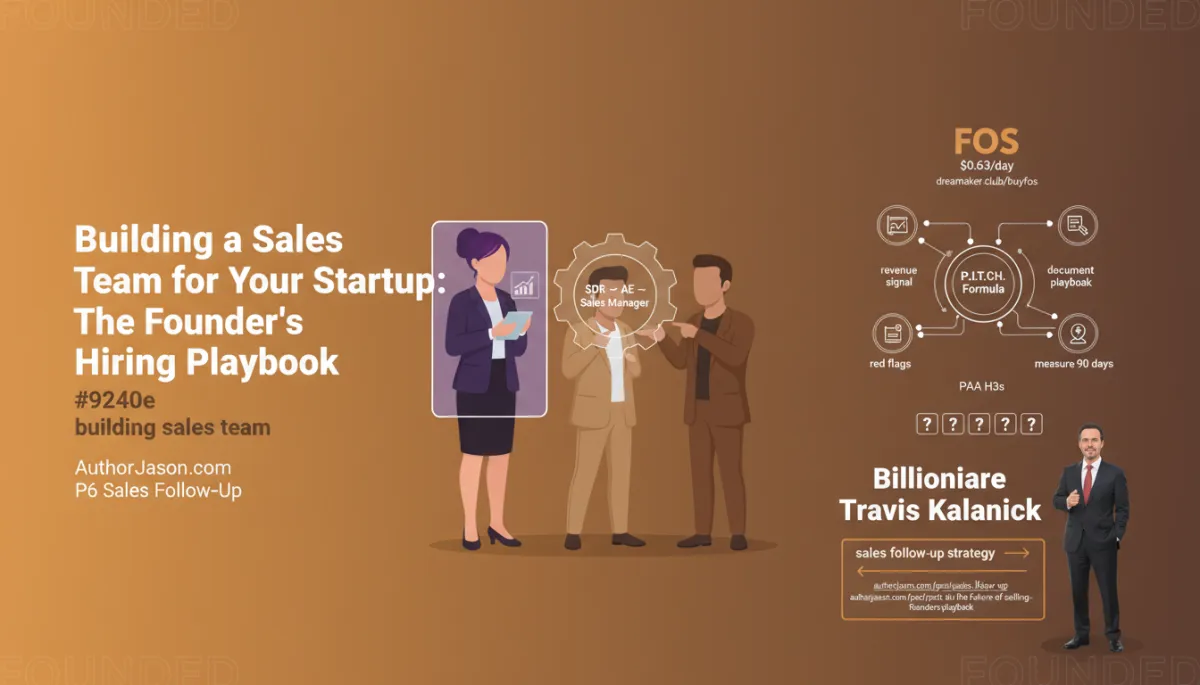
Building a Sales Team for Your Startup: The Founder's Hiring Playbook
Sales, Startup Growth, Building Sales Team
Building a Sales Team for Your Startup: The Founder's Hiring Playbook Inspired by Billionaire Travis Kalanick
Going from founder-led sales to a repeatable, scalable revenue machine is one of the hardest transitions in any startup. Jason has helped over 1,000 founders make that leap, rebuilt his own sales org three times, and generated more than $22M in revenue along the way. This playbook distills what works when you're building a sales team for the first time — and how to avoid the expensive mis-hires that quietly stall growth.

The Uber Lesson: Systemise Founder Sales Before You Hire
Uber went from founder-led sales to a global team of thousands in under five years. Kalanick didn't start by hiring a random army of reps — he first nailed exactly how he sold city-by-city, then turned that into a hiring and training system. Your startup doesn't need Uber's budget, but you do need that discipline. Before you think about a startup sales team, you need a simple, documented founder playbook that proves strangers will buy, not just friends and early believers.
1. When to Hire Your First Salesperson: The Revenue Signal That Matters
Most founders either hire sales too early — when they're still searching for product–market fit — or far too late, when they're drowning in inbound demand. Jason teaches a simple signal for hiring your first salesperson: consistent, founder-driven revenue that you can no longer handle without dropping balls. Practically, that usually looks like:
- 3–10 new customers per month, for at least three consecutive months, from a repeatable motion (not random one-offs).
- A clear ideal customer profile — you know who buys, why they buy, and what triggers the sale.
- You're regularly late on follow-ups, demos, or proposals because your calendar is full, not because you're avoiding sales.
When those three are true, hiring your first salesperson stops being a gamble and becomes an investment. You're not asking them to "figure out sales" — you're asking them to run and refine a motion that's already working for the founder.
2. The First Three Roles: SDR → AE → Sales Manager (In That Order)
A common mistake when building a sales team is hiring a "Head of Sales" as your first sales hire. Jason has watched founders burn months and runway this way. Instead, build your startup sales team in this order:
- Sales Development Representative (SDR) — They own top-of-funnel: prospecting, qualifying, and booking meetings. This frees you from cold outreach and first-touch conversations while keeping you close to the actual sales calls.
- Account Executive (AE) — Once you're consistently generating qualified meetings, bring in an AE to run discovery, demos, proposals, and closing. In the early days, they'll shadow your calls, then gradually take over.
- Sales Manager — Only when you have at least three to five reps and a working system should you add a manager. Their job is to coach, enforce the playbook, and protect your culture — not to invent the strategy from scratch.

Sequencing SDR, AE, then Sales Manager keeps you close to customers while you scale.
3. How to Document Your Founder Sales Playbook Before Hiring
Jason's rule: if it isn't written down, it cannot scale. Before you post a single job ad, capture how you sell today. It doesn't need to be perfect — it just needs to be explicit. Start with four simple documents:
- ICP and problem statement — Who you sell to, what pains they feel, and why your solution wins versus alternatives.
- Call flow — A step-by-step outline of your discovery and demo: questions you ask, stories you tell, and how you handle pricing.
- Email and message templates — Outreach, follow-up, and "breakup" emails that you already know convert. This is where a strong sales follow-up strategy becomes a competitive advantage.
- Pipeline stages and definitions — Clear criteria for when a deal moves from "new" to "qualified" to "proposal" to "closed" so you can forecast with confidence.
Jason often uses his P.I.T.C.H. Formula — outlined in detail here in the P.I.T.C.H. Formula breakdown — to help founders structure their conversations. The goal is not to script your reps word-for-word, but to give them a proven spine for every interaction, from first touch to signed contract.
4. Red Flags in Early Sales Hires You Cannot Ignore
Jason has seen founders hire "rockstar" sellers from big brands, only to watch them stall in a startup environment. When you're building a sales team from zero, character and learning speed beat polished resumes. Watch for these red flags:
- They talk only about logos, never about process. Great early-stage reps can explain how they sold, not just who they sold to.
- They expect leads handed to them. In a startup, everyone does some version of prospecting — even the founder and AE.
- They resist using your CRM or templates. If they won't follow a simple system when you're three people, they definitely won't when you're thirty.
- They blame "the product" too quickly. Healthy pushback is good, but early hires must own outcomes, not excuses.

Clear red-flag criteria protect your runway from expensive mis-hires.
5. How to Measure the First 90 Days of a New Sales Hire
The first 90 days are where most early sales hires quietly fail. Jason recommends treating this period like a structured experiment — with clear expectations by month:
- Days 1–30: Learn and shadow. They should master your ICP, product, and playbook, and shadow as many founder calls as possible. Key metrics: number of calls listened to, playbook comprehension, quality of mock calls.
- Days 31–60: Run tightly scoped conversations. Let them own parts of the call — intros, discovery, or follow-ups — while you still lead. Metrics: meetings run, opportunities created, adherence to your process.
- Days 61–90: Own pipeline with support. By now, they should be running full calls, managing a small pipeline, and closing early deals. Metrics: qualified opportunities, proposals sent, revenue closed, and how cleanly they maintain CRM data.

A simple 90-day scorecard keeps expectations clear for both founder and rep.
6. People Also Ask: Founders' Biggest Questions on Building a Sales Team
How do I know if I'm ready to stop doing all the selling myself?
You're ready when your calendar is full of sales conversations that follow a predictable pattern, and your growth is limited by time, not demand. If you can write down how you sell and show three to six months of consistent revenue from that motion, you're ready to start building a sales team, beginning with an SDR.
Should my first hire be a senior "Head of Sales" or a doer?
In almost every early-stage case, you want a doer — an SDR or AE who's excited to roll up their sleeves. A true Head of Sales makes sense once you have multiple reps, a working system, and a need for coaching and forecasting. Until then, strategy should sit with the founder, supported by a clear playbook.
How much should I pay my first sales hire at a startup?
Compensation will vary by market, but Jason recommends a simple rule: offer a base that feels stable, with on-target earnings tied to clear, achievable metrics. Early hires often value upside, learning, and equity — but they still need to pay rent. Benchmark against your region, then be transparent about how they can grow their earnings as the startup sales team scales.
What tools do I actually need for my first sales hire?
Keep it lean. A simple CRM, a calendar tool, call recording, and a basic outreach platform are usually enough. The real leverage comes from your documented processes and consistent follow-up discipline — not an overflowing sales tech stack.
How do I balance sales with product and fundraising as a founder?
In the early stages, you can't fully outsource sales — but you can design your weeks. Jason often recommends "sales days" and "deep work days" so you're not context-switching every hour. As your first SDR and AE ramp, your role shifts from running every call to refining the system and joining only the highest-leverage conversations.
How do I keep my early sales team aligned with our mission and values?
Your first hires will set the tone for every seller who joins later. Make your values explicit in the playbook — how you sell, what you will and won't promise, and how you handle tough conversations. Resources like this Harvard Business Review guide on building sales teams can help you think through structure, but culture is on you. Coach to the behaviour you want, and be willing to part ways quickly when someone sells in a way that doesn't fit.
Tier 1 Final: When You're Ready to Scale Beyond Yourself
Jason has watched founders like Tan, Teo, and Leon move from "I'm closing every deal myself" to leading confident, quota-carrying teams. The pattern is always the same: document the founder motion, hire in the right order, measure the first 90 days ruthlessly, and protect your culture as fiercely as your runway. That's how you turn scattered wins into a predictable, scalable sales engine.
If you want help implementing this, Jason built P6 Sales Follow-Up — a focused system for founders who want to turn "I'll get back to you" into closed revenue. You can learn more at AuthorJason.com, where he breaks down the exact follow-up frameworks he's used across $22M+ in sales and over 1,000 founder engagements.
For founders ready to go deeper, FOS is Jason's daily sales operating system — just $0.63 per day — designed to sit alongside your CRM and keep you executing. You can join at dreamaker.club/buyfos and get access to the same founder-led systems that helped Kalanick scale Uber city-by-city. Billionaire Travis Kalanick proved what's possible when you turn your personal selling style into a machine; Jason&aposs work is about giving you a practical, modern version of that playbook for your own startup.


