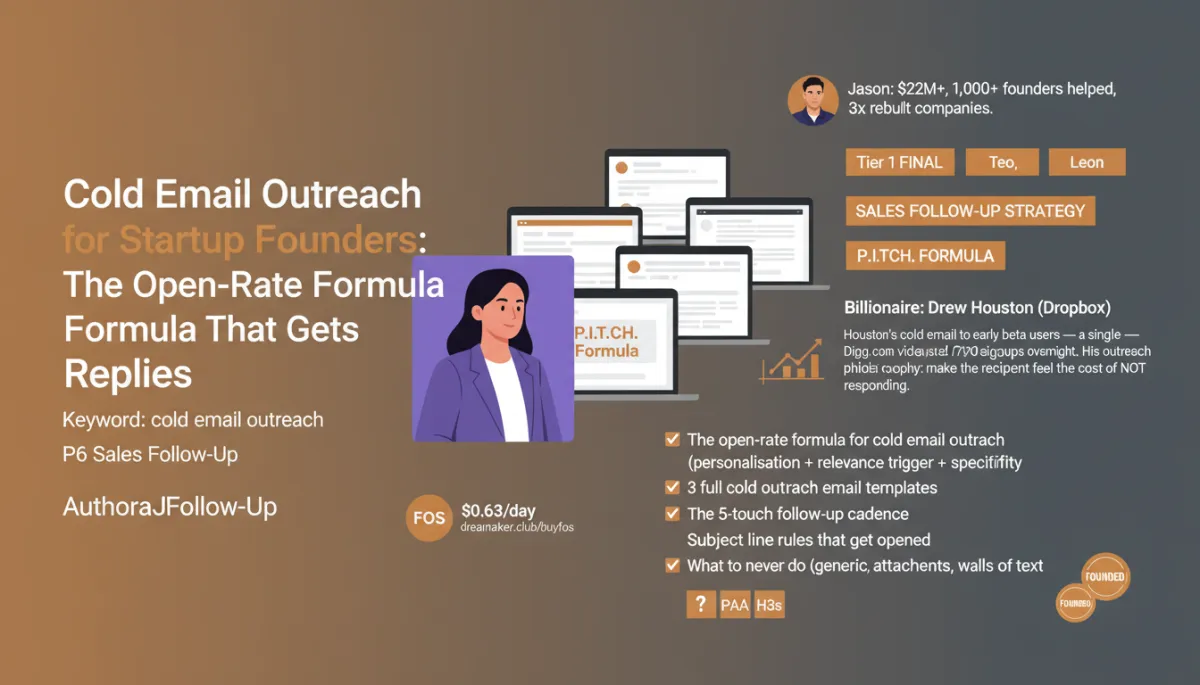
Cold Email Outreach for Startup Founders: The Open-Rate Formula That Gets Replies
Sales, cold email outreach, founder-led selling
Cold Email Outreach for Startup Founders: The Open-Rate Formula That Gets Replies (Billionaire Drew Houston Edition)
Cold email outreach is still one of the most reliable ways for founders to land first customers, investor meetings, and strategic partners – if your emails actually get opened. This guide breaks down the open-rate formula Jason teaches at AuthorJason.com, used by 1,000+ founders to drive $22M+ in pipeline, rebuilt three times across different markets, and refined inside his P6 Sales Follow-Up system.

The Billionaire Lesson: Why Your Open Rate Matters More Than You Think
Before Dropbox became a household name, Houston relied on cold email and one scrappy video posted to Digg.com. That single outreach asset generated 70,000 signups overnight. His philosophy was simple – make the recipient feel the cost of not responding. Jason’s work with founders mirrors that idea: a great cold email does not just ask for attention, it makes ignoring you feel expensive in time, money, or missed opportunity.
The Open-Rate Formula: Personalisation + Relevance Trigger + Specificity
Across thousands of cold email outreach campaigns, Jason sees the same pattern: founders obsess about copy, but ignore the simple formula that drives opens. In 2026, with average open rates floating between roughly 21% and 32% depending on industry and tracking distortions from Apple’s Mail Privacy Protection, your edge comes from three levers working together, not one clever line.
- Personalisation: Show you know the person, not just the persona – role, recent move, content they posted, or a specific initiative they own.
- Relevance trigger: Anchor the email to something that is already on their agenda – a product launch, hiring push, funding round, or metric pressure.
- Specificity: Make a concrete promise or outcome – “cut no-show rates by 23%” beats “improve your funnel.”
Subject Line Rules That Actually Get Cold Emails Opened
With open rates harder to trust thanks to auto-loaded pixels, you still need subject lines that earn real attention – and real clicks. Jason’s rules are simple, founder-friendly, and battle-tested in SaaS, B2B services, and even pre-product outreach.
- Keep it under 7 words. Long subjects truncate on mobile and feel like marketing, not a human note.
- Reference something they own. “Your Q4 churn target” or “Hiring plan for CS” beats generic “Quick question.”
- Avoid clickbait and cleverness. Curiosity is useful, but only when it is grounded in relevance – “Cut demo no-shows at <Company>” is better than “You’re leaving money on the table.”
- Test two at a time. For small founder lists, Jason recommends simple A/B tests – 25–50 sends per variant – and tracking replies, not just opens.

Tight, specific subject lines consistently lift real opens and reply rates.
Three Cold Outreach Email Templates You Can Steal Today
These cold outreach email templates follow Jason’s P.I.T.C.H. Formula – a framework he breaks down in detail in his piece on the P.I.T.C.H. Formula – but are written so any founder can plug them into their next campaign.
Template 1: Founder-to-founder problem validation
Subject: Your onboarding backlog at <Company>

Hey <First name>,

Noticed you’re hiring for 3+ roles in customer success at <Company> and recently rolled out <Product/initiative>.

I’m a founder building a lightweight way to cut onboarding time for new CS reps by 25–30% without adding another tool to your stack.

Two quick questions:
1) Are new reps currently ramping in under 60 days?
2) If not, is that a “now” problem or a “later” problem for you?

If it’s a “now” problem, would you be open to a 15-minute call next week to see what other teams in <Their industry> are doing?

Best,
<Your name>
Founder, <Startup>
Template 2: Investor or advisor outreach
Subject: Your fintech thesis & a quick question

Hi <First name>,

I read your post on <Platform> about reducing fraud friction in consumer fintech – especially your point about approval rates beating pure fraud minimisation.

I’m a founder working on <One-sentence product description> for <Specific user segment>. Early pilots with 3 small lenders lifted approvals by 12.4% while holding chargebacks flat.

Would you be open to a 20-minute call to pressure-test whether this fits your thesis, and what “must-have” would look like for you at seed?

If not you, is there one partner in your network who is particularly deep on this problem?

Thank you either way,
<Your name>
Template 3: Product-led trial outreach to target accounts
Subject: 14 days to fix <Specific metric> at <Company>

Hey <First name>,

Teams like <Peer 1> and <Peer 2> were seeing <Pain, e.g., “35–40% demo no-show rates”> before they tried our product.

We built <Startup> to do one thing: reduce <Pain> by 20–30% in 14 days, using your existing tools (no new CRM, no new calendar app).

If I set up a sandbox account for <Company> with your logo, one key workflow, and 3 ready-to-run experiments, would you take a 20-minute walkthrough this or next week?

If now is bad timing, just reply “later” and I’ll circle back in <X> weeks.

Best,
<Your name>

Reusable templates help founders focus on relevance, not reinventing the wheel.
The 5-Touch Follow-Up Cadence Jason Uses With Founders
Most cold outreach email campaigns fail not because the first email is bad, but because there is no disciplined follow-up. Jason’s sales follow-up strategy – the P6 Sales Follow-Up system – centres on a five-touch cadence that respects the recipient while keeping the conversation alive.
- Touch 1 – Initial cold outreach email: Short, specific, and anchored to a problem they own.
- Touch 2 – Nudge with value (2–3 days later): A brief reply to your own thread adding a screenshot, metric, or single insight – no attachment, no deck.
- Touch 3 – Social proof angle (4–5 days later): One-line case example, ideally from a peer company, with a renewed ask for a 15–20 minute call.
- Touch 4 – Soft break-up (7 days later): “Happy to close the loop if this is not a priority” – often triggers honest replies.
- Touch 5 – Time-shifted check-in (3–6 weeks later): Reaching back out with a fresh trigger – new feature, case study, or relevant industry shift.
What to Never Do in Cold Email Outreach
- Never open with generic fluff. “I hope this email finds you well” wastes space and signals mass automation. Start with the problem, not the pleasantries.
- Never attach decks or proposals on first touch. Attachments feel heavy, trigger spam filters, and ask for more attention than you have earned. Use links sparingly and only when clearly relevant.
- Avoid walls of text. Long paragraphs signal work. Break copy into short lines, use bullets, and make the call-to-action a single, simple decision.
- Do not over-automate. Hyper-personalisation at scale is possible, but obvious mail-merge mistakes (“Hi <First Name>”) will kill trust instantly.
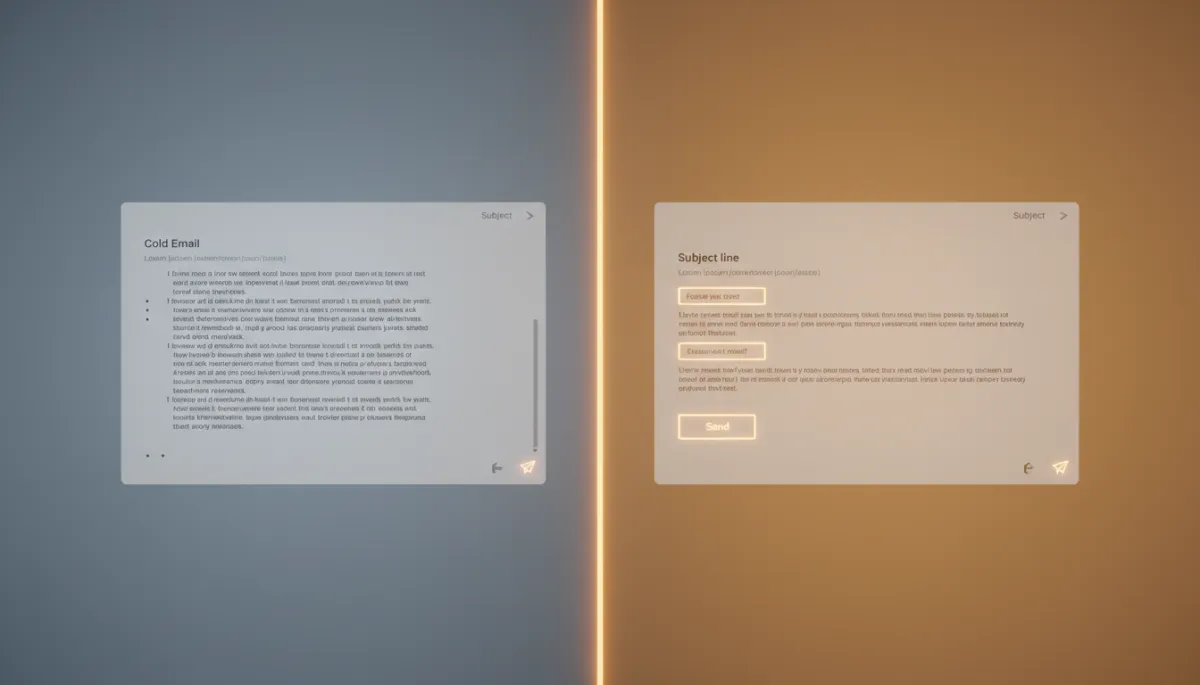
Clarity and brevity almost always beat cleverness and length in cold outreach.
People Also Ask: Founders’ Biggest Cold Email Questions
How many cold emails should a founder send per week?
For early-stage founders, Jason recommends 50–100 highly targeted cold outreach email sends per week, rather than blasting thousands of generic messages. This volume is big enough to learn, but small enough to write with care and personalise meaningfully.
What is a good open rate for founder-led cold outreach?
Benchmarks vary, but Jason aims for 40–60% real opens on small, well-targeted lists – above the 21–32% averages reported across industries. More important than opens, however, is reply rate and booked conversations per 100 emails sent.
Should I send cold emails from my personal or company address?
For founder-led sales, Jason prefers a personal address on the company domain – “[email protected]” – with a clear signature. It signals that a real person is reaching out, but still builds brand equity for your startup.
How long should a cold outreach email be?
Aim for 75–150 words. That is usually enough to show personalisation, state a specific problem, and make one clear ask. If you are forced to scroll twice on mobile, it is probably too long.
How fast should I follow up after no response?
Jason’s cadence uses 2–3 days for the first follow-up, then 4–7 days between later touches. The goal is to stay present without feeling like spam – each follow-up should add context, not just “bumping this to the top of your inbox.”
Do cold emails still work in 2026 with AI and automation everywhere?
Yes – especially for founders willing to do real research. AI helps with timing, segmentation, and drafting, but the winners are still those who understand their buyer deeply and speak directly to current priorities. Cold outreach email is not dying; lazy outreach is.

Track replies and meetings booked, not just inflated open-rate numbers.
Tier 1 Founders, FOS, and Your Next Step
Jason has worked directly with more than 1,000 founders – including Tier 1 operators like Tan, Teo, and Leon – to rebuild their founder-led sales from the ground up. The patterns are consistent: when your cold email outreach gets personal, relevant, and specific, your calendar fills, your story sharpens, and fundraising conversations shift in your favour.
If you want a structured way to apply these principles daily, his FOS system – available for about $0.63 per day at dreamaker.club/buyfos – walks you through building a repeatable outreach engine instead of chasing one-off hacks. Combined with the P6 Sales Follow-Up and the sales follow-up strategy playbook, it turns cold email from a chore into a compounding asset.
Billionaire Drew Houston proved that one well-executed outreach motion can change the trajectory of a company. Your version might not be a viral Digg video – it might simply be a disciplined, founder-led cold email system that reliably turns strangers into champions. Start with one improved subject line, one sharper template, and one five-touch sequence. Then scale what works.
To deepen your skills beyond cold email, explore broader sales perspectives from trusted sources like Email Outreach Trends and Digital Marketing Trends – then bring those insights back to a simple, human, founder-first outreach system.


