CRM Follow Up System for Startup Founders: Automate Without Losing the Human Touch
CRM, Sales Follow-Up, Startup Founders
CRM Follow Up System for Startup Founders: Automate Without Losing the Human Touch (Billionaire Tobi Lütke Edition)
A practical guide for founders who want a crm follow up system that feels human, scales with their pipeline, and doesn’t let warm deals quietly disappear.

Why founders keep losing deals in the follow-up gap
Ask any experienced founder and you will hear a similar confession—most lost deals didn’t say “no,” they just went silent. In 2026, even with AI-heavy CRMs and multichannel tools, over 90% of sales teams still lose qualified leads each month because follow-ups are inconsistent or late. Automation exists, yet deals die quietly between meetings, inboxes, and half-updated pipeline stages.
Jason has seen this pattern across more than 1,000 founders and $22M+ in tracked pipeline—especially in founder-led sales. The problem is rarely “not enough leads.” It is a missing, reliable crm follow up system that turns first conversations into closed revenue without turning the founder into a full-time SDR. That is the gap this article is designed to close.
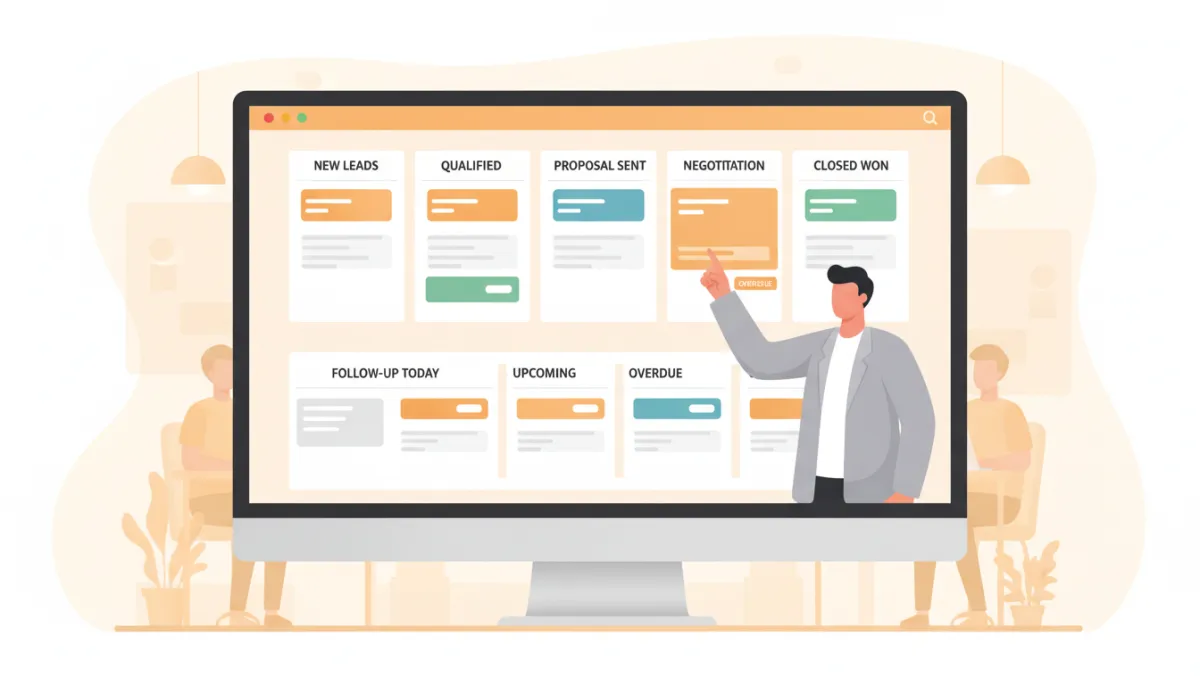
Most deals are lost to silence, not rejection—your CRM must prevent that.
What founders can learn from Lütke’s CRM-driven follow-up culture
Shopify’s rise is usually told as a product story, yet underneath it sits a disciplined CRM mindset. Lütke built Shopify’s merchant success on a CRM-driven follow-up system—every merchant had a structured check-in sequence that felt personal despite being largely automated. In today’s “agentic commerce” world, Shopify is pushing AI agents to orchestrate customer engagement, but the core is the same: nobody slips through the cracks, and every account gets thoughtful, timely touchpoints.
For early-stage founders, the lesson is straightforward. You do not need Shopify’s engineering team, but you do need a crm sales follow up rhythm that treats every lead like a merchant on a long-term journey—not just a one-shot demo. Your CRM should act like a quiet chief of staff, surfacing who needs a nudge today and drafting half of the work for you, while you bring the judgment and human nuance.
Designing a CRM follow-up system for founders: pipeline stages and triggers
Jason’s work with founders inside AuthorJason.com and the P6 Sales Follow-Up framework starts with one non-negotiable: your CRM is an operating system, not a notebook. That means your pipeline stages and follow-up triggers must be deliberately designed, not improvised. A simple, founder-friendly structure looks like this:
- Stage 1 – New Lead: Trigger an immediate, automated “thanks for raising your hand” email within 5 minutes, and a task to qualify within 24 hours.
- Stage 2 – Qualified / Discovery Booked: Trigger a calendar invite, a short pre-call context email, and a reminder task the day before the meeting.
- Stage 3 – Post-Discovery: As soon as you log the outcome, trigger a follow-up sequence: recap email within 2 hours, decision-check email at 3 days, “still interested?” nudge at 7 days.
- Stage 4 – Proposal Sent: Trigger a structured sequence of reminders, value reinforcement, and risk-reduction messages over 14–21 days, across email and LinkedIn.
- Stage 5 – Verbal Yes / Legal: Trigger internal tasks: contract prep, implementation planning, and a “welcome” email that reinforces momentum.
- Stage 6 – Closed Lost / Not Now: Trigger a nurture sequence for 90 days, then a quarterly check-in touch, so “no” becomes “not yet.”
The key is mapping every stage to automatic follow-up triggers—emails, tasks, and reminders—so your crm follow up system behaves like a consistent agent in the background, while you stay focused on the high-leverage conversations.
What is a CRM follow-up system for founders?
At its simplest, a CRM follow-up system is a repeatable set of rules that decides who you contact, when, and with what message—without depending on your memory. For founders, it is the bridge between early, scrappy selling and a predictable, compounding pipeline. It combines pipeline stages, automation, and personal judgment into one workflow you can run daily in under an hour.
How do you set up pipeline stages with automatic follow-up triggers?
Start by limiting yourself to 5–7 clear stages like the sequence above, then assign three things to each: an entry condition (what must be true to move a deal here), a maximum time allowed in that stage, and a templated follow-up sequence triggered on entry. Modern CRMs and AI copilots can auto-create tasks, draft emails, and nudge you when a deal is “overdue” based on those rules, turning your pipeline into a living system rather than static columns.
What CRM rules prevent deals from dying in silence?
Jason teaches five core CRM rules: every meaningful interaction must create the next dated action, no deal can sit without a future activity, response-time SLAs must be visible in your CRM, “not now” leads go into a nurture track by default, and stalled deals are reviewed weekly, not quarterly. These rules sound simple, yet they are the difference between a founder drowning in loose threads and a founder running a tight, calm pipeline.
How do you balance CRM automation with personalisation?
The practical answer is to automate structure, not sincerity. Use templates, AI-assisted drafts, and pre-built sequences for 80% of the message, then add a short, specific line that could only have come from you—referencing their situation, timeline, or prior conversation. Let the CRM handle timing, channel, and skeleton copy, while you bring the one or two sentences that make the email feel unmistakably human.
How do you track follow-up efficiency in your CRM?
Good founders track not just outcomes, but behavior. At a minimum, your CRM should show: time-to-first-response for new leads, number of follow-ups per opportunity, average days between touches in each stage, and conversion rates by stage. When those metrics surface on a simple dashboard, you can see where deals stall, which sequences perform, and where you personally drop the ball during busy weeks.
Which frameworks help founders build a reliable follow-up engine?
Jason’s sales follow up strategy and the P6 Sales Follow-Up model give founders a simple lens: every touchpoint should have a purpose, a promise, and a next step. Combined with his P.I.T.C.H. Formula for messaging, founders can plug structured language into their CRM templates so each automated nudge still sounds intentional, not robotic.
The 5 CRM rules that keep your pipeline alive
From three rebuilds of his own systems and thousands of live deals observed, Jason distilled five CRM rules that stop deals from quietly expiring:
- Every interaction creates a next action. No call, email, or demo ends without a dated follow-up task in the CRM—never “I’ll circle back sometime.”
- No opportunity without a future activity. If a deal has no next step scheduled, it is either moved to nurture or closed—no limbo column.
- Response-time standards are visible. Your CRM shows if you are outside your 24-hour or 48-hour SLA for new leads and hot opportunities.
- “Not now” is a nurture, not a graveyard. Lost or delayed deals automatically enter a light-touch nurture sequence, so they hear from you quarterly.
- Weekly pipeline review is sacred. Once a week, you and your CRM walk every active deal and ask: “What is the next meaningful move?”

A weekly CRM review turns scattered follow-ups into a deliberate sales rhythm.
Balancing automation with personalisation in 2026 CRMs
In 2026, most leading CRMs ship with AI copilots that can summarize calls, draft follow-ups, and suggest next steps. The risk is obvious—over-automation creates generic noise that your buyers ignore. Jason’s approach is to define clear “automation zones” and “human zones” inside your crm follow up system:
- Automation zones: timing, reminders, basic confirmations, meeting logistics, and gentle check-ins when there has been no response.
- Human zones: call recaps, proposal framing, pricing conversations, objection handling, and any message where stakes or nuance are high.
The P.I.T.C.H. Formula—explained in detail in Jason’s article on the P.I.T.C.H. Formula—helps you design templates that AI can safely personalize. You define the core promise, insight, timing, call to action, and human detail once, then let your CRM merge in context like use case, role, and previous objections. The result is scalable follow-up that still reads like a thoughtful note.
Tracking follow-up efficiency: the three dashboards founders need
A crm follow up system is only as strong as its feedback loop. Modern CRMs and AI analytics make it easy to see where your process breaks, but only if you choose a small set of metrics and review them consistently. Jason recommends three simple dashboards for founder-led teams:
- Speed dashboard: time-to-first-response, average time between touches, and number of overdue follow-up tasks per week.
- Depth dashboard: average number of follow-ups per won deal versus lost deal, and which sequences correlate with higher close rates.
- Stage-health dashboard: deals stuck beyond the maximum days in stage, with alerts for anything that has gone quiet.
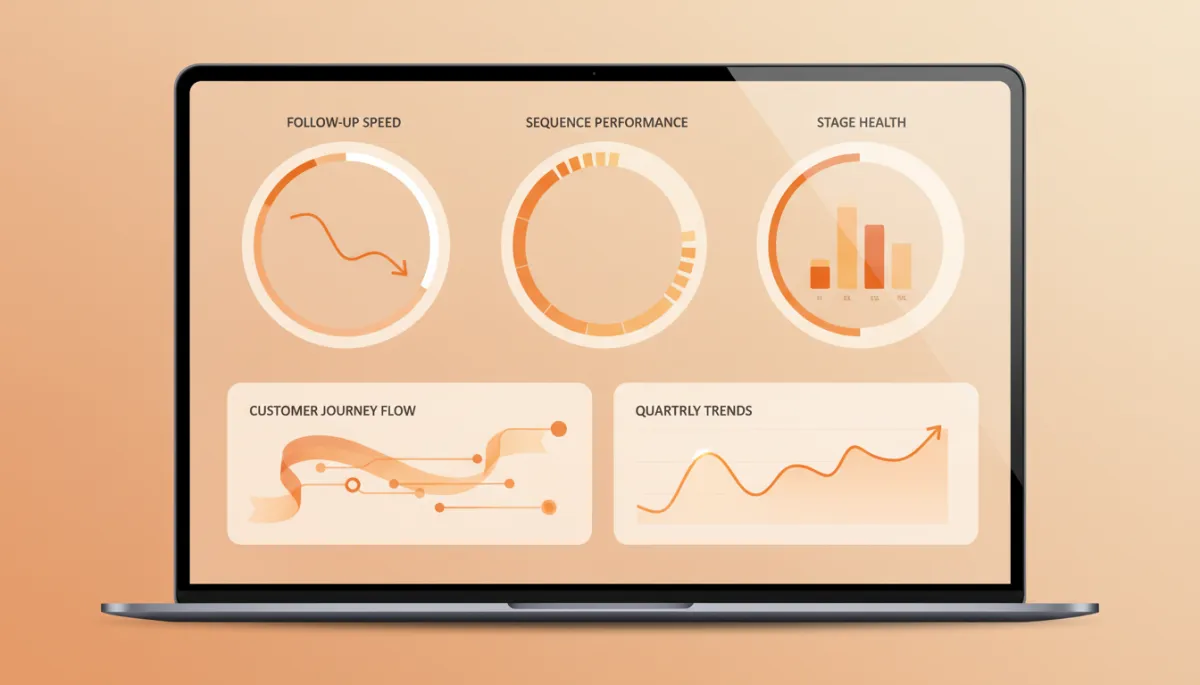
Simple CRM metrics reveal whether your follow-up engine is actually working.
External benchmarks from sources like CIO and Deloitte show that real-time, service-led CRM workflows outperform static pipelines because they react to customer signals immediately, not weeks later. When your CRM tracks these signals and you review them weekly, you can iterate your sequences the same way you iterate your product.
FAQ: Building a founder-friendly CRM follow-up system
Which CRM is best for founder-led follow-up?
The “best” CRM is the one you will actually live in daily. Tools like HubSpot, Pipedrive, and Close all support automated sequences, AI-assisted emails, and clear pipelines. What matters more is whether you configure them around your stages, your P.I.T.C.H.-driven templates, and your review rhythm. A simple, well-used CRM beats a powerful, abandoned one every time.
How often should founders personally follow up?
In the early stages, Jason recommends founders personally handle follow-ups for all high-intent opportunities—especially between discovery and proposal. As you grow, you can delegate parts of the crm follow up process to a sales team, but founder-led touchpoints still matter for strategic accounts. Automation should handle the cadence; you decide which messages carry your name.
How many follow-ups are too many?
Data from modern CRMs and sales benchmarks consistently shows that most teams stop far too early. Jason typically designs 7–10 touch sequences over 21–30 days, mixing email, LinkedIn, and occasionally SMS where appropriate consent exists. The line is not the number—it is whether each message adds context, clarity, or value. If your CRM templates do that, prospects rarely resent persistence.
How does the P.I.T.C.H. Formula fit into CRM automation?
The P.I.T.C.H. Formula gives you a consistent structure for every follow-up—clearly stating the problem, insight, transformation, call-to-action, and human detail. Once defined, these elements become building blocks your CRM and AI copilot can reuse across sequences, so every automated touch still feels like a coherent extension of your narrative instead of random nudges.
Can small teams really compete with enterprise CRM setups?
Yes—if anything, small teams have an advantage. Modern, AI-augmented CRMs give you capabilities that used to require full RevOps teams, from supervised write-back to multichannel sequencing. Your edge is speed and focus. Implement a lean crm follow up system now, and you will out-execute larger competitors who are still wrestling with siloed tools and complex approvals.
Where can founders learn a complete sales follow-up playbook?
Jason shares a full, founder-specific playbook in his sales follow up strategy guide, along with examples of real sequences that convert. Founders who want to go deeper into future-proof selling systems can also study broader CRM and AI trends from sources like CIO’s CRM trends and Deloitte’s outlook on real-time workflows.
Native ad: Turn your CRM into a follow-up machine for $0.63/day
If you want help turning these ideas into a working crm follow up system, Jason built FOS—his Founder Operating System—for exactly this problem. For $0.63/day, founders get plug-and-play pipeline stages, follow-up sequences, and P.I.T.C.H.-based templates that have been battle-tested with more than 1,000 founders and rebuilt three times as tools evolved. You can see what is inside at dreamaker.club/buyfos, then adapt it to your own CRM in a weekend.
Tier 1 founders, Tan, Teo, and Leon: your next move
Jason often points to founders like Tan, Teo, and Leon as Tier 1 operators—not because they never drop a ball, but because they build systems that catch the ball for them. They treat their CRM as an extension of their judgment, not a chore. They learn from operators like billionaire Tobi Lütke, who scaled Shopify’s merchant relationships through structured, CRM-led follow-up, then adapt those principles to their own stage and market.
If you want to operate at that level, the path is clear. Design your pipeline stages and triggers, adopt the five CRM rules, track your follow-up efficiency, and let automation carry the weight while you protect the human touch. When your crm follow up system runs quietly in the background, you get to show up as the founder your buyers actually want to talk to—present, prepared, and persistently helpful.


