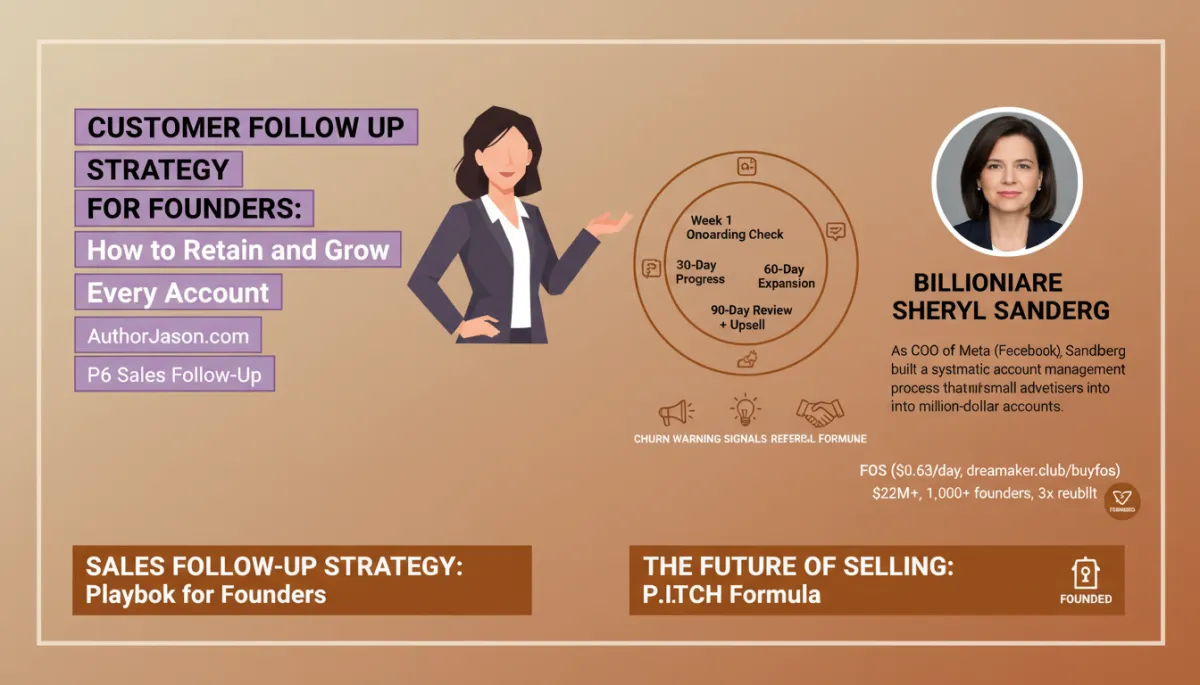
Customer Follow Up Strategy for Founders: How to Retain and Grow Every Account
Sales Strategy, Customer Follow Up, Founder-Led Growth
Customer Follow Up Strategy for Founders: How Billionaire Sheryl Sandberg Retained and Grew Every Account
As COO of Meta, Sandberg helped build a systematic account management process that turned tiny ad budgets into million‑dollar accounts. Her core belief applies to every founder — the follow-up after the sale is where the real relationship begins. In this article, you’ll learn a practical, 90‑day customer follow up strategy you can plug into your business, how to spot churn before it hits your Stripe dashboard, and how to turn satisfied customers into a steady referral engine.

Why Founders Need a Systematic Customer Follow Up Strategy
Jason has worked with more than $22M+ in sales volume, over 1,000+ founders, and has rebuilt his own follow-up systems three times. The pattern is always the same — founders close the deal, celebrate, then disappear into product, hiring, or fundraising. The customer hears nothing until renewal, upgrade, or the next pitch. By then, the relationship has cooled, competitors have circled, and expansion revenue is gone.
A deliberate customer follow up strategy solves three founder problems at once:
- It protects revenue you’ve already fought hard to win.
- It surfaces expansion and upsell opportunities you’d otherwise miss.
- It turns happy customers into a predictable source of high‑quality referrals.
If you want a deeper breakdown of founder‑led follow-up, Jason’s detailed sales follow-up strategy playbook shows how to operationalize this across your team. Here, we’ll focus on a 90‑day, account‑retention framework you can implement this week.
The 90-Day Customer Follow Up Framework for Founders
Week 1: Onboarding Check — Reduce Buyer’s Remorse Fast
The first week after a deal closes is emotionally fragile. The excitement of the sale fades, implementation work begins, and your customer quietly asks, “Did we make the right call?” Your job is to remove doubt, confirm momentum, and make them feel smart for choosing you. This is where founder‑led follow up with customers has disproportionate impact — your presence signals importance and commitment.
- Day 1–2: Send a short, personal welcome video or email recapping why they bought, the outcome they said they wanted, and the next 2–3 steps. Keep it simple, specific, and reassuring.
- Day 3–5: Quick onboarding check — “Are we on track?” Call or email with three bullets: what’s done, what’s next, where you need their input. This reduces friction and keeps momentum visible.
Day 30: Progress Review — Anchor the Value, Not the Features
By 30 days, your customer should have experienced at least one clear, measurable win. This is the moment to anchor the relationship around outcomes — not deliverables. Schedule a short review call and use a simple structure:
- Restate the goal they shared during the sale (cost savings, revenue, time, risk).
- Show proof — metrics, screenshots, or qualitative wins from their team.
- Ask: “What’s one thing we can improve in the next 30 days?”

A 30-day progress review locks in perceived value and exposes expansion paths.
Day 60: Expansion Conversation — Earn the Right to Upsell
At 60 days, your customer has enough experience to trust your team and enough results to justify doing more. This is where a thoughtful customer follow up strategy turns into expansion revenue — without feeling pushy. Jason often uses the P.I.T.C.H. Formula to structure this conversation, focusing on problems, impact, timing, change, and how you help.
- Show them where they’re under‑utilizing your product or service.
- Share 1–2 examples of similar customers who expanded and what changed.
- Propose a low‑risk, high‑leverage next step — a pilot, extra seats, or an added feature.
Day 90: Strategic Review + Upsell — Think Like an Investor
At 90 days, you step back and treat the account like a portfolio investment. What has their business gained? Where are the bottlenecks now? What would a “next‑level” version of this partnership look like? This is your chance to combine retention, upsell, and referrals in one structured conversation:
- Review results against the original business case.
- Present 2–3 options: maintain, expand, or co‑create something new.
- Ask for warm introductions if they’re thrilled — more on that below.
Churn Warning Signals — And How to Prevent Them Early
Churn rarely arrives as a surprise email — it shows up as quiet warning signals inside your accounts. A strong customer follow up strategy means you’re watching for those signals and responding before they turn into cancellations. Jason teaches founders to track three categories: usage, engagement, and sentiment.
- Usage drops: logins fall, projects stall, or implementation slows. Prevention — schedule a short “success audit” to remove friction and re‑align on outcomes.
- Engagement fades: they stop replying quickly, cancel meetings, or delegate you down the org chart. Prevention — reach out founder‑to‑founder, acknowledge the slowdown, and ask what changed.
- Sentiment shifts: subtle complaints, “We’re busy,” or “We’re reviewing tools.” Prevention — invite candid feedback, fix one visible issue fast, and confirm whether their priorities have moved.
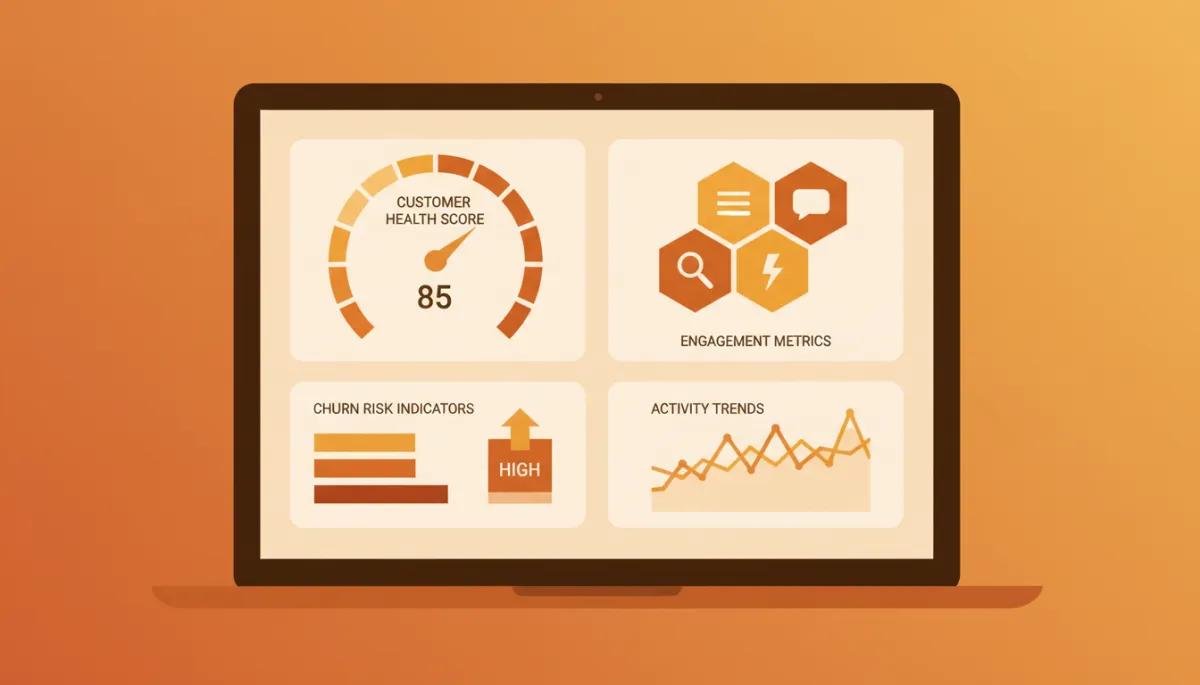
Simple health scores help founders see churn risk long before renewal dates.
Turning Satisfied Customers into a Referral Engine
Many founders treat referrals as a happy accident. Jason treats them as a designed outcome of a strong customer follow up strategy. The formula is straightforward — deliver visible wins, name the win out loud, then invite them to share that win with peers who care about the same result. Timing matters: the best moment to ask is right after a milestone or 90‑day review where you’ve made the value undeniable.
- Capture a short testimonial or case study during the 90‑day review.
- Ask for 1–2 specific introductions — “other heads of ops who care about X.”
- Make it easy: draft the intro email for them, and protect their reputation by showing how you’ll handle it.

Designed referral moments turn delighted customers into compounding growth channels.
People Also Ask: Founder Questions About Customer Follow Up
How often should a founder personally follow up with customers?
Early on, Jason recommends founders personally follow up with customers at least six times in the first 30 days, then at 60 and 90 days — especially for Tier 1 accounts. As you scale, keep founder involvement for strategic customers while your team executes the same cadence for the rest.
What makes a customer follow up strategy actually work?
Consistency, relevance, and clear next steps. Every touch should either remove friction, highlight a win, or open a new possibility. Random “checking in” emails get ignored — structured follow up with customers that respects their time earns trust and expansion.
How do I follow up without feeling pushy or salesy?
Anchor every message to their goals, not your quota. Share progress, insights, or risks they might miss. When you frame follow-up around protecting their outcome, it stops feeling like pressure and starts feeling like partnership — a principle Sandberg’s teams used with small advertisers who later scaled aggressively.
When is the right time to ask for referrals from a customer?
Ask right after a visible win — a successful launch, a KPI milestone, or a strong 90‑day review. That’s when the emotional memory of success is highest. Tie the ask to their peers’ benefit, not yours: “If you know others facing this same bottleneck, I’m happy to share what worked here.”
How can I systemize follow up if I’m a solo founder?
Start small — a simple spreadsheet or CRM with key dates (Week 1, Day 30, Day 60, Day 90) and a few email templates is enough. Block 30–45 minutes daily for follow-up only. Tools like HubSpot CRM or Pipedrive can automate reminders without adding complexity.
What’s the difference between Tier 1 and other accounts in follow up?
Tier 1 accounts are the customers where you, as founder, stay personally involved — because they drive outsized revenue, learning, or credibility. Jason often names them, like Tan, Teo, and Leon — the kind of accounts where a single renewal or expansion meaningfully shifts your growth curve. These accounts get the full 90‑day framework plus extra founder‑to‑founder check‑ins.
Native Ad: Build a Founder-Led Follow Up System That Runs Daily
If you want this level of structure without building it from scratch, Jason created FOS — a lightweight founder operating system — that runs for about $0.63/day. Inside, you’ll see how he applies the P6 Sales Follow-Up rhythm, the 90‑day framework, and referral prompts in a single workflow you can execute in under 45 minutes a day. You can get it at dreamaker.club/buyfos and adapt it to your own stack in a weekend.
For broader context on how sales is evolving — and why structured follow-up is becoming a core moat — Jason’s article on the P.I.T.C.H. Formula explores where founder‑led selling is heading next. You can also study how enterprise leaders think about account expansion in resources from firms like McKinsey and Gartner.
Conclusion: Follow Up Like Sandberg, Even If You’re Still Small
You don’t need Meta’s budget to borrow Sandberg’s principle — the real relationship begins after the sale. A simple 90‑day customer follow up strategy, clear churn warning signals, and a deliberate referral workflow can turn every new deal into a long‑term, expanding account. Jason’s work with founders proves that when you systemize follow-up, revenue stops feeling like a roller coaster and starts compounding.

Systemized follow-up transforms one-off wins into a stable, growing revenue base.
Final Native Ad: Install a Daily Follow-Up Rhythm That Protects Every Account
If this resonated and you want a practical way to operationalize it, Jason built FOS so founders can run a Sandberg‑style follow-up system without needing a huge team. For about $0.63/day, you get battle‑tested checklists, prompts, and dashboards that keep every account — especially Tier 1 clients like Tan, Teo, and Leon — on track for renewal, expansion, and referrals. Learn more at dreamaker.club/buyfos and explore more of Jason’s thinking at AuthorJason.com.


