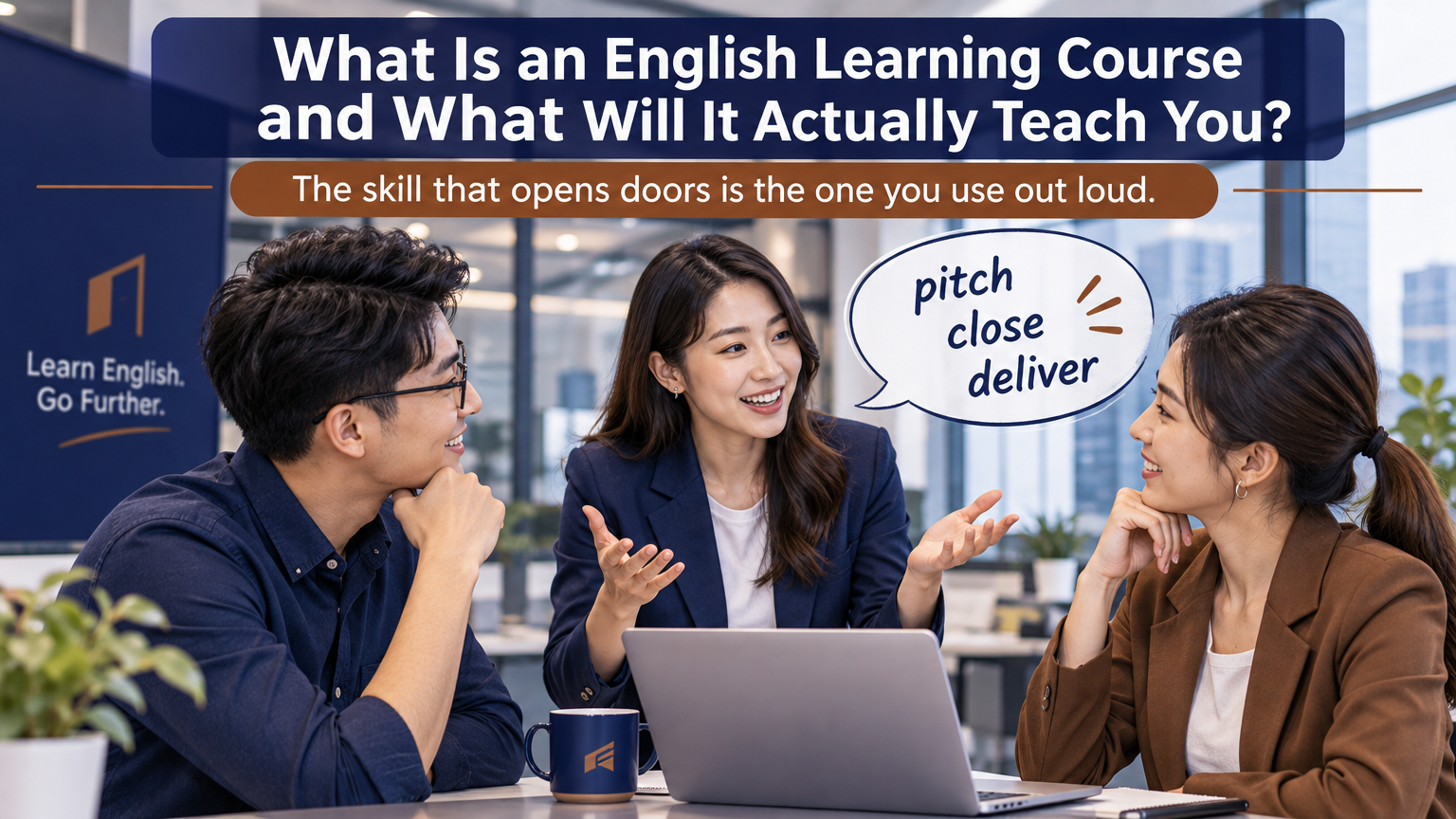
What Is an English Learning Course and What Will It Actually Teach You?
What Is an English Learning Course and What Will It Actually Teach You?
An English learning course is a structured program that builds your ability to read, write, listen, and speak in English — with the strongest programs prioritizing spoken fluency above all else. Done right, it closes the gap between knowing English and using it confidently in meetings, pitches, and high-stakes professional conversations.
From Fluency to Deals That Close
Jason Lim has 24+ years of coaching and teaching experience, working with clients across 42 cities globally. When one student learned to say what they meant — clearly, confidently, with presence — a small conversation became a partnership that grew far beyond anyone’s expectations. Fluency opened the door. Speaking skill is what closed it.
What Does an English Learning Course Actually Teach You?
Picture a founder in Manila. She knows English — reads it, writes it, studied it for years. But when a potential client asks an unexpected question on a Zoom call, she freezes, loses her thread, and the moment passes. The vocabulary was there. The grammar was there. The confidence to speak in real time was not. That gap — between knowing and doing — is exactly what a strong English learning course is built to close.
Credible programs typically develop these core skill areas:
| Skill Area | What You Practise | Why It Matters |
|---|---|---|
| Spoken fluency | Real-time conversation and role-play | Removes hesitation when it counts most |
| Pronunciation and clarity | Word stress, rhythm, intonation | First impressions form in seconds |
| Vocabulary in context | Business, negotiation, presentations | Words that land in real situations |
| Listening comprehension | Accents, fast speech, follow-up questions | You cannot respond to what you missed |
| On-camera delivery | Eye contact, posture, pace on video | Most professional conversations now happen on screen |
Practical takeaway: If a course does not put you in live speaking situations with real feedback every session, it is a reading class with an English label on it. The reps matter more than the rules.
Who Gets the Most Out of an English Learning Course?
The numbers make the opportunity clear. Communication ranked as the most in-demand skill on LinkedIn for both 2024 and 2025, according to LinkedIn Talent Insights as cited by VoxBooster’s Public Speaking Statistics 2026. The NACE Job Outlook 2025 found that more than three-quarters of employers named communication a critical attribute for new hires, with more than two-thirds specifically screening for verbal communication skills — not written, verbal.
Yet many professionals learn English through reading and writing, never through live speaking. The Preply Public-Speaking Survey 2024 found that 63% of Gen Z respondents would avoid public speaking altogether if given the choice — a signal that confidence in spoken English remains a widespread, unsolved problem even among the most digitally fluent generation.
An English learning course is especially valuable for:
- Non-native speakers in sales roles — fluency gaps create hesitation, and hesitation kills deals.
- New reps in their 20s and 30s — pitching on calls and on camera demands real-time verbal agility.
- Executives and founders — investor and client meetings require clarity and confidence under pressure.
- Freelancers and consultants — when you are the product, how you speak is part of the value you deliver.
How Do You Choose the Right English Learning Course?
Not all English learning courses are equal. Here is what separates the ones that build real skills from those that only feel productive:
- Live speaking sessions — passive video lessons do not build spoken confidence. Look for real-time speaking practice with a human instructor or coached peer group.
- Structured feedback — a good instructor tells you what to fix and how, not just that you should speak more.
- Progressive difficulty — courses that do not push you past your comfort zone will only make you comfortable, not competent.
- Real-world scenarios — pitches, meetings, negotiations, and Q&A sessions are where language skills are tested. Great courses simulate these environments.
- Speaking as the primary output — if the course measures success through written tests, it is teaching the wrong skill for professional performance.
Think of it like driving. You can read every driving manual ever published and still stall the car at a busy intersection. The manual is information. The wheel is where skill actually forms. An English learning course that skips live speaking is a manual without a wheel.
Related:
🎯 Presentation Skills Programme — Jason Lim
💬 What Is an English Language Course Online and What Will It Actually Teach You?
💬 What Is an English Speaking Class and What Will You Actually Learn?
What an English Learning Course Cannot Do on Its Own
Language gets you into the room. Presentation skills keep you in it. Many professionals complete a solid English learning course and still struggle to close a deal, land the pitch, or hold a room — because the gap was never really the words. It was the delivery. Voice, pace, structure, and presence are a separate layer of skill that sits above fluency. Even native English speakers lose deals because they cannot present. Even non-native speakers win deals because they can.
The lesson: an English learning course is a foundation. What you build on top of it determines whether the foundation pays off. Building in spoken delivery, persuasion, and confident on-camera presence — that is where the real professional edge comes from.
Build the Skill That Closes
Jason Lim has spent 24+ years coaching presentation and speaking skills across 42 cities globally. When a franchisee trained with Jason, a small conversation turned into a partnership that grew far beyond what anyone expected — because the words finally landed the way they were meant to.
An English learning course teaches you what to say. The Presentation Skills Programme trains you to say it in a way that moves people to act.
Sources
- VoxBooster — Public Speaking Statistics 2026 (citing LinkedIn Talent Insights 2024–2025 and NACE Job Outlook 2025)
- Preply — Public-Speaking Survey 2024 (63% of Gen Z would avoid public speaking)
- Jason Lim — Future of Selling Presentation Skills Programme


