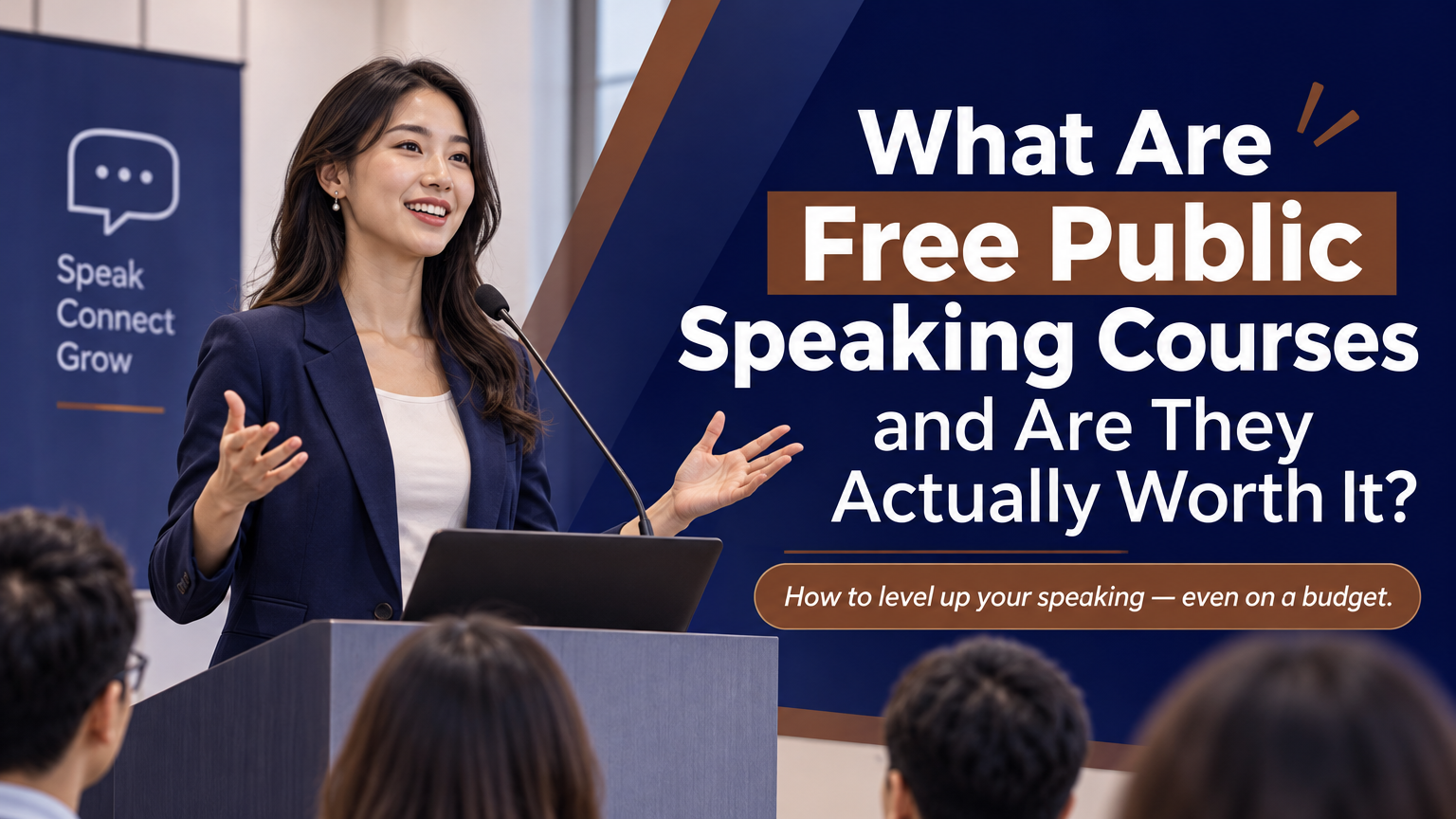
What Are Free Public Speaking Courses and Are They Actually Worth It?
What Are Free Public Speaking Courses and Are They Actually Worth It?
Free public speaking courses are structured programs — available online or in community settings — that teach foundational speaking skills such as delivery, structure, and confidence at no cost. They are genuinely worth starting with for most beginners. However, they typically stop short of the advanced delivery and closing skills that matter most in high-stakes sales, pitches, and boardroom presentations.
Speak Like Someone Who Closes Deals
Jason Lim has spent 20+ years coaching presentation and speaking skills to clients across 42 cities globally. When a franchisee trained with Jason, a small conversation about a project grew into a partnership deal far beyond what anyone had expected — because the words finally landed the way they were meant to.
Free courses build the floor. What Jason teaches builds the ceiling.
What Do Free Public Speaking Courses Actually Teach You?
Picture a startup founder who has watched every free YouTube tutorial on public speaking. She knows about eye contact, the power pause, and the rule of three. But the moment she steps in front of a room of investors, the room stays cold. The issue was never awareness — it was performance under pressure. Free courses tend to build awareness. The gap between knowing and doing is where real training earns its keep.
That said, free public speaking courses cover more than many people expect. Here is what most of them deliver:
| Skill area | Typical coverage | What it prepares you for |
|---|---|---|
| Structure and organization | Intro, body, conclusion frameworks | Basic presentations and class talks |
| Vocal delivery basics | Pace, volume, articulation | Being understood clearly |
| Confidence drills | Practice prompts, self-recording | Reducing avoidance of speaking moments |
| Filler-word reduction | Awareness exercises | Cleaner, more credible delivery |
| Audience awareness | Reading the room basics | Adapting to different listener types |
The practical takeaway from that table: free courses cover the foundation well. What they rarely address is what happens when the stakes are real — when someone pushes back, when the buyer goes quiet, or when you need to close the room rather than just finish your slides.
Where Can You Find Reputable Free Public Speaking Courses?
These are the most credible options available at no cost:
- Toastmasters International — with more than 265,000 members in over 13,800 clubs across nearly 150 countries, Toastmasters is the largest free or near-free speaking practice network in the world. Weekly meetings, structured feedback, and a progressive competency track make it effective for consistent practice.
- Coursera and edX free audits — university-affiliated courses on communication and public speaking are available to audit for free. You receive the content without the certificate.
- YouTube tutorials and recorded talks — useful for concept exposure and watching strong speakers in action. Not a substitute for practice with feedback.
- Community organizations and meetups — local business groups, chambers of commerce, and BNI chapters frequently offer speaking slots at no cost.
The honest limitation: every option above gives you content or practice time. None gives you the real-time expert coaching loop — watch, correct, repeat — that accelerates real improvement.
Related:
- Presentation Skills Coaching Program — Jason Lim
- What Is an English Speaking Class and What Will You Actually Learn?
- How Do You Improve Your Speaking Skills?
When Are Free Public Speaking Courses Not Enough?
The data makes the gap clear. According to the Preply Public-Speaking Survey 2024, 63% of Gen Z respondents said they would avoid public speaking if they did not have to do it. And yet, communication ranked as the most in-demand skill on LinkedIn for both 2024 and 2025, according to LinkedIn Talent Insights as cited by VoxBooster. Even more pointed: the NACE Job Outlook 2025 found that more than three-quarters of employers named communication a critical attribute for new hires, and more than two-thirds specifically screened for verbal communication — not written, verbal.
Free courses can close the awareness gap. They rarely close the performance gap. Consider an analogy: knowing the rules of driving is not the same as having the reflexes to merge at speed on a highway. Speaking skill is built through deliberate repetition with expert correction, not through passive learning.
Free courses are worth starting. They become insufficient when:
- You are closing enterprise deals or investor rounds where one presentation decides the outcome
- You are on camera regularly in sales calls and your close rate is not where it should be
- You have been through free content already and still freeze, rush, or lose the room
- You need to handle live objections with calm authority, not prepared scripts
That is the point where speaking skill transitions from a nice-to-have into the direct cause of deals lost or won. Choosing a better slideshow software is not the fix — any more than upgrading your car solves a skills gap at the wheel. The skill is what changes the outcome.
You Have Already Started. Now Go Further.
Free courses build awareness. Jason Lim’s Presentation Skills program builds performance — the kind that holds rooms, handles objections, and closes deals. Clients trained by Jason have gone on to turn conversations into partnerships that grew far beyond what anyone expected. If you are ready to close the gap between knowing and doing, this is where to start.
Key Takeaways
- Free public speaking courses are genuinely useful for beginners — they build foundational awareness and reduce avoidance
- Toastmasters remains the most practical free option for consistent, structured practice with real feedback
- The performance gap — what happens under real pressure — is rarely closed by free content alone
- Communication is the #1 skill employers demand: the cost of staying at “good enough” is paid in every stalled deal
- When the stakes are high, free courses are the floor, not the ceiling
Sources
- VoxBooster — Public Speaking Statistics 2026 (Chapman University Survey 2025, LinkedIn Talent Insights 2024–2025, NACE Job Outlook 2025, Toastmasters International)
- Preply — Public-Speaking Fears Study 2024 (63% Gen Z avoid public speaking; 59% adults avoid)
- Jason Lim — Future of Selling Presentation Skills Program (20+ years experience, 42 cities globally)


