
How to Build a Startup That Sells: The Strategy Guide and Startup Survival Book for Founders Who Build Great Products Nobody Buys
Startups, how to build a startup that sells, startup sales strategy founders, founder-led sales startup
How to Build a Startup That Sells: The Strategy Guide and Startup Survival Book for Founders Who Build Great Products Nobody Buys
This is a playbook for founders who can ship product but struggle to ship revenue. Jason shows how to build a startup that sells, starting with conversations, not code, so your idea doesn’t die quietly in a crowded app store.
Why Most Startups Build Everything Except the One Thing That Keeps Them Alive
Most founders Jason meets can ship features faster than they can send a simple sales email. They polish dashboards, tweak onboarding flows, and obsess over AI prompts. But they avoid the one thing that actually answers how to build a startup that sells: talking to people who can pay them money.
It is not laziness. It is fear. Fear of rejection. Fear of hearing, “This is nice, but I wouldn’t pay for it.” In a world where AI-native startups are growing 156% a year on average, according to AWS, the founders who win are the ones who treat sales like oxygen, not like an optional feature.

The first real sales asset is not a deck; it is a notebook full of customer words.
The Startup Mistake That Kills Great Ideas Before the Market Ever Sees Them
Jason sees the same pattern in Singapore, in the US, and online. Founders wait for “ready.” They tell themselves, “Once the product is more polished, then I’ll sell.” But markets move. Competitors ship. Cash runs out. And the startup that could have helped real people never gets its shot.
Harvard Business Review has already warned that old sales playbooks are failing in crowded markets. Buyers are overwhelmed. They ignore generic pitches. The startup sales strategy founders need in 2026 is simple: show up early, ask better questions, and offer to solve one painful problem before you talk about features.
Jason is kind about this. He has been there three times. Three rock bottoms. Three times back. He knows shame does not help. What helps is a forgiving, practical path to founder-led sales that feels human, not slimy.

A simple, honest funnel on paper beats a complex CRM nobody uses.
How Jeff Bezos Built Amazon by Selling Before He Scaled
Think about Jeff Bezos in the early Amazon days. No Prime. No warehouses full of robots. Just a tiny team, packing books by hand, and Bezos himself calling customers to ask how the experience felt. Before Amazon became a technology company, it was a founder-led sales startup obsessed with serving people one order at a time.
He sold the idea of a better way to buy books long before the infrastructure caught up. That is how to get startup revenue when nobody knows your name yet. You sell the promise clearly, deliver personally, and learn faster than anyone else in your space. Revenue becomes your most honest feedback loop.
Brian Chesky did the same with Airbnb, walking door to door in New York, taking photos of hosts’ apartments himself. Marc Benioff did it with Salesforce, selling big contracts before there was a detailed roadmap. Different cities. Different decades. Same pattern: the founder sold first, then scaled.

When the founder packs the first orders, every box carries a learning.
The P.I.T.C.H. Formula: Jason's System for Building a Startup That Generates Revenue From Day One
Jason built the Future of Selling System (FOS) as a simple answer to a hard question: how can a founder who hates “selling” still build a startup that sells? His answer is the P.I.T.C.H. Formula, a way to structure every sales day so it feels like service, not pressure.
In FOS, founders learn to prepare, set intent, teach, close, and build habits around sales. Not in theory, but in tiny, repeatable moves. Graduates have generated more than $22M in combined sales. Over 1,000 founders since 2015 have used it to turn quiet products into real revenue, from Singapore to the rest of the world.
The 5 Founder Sales Moves Every Startup Must Master Before Hiring Anyone
Validate by selling — not by building
The fastest way to test an idea is to ask someone to pay for it. Not a survey. Not a like on social. A real invoice, even if it is small. That is how to get startup revenue that actually means something. Fast Company notes that investors now want real revenue, not just projections. Jason agrees.
Your first 10 customers come from conversations, not campaigns
Those first customers startup founders dream about rarely come from ads. They come from DMs, coffee chats, and referrals. Forbes and HBR both point to relationships and networks as the real engine for early customers. Jason teaches founders to build a short list, reach out kindly, and ask for honest time, not favors.
Price on value, not on fear
In 2026, usage-based pricing and subscriptions are everywhere. Revenera’s data shows more companies shifting to flexible models. But the core rule stays the same: price based on the value you create, not on how scared you feel. Jason reminds founders that discounting from fear is like poking holes in your own lifeboat.
Build the sell-learn-improve loop
A strong startup growth strategy is not a straight line. It is a loop. Sell to a few. Learn what worked. Improve the offer. Then repeat. McKinsey and others talk about data-driven optimization. Jason brings it down to street level: one spreadsheet, one weekly review, one small experiment at a time.
Know when to hire your first salesperson
Jason is clear. Do not hire sales to fix a broken offer. Hire when you, as founder, can already close a repeatable type of deal. Salesforce’s own story shows that even with a big vision, Benioff sold first. Then he scaled the motion. Until then, founder-led sales startup mode is not a phase. It is your edge.
- Talk to real buyers weekly and ask for paid commitments early.
- Use simple tools to track every lead, call, and outcome.
- Raise prices when customers say “this is cheap,” not “this is fair.”
- Review sales conversations weekly to refine your message and offer.
- Only hire sales once you can explain your own sales process in steps.
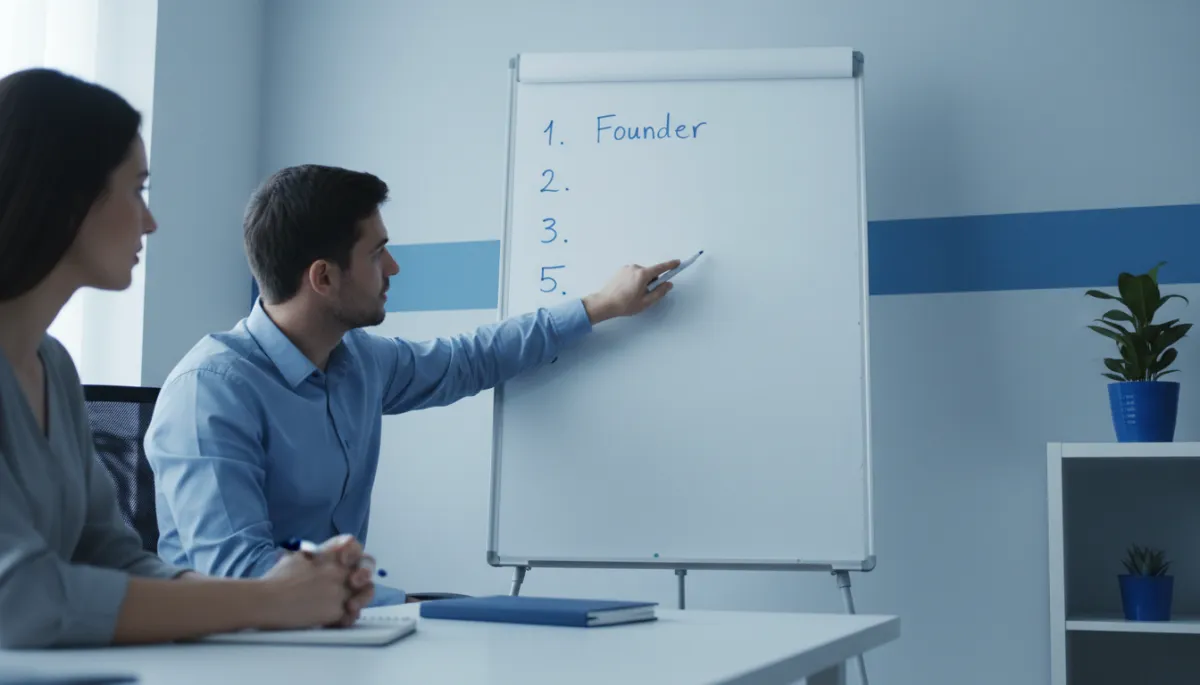
A clear, simple founder sales process is the seed of every future team.
Real Startup Founders, Real Revenue — What Changes When the Founder Sells First
Jason has watched founders shift from panic to calm once the first few invoices are paid. One fictional founder, Maya, built a B2B analytics tool in Singapore. For a year, she hid behind dashboards. No revenue. No runway. After joining FOS, she spent four weeks doing nothing but founder-led sales calls using the same how to get clients as a startup founder approach Jason teaches.
She closed her first five customers. Small contracts. Huge emotional shift. Suddenly, “Will this ever work?” turned into “How do I serve them better?” Her product roadmap changed. Features she loved got cut. Features customers begged for got built. This is what happens when startup sales strategy founders use is built on reality, not fantasy.

The first few paid invoices matter more than any pitch competition trophy.
Start Selling Your Startup This Week
Jason believes every founder can learn to sell. Not in some distant future, but this week. The path is not glamorous. It looks like a list of 20 names, a script written in plain English, and a heart willing to hear “no” without making it mean “never.”

A quiet weekly call block can turn a side project into a real company.
If you want help, Jason’s Future of Selling System is one path. It has already guided founders to results like Tan’s $29,693 in 16 days, Teo’s 63 customers in 100 days, and Leon’s journey from $2.5K to more than $2M. The system is simple, kind, and built for people who never saw themselves as “salesy.”
However you choose to move, let this be the week you stop building in silence. Your startup deserves to be heard. Your customers are waiting. And you do not have to do any of this alone.


