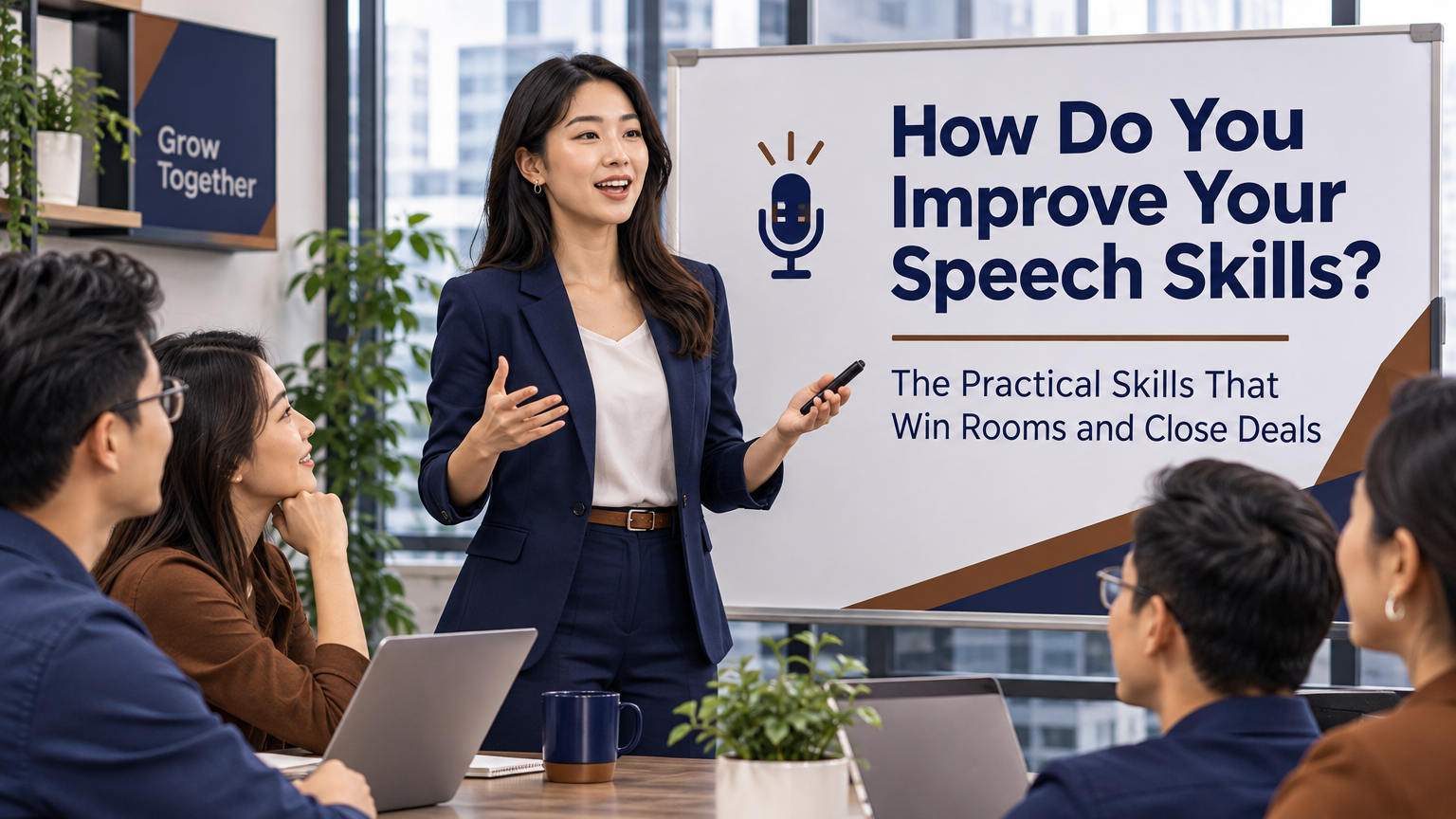
How Do You Improve Your Speech Skills?
You improve your speech skills through deliberate, structured practice that targets the mechanics breaking down under pressure — vocal delivery, message clarity, and confident presence. The core loop: practice in conditions close to the real thing, get specific feedback, and repeat systematically. That loop separates professionals who command rooms from those who lose deals before finishing their first sentence.
🌟 From a Small Pitch to a Career-Defining Partnership Deal
A franchisee student used Jason Lim’s presentation framework to transform a small project pitch into a career-defining partnership deal. The room did not change. The speaking skills did.
Jason Lim brings 20+ years of coaching and teaching experience to founders, sales reps, and executives across 42 cities globally — helping them turn shaky pitches into signed deals through Presentation Skills and Speaking Skills training.
Why Do Most People Struggle to Improve Their Speech Skills?
Picture two sales reps walking into the same client meeting. Same product. Same pricing. Same proposal. One speaks with authority, pauses at the right moments, and handles every challenge with composure. The other rushes, fills silences with “um,” and visibly loses confidence the moment the client pushes back. Only one walks out with a signed contract.
The gap is not the product. It is speech skills — and it is a gap most professionals leave unfilled. According to the Chapman University Survey of American Fears 2025, 33.7% of Americans are afraid or very afraid of public speaking. Yet communication ranked as the number-one most in-demand skill on LinkedIn for both 2024 and 2025, and the NACE Job Outlook 2025 found that more than three-quarters of employers name communication a critical attribute for new hires, with more than two in three specifically seeking verbal communication skills.
The demand is high. The confidence gap is real. That gap is where deals are lost — and where the right training pays off fastest.
What Does It Actually Take to Improve Your Speech Skills?
Improvement does not come from reading articles or watching videos about speaking. It requires deliberate, structured reps in conditions that mirror real-world pressure. Here is what moves the needle:
| Skill Area | What to Practice | Why It Matters |
|---|---|---|
| Vocal Delivery | Pace, pause, volume, and tonal variety | Signals authority; holds attention |
| Message Structure | Opening hooks, logical flow, clear calls to action | Listeners remember and act on what you said |
| On-Camera Presence | Eye contact to lens, reducing filler words, stillness | Video calls are now a core sales channel |
| Handling Pushback | Responding to objections without losing the thread | Wins rooms that challenge you |
| Audience Awareness | Reading the room and adapting in real time | Keeps conversations two-way, not broadcast |
Think of it like learning to drive. A skilled driver performs confidently in any car because the skill lives in them — not the vehicle. The same is true for speech skills: choosing a better microphone, a fancier deck, or a new tool does not substitute for knowing how to speak under pressure. Skill is what travels with you into every room.
How Do You Build a Speech Skills Practice Routine That Works?
A 2024 Preply public-speaking study found that 63% of Gen Z respondents would avoid public speaking altogether if they had no obligation to do it. Avoidance is the most common response to discomfort — and the most reliable way to stay stuck. The professionals closing more deals and landing more yeses are the ones who build consistent, deliberate practice into their week.
Here is a practical starting framework:
- Record yourself daily — even for five minutes. Read a paragraph from a proposal or pitch aloud, record it, and play it back. Notice pace, filler words, and energy level.
- Drill the opening and the close. The first 30 seconds of any presentation set the authority level for everything that follows. The close is where deals are won or lost.
- Practice under simulated pressure. Deliver your pitch to a timer, an empty chair, or a colleague who is allowed to push back. Comfort in a controlled setting does not equal readiness for a real room.
- Get specific feedback, not general encouragement. “That was great” does not improve your skills. “Your pace drops right before the ask” does.
- Repeat in short, frequent sessions. Three 10-minute sessions a week beat one 30-minute session the night before the meeting.
Related:
→ Future of Selling — Presentation Skills Coaching with Jason Lim
→ How Do You Improve Your Speaking Skills?
→ What Is a Speech Communication Class and What Will You Actually Learn?
What Is the Single Biggest Shift That Improves Speech Skills Fast?
Moving from passive to active preparation. Most people prepare by reviewing their material in their head. The professionals who improve fastest prepare by speaking aloud, recording, reviewing, and adjusting — then doing it again. The gap between how you think you sound and how you actually sound is where every high-stakes deal is decided.
Speech skills are not a personality trait. They are a craft. Craft is built through deliberate practice, structured coaching, and real feedback over time. Even modest, consistent effort compounds quickly. The professionals who build this habit are the ones closing deals, landing the room, and walking out with signed contracts — not the ones with the best slides.
👉 Ready to Build Speech Skills That Win Rooms?
A franchisee student used Jason Lim’s framework to transform a small project pitch into a career-defining partnership deal. Same room. Different skills. That transformation starts with Presentation Skills and Speaking Skills coaching — not a new tool, a better deck, or a follow-up email.
Sources
- VoxBooster — Public Speaking Statistics 2026 (Chapman University Survey of American Fears 2025; NACE Job Outlook 2025; LinkedIn Talent Insights 2024–2025)
- Preply — Public-Speaking Fears Study 2024 (63% of Gen Z avoid public speaking)
- Jason Lim — Future of Selling (20+ years experience; 42 cities globally; credibility cues verified)


