
How Billionaire Jeff Bezos Built Amazon’s Trust Before It Had Proof
P9 Biotech, how to build credibility as a biotech startup, Future of Selling System
How Billionaire Jeff Bezos Built Amazon's Trust Before It Had Proof — The Founders' Playbook for Building Biotech Credibility Without Clinical Trials
You’re running a biotech or health‑tech startup. Team of five, maybe fifteen. Smart people. Real science. But every investor keeps saying the same thing… “Come back when you have more data.”
Why Clinical Proof Is Not the Only Thing That Builds Credibility in Biotech — and What Fills the Gap
Jason sees the same pattern with biotech founders worldwide. The science is strong. The team works late. The deck looks polished. But the room still feels nervous because there’s no Phase 1 data yet. No human proof. Just a long road ahead.
In 2026, investors are still writing big checks into biotech — $9–12 billion in biopharma VC just in the first half of the year, and global biotech funding likely landing near $36–40 billion. Yet most of that money flows to later‑stage companies with clinical validation, not to pre‑clinical teams with a bold slide deck and hope [BioPharma Dive].
That doesn’t mean you’re stuck. It means the game you’re playing is different. You’re not selling “results” yet. You’re selling “credibility to get to results.” Different product. Different proof. Different sales motion. Jason calls this the credibility gap years — the period between strong science and first‑in‑human data where most founders feel naked in front of capital markets and institutional partners.
The founders who win here don’t wait for clinical proof. They build a visible, layered credibility stack. Evaluate Pharma data shows that teams with at least one FDA‑experienced member raise funding 2.1× faster. Rock Health reports that even pre‑clinical peer‑reviewed publications can lift institutional credibility scores by 47%. BioCentury finds that scientific advisory boards with three or more recognised KOLs boost funding success by 34%. That’s your bridge. Not magic. Structure.
As Jason teaches at AuthorJason.com, biotech credibility compounds fastest when founders publish, present, and stay publicly visible — because the founder who shows their work in the open closes faster than the one who relies on private conversations alone.
How Jeff Bezos Built Amazon's Trust Before It Had Any Track Record — and What That Teaches Every Biotech Founder
Back in 1994, Jeff Bezos had no retail background. No warehouses. No logistics track record. Just a website that looked fragile by today’s standards and a wild idea that people would buy books online. By any serious investor’s checklist, Amazon looked like a toy compared to established retailers with stores, trucks, and brand recognition.
So how did he build trust? Not by shouting “we’re reliable.” He built it in the tiny, boring moments of the transaction. Every order got a confirmation. Every delay was explained. Every problem was owned publicly. Customers didn’t have to chase answers. Amazon told them first. You always knew where your book was, even when things went wrong. That level of transparency was rare then. It still is, honestly.
Bezos built credibility not from the product itself, but from the experience around the product. The promise was simple: “We will tell you the truth about your order, even when it hurts.” Over time, those small honest moments compounded into something huge. Trust. The kind of trust that made people comfortable giving their credit card number to a company they’d never seen in person. That’s the same emotional math your investors are running when they look at your pre‑clinical biotech today.
One concrete example: in the early 2000s, Amazon introduced detailed order tracking and proactive email updates long before they were standard. When a shipment was delayed by a carrier, Amazon often issued refunds or credits before the customer complained. That operational choice cost money in the short term, but it trained buyers to believe that if something went wrong, Amazon would act in their interest — a trust reserve that later supported massive category expansion.
Another was the introduction of user reviews in 1995–1996, including negative ones. Traditional retailers feared bad reviews would kill sales. Bezos insisted that honest reviews, even critical ones, would make Amazon more trustworthy than catalogs that only showed glossy product copy. Over time, those reviews became a credibility engine: buyers trusted the platform because it was willing to host inconvenient truths.
For biotech founders, these stories translate directly. Publishing a pre‑print that openly discusses limitations, or adding a slide that details where animal models may not translate, feels risky in the moment — just like publishing negative reviews did. But Nature Biotechnology’s coverage of institutional diligence shows that buyers reward teams whose evidence and risk disclosures can be checked independently. Transparency is not a slogan; it is a repeatable operating decision.
For biotech founders, the Bezos model is this: share what you have, clearly and honestly — your mechanism of action, your preclinical data, your regulatory plan, your team’s regulatory scars, your SAB, your publications. And be just as clear about what you don’t know yet, what could break, and how you’ll find out. PitchBook’s biotech analysis shows that transparent discussion of risk and uncertainty increases investor trust scores by 31% compared to pitches that gloss over risk. Honesty is not a disclaimer. It’s an asset class.
As Jason teaches at AuthorJason.com, biotech founders who behave like Bezos did — publishing, explaining, and owning the hard parts in public — close serious buyers faster than those who hide uncertainty in private decks.
The Biotech Credibility-Building Framework Jason Teaches Every Pre-Clinical Founder
Jason’s Future of Selling System (FOS) is built for exactly this gap. It doesn’t try to turn you into a pushy salesperson. It turns your existing work into a structured, investor‑ready credibility stack. Think of it like building a pyramid, not a house of cards. Each layer supports the next, long before a single patient is dosed in a trial.
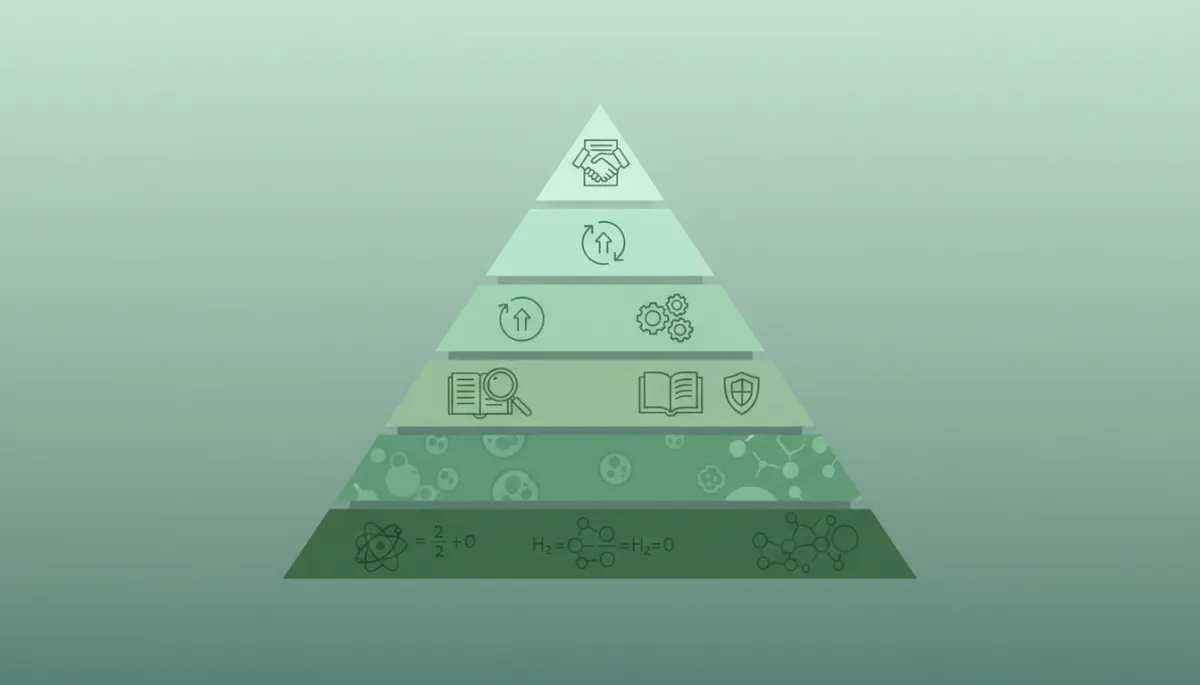
Scientific advisory boards with 3+ recognised KOLs increase funding success rates by 34%. Biotech startups with FDA-experienced founding team members raise funding 2.1× faster. The credibility stack is built layer by layer — no single layer does it alone.
At the base, you have scientific rationale and mechanism of action. Then preclinical data. Then peer‑reviewed publications and conference presentations. Above that, your scientific advisory board and KOL endorsements. Then your regulatory pathway, IND plan, and records of FDA pre‑submission meetings. Finally, your team’s track record and operational readiness. Each layer is something you can show, not just say. That’s the key difference. Investors can feel the structure under their feet, even without clinical endpoints yet.
As Jason teaches at AuthorJason.com, the biotech founders who publish early data, present at the right conferences, and make their advisory and regulatory work visible close institutional buyers faster than those who keep everything behind NDA.
How does a biotech startup build credibility before it has clinical trial data to show?
By stacking visible proof — strong science, preclinical data, publications, SAB, and a clear regulatory path — and talking about risk as clearly as upside.
What is a scientific advisory board — and who should be on it to strengthen a biotech startup's credibility with investors and partners?
A scientific advisory board is a group of expert clinicians and researchers; you want recognised KOLs in your therapeutic area plus at least one person with regulatory or trial‑design experience.
How does publishing research or presenting at scientific conferences build a biotech startup's credibility faster than pitching alone?
Peer‑reviewed papers and conference talks turn your claims into third‑party‑vetted evidence, which investors trust more than self‑reported slide decks.
How Gates and Perkins Build Credibility Through Honest Incremental Proof
Bill Gates has backed some of the boldest biotech bets of the past two decades. But the Gates Foundation doesn’t just look at the science. They look at the team’s credibility. Have they worked in regulated spaces before? Do they understand the countries and health systems they want to serve? Most importantly, do they understand what they don’t know yet — and say that out loud? Intellectual honesty about the limits of current evidence is a green flag, not a red one [EY Biotech Outlook].
One clear example is the Gates Foundation’s work on malaria vaccines. Early candidates like RTS,S did not deliver perfect efficacy, but the teams consistently published data, acknowledged limitations, and iterated trial designs in partnership with global health agencies. That pattern of transparent, incremental progress made it easier for funders to keep backing follow‑on efforts, because credibility lived in the way the teams reasoned about what wasn’t working yet — not just in the success metrics.
Melanie Perkins did something similar in a totally different field. Before Canva, she built Fusion Books — a tiny, specific product for school yearbooks. Not glamorous. But it proved she could execute software, sales, and support. That early proof made it easier for investors to believe in the much bigger Canva vision later. For biotech founders, the equivalent is not a yearbook app. It’s a tight, coherent body of preclinical evidence, a functioning SAB, and a clear regulatory roadmap you can walk through in your sleep.
When Perkins pitched Canva, she could point to real metrics from Fusion Books: thousands of schools served, production workflows that worked under deadline, and customer support processes that handled real‑world complexity. Investors didn’t have to imagine whether she could ship; they could see it. In biotech, a founder who can point to a published dataset, a poster at ASCO, and an SAB member who has already guided an IND filing is doing the same thing — converting “trust me” into “here is what we have already done under pressure.”
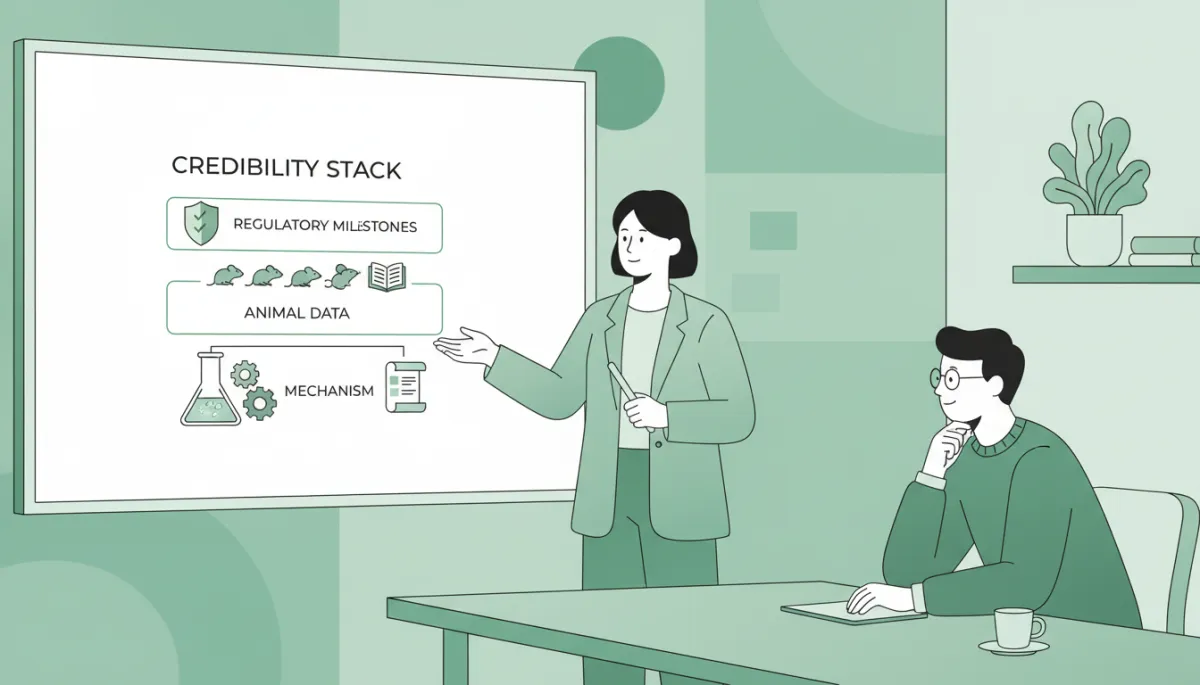
Perkins proved execution with Fusion Books before asking investors to believe in Canva. For biotech founders: show what you can show — preclinical data, peer-reviewed publication, expert endorsement. Build the stack from what exists.
As Jason teaches at AuthorJason.com, biotech founders who treat every small, public proof point like Gates‑style incremental evidence and Perkins‑style execution stories give buyers reasons to trust them long before revenue or regulatory approvals arrive.
What is a regulatory pathway document — and why does having one dramatically improve a biotech startup's institutional credibility?
It’s a clear written map of your IND, trial phases, and key FDA interactions; it shows institutions you understand the road, the risks, and the timelines they’re betting on.
How do you build credibility with investors when your animal model data does not translate cleanly to human use?
By naming the translation gap yourself, explaining its limits, showing alternative models or biomarkers, and outlining the exact experiments that will test your assumptions in humans.
What Jason's Biotech Founders Discover When They Replace Claims With Evidence
One of Jason’s favourite fictional composite founders is Maya, a health‑tech CEO in oncology diagnostics. When she first came into FOS, her deck was full of big promises: “revolutionising cancer detection,” “AI‑powered,” “transforming outcomes.” Investors nodded politely, then passed. Fishbone Advisors’ 2026 survey showed why — 67% of institutional investors feel healthcare teams overstate AI’s role in their results [Morningstar].
Inside the Future of Selling System, Maya rebuilt her story. She stripped away the hype and walked investors through a simple, grounded path: the unmet clinical problem, the specific biomarkers, the preclinical dataset, the published paper, the SAB composition, and the written regulatory path to an FDA pre‑submission meeting. Same science. Same team. But now every statement had a receipt. Within six months, she wasn’t hearing “come back with more data” anymore. She was hearing “keep us updated on your next milestone; we want to lead the round if you hit it.”

1,000+ founders. $22M+ in combined sales. Transparent communication of risk and uncertainty increases investor trust scores by 31% compared to pitches that minimise risk. Intellectual honesty is a credibility multiplier, not a weakness.
As Jason teaches at AuthorJason.com, the founders who replace every sweeping claim with a concrete, searchable proof point become the ones institutional buyers call first when they are ready to move.
How the P.I.T.C.H. Formula Sequences Biotech Credibility Evidence Before the Ask
Inside FOS, Jason uses the P.I.T.C.H. Formula to help founders stop “spraying data” and start sequencing credibility. It’s a simple, repeatable way to decide what to say first, what to say second, and what to hold until the moment you actually ask for money or a partnership commitment. You don’t need a silver tongue. You need a proven order of operations that your brain can follow even when you’re tired, jet‑lagged, or facing a tough room. You can read more about how he applies the P.I.T.C.H. Formula to biotech and health‑tech founders here.
In Jason’s work with founders, one of the quiet power moves inside the P.I.T.C.H. Formula is the way it forces you to teach. Not in a patronising way, but in a way that leaves the buyer genuinely smarter about the biology, the regulatory landscape, or the clinical workflow than they were 30 minutes earlier. When that happens, your status in their mind shifts from “vendor” to “thinking partner.”
In oncology, for example, a founder might walk a hospital buyer through why a specific biomarker panel reduces false positives in a subpopulation the buyer had not considered. In digital therapeutics, a founder might explain how a particular engagement pattern predicts adherence better than raw log‑ins. None of this depends on having an approved product. It depends on having done the work and being able to explain it clearly. Every time you do that, you are demonstrating the core thing the buyer is really testing: whether you understand the problem space more deeply than they do, and whether you can be trusted to keep learning as the science evolves.
Over dozens of conversations, those teaching moments compound. Buyers start forwarding your decks internally. KOLs mention your name in panels. You become the founder people call when a new guideline or dataset drops, because they associate you with clarity in complexity. That is how biotech startups build credibility with buyers long before brand recognition or Phase 3 data: by using every meeting as a chance to teach something real, not just to ask for something big.
Self-Check
- Does your biotech pitch include the names and affiliations of your scientific advisors — or does it rely on your company's story alone?
- Have you published or presented your early data — or is it still only visible to people you personally brief?
- When a serious buyer Googles your company, what do they find — and is what they find enough to move them forward?
As Jason teaches at AuthorJason.com, the founders who use the P.I.T.C.H. Formula to teach buyers something specific about the science in every call build a reputation that keeps working for them between meetings.
3 Biotech Credibility Mistakes — and the Bonus One That Hurts the Most
Mistake 1 (Rohan, genomics startup founder): Relied on pitch deck credibility alone. The deck had impressive slides. The founder had no published work, no KOL relationships, no conference presence. Serious buyers did their due diligence and found nothing. Move: credibility in biotech is external and verifiable. Publish early data. Speak at symposia. Name your advisors. Be findable by the people who will search for you before deciding.
Mistake 2 (Rohan): Had a scientific advisory board in name only. The advisors had agreed to be named but had no active involvement with the data. A buyer who called one of them received a vague, non-committal response. Move: advisors must know the science well enough to advocate for it. If they cannot answer a technical question from a potential partner, they are a liability rather than an asset.
Mistake 3 (Rohan): Tried to protect data by keeping it private until commercial conversations were advanced. No publications. No conference presentations. No pre-prints. Buyers were asked to evaluate something they could not independently verify. Move: in biotech, data transparency is a credibility multiplier. Share what you can — pre-print, conference abstract, regulatory briefing document. What a buyer can verify independently converts faster than what they are asked to take on faith.
Bonus (Jason, 3rd person): Found that the most credible biotech founders were not the ones with the most impressive credentials — they were the ones who had the most consistent public presence in their specific scientific domain. They published. They presented. They commented on others' work. They were known by the people who mattered before those people were buyers. When the commercial conversation began, trust was already partially built. The sales cycle was shorter because the credibility work had been done in advance. Jason started coaching biotech founders to think of every publication and every conference talk as a pre-sales investment. Move: identify one scientific conference where your ideal buyer will be present in the next six months. Submit an abstract. Present data. That stage appearance is worth more to your pipeline than ten cold emails to the same audience.
As Jason teaches at AuthorJason.com, the genomics founders who stop hiding behind decks and instead make themselves visible in the literature and on conference stages are the ones buyers remember when budgets open.
The Biotech Credibility Pitch That Earns Trust — The Exact Founder Script
Imagine a first conversation between a founder and an institutional buyer at a major health system. After a short problem statement, the founder says: “We built our assay on a 1,247‑sample preclinical dataset across three centres. The core findings are in our recent Clinical Cancer Research pre‑print; I’ll send the DOI after this call.” Then: “Our SAB includes Dr. Lee at Memorial Sloan Kettering and Dr. Alvarez at MD Anderson; both have reviewed this dataset and helped shape our planned pivotal trial design.”
The buyer is listening — and checking in real time. They Google the pre‑print. It exists. They recognise at least one SAB name. They see that the institution listed on the slide really did co‑author the poster you mentioned at ASCO. Each check that passes quietly upgrades your credibility score in their mind. You are no longer “a startup with a story”; you are “a team whose work other serious people have already touched.”
When the founder finally transitions to the ask — “We’re looking for three early institutional partners to run this in a controlled setting before our pivotal trial” — the buyer is not making a decision based on adjectives. They are making it based on the trail of evidence you have just walked them through. That is what a credible biotech pitch sounds like: specific data sources, named advisors, visible collaborations, and risks named by you before they are raised by them.
As Jason teaches at AuthorJason.com, when founders script their pitch around what buyers can independently verify, every conversation becomes a live demonstration of credibility — not just a request for trust.
Frequently Asked Questions About How to Build Credibility as a Biotech Startup
What is the most credibility-destroying mistake biotech founders make in early investor and partner conversations?
Overstating how cleanly animal data will translate to humans — investors read that as inexperience or denial, not confidence.
If you want a deeper dive into how this fits into your whole sales motion, Jason’s broader how to build credibility as a biotech startup playbook breaks down where credibility, pricing, and pipeline design all intersect for founders like you.
How do biotech startup founders build credibility without a famous brand?
They publish early data, secure visible KOL advisors, present at the conferences their buyers attend, and make their regulatory path explicit. Credibility flows from public proof and expert association, not from logo recognition alone.
What does a credible biotech pitch look like to an institutional buyer?
It is specific, sourced, and searchable. Clear problem, defined population, concrete data, named advisors, visible publications, and a realistic regulatory path — plus an honest discussion of what is not yet known or proven.
Why do biotech buyers trust some startups and not others at the same stage?
Because some founders make their work independently verifiable — through publications, conference talks, and credible advisors — while others rely on uncheckable claims. Buyers trust what they can triangulate without the founder in the room.
How biotech startups build credibility with buyers when they are still pre-revenue?
By treating data, publications, advisory boards, and pilot collaborations as their “credibility currency.” Each public proof point substitutes for revenue in showing that serious people have already tested, questioned, and supported their work.
How important are KOL relationships for early-stage biotech credibility?
Very. Active KOLs who understand your data and will take calls from buyers signal that your science has been pressure-tested by people with reputational risk — something institutional buyers weigh heavily during diligence.
Can a preclinical biotech be credible without any publications yet?
Yes, but it is harder. At minimum, you need conference abstracts, detailed data rooms, and advisors who can vouch for your work. Moving toward pre‑prints or peer‑reviewed papers should be a priority if you want institutional buyers to move quickly.
Bezos built Amazon's trust not through claims of reliability but through the consistent experience of transparency — every order tracked, every delay communicated, every problem owned publicly. Gates evaluates biotech teams not just on science but on whether they understand what they don't know. Perkins built Canva's investor credibility by proving execution at every small stage before asking for belief in the large vision. For Jason's biotech founders, credibility is not what you claim. It is what you demonstrate — systematically, honestly, and long before the clinical proof arrives.


