
How Billionaire Jeff Bezos Built Amazon Without a Single Ghosted Proposal
Sales, Startup Founders, Why Proposals Get Ignored
How Billionaire Jeff Bezos Built Amazon Without a Single Ignored Proposal — A Founder’s Guide to Winning Before You Hit Send
Jeff Bezos, Bill Gates, and Mark Cuban all learned the same lesson early: proposals don’t close deals — conversations do. This is the quiet truth behind why proposals get ignored — and why Jason built the Future of Selling system to help founders win the decision before any PDF leaves their laptop.
Why Most Proposals Get Ignored Before the Prospect Even Reads Them
Think about the last time you were a buyer, not a founder. Your inbox was full. You skimmed through messages, starred a few, and then real life pulled you away.
That’s what happens to most proposals. Research from Propoze shows that 60% of buyers never respond to a proposal without follow-up. The proposal is rarely explicitly rejected. Life, priorities, and noise simply swallow it.
Jason sees this pattern with almost every founder he coaches. They’re leading all the sales. They care deeply. They spend three hours crafting a beautiful proposal… then watch it disappear into a black hole of “Viewed” with no reply.
The data backs up their frustration. Flowlu and Instantly show that only 2% of sales happen on the first contact. The average B2B deal needs around 8 touchpoints over 84 days. One emailed proposal is just a tiny touch in a much longer journey.
When founders send a proposal without a live conversation wrapped around it, they’re asking a busy human to do heavy lifting alone: read, interpret, compare, and decide. It’s no surprise many choose silence instead.
As Jason teaches at AuthorJason.com, the “ghost” usually appears in the conversation before the proposal, when expectations, decision criteria, and the next step are left vague — forcing the document to do all the work on its own.
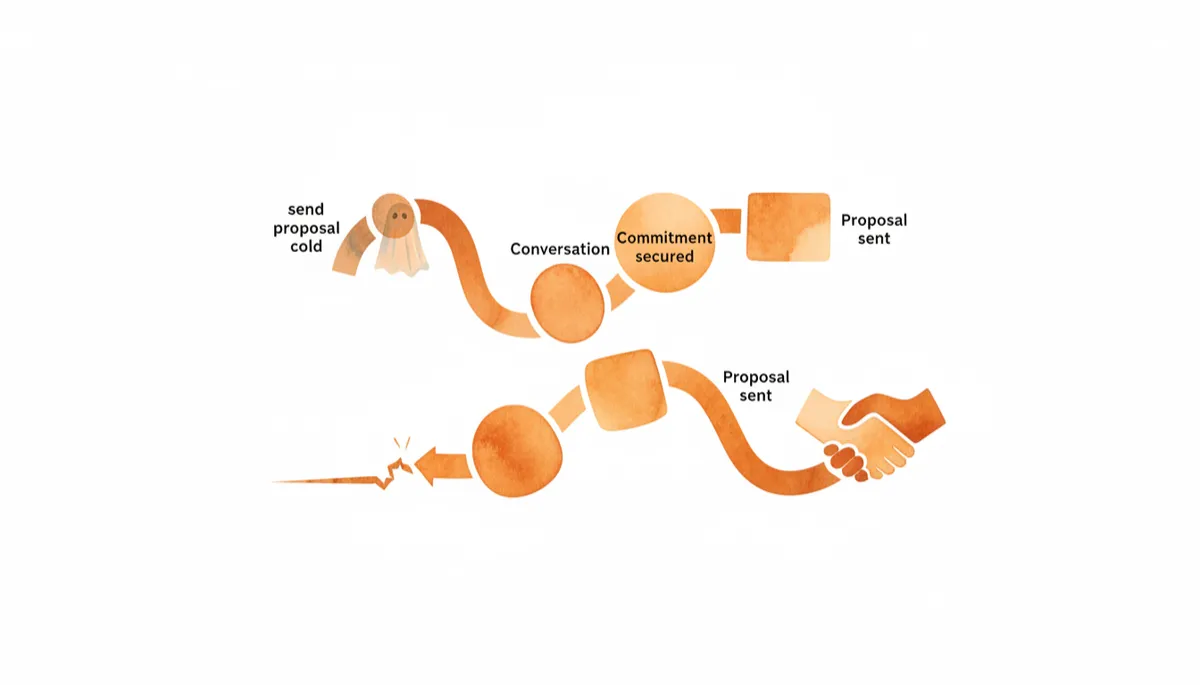
60% of buyers never respond to a proposal without follow-up. Ghosting is rarely about the proposal itself — it’s about what never happened before you sent it.
How Jeff Bezos Built Amazon Without Sending a Single Proposal Into the Void
Jeff Bezos built Amazon by obsessing over what customers needed before he asked them to make any decision. His core principle was simple: reduce friction at every step of the buyer’s journey.
Inside Amazon, Bezos was known for refusing to send anything important without a clear conversation first. No report, no proposal, no memo was supposed to fly solo. Every document lived inside a discussion about what it was meant to accomplish and which decision it supported.
Amazon’s culture blocked one-way communication. Memos didn’t just “arrive” in someone’s inbox. They arrived in a meeting, where people read them silently, then debated them live. The document was an anchor, not a lonely traveler.
Bezos believed that any document sent into the void — without a shared goal, clarity on the decision-maker’s priorities, or a next step — was a document destined to be ignored. For startup founders, this is the hidden explanation for why proposals get ghosted so often.
Ghosting is rarely about the PDF itself. It’s about everything that didn’t happen before you sent it: missing expectations, a fuzzy decision path, and the absence of a live conversation.
One famous example is Amazon’s 1997 shareholder letter, where Bezos laid out the company’s long-term focus on customer obsession and free cash flow. That letter wasn’t a standalone memo; it was the culmination of months of internal debate about strategy. By the time it was published, the decisions inside it were already being executed, not theoretical.
Later, when Amazon launched Prime in 2005, the internal “proposal” for two-day shipping was preceded by deep analysis of customer behavior and several narrative memos. Teams challenged assumptions in meetings long before any final document went to the board. The written plan reflected commitment that had already been earned in conversation — which is why execution moved quickly instead of stalling in silence.
Bezos also established the rule of the six-page narrative memo for major decisions. Senior leaders sat quietly for 20–30 minutes to read the memo together, then discussed it in depth. No one was allowed to skim, forward, or ignore it. The process itself made ghosting structurally impossible — the decision lived in the room, not in an inbox.
As Jason teaches at AuthorJason.com, when the goal of the proposal is agreed out loud before you write it, silence stops being an easy option — because the real decision already happened in the pre‑proposal conversation.
The Three Rules Jason Teaches Every Founder to Stop Ghosting Before It Starts
Jason has coached founders through thousands of sales cycles. Their teams are small but mighty. They can’t afford to waste weeks chasing silence.
- Rule 1: No proposal without a decision path. Before agreeing to send anything, Jason’s founders ask simple questions: “Who will review this?”, “When do you plan to make the decision?”, “What do you need to see to feel comfortable moving forward?”
- Rule 2: Review it live before you send it alone. They book a call to walk through the proposal on screen. Gong’s analysis of 304,174 emails shows that the phrase “Haven’t heard back from you” increases replies but reduces booked meetings by 14%. Jason flips the equation: earn the meeting first, so the proposal is never alone.
- Rule 3: More eyes, higher odds. Proposify’s study of 1.3M proposals found that when 2+ stakeholders view a proposal, close rates double(source). Jason trains founders to map the buying group early and invite those people to the live review session.
As Jason teaches at AuthorJason.com, when the decision path, timeline, and stakeholders are agreed before the document exists, the real decision has already begun — the proposal just records it instead of begging for attention.
Why Do Buyers Go Completely Silent After Receiving a Proposal?
Most buyers go silent because the proposal arrives without a clear decision path, lands in a crowded inbox, and feels easy to postpone — not because they secretly hate your offer.
Does a Ghosted Proposal Always Mean “No” — or Can You Revive Ignored Deals?
Ghosting is often a soft “not now,” not a hard “no,” and deals can be revived when you reopen a real conversation instead of sending guilt‑driven “just following up” messages.
What’s the Biggest Reason Proposals Get Ignored — and How Do You Prevent It?
The biggest reason is sending proposals to curious prospects, not committed buyers; prevent this by securing a clear decision timeline, stakeholder list, and next step before you ever agree to send anything.
Why Do Buyers Stay Silent After Receiving a Proposal?
Buyers usually stay silent because the proposal feels like extra homework: too much to process, no clear deadline, and no agreed next step — so “later” quietly turns into “never.”
How Long Should You Wait Before Following Up After Sending a Proposal?
Follow up within 24–48 hours while the conversation is still warm, especially if you agreed on a decision date in your last call. Waiting a week invites quiet drift.
What’s the Best Follow‑Up Message for a Ghosted Proposal?
The best follow‑up names the decision and offers an easy out: “Should we pause this for now, or is there one concern we haven’t addressed yet?” Honesty reopens real dialogue.
How Gates and Cuban Use Proposals to Make Ghosting Structurally Impossible
Bill Gates didn’t send the IBM proposal as a “let’s see what happens” document. By the time the proposal existed, the direction had already been agreed in conversation. The paper was confirmation, not exploration.
Gates held multiple discussions with IBM executives before any formal draft. They aligned on needs, architecture, and constraints. When the proposal finally landed, both sides already understood what it said. There was nothing surprising left to ignore.
In the early 1980s, when Microsoft negotiated to provide the operating system for the IBM PC, Gates first secured the rights to QDOS (later MS‑DOS) from Seattle Computer Products. Only after aligning with IBM leaders on architecture and licensing model were the formal agreements drafted. The “proposal” reflected a structure both sides had already tested in conversation — which is why the deal moved instead of stalling in endless revisions.
Years later, when Gates led Microsoft’s shift toward “Trustworthy Computing” in 2002, he sent a famous company‑wide memo only after intense internal discussion about security priorities. That memo functioned as a proposal for a new culture, but the leadership team had already committed. The memo clarified rather than convinced — again, no room for ghosting.
Mark Cuban approaches deals with a similar spirit. On Shark Tank and in his private investments, he repeats a simple idea: if a deal is going to happen, it becomes clear quickly. Confusion and delay are warning signs, not neutral signals.
Cuban’s rule is blunt and kind at the same time: before you send anything, get a verbal commitment to a decision path. Who decides? When do they decide? What do they need to see? If they can’t answer, the proposal is too early.
Off camera, Cuban has described walking away from deals when founders couldn’t clearly explain who the decision‑maker was or what the buying timeline looked like. Instead of sending a term sheet into fog, he asks sharp questions until the path becomes clear — or he cancels the offer entirely. His bias toward clarity over hope is exactly what prevents ghosted documents.
As Jason teaches at AuthorJason.com, when you borrow this discipline — no proposal until scope, budget, and authority are spoken out loud — you make it structurally hard for buyers to disappear, because they’ve already chosen their path.

Cuban’s rule: before you send anything, get a verbal commitment to the decision path. Know who decides, when, and what they need to see. If they can’t answer, the proposal is too early.
How Do You Avoid Getting Ghosted by Setting Better Expectations Before Sending?
Avoid ghosting by agreeing on the decision date, who will review, and a live review call before you promise to send the proposal — so it arrives as a step in a shared plan.
What Should You Do When a Prospect Ghosts You After the Proposal — and When Do You Stop?
After a ghosted proposal, shift from pushing to serving: share one useful idea, invite a short call to reassess timing, follow up three to five times over several weeks, then gracefully park the deal while keeping the door open.
What Jason’s Founders Experience When They Stop Sending “Cold” Proposals
When founders plug the Future of Selling system into their existing pipeline, something subtle but powerful happens. They stop blaming their writing skills and start adjusting their sequence. The pressure lifts off their shoulders and moves onto the process itself.
One founder, Maya, led an eight‑person SaaS team. She heard “Great call, send the proposal” every week and then… silence. After working with Jason, she refused to send a single proposal without a live review on the calendar. Within one quarter, her close rate doubled — even though her product and pricing stayed exactly the same.

Over 1,000 founders. More than $22M in combined sales. Reviewing the proposal with the buyer live — instead of sending and waiting — makes ghosting structurally impossible.
Jason is candid about his own journey too. He’s hit bottom three times and rebuilt three times. That’s why his voice with founders never carries judgment. If you’ve been ghosted, you’re not broken. You’re just playing a game without seeing the full board yet.
As Jason teaches at AuthorJason.com, the moment you treat the pre‑proposal conversation as the real decision point, your deals speed up, your pipeline gets lighter, and the question “Why are proposals getting ignored and how do I fix it?” stops being a mystery and becomes a repeatable system.
How the P.I.T.C.H. Equation Earns You the Right to Send a Proposal
Inside the Future of Selling system, Jason teaches a simple, repeatable P.I.T.C.H. equation. It’s not about clever scripts. It’s about steering the conversation so the proposal becomes the natural next step, not a hopeful leap.
The equation helps founders slow down at the right moments, ask braver questions, and co‑design the solution with the buyer. By the time the document is written, both sides already feel like they’re on the same team. That’s when proposals get fast replies instead of quiet ghosts.
The “Intent” step inside P.I.T.C.H. is where most founders discover what was missing. Instead of racing to “send something,” they pause and ask why the buyer wants the proposal in the first place, what decision it will support, and what will happen immediately after they review it. That brief pause changes everything.
When the reason for sending the proposal is completely clear to the buyer, silence stops being a neutral option. If they’ve already agreed, “We’ll use this to decide between option A and option B by next Friday,” then ignoring the document means breaking a commitment they said out loud. The ghost loses its hiding place.
Jason has watched founders change their deals just by asking: “What would you like this proposal to help you decide?” That single intent question turns a cold PDF into a tool the buyer asked for. When the proposal finally arrives, it answers a question they framed — and people rarely ignore their own questions.
Self‑Check
- Before sending your last proposal, had the buyer confirmed they had the budget, the problem, and the authority to decide?
- Did you send the proposal cold, or did you review it with them on a call?
- When silence fell over a proposal, did you follow up with a new angle — or just a reminder of the original email?
As Jason teaches at AuthorJason.com, the “intent” work you do before you open your proposal software is what makes ghosting rare — because the buyer has already chosen to treat the document as a decision tool, not optional reading.
3 Reasons Proposals Get Ghosted — and the Extra One That Hurts Most
Reason 1 (Raj, tech services founder): he sent the proposal before confirming budget. The buyer loved the approach. The price was outside their range. They didn’t know how to say that, so they chose silence instead. Move: before writing, ask, “If we put together a proposal in the range of X, would that be within what you’ve set aside?” This one question prevents 60% of all ghosting.
Reason 2 (Raj): he sent the proposal to the wrong person. His contact had influence but no authority. The proposal sat in their inbox while they waited for approval that never came. They were too embarrassed to admit they couldn’t decide. Move: before writing, ask, “Is this your decision, or will others be involved?” That question tells you whether you’re writing for one person or three.
Reason 3 (Raj): he never set a response timeline. The proposal had no deadline. The buyer felt no urgency. It sat in a “To review” folder for six weeks until a competitor closed the deal. Move: build a response window into the proposal: “I’ve reserved this capacity until [date] — after that I may need to reallocate the time.” This isn’t a pressure trick. It’s a shared expectation.
The extra reason (Jason, in third person): he spent years teaching follow‑up tactics for ghosted proposals before realizing that the “ghost” wasn’t a follow‑up problem — it was a pre‑proposal problem. By the time the proposal was sent, the decision to ghost had already been made. The buyer wasn’t ready to say yes. They weren’t ready to say no. So they chose silence as the path of least resistance. The solution was never in the follow‑up email. It was in a 10‑minute pre‑proposal call where Jason taught founders to ask three questions before writing a single word: Do you have the problem? Do you have the budget? Are you the decision‑maker? Proposals sent after these three yeses are almost never ghosted. Move: get three yeses before you write a single line of the proposal. The document can’t do what the conversation didn’t.
As Jason teaches at AuthorJason.com, most “ghosts” are just unasked questions about budget, authority, and timing — solve those before you write, and proposals start coming back with clear answers instead of silence.
What to Do When Your Proposal Gets Ghosted — The Founder’s Exact Script
Here’s how Jason trains founders to follow up when a proposal goes quiet. Instead of guilt or vague reminders, they use a short, direct script that makes it safe to tell the truth — yes, no, or not now — and often rescues stalled deals.
Founder: “Hi [Name], when we spoke you said the proposal would help you decide between doing this now or later this year. Has anything changed in your priorities since then?”
Buyer: “Honestly, the budget got tighter and I wasn’t sure how to justify it, so I set it aside.”
Founder: “Thanks for sharing that. Would it help if we looked at a phased version that fits the current budget, or should we treat this as a Q1 conversation instead?”
Buyer: “A phased version could work — let’s jump on a quick call.”
Sometimes the buyer chooses to close the loop instead: “Let’s put this on hold for now.” That’s still a win. You have clarity, your pipeline is clean, and you can come back later with a fresh, intentional conversation instead of chasing a ghost.
As Jason teaches at AuthorJason.com, the best script for a ghosted proposal asks about the decision, not the email — it respects the buyer’s reality and gives them an easy way either to re‑engage or to say no.
Frequently Asked Questions About Why Proposals Get Ignored
How Does Sending a Proposal Too Early in the Sales Process Increase Ghosting?
Turning the proposal into a research document for a curious buyer instead of a confirmation for a ready buyer makes it more likely to get filed, forwarded, or forgotten instead of driving a clear yes or no.
Remember that 48% of reps never make it to a second follow‑up(Gong). When the proposal goes out too early, and follow‑up stops too early, ghosting becomes the default outcome. Jason’s approach is kinder to both sides: wait until the buyer is ready, then stay present until the decision is made.
How Many Follow‑Ups Are Reasonable After a Proposal Before You Risk Annoying the Buyer?
Jason typically recommends three to five thoughtful follow‑ups over several weeks, each adding new value or a different angle — not repeating “just checking in.” After that, park the deal gracefully and leave the door open.
Should You Include an Expiry Date or Response Window Inside Your Proposals?
Yes — a clear response window turns the proposal into a time‑bounded decision tool instead of an open‑ended file. Frame it as protecting your capacity, not pressuring them: “I can hold this slot until [date].”
How Soon Should You Schedule a Proposal Review Call After Sending It?
Ideally, you book the review call before you write the proposal, and schedule it for a few days after sending. This keeps momentum and prevents the document from being buried in the inbox.
What If the Buyer Keeps Delaying the Proposal Review Meeting?
Treat repeated delays as a signal, not an accident. Ask directly: “Has this dropped in priority for now?” That question often reveals the real blocker so you can adjust scope, change timing, or step away cleanly.
How Does Proposal Length Affect the Chances of Being Ignored?
Overlong proposals increase cognitive load and delay reading; concise proposals focused on outcomes and written in the buyer’s own language are more likely to be reviewed quickly and discussed with stakeholders.
Is It Better to Call or Email When Following Up on a Ghosted Proposal?
Use both. Start with a short, specific email, then follow with a brief call or voicemail. Different channels surface different responses, and respectful persistence signals professionalism, not desperation.
What Jason’s Tier‑One Founders Prove About Ghosted Proposals
Jason’s tier‑one founders show what becomes possible when proposals stop going out cold. Tan generated $29,693 in 16 days. Teo brought in 63 clients in 100 days. Leon grew from $2.5K to over $2M. Different products, same shift: proposals became the last step, not the first hope.
One of Tan’s nearly ghosted deals was with a mid‑sized agency that went silent after receiving his proposal. Instead of nudging politely, he asked, “Is this closer to ‘not now’ or ‘never’?” The buyer admitted they weren’t sure their team could handle the implementation. Together they redesigned the scope into two phases — and the deal closed within a week.
Teo saved a stalled SaaS contract with one question after two weeks of silence: “What would make this an easy ‘yes’ or an easy ‘no’ for you?” The client revealed an internal concern about integration they’d never mentioned. Teo brought their engineer into a 20‑minute call, removed the blocker, and the proposal was signed that same day.
Leon had an enterprise client who kept postponing the review. Instead of chasing dates, he wrote: “Should I assume priorities have changed and close this file, or is there one thing we haven’t answered yet?” The buyer admitted a competitor had undercut the price. Leon reframed his proposal around total cost of delay, not sticker price — and won the contract.
For a founder leading a team of five or more, this is the real win. You’re not trying to become a full‑time salesperson. You’re trying to build a company where sales conversations are honest, human, and predictable — for you and your team.
That’s why Jason links this article into a broader guide on why proposals get ignored and how to pitch in a way that respects how modern buyers actually make decisions. You deserve a system that supports you, not a guessing game that drains you.
As Jason teaches at AuthorJason.com, tier‑one founders win not because they chase harder, but because they design their process so every proposal gets a fast, honest answer — or never needs to be written at all.


