
How to Pitch to Investors and Clients: The Strategy Guide and Startup Survival Book for Founders Who Have the Vision but Keep Losing the Room
Sales pitch, startup pitch guide, how to pitch to investors and clients
How to Pitch to Investors and Clients: A Strategy Guide and Survival Playbook for Startup Founders with Vision Who Keep Losing the Room
A practical, forgiving guide that helps founders stop losing rooms, start earning trust, and turn clear structure into signed checks and paying customers in 2026 and beyond.
Quick Summary (TL;DR): Jason’s Future of Selling system gives founders a simple five-part way to stop rambling, start leading the room, and pitch with quiet confidence to both investors and clients. Use one tight story, one clear proof point, and one clear ask. You don’t need to be a “born closer” to win; you need a repeatable structure and a few new habits.
Why do founders with great products lose the room in the first 60 seconds?
Jason has watched brilliant founders in Singapore and beyond walk into a room holding gold, then walk out with nothing. Not because the idea was weak, but because the first 60 seconds were messy, rushed, or unclear. In 2026, investors skim pitch decks in under four minutes and quickly decide whether they’ll lean forward with interest or check out mentally (Storydoc, research.mental-momentum.ai, rel="noopener").
Think of attention like an elevator door. It’s wide open at the start. If a founder spends that time apologizing, over-explaining the tech, or telling their life story with no point, the door quietly closes. Once it’s closed, even great numbers struggle to open it again. Jason built the Future of Selling system to help founders stop wasting that opening gap and use it like the first clean, sharp cut of a knife.
People also ask: How do I start my pitch if I feel nervous?
Say the problem out loud in one simple sentence. That shifts the focus off you and onto the pain you solve. Nerves are normal; clarity is what earns attention.

Simple notes beat crowded slides when the goal is real connection, not performance.
The pitch mistake that makes investors and clients disconnect instantly
The biggest killer isn’t bad design; it’s founder‑centered monologue. Long intros about the team. Ten features in a row. A tour of every slide. Meanwhile, the investor is thinking: “What is this? Why now? And why you?”—and not getting answers fast enough. Reports from McKinsey and others keep showing that decision‑makers reward clarity and ease of evaluation: clear numbers, a clear ask, a clear path (SSRN, McKinsey, rel="noopener").
Jason teaches founders to flip the script. Start with their world. Their pain. Their risks. Their upside. It’s like walking into someone’s house and commenting on the leak in their ceiling instead of your new shoes. When founders do that, investors and clients relax. They feel understood, not sold to. Questions become curious instead of defensive.
New! [September 2026] Dear founders… Do you also feel it’s really hard to keep a room’s attention when you pitch as a founder in 2026? Jason felt that too. He hit rock bottom three times, watched rooms go cold, and decided he just “wasn’t a sales guy.” Later he discovered what was missing was structure, not talent. Salesforce once shared that 76% of sales reps missed quota in a single year (rel="noopener"). If trained sales pros struggle, of course founders do too. Jason built the Future of Selling system so 1,000+ founders could learn a kinder, clearer way to sell, generate over $22M in combined sales, and bounce back 3× after each fall. If you’re tired of guessing your pitch, you can get the full system for $19/month—about $0.63 a day—with no risk via this link. Give your next room a better version of you.
People also ask: What do investors want to hear first?
They want to hear the problem, who feels it, and why it matters now. Your numbers and tech land much better once that’s clear.
How Steve Jobs designed the most studied pitch in business history
Jason often points founders to Steve Jobs on stage in 2007 unveiling the first iPhone. Jobs didn’t start with features. He started with a shared pain: we all hated our phones. Heavy. Ugly. Hard to use. He stayed in that pain long enough for the audience to nod along. Then he hinted at the solution: “Today, Apple is going to reinvent the phone.”
The structure was simple: problem. Big promise. Then the famous line: “An iPod, a phone, and an Internet communicator… are you getting it?” That was the hook and the wow moment at once. After that, the demo felt inevitable, not forced. Jason reminds founders that this is still the most studied pitch in business history—not because of the slides, but because Jobs made the room feel the problem before he showed the product.
Great pitches unfold like a story, not a rushed product tour racing the clock.
People also ask: Should I copy Steve Jobs’ style?
No. Copy his structure, not his voice. Your calm, honest style works far better than impersonating someone else.
The P.I.T.C.H Formula: Jason’s five-part structure for pitches that actually close
Inside the Future of Selling system, Jason teaches a simple framework called the P.I.T.C.H Formula that founders can use with both investors and clients. P is Prepare, I is Intent, T is Teach, C is Close, and H is Habits. It’s a full selling system, not just a memorized script. Here, he focuses on the pitch‑story part, so founders stop guessing and start following a path that has already helped 1,000+ founders through AuthorJason.com, Singapore, and beyond.
If you want to go deeper into how Jason approaches preparation, intent, and post‑meeting habits, he explains that in his main article on the P.I.T.C.H Formula. For now, treat this guide as your “front‑line survival manual” when you walk into a room this week and need a structure you can lean on even when your hands are shaking.
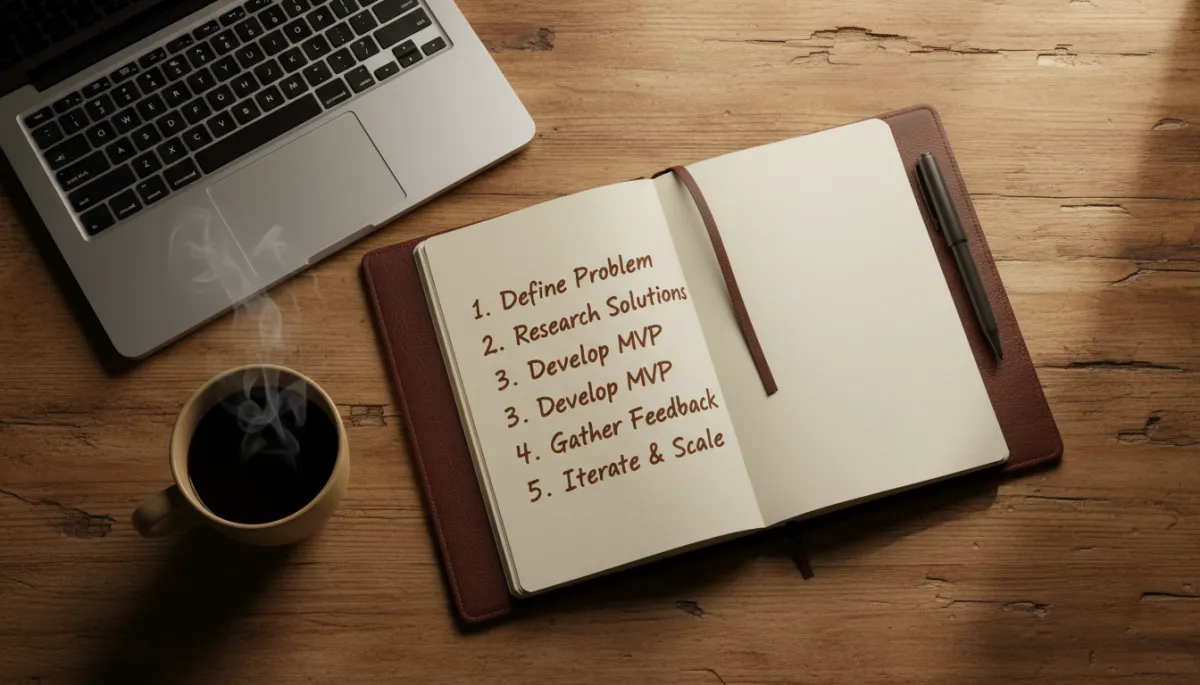
A clear outline on paper calms your brain and frees you to really listen in the room.
A 5‑part founder pitch that works for both investors and clients
Jason’s founder pitch mirrors what research now confirms: short, structured, story‑driven pitches win more attention (Forbes, TechCrunch, rel="noopener"). It works with investors and clients because both groups care about the same things: the problem, the solution, the proof, and the risks. The only difference is the ask. Here’s the five‑part structure he uses inside the Future of Selling system when he trains founders on how to pitch a startup or win new clients.
The Hook
The Problem
The Solution
The Proof
The Close
Part 1 — The Hook (capture attention in 10 seconds)
Jason tells founders to start with one sharp sentence about a real shift in the world. “In 2026, investors spend less than four minutes per deck while sales teams are still wasting hours on manual outreach.” Short. True. No buzzwords. The hook should feel like a headline from their life, not a slogan from your brochure.
Part 2 — The Problem (make them feel the pain, not just understand it)
Next, he slows down and paints the cost of the problem: lost revenue. Wasted time. Stress. He uses everyday metaphors: “It’s like pouring water into a bucket with ten holes and then blaming the water.” This is exactly where many founders rush. Jason reminds them: investors and clients need to feel the leak before they care about the patch.
Part 3 — The Solution (your product as the inevitable answer)
Only then does Jason let founders introduce the product. One sentence on what it does. One sentence on how it works at a high level. Then a quick, focused demo or story. No feature laundry list. Just enough for the investor or client to see: “Ah, this is built exactly for that leak you just showed us.”
Part 4 — The Proof (one result that kills the doubt)
Proof is where most founders drown people in numbers. Jason teaches the opposite. One clear story. One clear metric. “This customer cut admin time in sales by 40% and added $120,000 in ARR in 90 days.” That one sentence does far more work than a dense stats table. Later, you can always send a deeper deck or link them to his guide on how to close a sale.
Part 5 — The Close (one clear ask, one clear next step)
Finally, Jason insists on one clean ask. Not three options. Not “Let us know what you think.” For investors, it might be: “We’re raising $1.5M to reach 200 customers in 18 months.” For clients: “If this solves the leak we described, are you open to a 30‑day trial starting next week?” The close should feel like the natural next step in a shared story, not a sudden leap.

One clear result and one clear ask turn fuzzy interest into real decisions.
Real founders, real pitches — what changes once the structure clicks?
Jason has seen this five‑part structure change rooms. One founder, “Mei,” joined the Future of Selling system after three failed investor meetings in Singapore. She thought her problem was her accent and shyness. Jason helped her rebuild the pitch around the hook, problem, solution, proof, and close. Same product. Same deck. New order and new calm. On her next call, the investor stopped her mid‑pitch and said: “This is the clearest pitch I’ve heard this week. Let’s talk numbers.”
Billionaires play the same game. Elon Musk pitched reusable rockets when most experts said they were impossible. He didn’t just talk engineering. He framed the problem first: the insane cost of throwing rockets away after one flight. Then he painted the solution: “Falcon 9,” landing and flying again. Then the proof: early tests, footage, contracts, and a path that later led to multi‑billion‑dollar deals with NASA and the private sector. Larry Page walked into Sequoia and Kleiner Perkins with just one slide for Google in 1999. The story was simple and undeniable: search was broken, and their algorithm made results meaningfully better. Clear problem. Clear solution. Clear upside. $25M followed.

Once the structure settles in, founders stop performing and start having honest business conversations.
New! [September 2026] Dear founders… If you walk out of rooms replaying every word in your head, Jason wants you to know this: you’re not broken; your system is. He’s felt that sting too, three times. In a world where Salesforce shows most sales reps miss quota and investors skim in minutes, it’s natural to feel overwhelmed. That’s why he built the Future of Selling system—a kind, step‑by‑step way to learn pitching, follow‑up, and closing that has helped 1,000+ founders create
over $22M in combined sales and climb back from rock bottom 3×. If you want daily support for less than a cheap coffee, you can join for $19/month—about $0.63 a day—via dreamaker.club/buyfos. Your next investor or client doesn’t need a perfect you. Just a prepared you.
Give your best pitch this week
Learning how to pitch to investors and clients is not about becoming someone else. It’s about giving your current self a stronger floor to stand on. Jason’s journey—three crashes, three comebacks—is proof that founders can learn this late, tired, and scared, and still turn things around. Graduates of the Future of Selling system have gone on to generate over $22M in combined sales, including flagship wins like $29,693 for Tan in 16 days, 63 clients for Teo in 100 days, and Leon’s growth from $2.5K to over $2M. The same structure is available to you.
This week, Jason suggests one simple step. Take your current deck or script. Rewrite it into the five parts: hook, problem, solution, proof, close. Practice it once in front of a mirror, once with a friend, then once with a low‑stakes client. Notice where you rush. Notice where you breathe. Every pitch is a rep. Every rep is a brick. Over time, you’re not just learning how to pitch a startup—you’re building a life where your ideas finally get the chance they deserve.

The next room you walk into can feel different, even if you don’t—yet.
🗂️ Go deeper — Sales pitch playbooks


